


Likes
Comments
Share


Likes
2
Share


@rastafarmerc_zzz
Follow
had crazy smell when I opened the glass it smelled like two rooms away
Very good high more indica


Likes
7
Share


@Brickie74
Follow
Well this is actually where i started. I had already germinated the Green Tea (Forbidden Fruit x Gelato) seed. Now i think i am caught up. I will try to post as many videos as possible. I suck at typing and with the dictation it takes longer to fix the f_ck ups than to just type what I wanted. I can just explain what I'm doing or what I've done for the week. This is my first ever grow journal so it may be all over the place....we will see.....
I have multiple grows happening at the same time....sometimes I get carried away...lol....and might have a few more than I expected to have. I will do my best to keep things up to date and current. I definitely want to start running right out of the gate and make a pretty decent journal.

Likes
168
Share


@Still_Smoq
Follow
📆 Week 2, 13-19 May 2024
13-19 May - Observed and watched the seedling grow.
📑 Plant is strong and healthy. I see no problems in early development or the speed of growth.
🍶 13 May initial nutrient solution not changed, 1st change is week 3
🍽️ 13 May initial feeding schedule unchanged
💧 Using reverse osmosis water with EC/TDS at 0
🐉 Nutrient solution EC 1.0 at 72 degrees F
🔆 Light power at 50%, DLI 12-15 canopy coverage at 18hrs
😤 Using PYPABL, Air Pump, 400GPH
That is it for this week. Thanks for the look, read and stopping by.

Likes
121
Share


@Cruzsider
Follow
Love this strain. My new favorite. I'll be back with more information.
Likes
3
Share


@Bigbombbudz
Follow
Another week closer...
Everything is moving along,
From that one day of missing feeding last week when we set the clocks back it messed with one of my girls, but not much I can do about it..
I have about 20 days to go, so no matter what it will not change anything now., ..just have to live with it..
Besides that looking good.
until next week, smoke a fatty, help out your fellow grower.


Likes
31
Share


@Dunk_Junk
Follow
Growing well this week. Making more leaves to catch the light!!!
Timelapse is rubbish this week... Must do better.


Likes
Comments
Share

@Lontra
Follow
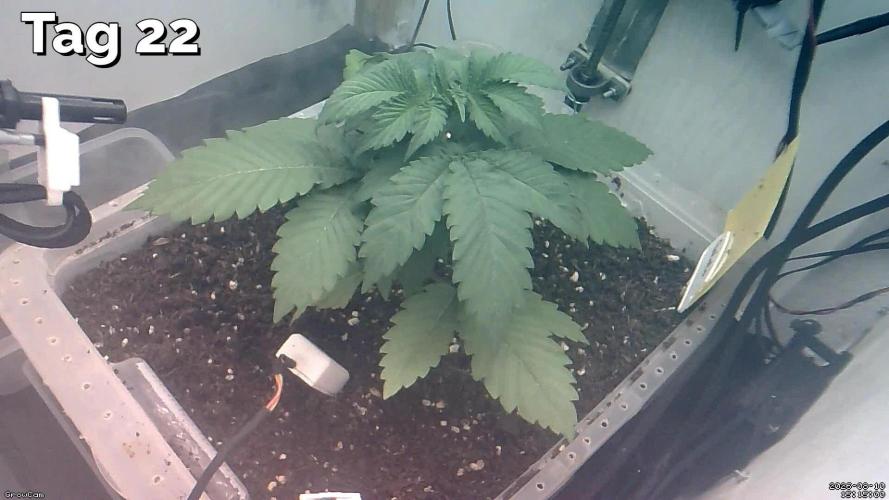
Die Woche verlief insgesamt ganz ok. Sie wurde zu Beginn der Woche an Tag 22, ein paar Stunden nach dem Gießen, getoppt. An Tag 22 und 23 habe ich die 4 Triebe, die ich behalten habe, nur ganz leicht mit etwas Draht voneinander separiert, das eigentliche LST begann dann langsam ab Tag 24.
An Tag 28 habe ich entdeckt, das vor allem die 2 oberen Triebe an den Stammansätzen leichte Risse aufwiesen. Daraufhin habe ich das LST etwas überarbeitet und die 4 Triebe jeweils auf ca. halber Länge noch mal von unten unterstützt.
Der pH-Wert des Bodens lag laut einem pH-Bodentest mit optischer Skala an Tag 22 eher in Richtung 6 als 7, daher hatte ich mich zu Beginn der Woche dagegen entschieden zu Spülen. Stattdessen soll die Erde und vor allem auch das Hydrogel sich langsam durch mein planmäßiges Gießen weiter in einen optimalen Bereich verschieben. Das bisschen Drain, das ich an Tag 25 beim Gießen erhielt, wies dann auch einen pH-Wert von ~6,7 auf. Das scheint also zu funktionieren.
Seit Tag 22 habe ich die Menge an Bittersalz auf ca. 0.25g/l erhöht, um das Ca:Mg Verhältnis meines Leitungswassers besser für die Wachstumsphase anzupassen. Das hätte ich vermutlich bereits früher tun müssen. Beim zweiten Gießen habe ich etwas mehr Fish-Mix genutzt, um potenziellem Stickstoffmangel entgegenzuwirken und auch etwas Alg-A-Mic hinzugefügt, um die Pflanze vor allem gegen die heißen Temperaturen diese Woche zu unterstützen (zum Teil für einige Stunden knapp über 30°C).
Gegossen wurde diese Woche 2 mal, jeweils 1 Liter.
1. Gießvorgang: Tag 22, 1ml/l Fish-Mix, 1ml/l Acti-Vera, ca. 0.24g Bittersalz, pH-Wert ~6.4, EC-Wert ~0.95mS/cm
2. Gießvorgang: Tag 25 (vermutlich etwas zu früh), 1.5ml/l Fish-Mix, 1ml/l Acti-Vera, 1ml/l Alg-A-Mic, ca. 0.24g Bittersalz, pH-Wert ~6.4, EC-Wert ~1.18mS/cm
Zusätzlich gab es an Tag 28 noch eine leichte Blattdüngung für die Unterseiten der Blätter, mit: 0.5ml/l Fish-Mix, 0.8ml/l Alg-A-Mic und etwa 0.3g/l Bittersalz.
Gestern war die Erde dann noch feucht genug, um das nächste Gießen noch 1-2 Tage hinauszuzögern.
Das Licht wurde nach dem toppen zunächst erst etwas abgeschwächt (~220 PPFD), dann über die Woche langsam wieder erhöht und steht jetzt bei ca. 460 PPFD, also in etwa bei einem DLI-Wert von 30.
Die Pflanze wächst weiterhin gut, wirkt aber noch immer nicht vollkommen glücklich. Das frische Wachstum zeigt mittlerweile etwas mehr Symmetrie, aber eine leichte Asymmetrie bleibt. Die ältesten Fächerblätter sehen immer noch chlorotisch aus, haben sich aber nicht dramatisch weiter verschlechtert. Etwas Sorgen machen mir die neueren, bereits größeren Fächerblätter in der Mitte, da sich auch diese anscheinend von den Spitzen her aufhellen und etwas chlorotisch aussehen. Das frische Wachstum hingegen sieht schon ganz okay aus.


Likes
24
Share


@m0use
Follow
***Sponsored Grow*** = Medic || https://medicgrow.com || Grow = ***Sponsored Grow***
Ok, so bigger news this week, I got rid of one of the plants in the tent as it was an auto vs fast flower :/ and I performed a bunch of LST and some Defoliation to all the plants. This plant was not to bad in terms of lst needs and defoliating needs as much as the other ones. This will be the last week they are in Veg and switching to flower cycle next week with a 12/12 photoperiod. I was going to try a 13/11 but I wanted to test out the automatic light functions on the Medic Grows Minisun-2, So this will be relieved next week.
Been having issues with PH in the medium again and some nutrient uptake. I am thinking I will switch to another brand I have to use up, trip tonic from my last grow on the balcony. Its a bit more complex and not as easy as mix into water and feed but I think its going to help me solve a lot of the issues I am getting. Given this update is a few days late some of these pics are not from today. the clones in the photos above are from the beginning of the week when I potted them up. They have not done well at all and may not make it. can only hope for the next few weeks they pull through.
Till next week.
***Sponsored Grow***
Official Website:
https://medicgrow.com/
+
https://www.emeraldtriangleseeds.co.uk/
Facebook:
https://www.facebook.com/medicgrowled
+
https://www.facebook.com/OriginalETS/
Twitter:
https://twitter.com/medicgrow
+
https://twitter.com/emeraldseeds
Instagram:
https://www.instagram.com/medicgrow420/
+
https://www.instagram.com/emeraldtriangleseeds/
YouTube:
https://www.youtube.com/channel/UCNmiY4F9z94u-8eGj7R1CSQ
Growdiaries:
https://growdiaries.com/grower/medicgrowled
https://growdiaries.com/grow-lights/medic-grow
+
https://growdiaries.com/grower/emeraldtriangleseeds
https://growdiaries.com/seedbank/emerald-triangle-seeds

Likes
21
Share


@PrairieFrostGrow
Follow
****** Week 8 Flower, November 7 to 13, 2020 ******
Hey Growmies......winding this run down........they are ripening this week and next.......this is the second week of flush.
Lights are down and temps are down to mimic fall.
Just lots of plain RO water this week......keep flushing out the media👍
One is growing spears......the other is growing bats😂👍
So much fox tailing that there will be a good mixture of trichomes at different stages of ripening.......should make for good smoke! Trichomes are continuing to come out more and bud swelling has continued,👍
That’s what I have for a quick update gang........as you can see they are by themselves in the tent now......these girls have more Sativa in them and taking a little longer to finish......better for me with trimming as well🤪😃🙏

Likes
4
Share


@Cannabeast40
Follow
Week 3 and a repot is done and now in day 3. Finally it’s settling down after the repot, which was not pretty at all😂
Hope to get some massive plants this run 🌱
________________________________________________________________________________________
Light from @MedicGrowLED 😎
NEO 780 LED🔥
780 Watt⚡️💥
PPF of 2184 μmol/s & 2.8 μmol/J🔥
Full Spectrum V1/F1 🌈
WiFi smart connection & Smart Aura Control 😱

Likes
22
Share

@wolfvb
Follow
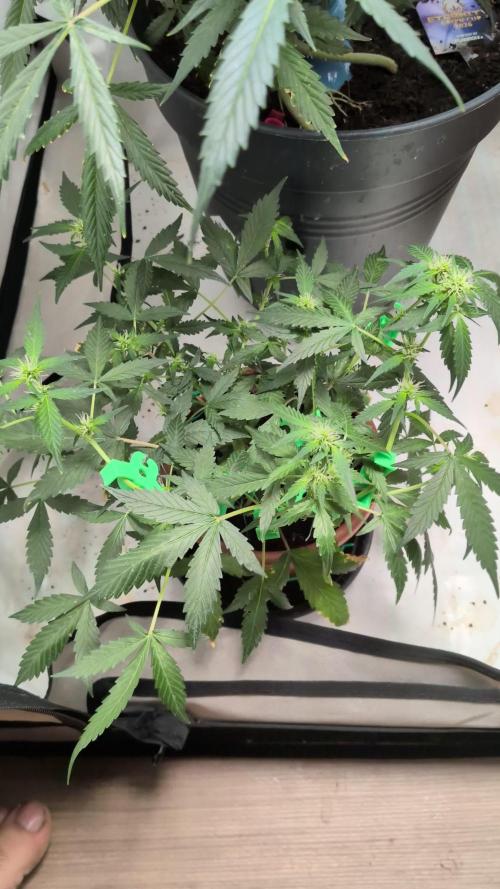
Week 7 Update: Welcome to the Jungle! (Flowering has officially begun)
General Observations:
Week 7 is here, and the stretch is on! The plant has officially transitioned into the flowering phase. As you can see from the photos, bud sites are developing rapidly all over the plant, and there is an explosion of white pistils (hairs) at every top. The plant seems incredibly happy and vigorous right now.
Training & Canopy Management:
The Low Stress Training (LST) has been paying off massively. You can see in the close-up shots how the green LST clips and wire ties have successfully kept the main stem bent and the canopy even. Because of this, multiple colas are reaching the top of the canopy and getting an equal share of the light. The stems are thickening up nicely to support the future buds. I'm keeping a close eye on the clips and wires to ensure they aren't choking the stems as they grow thicker.
Plant Health:
Overall health is excellent. The foliage is a lush, dark green, indicating that nitrogen levels have been solid through the vegetative stage. No major signs of stress, pests, or deficiencies. The leaves are praying upwards, which means she is loving the light and current environmental conditions.
Next Steps for this Week:
Nutrients: Now that she is heavily developing flowers, I will be adjusting/continuing the bloom nutrients to give her the Phosphorus and Potassium (P-K) she needs to swell those buds, while slowly easing off the Nitrogen. (Edit this part based on your actual feeding schedule)
Defoliation: I might do some very light defoliation of the lower, shaded leaves that aren't getting light, just to improve airflow and direct the plant's energy strictly to the top colas, but I don't want to stress her out too much during the stretch.
Environment: Keeping humidity in check as the bud sites get denser to prevent any future issues.
Looking forward to seeing these little puffballs swell up over the next few weeks! Happy growing! 🌱✌️
Likes
15
Share


@Stash074
Follow
No complaints this week. All the ladies are growing strong and healthy. Remember how stunted this plant was a few weeks ago? Now she stands taller than some of the other ladies. Speaking of, I have my 2nd trellis positioned exactly 12 inches a part from the 1st trellis. As you can see. There are many Colas that are over a foot long. I do believe that I will yield more from this harvest than the last. Only time will tell. I will keep yall updated in my next upload, Happy growing 🍃😎


Likes
27
Share


@Stealthman
Follow
The plant of course is much more smaller with the restricted root zone causing a bonsai effect. However, she performed really well under the circumstances with a relatively large yield all things considered. I usually smoke high CBD but was very impressed with this high. Let's see how it goes after spending more time under the influence.
Review...
Growing in the solo cup sized container proved to be much more challenging than a regular grow. The plant soon became stressed dealing with the tiny root zone making everything hyper sensitive. The first issue was showing as tip burn even though the ppm was kept in the 650-850 range. Then the leaves showed a general yellowing overall specially showing at the bottom fan leaves. At this point I was changing the nutrient solution every 2-3 days trying different nutrient brands and concentrations seemingly without much success. It was a nerve wracking period which ultimately lead me back to General Hydroponics with amendments. I did learn that the plant can weather the storm even with less than perfect vegetative leaves while she focuses all her energies into calyx production. It’s was upsetting to see less than stellar health but eventually all the leaves drop and the flowers power on seemingly without issue.
The cascading diamond structure developed as a result of a couple broken branches that occurred during the training process in an effort broaden the plant profile with wider lateral spacing. Although initially upset when the fractured branches that withered after being bandaged up and . After removal of said branches it was exciting to see the new possibilities. The cascade formation called for additional side lighting to maintain uniform bud size all the way down the front lower end of the plant. I was looking to create a stadium like effect.
The experience of operating the visual hydroponic unit called for a number of practical adjustments along the way. Although initially, very excited with the system concept as an integrated design with nutrient solution supply and gravity drain through the pump, with the air supply inside the pipe with the air bubbler acting as the drain/root filter... in hindsight, obviously, it would not work as the root mass became denser and denser. The first issue, as the path of least resistance, the air was forced back down the nutrient supply pipe. This prevented the pump from priming itself and subsequently no nutrient solution delivery was even possible. As a result, the original air stone was left in place to prevent the roots from entering the nutrient tank and a new bubbler stone simply added to the tank itself.
Although the original idea was for the air to be continuously pumping directly through the roots, the flood and drain would actually be just as good when drawing the fresh air in and out with each pump/drain of nutrient solution. The ON cycle was initially set to 10 seconds which eventually became 30 seconds as the roots mass grew denser. This proved to be too unreliable as the fill level was no longer consistent which required constant monitoring to be sure that there was no flooding over and above the container lid. It which case, a simple feeder tube to the top of the root zone was the best option. The ON cycle was set to 5 seconds with a 15 minute OFF interval. Overall the biggest concern was the timer itself, which had several bad reviews for malfunctions with growers losing their plants. However, I have no choice as this was one of the few timers that was capable of cycling down to the second but it all workout fine in that regard… no problem.
Was it a perfect grow?... no, definitely not. However, as a relative beginner, it was definitely a great learning experience. Mostly, I need to work on the nutrient blend and concentration. For more control, a backup tank with float valve delivery to maintain the water level for this particular system would be a good idea as well.
Likes
24
Share

@m0use
Follow
***Sponsored Grow*** = Medic || https://medicgrow.com || Grow = ***Sponsored Grow***
Not a whole lot is happening this week, still having some PH issues in the medium, I believe this is from the microbial mass I added a while back. A microbe product, PH going into the medium is around 6.5-6.8 and coming out is between 5.5-5.8, so something is acidifying it up. Also noticed the runoff last week was a bit higher at times. So lowered the feed down quite a bit, going in at 1.4EC vs 1.8 will bump it up to 1.5 and 1.6 in the next few weeks. I also added in a bit of a PK booster. nothing to crazy only 60ppm worth on a total allowance of 700PPM
Lights now running at 100% with V1 spectrum, decided to go with 100% now vs after stretch, will see how it works out.
Till next week.
***Sponsored Grow***
Official Website:
https://medicgrow.com/
+
https://www.emeraldtriangleseeds.co.uk/
Facebook:
https://www.facebook.com/medicgrowled
+
https://www.facebook.com/OriginalETS/
Twitter:
https://twitter.com/medicgrow
+
https://twitter.com/emeraldseeds
Instagram:
https://www.instagram.com/medicgrow420/
+
https://www.instagram.com/emeraldtriangleseeds/
YouTube:
https://www.youtube.com/channel/UCNmiY4F9z94u-8eGj7R1CSQ
Growdiaries:
https://growdiaries.com/grower/medicgrowled
https://growdiaries.com/grow-lights/medic-grow
+
https://growdiaries.com/grower/emeraldtriangleseeds
https://growdiaries.com/seedbank/emerald-triangle-seeds
Likes
11
Share


@Damonkey
Follow
Remaining three plants in the tent have now gone into flush. The Cherry is looking good, the quality looks like it’ll be fantastic, the smell, wow great sweet cherry funk......🤔cherry? Well fruity for sure. Ima enjoy dis girl when she done.😍😍😍