The Grow Awards 2026 🏆
Likes
Comments
Share
@PuufPuuf
Follow
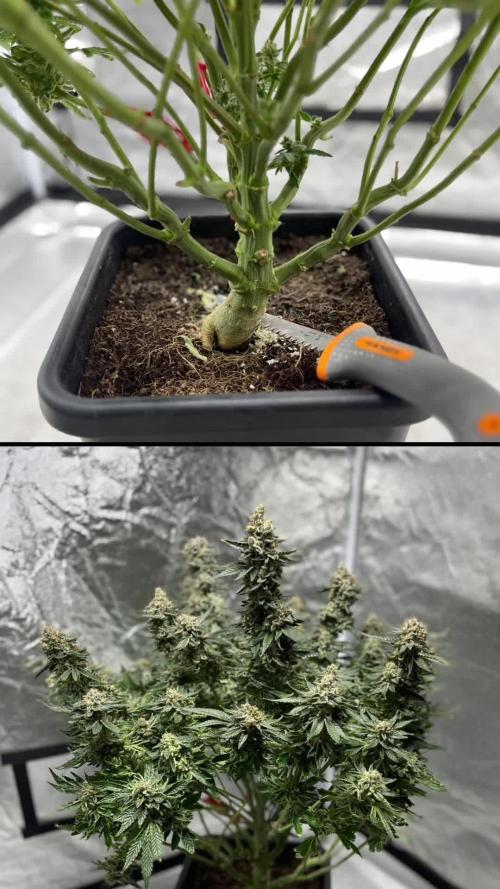
Hallo to You all my familly and usual visitors. Thank you for stopping by and all the likes and comments....You make my day! I gave the Blue Cheese a trim on 5th december and gave her four days of darkness, the chop was performed on december 9th I took a lot of photographs and videos commemorating these events for you to enjoy :) I think she came out quite decent especially considering that she had some monster/deformed leaves till the 4th week of veg. also looking back I should have moved her to the bigger place in that time...she would be far more symmetrical ;) It was a joy to work with Mars Hydro and their equipment in this grow. A big thanks to the Mars Hydro team for this opportunity, you truly provide first class grow kits and lamps. That's all i have for you till the drying & curing process is over I will update then. I want to thank you all for accompanying me in this journey, all the likes and comments...You growmies make me feel here at GD at home thank you 🙌👊😇
Likes
3
Share
Semana 9 y estimo que la próxima será la de cosecha, ojalá en el día 75 o algo así. Ya veo los tricomas lechosos y en menor cantidad ámbar, por lo que estimo esa fecha para el corte puesto que luego de cosechada la planta sigue madurando debido al proceso de secado/curado, huele muy bien y luce genial // Week 9 and I estimate that the next will be the harvest, hopefully on day 75 or something like that. I already see the milky trichomes and in less amber, so I estimate that date for the cut since after harvesting the plant continues to mature due to the drying / curing process, it smells very good and looks great
Likes
9
Share
@MassEric
Follow
Another week down and we are definitely off to the races. The stretch is real...... As in holy crap these are racing toward the ceiling. Eleven inches in a week. Looks like I'm going to be adding something to the top area to help keep things stable once the bugs really start filling in. Not my favorite trait in a plant when they run like this. Well, this is why we pheno hunt right? I'll give the clones I took early on to a friend for an outdoor grow. Darn timelapse had an issue with the camera towards the end so it got a big wonky. All reset for the next week. Thinking of moving it close to a bud to see if we can just watch one of those form.
Likes
63
Share
Medium: 🥥🥥🥥🥥 Coco remains as the most manageable medium in our arsenal. It’s simplistic, similar to conventional soil but as a nutrient neutral medium, it’s also much more tailored to the growers preferences in terms of feeding. It’s best attribute is excellent drainage and consistency - a lot fluffier than soil which definitely translates to faster growth rates. It’s a damn shame that this particular grower forgot the cardinal f$&@king rule when it comes to any grow - always water to run off and pay attention to the strength of the feed in relation to the plants growth stage. If we had followed these basic principles we wouldn’t have run into the serious late stage burn that almost toasted the whole plant. On the flip side of that, coco flushes out incredibly well and if not for this attribute, the whole grow would’ve been an unmitigated disaster. Method 🎚️🎚️🎚️🎚️ Uggghhh - hindsight f$&@‘n sucks sometimes. Best descriptor for how we grew this girl - imagine having the dinner table set with your finest china, a bottle of the most expensive red wine you can find, a brand new top-o-the-line BBQ, and then burning the absolute f$&k out of a $40 prime rib. That’s exactly how this grow feels... We were looking to scrog it the whole time and this went perfectly. The plant helped quite a bit with longer than expected internodal spacing. This allowed for a really even canopy/bed of buds. Again though, the vipar 450w (truly a 200w~) shit the bed mid veg. And we needed a replacement. Went with a 100w SpiderFarmer QB. While I truly am pleased with the purchase I do believe that we should’ve upp’d to the 200w model (or 2, 100w models) to achieve a similar output and result - @silverback_guerilla was right on point with the lighting advice (*again). Given the reduced yield it just feels like the nodal spacing and overall bud quality may have suffered with the reduced power. This, despite the better light spectrum and overall coverage in general. As an aside - an additional Fixture is now on the way😉👍. Worst part about this is we’ll never really know what the true limiting factor actually was due to the nute burning. Probably the single most stupid, rook mistake I could’ve made was not watering to runoff.... just too much shit going down in the world (and in life) these days and I started to treat the grow like it was on auto pilot🤬🤬🤬. The whole worlds a cluster f$&k right now so why should the grow be any different right? 4/5 for the method, losing1 point because the grower is a lazy moron. Yield/Harvest🌴 The final numbers are better than expected, 2.26oz of usable bud. Not overly fluffy and not overly dense. Not glazed in frost but not without a little shimmer. All around mediocre unfortunately. What it coulda? Shoulda? Woulda been??? Note sure 🤔 but we’ll take it👍. On a more positive note - There was still another new addition to our grow cycle. This time on the back end. Everyone knows that trimming just plain sucks. When we’re spitt’n out 3-4 plants every few months, the exercise is a dreaded necessity if were gonna maintain the vast array of choice that we’re used to🤙👌. The whole process just for one plant can take hours unless you have help. We prefer to wet trim too so for those that don’t require a commercial size trimmer, the only option to save some time is a trim bowl. We bit the bullet, dropped the cash on one - have NOT been disappointed at all! Not only did it cut the chop process from 2-3 hours down to a mere 45 minutes, the buds literally came out rack ready. There was no need to do any touch up trimming and the bud photos you see are as-is, right out the bowl🤩. Really coulda used this last fall and I would recommend this to anyone who chops more than a handful of plants per year. Just awesome and worth every penny!👌🤙👍 At times like these, we should all just be thankful that we still have both the opportunity and ability to grow our own✌️. Best be to all of you and stay safe out there.👊 Background For those not in the know, SSSC has been around for 40 years. Out of Amsterdam, they are the 2nd such breeder to market their genetics worldwide and can lay claim to the origins of their beans better than most (if not all) others. They’ve produced here an indica hybrid cross of M33/Friesland Indica with an elite clone of Lava Cake. We’re hoping to encounter one of the purple phenos but only time will tell. She’s supposed to be super strong too and not for the faint of heart 👍. We’ve been wait’n on this one awhile and she’ll be getting individual treatment in the small cab - 5gal. Coco w/perlite and the typical nute regimen. Advance props for the best packaging I’ve ever seen (although you may need to be an 80’s baby or older to truly appreciate it😉). See week 1 photos.
Likes
9
Share
Got mold in one of the buds. So I removed it... don’t think she gonna make it... so much rain no sun.... amazing smell when visiting her But got a new problem I just discovered there’s a human path.... not far from the place I can see them they can’t see me... yet.... maybe try make some oil on here. She already really sticky
Likes
4
Share
@Jakevns
Follow
Week 3 tested us with some brutal heat—the garage hit 98°F and stayed in the 90s most of the week. I held off on training to avoid stressing her further, but despite the conditions, she pushed through like a champ. On Day 20, she officially hit pre-flower, with pistils showing at the nodes. And today, Day 21, I started gentle LST, giving her a soft first bend to open up the canopy. I’ll continue shaping her slowly over the next few days to avoid over-bending like last time. Watering was based on feel and pot weight. I gave her RO water three times this week—once with Cal-Mag—and she absorbed it slower than usual after I topped the pot with fresh soil. No signs of overwatering. To finish the week strong, I brewed and applied my first batch of compost tea (“Tea Party #1”) using worm castings, molasses, and fish emulsion. It steeped for ~18 hours with strong bubbling, then I diluted it 50/50 with RO and gave her a healthy feed to kick off flower. Despite the heat, she’s right on track. Week 4 starts tomorrow, and I’m hyped to watch her stretch and stack.
Likes
14
Share
Day 120 On day 120, the plant appears to be in a very advanced stage of flowering, with large, dense clusters of buds forming across the entire canopy. The flowers are heavily coated with a thick layer of crystal-like trichomes, giving them a frosty and mature appearance. The leaves near the top remain mostly green, though some show subtle fading, while the lower leaves display more pronounced yellowing, creating a clear contrast between the upper and lower sections of the plant. The overall structure is wide and full, with many branches carrying well-developed buds. The environment’s reflective surfaces emphasize the size and texture of the flowers. The plant looks robust and visually mature, showing the typical signs of nearing the very end of its life cycle.
Likes
21
Share
(Encontrarás la traducción a "Español" en la última parte de la descripción) 21/September/2018: (Photo 1, 2, 3, 4, 5, 6 & 7) Foliar application of Neem oil, Potassium Soap MIX with organic insecticide (Tec-Forte) to combat Trips and white flies. I sprayed 0.5 l of water with 2.5 ml N.Oil + 2.5 ml P.Soap and 0.1 ml of Tec-Forte @ 9 P.H. 27/September/2018: (Photo 8, 9, 10 & Video 1) ** WEEK 7 EXACT WATERING CALENDAR ** 21/09/18 - 1.5 l of water @ 6.4PH + Foliar 22/09/18 - 1.5 l of water + "1/2 dose" of all "PREVIOUS WEEK" nutrients @ 6.4PH 23/09/18 - 1.5 l of water @ 6.4PH 24/09/18 - 1.5 l of water + "1/2 dose" of all "PREVIOUS WEEK" nutrients @ 6.4PH 25/09/18 - 1.5 l of water @ 6.4PH 26/09/18 - 2 l of water + All week nutrients @ 6.4PH & 1.55 E.C. 27/09/18 - 1 l of water @ 6.4PH ----------- ESPAÑOL ------------ 21/Septiembre/2018: (Foto 1, 2, 3, 4, 5, 6 & 7) Aplicación foliar de Aceite de Neem y Jabón Potásico con (Tec-Forte) para combatir Trips y mosca blanca. He echado 0,5 litro de agua con 2,5 ml de Aceite de Neem, 2,5 ml de Jabón Potásico y 0,1 ml de Tec-Forte @ 9 P.H. 27/Septiembre/2018: (Foto 8, 9, 10 & Vídeo 1) ** SEMANA 7 CALENDARIO DE RIEGO EXACTO ** 21/09/18 - 1,5 l de agua @ 6,4PH + Foliar 22/09/18 - 1,5 l de agua + "1/2 dosis" de los nutrientes de la "SEMANA ANTERIOR" @ 6,4PH 23/09/18 - 1,5 l de agua @ 6,4PH 24/09/18 - 1,5 l de agua + "1/2 dosis" de los nutrientes de la "SEMANA ANTERIOR" @ 6,4PH 25/09/18 - 1,5 l de agua @ 6,4PH 26/09/18 - 2 l de agua + Nutrientes de la semana @ 6,4PH & 1.55 E.C. 27/09/18 - 1 l de agua @ 6,4PH
Processing
Likes
33
Share
She showed minor discoloration so I added very very little nute from GHE line of course AFTER checking and adjusting ph level first :)
Likes
4
Share
@GeminiCQC
Follow
This plant was ready on Sunday, but I didn't have the time nor energy to chop her. Today was the day, and I am excited to see how it is after the dry. Maybe this will allow me to take a break before I get my next lineup selected.
Likes
7
Share
Week 6 and I'm back to normal nutrients regimen. Frost and size is increasing. No issues with anything and they're pretty much on cruise control 😎
Likes
5
Share
@Ryno1990
Follow
Week 1 of veg an this Tropicana Cookies auto is looking good growing by the day under this fold 6 from medic grow can't wait to see her in a couple weeks
Likes
6
Share
July 6th @GbaGrow Update July 11th @GbaGrow Update July 12th. I discovered a pleasant surprised right. If done correct and effectively, I maybe introducing to the cannabis community a new Haze. Two days ago on July 10th, i transplanted them into a two gallon pots into a tent.
Likes
4
Share
This thing has a great smell to it I can’t explain the smell best I can say is candy but like it’s a candy in a wrapper smell if you get me already sticky
Likes
17
Share
@Hoodoo
Follow
2020-07-05 New week. Reduced nutrients because of the slight burn on plant 2... and plant 1 drinks so quickly that it rapidly raises PPM so I have to actually find the right sweet spot. It's drinking about a gallon a day? Plant 2 is still a week behind and slightly stunted but the flowers are coming out. They are more compact than Plant 01. This is supposed to be the same species but I'm getting 2 very different phenotypes on the exact same nutrients.. not very strong genetics? Not sure. 2020-07-05 2020-07-05 2020-07-08 Forgot to take pics this week! Here you go! Plant 01 has grown so insanely strongly and is producing so many nice looking bud sites, i am blown away!! I have had to 'supercrop' the top by bending the stem very carefully and adding a wire knuckle so that it wouldn't immediately just stand back up overnight. I tried this with 2 experimental colas and they perked back up and stayed laying down. They will slightly obstruct the lower flowers but the tops all looked so promising, I couldn't bring myself to cut them. I will seriously have to cut down on veg time next grow! I can easily stop at week 5 in the future with these seeds and grow up nice buds. 2020-07-11 Updated with yesterday's photos. Changed nutrients today, stuck with 1600 EC for plant 01 and went back down to 1400 for plant 02.
Likes
20
Share
@AsNoriu
Follow
Added first time molasses during feeding will be doing it for last 3 weeks before flush. For couple plants with redish leaves stems gave epsom salt. Thinking to give it to all of them. To me they look too skinny, but its aftermath of strech i quess ... Would love to have one more hlg 240 ...
Likes
45
Share
2nd net is up. Early bud formations are promising. holding up to the extremes pretty well, some leaves taking minor damage, but overall, she is holding up, gave her 1 night at 50F see how she would react, stressful. Not advised as it messes with her metabolism, but I want to see if it triggers any anthocyanin response. Love to see her purp up but no signs yet. Remember, For every molecule of glucose produced during photosynthesis, a plant needs to split six molecules of water. This process provides the hydrogen needed for synthesizing glucose and other organic compounds, while oxygen is released as a byproduct. Homework. If Rubisco activity is impaired and it cannot properly function or regenerate its substrate, the plant's leaves are likely to turn a pale green or lime green, a condition known as chlorosis. Essentially, Rubisco activity is highly regulated and susceptible to various environmental and metabolic factors that can cause it to become inhibited, leading to an apparent failure in RuBP regeneration due to a lack of consumption. Rubisco regeneration is intrinsically linked to nitrogen supply because Rubisco is a major sink for nitrogen in plants, typically accounting for 15% to over 25% of total leaf nitrogen. The regeneration phase itself consumes nitrogen through the synthesis of the Rubisco enzyme and associated proteins (like Rubisco activase), and overall nitrogen status heavily influences the efficiency of RuBP regeneration. RuBisCO is a very large enzyme that constitutes a significant proportion (up to 50%) of leaf soluble protein and requires large investments in nitrogen. Insufficient nitrogen supply limits the plant's ability to produce adequate amounts of RuBisCO, thereby limiting the overall capacity for photosynthesis and carbon fixation. Maintaining the optimal, slightly alkaline pH is crucial for the proper function and regeneration of Rubisco. Deviations in either direction (too high or too low) disrupt the enzyme's structure, activation state, and interaction with its substrates, leading to decreased activity and impaired RuBP regeneration. (Lime/yellowing) Structural Component: Nitrogen is an essential building block for all proteins, and the sheer abundance of the Rubisco protein makes it the single largest storage of nitrogen in the leaf. Synthesis and Activity: Adequate nitrogen supply is crucial for the synthesis and maintenance of sufficient Rubisco enzyme and Rubisco activase (Rca), the regulatory protein responsible for maintaining Rubisco's active state. Nitrogen deficiency leads to a decrease in the content and activity of both Rubisco and Rca, which in turn limits the maximum carboxylation rate, Vmax, and the rate of RuBP regeneration Jmax, thus reducing overall photosynthetic capacity. Nitrogen Storage and Remobilization: Rubisco can act as a temporary nitrogen storage protein, which is degraded to remobilize nitrogen to other growing parts of the plant, especially under conditions of nitrogen deficiency or senescence. Nitrogen Use Efficiency (NUE): The allocation of nitrogen to Rubisco is a key determinant of a plant's photosynthetic nitrogen use efficiency (PNUE). In high-nitrogen conditions, plants may accumulate a surplus of Rubisco, which may not be fully activated, leading to a lower PNUE. Optimizing the amount and activity of Rubisco relative to nitrogen availability is a target for improving crop NUE. Photorespiration and Nitrogen Metabolism: Nitrogen metabolism is also linked to the photorespiration pathway (which competes with carboxylation at the Rubisco active site), particularly in the reassimilation of ammonia released during the process. To increase RuBisCO regeneration, which refers to the process of forming the CO2 acceptor molecule Ribulose-1,5-bisphosphate (RuBP) during photosynthesis, the primary methods involve optimizing the levels and activity of Rubisco activase (Rca) and enhancing the performance of other Calvin-Benson-Bassham (CBB) cycle enzymes. Biochemical and Environmental Approaches: Optimize Rubisco Activase (Rca) activity: Rca is a crucial chaperone protein that removes inhibitory sugar phosphates, such as CA1P (2-carboxy-D-arabinitol 1-phosphate), from the Rubisco active site, thus maintaining its catalytic competence. •Ensure optimal light conditions: Rca is light-activated via the chloroplast's redox status. Adequate light intensity ensures Rca can effectively maintain Rubisco in its active, carbamylated state. •Maintain optimal temperature: Rca is highly temperature-sensitive and can become unstable at moderately high temperatures (e.g., above 35°C/95F° in many C3 plants), which decreases its ability to activate Rubisco. Maintaining temperatures within the optimal range for a specific plant species is important. •Optimize Mg2+ concentration: Mg2+ is a key cofactor for both Rubisco carbamylation and Rca activity. In the light, Mg2+ concentration in the chloroplast stroma increases, promoting activation. •Manage ATP/ADP ratio: Rca activity depends on ATP hydrolysis and is inhibited by ADP. Conditions that maintain a high ATP/ADP ratio in the chloroplast stroma favor Rca activity. Enhance Calvin-Benson-Bassham (CBB) cycle enzyme activity: The overall rate of RuBP regeneration can be limited by other enzymes in the cycle. •Increase SBPase activity: Sedoheptulose-1,7-bisphosphatase (SBPase) is a key regulatory enzyme in the regeneration pathway, and increasing its activity can enhance RuBP regeneration and overall photosynthesis. •Optimize other enzymes: Overexpression of other CBB cycle enzymes such as fructose-1,6-bisphosphate aldolase (FBA) and triose phosphate isomerase (TPI) can also help to balance the metabolic flux and improve RuBP regeneration capacity. Magnesium ions, Mg2+, are specifically required for Rubisco activation because the cation plays a critical structural and chemical role in forming the active site: A specific lysine residue in the active site must be carbamylated by a CO2 molecule to activate the enzyme. The resulting negatively charged carbamyl group then facilitates the binding of the positively charged Mg2+ion. While other divalent metal ions like Mn2+ can bind to Rubisco, they alter the enzyme's substrate specificity and lead to dramatically lower activity or a higher rate of the non-productive oxygenation reaction compared to Mg2+, making them biologically unfavorable in the context of efficient carbon fixation. The concentration of Mg2+ in the chloroplast stroma naturally increases in the light due to ion potential balancing during ATP synthesis, providing a physiological mechanism to ensure the enzyme is activated when photosynthesis is possible. At the center of the porphyrin ring, nestled within its nitrogen atoms, is a Magnesium ion (Mg2+). This magnesium ion is crucial for the function of chlorophyll, and without it, the pigment cannot effectively capture and transfer light energy. Mg acts as a cofactor: Mg2+ binds to Rubisco after an activator CO2 molecule, forming a catalytically competent complex (Enzyme-CO2-Mg2+). High light + CO2) increases demand: Under high light (60 DLI is a very high intensity, potentially saturating) and high CO2, the plant's capacity for photosynthesis is high, and thus the demand for activated Rubisco and the necessary Mg2+ cofactor increases. Mg deficiency becomes limiting: If Mg2+ is deficient under these conditions, the higher levels of Rubisco and Rubisco activase produced cannot be fully activated, leading to lower photosynthetic rates and potential photo-oxidative damage. Optimal range: Studies show that adequate Mg2+ application can enhance Rubisco activation and stabilize net photosynthetic rates under stress conditions, but the required concentration is specific to the experimental setup. Monitoring is key: The most effective approach in a controlled environment is to monitor the plant's physiological responses e.g., leaf Mg2+ concentration, photosynthetic rate, Rubisco activation state, and adjust the nutrient solution/fertilizer to maintain adequate levels, rather than supplementing a fixed "extra" amount. In practice, this means ensuring that Mg2+ is not a limiting factor in the plant's standard nutrient solution when pushing the limits with high light and CO2. Applying Mg2+ through foliar spray is beneficial to Rubisco regeneration, particularly in alleviating the negative effects of magnesium (Mg) deficiency and high-temperature stress (HTS). While Mg can be leached from soil, within the plant it is considered a mobile nutrient, particularly in the phloem. Foliar-applied Mg is quickly absorbed by the leaves and can be translocate to other plant parts, including new growth and sink organs. Foliar application of: NATURES VERY OWN MgSO4 @ 15.0g L-1 in a spray bottle. For those high-intensity workouts when 1 meal a day is just not enough! Foliar sprays are often recommended as a rapid rescue measure for existing deficiencies or as a supplement during critical growth stages, when demand for Mg is high. Application in the early morning or late evening can improve absorption and prevent leaf burn. The plant was getting a little limey yellow in the centre. Shortly thereafter, she was back in business, green mostly regenerated. The starting point [of creativity] is curiosity: pondering why the default exists in the first place. We’re driven to question defaults when we experience vuja de, the opposite of déjà vu. Déjà vu occurs when we encounter something new, but it feels as if we’ve seen it before. Vuja de is the reverse—we face something familiar, but we see it with a fresh perspective that enables us to gain new insights into old problems. Confidence is evidence... nothing more. You are confident because you have driven 10,000 times, you are confident because you have spoken 10,000 times. People think confidence is a feeling, but it's not. If you want more confidence, then you need to create evidence, take more shots, collect more data, build more experiences, take more risks; fail, confidence doesn't come first; it is the reward you get for doing the work. no one else wants to do.
Likes
47
Share
@BloodBath
Follow
The white stuff on my plants is a cal carb foliage spray. It rinses off after a good 30-40 hrs. It helps a lot. Not everything needs to be fed through the roots. I have 0 negative feedback. The Skywalker OG just keeps pushing out trichomes and resin all over. Plant is bent over on purpose obviously because if my light to plant distance. It helped 200%. Buds are super super white. Hairs starting to turn orange. Gonna start checking on the trichome heads for color the next few weeks. Northern Lights is also doing really well for what a mutant she was. Plant did not do well in veg and out of no where it started growing all crazy. I let her go and do her thing and just maintained what I had to. Buds are super super dense on this one. Can’t wait to cut these down and enjoy them once they’re dry and cured. Next is the sour wiz to go all out and produce some stellar cannabis. Next I wanna give a try at auto seeds. Hear a lot of great feedback about them and can’t wait to see the difference.