




Likes
5
Share


@GrowFunMD
Follow
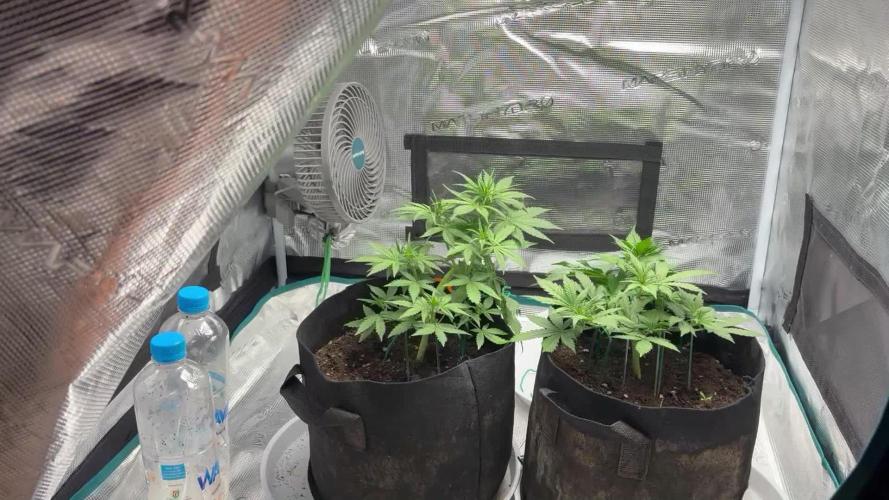
Harvested Plant #2 and Plant #3 at 11 weeks. Still have #4 and #5 to go. They are just about ready. Been waiting until the leaves turn purple. These plants have been flushing for weeks because I thought they were going to be done sooner, but they haven't missed a beat. They have a very strong, sweet smell. I highly recommend Cobbler Crisp!!!



Likes
31
Share


@Canna96
Follow
Hey now, I hope everyone is having a great weekend. The Strawberry Banana is doing well, I am just doing some LST every couple of days, and she is just starting to stretch. She is still feeding on silica, cal mag, and maxi grow veg nutes by GHE. She seem to be loving this Medic Grow Spectrum X, which I am now running at 70% and also running the UV/IR bars for 1 hour before lights off. I also did a light defoliation this week to allow some airflow and her to focus more energy on the upper branches.
I will continue to with LST and veg nutrients until the vertical growth stops, then I will transition her to flower nutrients, and change her lighting to the red spectrum. Not much to do this week except watch her stretch and some light LST>
Thanks for stopping by, Stay Safe and Blaze On!!! 💪
Website: https://medicgrow.com/
https://growdiaries.com/grower/medicgrowled


Likes
25
Share


@OZDAOgrow
Follow
2 weeks into the growing season.
Things are going well, starting to apply LST to some plants. I have also started to remove little by little those leaves that interfere with light penetration.
Bruce Banner unfortunately turned out to be retarded in development, but I won't remove him, in my experience, retarded people often turn out to be very strong ^_^
Likes
177
Share


@DreamIT
Follow
Strong genetics, resistant, fast enough, easy to grow and never pretentious. I will try further training techniques on this strain, while waiting to make more room in the box to plant the Red hot cookie as well. If you like sweet flavors and fragrant plants this is definitely for you! Soon new updates for a cycle of only plants in "monstercropping", to continue my eternal red garden 😁🦄 thanks for following me up to here and leave a comment and suggestions 🦄👍🤘

Likes
20
Share


@MrPott
Follow
Did a bit of LST, did a bit of trimming of the fan leaves to expose the bud sites. Hopefully it won't affect her too much. Kinda regret putting her in a small pot but hey, experiments right?

Likes
16
Share


@CJgrows
Follow
Not there yet checking trichomes starting this week. Probably have 2-3 weeks left. The strawberry pie continues to outshine the other strains. Gorilla glue is a close second with nice dense buds but not as many trichomes. The grapefruit may be a late maturing plant it seems like it’s starting to stack up but has a long way to go I’m guessing 4-5 weeks so not so impressed with the grapefruit for an auto. The grapefruit is acting more like a photo as you can see in the pictures the tallest plants are grapefruit. Only time will tell but I like autos for there fast turn around time if I wanted a plant that takes 12-14 weeks I would get photos and get bigger yields.
Likes
3
Share


@Ctbest2023
Follow
So it looks like only one is flowering the other one looked like it was starting but then went back into veg im just going to roll with it and see what happens the one that is flowering is the one with grow dots in soil and I only add cal mag once or twice a week don’t mind other plants in pic the one that is flowering is coming along nicely though
Likes
14
Share

@Chubbs
Follow
What up what up, weekly update on these FrostBangers, they've definitely transitioned beautifully into flower and now almost everyday you can see the flower sites swelling getting bigger. I raised my lights this week as they where getting about 12in from the top of the canopy and I usually like it to be a little further that that. All in all Happy Growing.
Likes
16
Share

@H0BBYGAERTNER
Follow
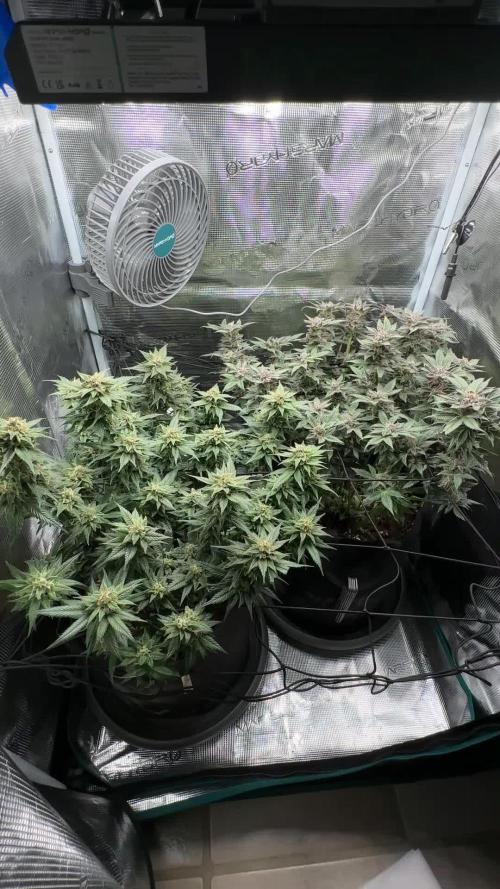
WEEK #20 – WE'RE GETTING JUICY
Final Stretch (or so).
-2/-1 weeks for SMC and -1/0 weeks for Skywalker *Haze* according to Dutch Passion standard. So we're a bit overdue. But with the size of the plants, who cares? Still very little healthy plants, no signs for "end of life". Checked trichomes on top buds regularly: Milky way is here, but still not much amber. In fact not noticeably more than last week. Skywalker (to be expected) still a bit behind. But i can see additional calyxes forming (green/fresh pistills), so totally worth the wait. 😍
This time i cropped the detail shots to avoid the mediocre resizing of growdiaries. It's fun to just look at the plants, i hope you can imagine as well now.
Regarding smell, it hit me today 😰. SMC smells like fruit loops - not kidding. Well, a bit of fuel/diesel smell in the air, but full sweet fruitiness.
1-2 more weeks, fingers crossed. 😺

Likes
Comments
Share

@DogDoctorOfficial
Follow
🌱 8×8 Adventure – Folder 10
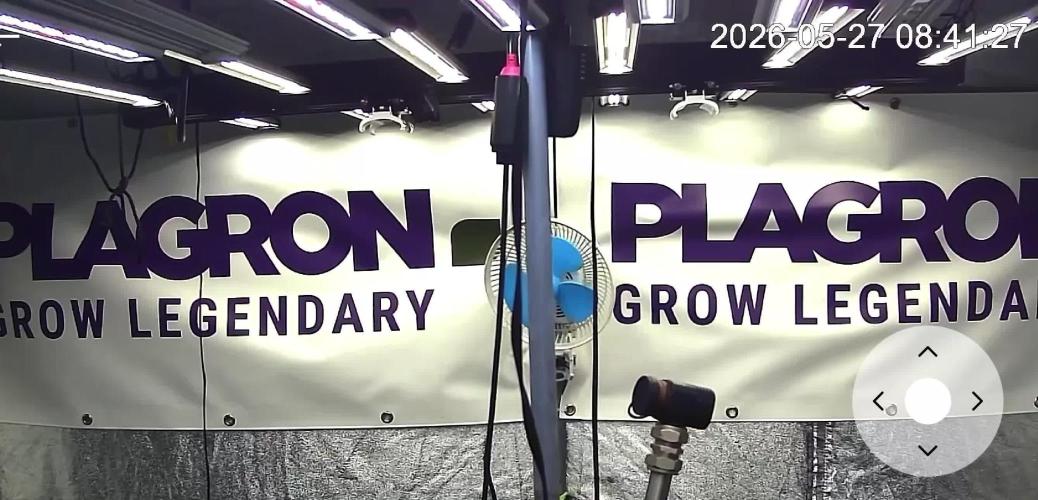
Frosted Guava – Plant A | Week 4 | The Compact Contender Begins to Bloom
Every phenotype tells its own story, and that is exactly why this 8×8 Adventure continues to fascinate me. Growing twelve different genetics under the same environment using the 12/12 From Seed technique has become a constant lesson in how differently each cultivar interprets identical conditions. Some immediately stretch toward the light, while others choose patience, investing their energy into structure before committing to vertical growth.
Frosted Guava Plant A clearly belongs to the second group.
Rather than racing upward, she has spent these first weeks building an incredibly dense, compact framework. Looking at her today, it’s easy to understand why this phenotype caught my attention. Every internode remains tight, every branch is stacked close together, and the entire plant carries an impressive amount of healthy foliage without sacrificing vigor. She may not be the tallest lady in the tent, but she’s quietly building what looks to become an exceptionally productive little bush.
The most exciting part?
Despite her compact stature, she has officially begun announcing that flowering is just around the corner.
⸻
🌱 Building a Foundation Before the Stretch
One of the things I enjoy most about documenting these grows is watching personality emerge before flowers ever appear.
Frosted Guava Plant A has developed into exactly the kind of plant that rewards patience.
Instead of producing long internodal spacing, she has focused on creating a dense network of future flowering sites. Looking closely, nearly every node is alive with vigorous new growth, and fresh shoots are beginning to compete for dominance. The canopy is naturally uniform, making future light penetration much easier than on taller, more open phenotypes.
Sometimes growers become concerned when a plant doesn’t stretch early under 12/12, but genetics ultimately decide how that energy is distributed.
In this case, the energy has clearly gone underground first into the roots, then into stem thickness, branching, and node production before committing to vertical growth.
The result is a plant that already feels mature despite standing only around 25 cm tall.
⸻
✂️ Gentle Low Stress Training
Instead of aggressive manipulation, this phenotype has been guided with a much softer approach.
Throughout the week I continued using simple leaf bending, leaf tucking and gentle repositioning to expose hidden growth tips. No unnecessary stress, no heavy defoliation—just encouraging light to reach every developing branch naturally.
This technique has worked beautifully.
Rather than removing valuable solar panels, the larger fan leaves are simply moved out of the way, allowing the lower shoots to receive enough light to become future flowering tops.
Sometimes the simplest training methods are also the most effective.
The goal isn’t forcing the plant into shape.
The goal is helping her discover her own.
⸻
🌸 The First Signs of Flower
One of the most enjoyable moments during a 12/12 From Seed project is seeing that unmistakable transition.
This week those first pre-flower structures have become impossible to ignore.
Tiny clusters are beginning to form across the upper nodes, the apical growth has changed shape, and the plant is slowly shifting away from vegetative expansion toward reproductive development.
She isn’t waiting.
Exactly as expected with this cultivation method, Frosted Guava is entering bloom while still maintaining a beautifully compact architecture.
If the coming stretch remains moderate, this could easily become one of the densest canopies inside the entire 8×8 tent.
⸻
🌡️ Environmental Conditions
This week the room remained remarkably stable despite the warm summer conditions.
Grow Environment
• 🌡️ Day Temperature: 33°C
• 🌙 Night Temperature: 25°C
• 💧 Relative Humidity: 63%
• 🌱 Substrate Temperature: 21°C
• 💦 Nutrient Solution Temperature: 26°C
• ⚡ EC: 1.35 mS/cm
• ⚗️ pH: 6.1
• ☁️ CO₂: 639 ppm
• 💧 Daily Water Consumption: 1.1 L
• ? Pot Size: 15 L
• ☀️ Light Schedule: 12/12
Although daytime temperatures continue to push higher than ideal, the plants have responded exceptionally well. Healthy leaf posture, rich coloration, vigorous growth and strong transpiration all suggest that root-zone conditions remain stable enough to offset the environmental heat.
Sometimes plants tell you far more than any environmental sensor can.
And these leaves are telling me they’re happy.
⸻
Feeding Program
The nutrition program remained intentionally balanced to support both continued vegetative development and the beginning of flower initiation.
This week’s recipe consisted of:
• Terra Grow — 1.8 ml/L
• Power Roots — 1 ml/L
• Pure Zym — 1 ml/L
• Sugar Royal — 1 ml/L
• pH Plus — 0.03 ml/L
• Lemon Kick — 0.03 ml/L
With an EC of 1.35, the feeding remains moderate while supplying everything needed to sustain healthy growth without pushing the plant harder than necessary.
The rich green foliage suggests the balance is right where it should be.
⸻
🔬 Phenotype Notes
Looking over this week’s photographs, several characteristics stand out.
The stem has thickened noticeably and provides an excellent foundation for future flower weight. Branch spacing remains extremely tight, giving the plant a naturally bushy appearance without requiring topping or more invasive training.
The new growth is vibrant, healthy and full of energy, while the canopy remains surprisingly symmetrical despite only using leaf tucking.
Perhaps the most interesting observation is just how many future flowering sites are already visible. Nearly every branch tip appears ready to contribute to the final canopy.
She may not be trying to become the biggest plant.
She may simply be trying to become one of the fullest.
Sometimes that’s an even better strategy.
⸻
🔮 Looking Ahead
The coming week should be one of the most exciting yet.
With flowering now beginning, I expect Frosted Guava Plant A to enter her stretch phase while continuing to produce additional flowering sites throughout the canopy.
Training will remain gentle, focusing on canopy management rather than forcing structure. If she maintains this compact architecture while adding vertical growth, she could develop into one of the easiest plants in the room to manage.
Every day she becomes a little more confident.
And every week she gives another reason to be excited about what’s coming next.
⸻
💚 Final Thoughts
Projects like this remind me why I love growing.
No two plants ever read the same script.
Even when sharing identical lighting, nutrition, temperatures and care, every genetic line chooses its own path. Frosted Guava Plant A has decided that patience comes first—building strength before height, structure before stretch, and now finally revealing the first signs that flowering has officially begun.
Watching those decisions unfold is one of the greatest rewards of documenting every week of this journey.
A huge thank you to Zamnesia for providing these exciting Frosted Guava genetics, Plagron for the reliable soil and nutrient line that keeps this entire project thriving, and Future of Grow LED for delivering the powerful, even lighting that allows every phenotype to express its full potential.
As always, thank you to the incredible GrowDiaries platform for giving growers around the world a place to learn from one another, and to everyone who follows this 8×8 Adventure week after week. Your encouragement, questions, advice and enthusiasm continue to make this journey even more rewarding.
Growers Love and see you all next week, as Frosted Guava Plant A takes her first real steps into bloom. 🌱💚

Likes
12
Share


@JeyGanesha
Follow
La prima delle runtz è quasi arrivata a maturazione. Aspetterò ancora qualche giorno poi inizio a tagliare le più mature..mm
Gnam gnam gnam 😆🤣non vedo l'ora di gustare queste delizie🤣😆😆
Likes
9
Share


@ThePifferyAndCo
Follow
Week 2 of flower. Blue dream stopped stretching but the holy communion has continued stretching throughout the whole week into the 3rd.

Likes
13
Share


@MJ_LIVINGSOIL
Follow
We plan to pre-flowering in next week. In this week we are stop topping in these girl. And make
160 cola per 1 plant and training with maintenance cut for Top bud every cola.
We use compost tea and craft organic fertilizer to take nutrient to soil and plant can use it for flowering stage.

Likes
4
Share


@Canaryweed_tf
Follow
Ya tenemos está cuarta semana de la GorillaKingAuto del banco de Kannabiaseeds. En está semana la planta ha pegado un estirón muy considerable me está sorprendiendo mucho, si se fijan en el video podéis ver que ya le están saliendo los primeros pelitos blancos de flora. Pronto nuevas noticias 😘

Likes
4
Share


@UtterLoudPack
Follow
This week is pretty routine plants look good was going to flower for 10 weeks but most of the fan leaves are turning yellow indicating that it's almost time to harvest. There aren't too many new white hairs growing most are turning orange.

Likes
22
Share


@Knert
Follow
D29: Pistils are clearly showing now. She's looking really good and vigorous. I did notice a (very) small number of brown pistils. Might be from being a little bit careless while doing LST and toching it with the iron wire, could that be? Or could there something else going on? Speaking of LST, from now on I'm going to let the main cola grow upward again. I kept her really low to give the lower branches enough space, and I think that's the case now. I also tucked away most of the fan leaves that were blocking the light of certain tops. I think I'm going to plant her out in full ground by the end of the week. Temperatures are supposed to be 20+°C then. Any thoughts about that?
D31: I decided to let it stay in its current pot, in order not to stress the roots right before flowering. She still keeps on growing every day, still at a surprisingly high pace. Also, I'm tucking away the fan leaves and other leave that are blocking the sunlight from the tops. Tomorrow it's watering time again, right before the start of week 6. Since I'm only watering her after the soil is almost dried out, I'm probably not watering her for another 5-6 days. My question now is what fertilisers I should be adding. There's already 60g of granular 6-3-3 fertiliser in it (added over the past two weeks), so I won't be adding any more of that anymore. I have phosphorous grains (6-16-0), and potassium grains (2-0-20) and I'm wondering if I should already add those potassium grains or just stick with phosphorous grains this time and add potassium grains next watering when it's (probably by then) just started flowering. Any advice?


