


@DogDoctorOfficial
Follow
Week 6 Veg Report – Runtz We Meet Again!
Another week, another step forward in our Eternity Grow Cup 2025 journey, and oh boy, do we have a lot to unpack! These Runtz girls are showing their potential, and we’re dialing in every little detail to ensure they thrive. Let’s dive deep into everything that happened this week!
Cal-Mag Deficiency Adjustment – Pheno #5’s Special Needs
This week started with a close inspection of our phenos, and we noticed that Pheno #5 was showing early signs of a calcium/magnesium deficiency. Whether it was slightly off VPD levels or this particular plant being more demanding, we decided to correct it by increasing the dose of RO Water Conditioner. Now, while this isn’t a direct substitute for Cal-Mag, it does contain trace amounts that can help stabilize the situation.
🔬 Understanding Cal-Mag Deficiency:
Calcium and magnesium are essential secondary nutrients. Calcium strengthens cell walls, preventing issues like tip burn and weak stems, while magnesium plays a critical role in chlorophyll production, allowing plants to efficiently absorb light energy.
💡 Signs of Deficiency:
• Yellowing between veins (Magnesium)
• Rust spots on leaves (Calcium)
• Slow growth and weak stems
⚡ How We Address It:
• Slightly increasing RO Water Conditioner to see if trace minerals help
• Keeping an eye on overall nutrient uptake to ensure no lockout
• Monitoring VPD (Vapor Pressure Deficit) closely to optimize nutrient absorption
Let’s see how she reacts next week!
Branching Development – Pheno #2 Leading the Race
All five phenos are thriving, but Pheno #2 is showing the most aggressive branching, pushing outward faster than her sisters. However, overall, we’re seeing very uniform growth, which speaks volumes about the stability of these genetics.
🌱 What is Branching & Why It Matters?
Branching is the plant’s way of expanding its canopy, increasing surface area for photosynthesis, and maximizing potential bud sites. Well-structured branches allow better airflow, light penetration, and more even growth—key for a successful high-yield harvest.
⚖️ Topping vs. Leaf Bending – The Training Choice
Instead of topping, I’ve decided to go with leaf bending for now. This method allows for gentle manipulation of the plant’s growth without causing major stress. Once we introduce the SCROG (Screen of Green) net, this training will help maximize the canopy spread.
Moving to the TrolMaster Ecosystem – A Game Changer
Big move this week—our Runtz girls officially transitioned into the TrolMaster Ecosystem, and let me tell you, they are absolutely loving it! Under the ThinkGrow Model 1 LEDs, they’re thriving, leaves praying upward, soaking in that optimized spectrum.
💡 ThinkGrow Model 1 LEDs – Why They Work
• PPFD of ~400 µmol/m²/s at their level, running only on Channel One
• Full-spectrum lighting tailored for optimal vegetative growth
• Passive cooling design, keeping temps stable while saving energy
Environmental Conditions (Measured on the TrolMaster Tent-X and the AMP-3)
• Temp Max: 26.6°C | Min: 16.2°C
• RH Max: 77% | Min: 52%
• VPD Max: 1.65 kPa | Min: 0.43 kPa
• Solution pH: 5.8
• EC: 0.96
• Water Temp: 16.3°C
Why These Numbers Matter:
• Keeping VPD in check ensures efficient nutrient uptake
• pH and EC levels fine-tuned for maximum root absorption
• Water temp stable to avoid root shock and slow growth
Autopot System Prep – Getting Ready for the Next Phase
The week wraps up with us cleaning and preparing the Autopots for their next phase. These self-watering systems will allow the Runtz girls to access water and nutrients at their own pace, optimizing growth as we head into pre-flower soon!
A huge THANK YOU to Zamnesia, Plagron, and GrowDiaries for making this incredible Eternity Grow Cup 2025 possible! Also, a big shoutout to my main sponsors, thank you for keeping this journey running:
🔥 Aptus Holland – Precision nutrients for peak plant health
⚡ TrolMaster – Bringing automation and accuracy to the grow
🌱 Pro-Mix – The foundation of strong roots and healthy plants
💨 The CannaKan – Premium solutions for top-tier results
Grove Bags – Revolutionizing post-harvest storage & terpene preservation
📜 Ziggi Papers – The ultimate rolling experience
And of course, a massive thank you to the community—followers, supporters, lovers, and even the haters. You ALL fuel this journey, and I appreciate every single one of you!
🚀 Good luck to all fellow competitors—watching everyone’s grows is inspiring, and the competition is fierce!
📢 Join the journey on YouTube & Instagram for exclusive content, behind-the-scenes action, and more insights into this epic run!
👊 Let’s keep pushing, learning, and making history—see you all next week for another deep dive into the Runtz We Meet Again grow! 🌿🔥
💚 growers love to all 💚
Genetics - Runtz https://www.zamnesia.com/6000-zamnesia-seeds-runtz-feminized.html
Nutrients - Plagron https://plagron.com/en/hobby
- Aptus Holland https://aptus-holland.com/
Controls - Trol MAster https://www.trolmaster.eu/
LED - https://www.futureofgrow.com/en
LED - https://www.thinkgrowled.com
Soil - https://www.promixgardening.com/en
Germination - Cannakan https://cannakan.com/?srsltid=AfmBOopXr-inLXajXu3QFgKXCXXos4F1oEvScjMKIB5MR5dk8-GJ-F49
DOGDOCTOR 15% off
Smoking Papers - https://ziggioriginal.com/
Terpene saver - https://grovebags.com/
As always thank you all for stopping by, for the love and for it all , this journey of mine wold just not be the same without you guys, the love and support is very much appreciloved and i fell honored with you all in my life
With true love comes happiness Always believe in your self and always do things expecting nothing and with an open heart , be a giver and the universe will give back to you in ways you could not even imagine so
As always, this is shared for educational purposes, aiming to spread understanding and appreciation for this plant. The journey with nature is one of discovery, creativity, and respect. Let’s celebrate it responsibly and continue to learn and grow together!
Growers Love To you All 💚
#EternityGrowCup #RuntzHunt #GrowersLove #CannabisCommunity #AptusHolland #ProMixSoil #TrolMaster #Zamnesia #Plagron #ZiggiPapers #Grovebags


@DogDoctorOfficial
Follow
Time to give this P2000 a secont run, and in it i will run a single clone that i took from my previous run, i took one from each phenotype and from them i chose the one i like the most in terms of plant structure , terpene profile and in the end smoke test also, that one is the most important one lol and the one with the most value on my decision, saying this dont judge me on this hahahaha i kind a forget it in the corner and now its time to bring her up to her full potential.
I started by transplanting her from her tinny pot to a 25 L one , had to the soil 100g of All in one Pellets, a touch of microbial life and some Mycor to the roots and ready she is, gave them a foliar feeding with APTUS HOLLAND nutrispray and gave them a full feeding with the on the water sine the pallets will take a couple days minimum to start breaking and becoming available for the plants to take, i will let her adapt to it all for now and then i will star training her to became a tiny ginormous beautiful lady best, covered in trichomes and smelling like pines falling out of pine trees in the middle of the woods.
As for the PAR department for now i am giving them 600 PPFD and running my VIPARSPECTRA P2000 @ 69%
Looking at them an i decided that it was a good idea to start some training going on in this girl, so i gave her a new look and lets see how she goes from here, i spray them again with APTUS HOLLAND Nutrispray to help thing move faster .
And they are coming back to life , in just a couple of days i can notice that they love the fact that im giving them my love and attention
Is it just me or they are bouncing back fast af ? Not complaining at all hehehe , did some more training today, if they keep evolving like this i will be able soon to start taking leafs and selecting what to keep and what have to go.
Just recently started collaborating with APTUS HOLAND and i have to give a big shoutout to them ,Thank you Aptus Holland for believing in my love for growing , fells amazing wen you already believe and buy a product and they come and start supporting your love for it all 🙏🙏🙏💚💚💚🙌🙌🙌✊✊✊
As always thank you guys for your love , your time, your support and it all, i fell blessed and i am truly thankful 💚💚💚🙏🙏🙏🙌🙌🙌
Let the games begin hihihihi
All i grow is medicine for myself, for me and for my best friend with is me 😆 nothing to sell, so don’t even ask 😅💚💚💚
All info and full product details can be find in can find @
https://viparspectra.eu/collections/grow-lights DISCOUNT CODE 5% - DOGDOCTOR ( all store )
https://www.zamnesia.com DISCOUNT CODE 10% - GROWITGD ( just for seeds )
https://aptus-holland.com/
#aptus #aptusplantteck #aptusgang #aptusfamily #aptustrueplantscience #inbalancewithnature #trueplantscience #viparspectra #zamnesiaseeds #growerslove
With true love comes happiness 💚🙏 Always believe in your self and always do things expecting nothing and with an open heart , be a giver and the universe will give back to you in ways you could not even imagine so 💚💚💚
More info and updates @
https://growdiaries.com/grower/dogdoctor
https://instagram.com/dogdoctorofficial
https://youtube.com/channel/UCR7ta4DKLFMg2xxTMr2cpIg
💚💚💚Growers love to you all 💚💚💚


@GoodTimesOrganics
Follow
Hi liebe Community and Welcome back! 💚
Jetzt kommen wir allmählich Richtung finaler Blütewoche.
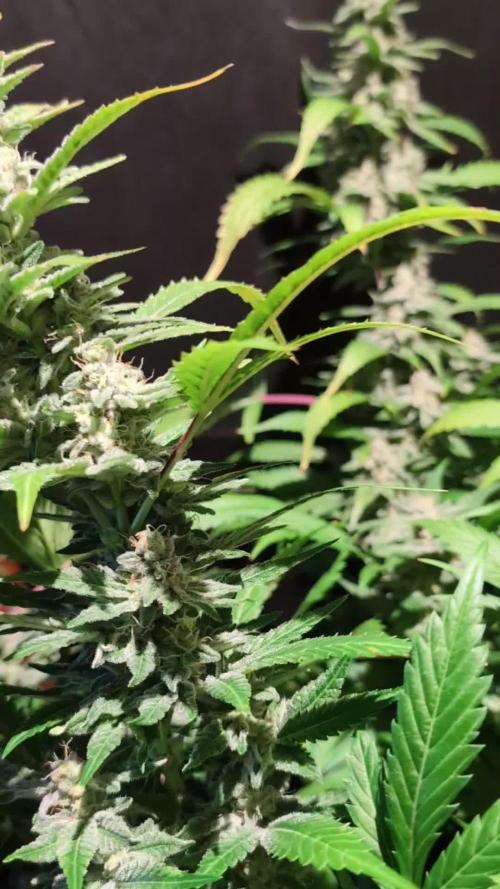
Es lässt sich beobachten, dass die Blütenbildung im mittleren Bereich der Colas stark ausgebreitet hat und die Pflanze Richtung Spitze eher etwas dünner wird.
Sie bildet die Blüten sehr vielseitig aus, von dünner kompakt bis hin zur breiten dichteren stellen.
Bei diesem Genotypen, ist das Wuchsverhalten eher etwas Indica dominiert, da sie nicht so sehr in den Stretch ging.
Ihr Geruch wirkt jedoch inzwischen immer intensiver in Richtung Grapefruit (GMO). Wie beschrieben kommt dieses Aroma stark aus dem GMO Phenoltypen. Allerdings drückt bei ihr auch eine etwas süße und mehr fruchtige Note durch.
Die Wachstumsbedingungen im Growzelt sind aktuell wieder super!
———————
🌞 Temp: 22°C
🌚 Temp: 20 °C
💨 RH: 53%
VPD: 0,91 kPa
😎PPFD: 830 mqm
———————
Stay Tuned! 💚



@Ninjabuds
Follow
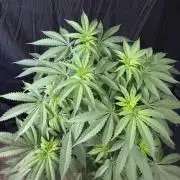
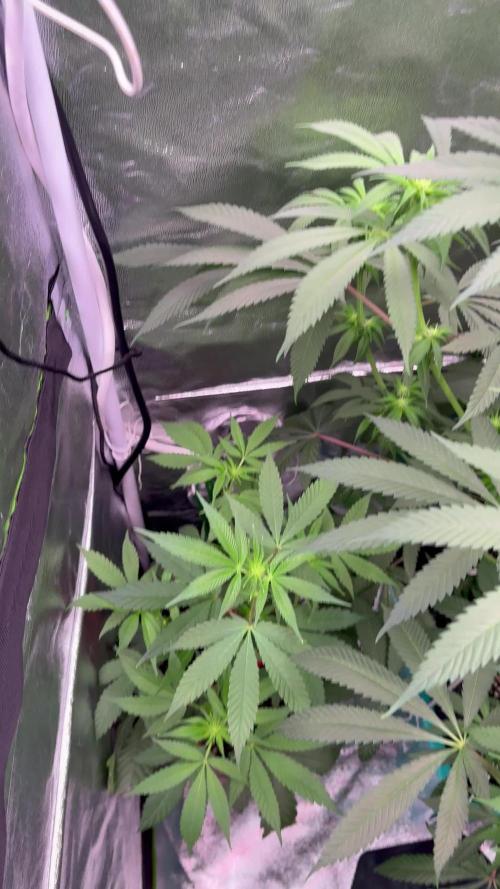
The plants are looking really healthy. I’m still getting used to my new lights. I think I didn’t push enough light in week 2 of flower I’m ramping up the light intensity now. I had to whip out my par meter I was keeping the light to far off the plants. This light has to be closer to the plants than my mini sun. I’m lurking this light a lot I just need to get used to it


@Grower_Of_Persia
Follow
week intel:
every thing is amazing girls are ripening , we can now cause more e.c stress than before because:
1-plants are very mature now and can handle stress
2- at this week its the only stress that is helpful for increasing plant resins
stresses :
E.C stress around 1.6 and 1.7 3 times a week
feeding:
i replaced B-52 with Bloom Base Nutrient
i feed them 3 times this week with this order :
day 1 : i feed them high with base nutrients(calcium & micros (half dose) + Bloom) about 850 ppm - 1.7 e.c to cause a little stress.
day 3 : i feed them high dose of Top-Max + Bloom Base Nutrient around 877 ppm - 1.7 e.c to cause stress .
day 5 : i feed them high dose of Feeding Booster around 850 ppm - 1.7 e.c to cause e.c stress again
guide of the week :
last weeks are time of ripening , and the only helpful stress is e.c stress at this moment


@B4niTa
Follow
Chopped day 75 one week earlier than i want because some problems. Easy for trimming, only few hours 😁


@sellem
Follow
30/11: Off with their heads! on Day 15, i deemed both of them worthy of topping. Lets see how they take it! Watered them with 1L beforehand, 4ml/L rootjuice, 2ml/L Grow and activera, and 0,4g/L of microbes.
4/12: Training time! Stakes are in, canopy looks nice and even (enough) for me! Probably watering tomorrow on the 5th as the soil is still a bit too damp and the pots still a bit too heavy for my liking. Grow rate has drastically increased, they look nice and green, and topping hasnt stunted them. Cant wait for the coming weeks!
6/12: its the 6th now and i havent watered yet! overdone it on the 30/11 maybe. Oh well! theyre doing reasonably fine. Added timelapse. See you next week!


@Backtotheroots2222
Follow
Throw seeds as ... Smells like sweet kush/haze/old leater shoes/earthy lite pepper..no Berry no peach...i am happy with it..verry easy to grow..fast... have good body ratio..




@DogDoctorOfficial
Follow
💙 Project Blue Tent – Week 13
🌿 Blue Waffle F1 – Pheno B
🌱 Same Genetics, Different Expression – A Beautiful Fade into Lighter Greens
Hello everyone, and welcome back to another chapter of Project Blue Tent! 💙🌱
My friends, we're back with another individual report, and this time it's all about our beautiful Blue Waffle F1 Pheno B!
And honestly, what can I say?
These girls are amazing! 😂💙
We've reached another interesting stage of flowering, and while all four plants are sharing the same environment, the same reservoir, the same irrigation system, and the same general cultivation approach, each one continues to show us her own individual characteristics.
Last week, we talked about the beautiful development of our Blue Waffle F1 girls and the incredible details we've been capturing through photography and focus stacking.
This week, we're continuing that journey.
The room is moving towards the final stage of flowering. We're gradually reducing temperatures, lowering the nutrient concentrations, and beginning to decrease the output of the overhead LEDs.
The two LumiFlora under-canopy fixtures remain part of the experiment, and the irrigation system continues supporting all four plants.
But today, we're not simply repeating the room update.
We're looking at what makes this particular girl different.
Because even when plants share the same genetics, that doesn't mean they will express themselves in exactly the same way.
And Pheno B is giving us a beautiful example of that.
Her structure is a little different from her sister's. Her flower development has its own character, and her colours are moving more towards lighter shades of green rather than the more pronounced blues, purples, and reddish tones we've been admiring on Pheno A.
She's still compact. She's still beautiful. And the aroma?
Absolutely incredible!
Let's take a closer look. 💙🌿
🌸 WEEK 13 – MOVING TOWARDS THE FINISH
We're now in Week 13 of flowering, and the entire room is gradually moving towards the final stage of the journey.
The major structural work has already been completed.
The plants have been trained, topped, managed through the stretch, and supported with the SCROG system. The second layer of support remains in place, and the under-canopy lighting experiment continues.
At this stage, we're concentrating on maintaining a stable environment and observing how each plant develops.
We're not looking to make unnecessary structural changes just because another week has passed.
Instead, we're watching the flowers, the changing foliage, the overall structure, and the characteristics each phenotype is expressing.
And this is where things become particularly interesting.
Pheno A and Pheno B share the same cultivar, but they aren't identical copies of one another.
They have their own morphology, their own individual appearance, and their own way of progressing through flowering.
Pheno B is now showing us a different side of Blue Waffle F1.
And I'm really enjoying seeing those differences develop!
🌿 SAME GENETICS, DIFFERENT MORPHOLOGY
One of the most interesting things about documenting individual plants is that it gives us the opportunity to observe differences that might otherwise be overlooked.
Our two Blue Waffle F1 plants share the same cultivar, but each comes from a different seed.
And although they share the same growing environment, their physical expression isn't identical.
Pheno B has a different overall structure from her sister.
The way her flowers are developing, the way the plant presents itself, and the colours she's expressing are all slightly different.
We're still seeing that compact appearance, but the overall morphology isn't exactly the same.
It's a reminder that a cultivar name doesn't guarantee that every individual plant will look identical throughout its life cycle.
Genetics provide the potential for particular characteristics, but individual plants can express that potential differently.
Environmental conditions can also influence how plants develop, so we shouldn't automatically attribute every difference to genetics alone.
And that's precisely why we document these plants separately.
We're not trying to force them into the same description.
We're observing what each one actually shows us.
Pheno A has her own personality.
Pheno B has hers.
And both deserve their own spotlight! 💙🌱
🌱 A DIFFERENT STRUCTURE, BUT STILL BEAUTIFULLY COMPACT
Let's talk about the structure of this girl.
Pheno B remains compact and beautifully developed, but when I compare her with Pheno A, I can see differences in the way the plants have expressed themselves.
The overall morphology is slightly different, and the flower formation isn't quite the same.
It's difficult to say exactly why those differences have developed.
It could be down to individual genetic expression, environmental influences, or a combination of factors.
Even though the plants share the same tent, they don't necessarily experience every condition in precisely the same way at every point across the canopy.
Light distribution, local airflow, and individual plant characteristics can all contribute to differences in development.
However, we don't have enough evidence to identify one specific cause here.
And that's perfectly fine.
We're documenting the observations rather than inventing an explanation.
What matters is that Pheno B has developed her own structure, and we're now able to appreciate that individual expression as flowering progresses.
She's looking beautiful, and I'm happy with what we're seeing.
🌸 FLOWER FORMATION – HER OWN WAY OF DOING THINGS
The flower formation is another area where I notice differences between the sisters.
Although both plants remain compact and are progressing through the same general flowering stage, their flowers don't present themselves in exactly the same way.
Pheno B has her own pattern of development, and this is something I'm particularly interested in following as we move closer to the finish.
Was it something about the environment?
Was it simply the individual expression of this plant?
Could it be a combination of factors?
At this point, I can't give you a definitive answer.
And I don't want to pretend otherwise.
Sometimes, when we're growing several plants together, we see differences that are easy to observe but much harder to explain with certainty.
That's part of the learning process.
We record what we see, compare the plants, and continue observing as they mature.
The important thing is that Pheno B is developing beautifully, and her individual characteristics are becoming increasingly clear.
Her sister might be showing a more colourful expression, but Pheno B has her own charm.
And that's exactly why I love keeping separate phenotype diaries.
🌿🌈 THE COLOURS – A DIFFERENT KIND OF BEAUTY
Now, this is where Pheno B really separates herself from her sister.
While Pheno A has been showing us a more pronounced mixture of blues, purples, reddish tones, and greens, Pheno B is moving towards lighter shades of green.
Her fade is different.
It's less about those strong contrasting colours and more about the changing green tones we're seeing throughout the plant.
And honestly, my friends, there's absolutely nothing wrong with that!
😂💚
Not every plant needs to develop the same colours to be beautiful.
Different phenotypes can express different pigmentation patterns, even when they share the same cultivar.
Genetics can influence those characteristics, while environmental conditions and the stage of maturity can also play a role.
We're seeing Pheno B move towards a lighter, greener appearance as she progresses through flowering.
That's what the plant is showing us, and that's what we're documenting.
I'm not going to claim that the cooler temperatures alone caused this particular fade, because we can't establish that from our observations.
Instead, we'll continue watching her colours develop alongside the other signs of maturity.
And I have to say, I really like seeing the contrast between the two sisters.
One is showing a more colourful palette.
The other is expressing herself through lighter greens.
Same cultivar. Same room. Different individual expression.
That's what makes this comparison so interesting! 💙🌿
❄️ COMPACT FLOWERS AND PLENTY OF DETAILS TO OBSERVE
Despite the differences in colour and structure, Pheno B remains compact and attractive.
The photographs give us a closer look at her flowering sites and the details developing across the plant.
And this is another reason I enjoy documenting each phenotype individually.
When we look at the whole tent, it's easy to concentrate on the general appearance of the canopy.
But once we start looking at individual plants, we can appreciate their particular characteristics much more clearly.
The flower structure.
The arrangement of the flowering sites.
The way the plant presents its foliage.
The changing colours.
And the small differences that make one phenotype distinct from another.
We're continuing to observe the flowers and the developing trichomes as the plant progresses.
The pistils are also changing as flowering advances, but their appearance alone doesn't tell us everything about maturity.
We'll keep looking at the overall development rather than relying on a single visual indicator.
For now, Pheno B is looking beautiful, and I'm excited to continue documenting her progress.
📸 PHOTO STACKING – LOOKING CLOSER AT THE DETAILS
Photography remains an important part of Project Blue Tent.
This week, we've continued capturing photographs of the plants and documenting the flowering sites through close-ups and focus stacking.
As many of you already know, focus stacking combines multiple images captured at different focus distances to create a final photograph with greater depth of field.
It's a fantastic technique for showing intricate details that can be difficult to capture in a single frame.
The process also takes time.
We need to set up the camera, choose the composition, capture the individual frames, and then process the stack.
And when we're working inside the grow room rather than in a dedicated studio, we have to work with the conditions available to us.
But that's part of the process, too.
The aim is to document the plants as accurately and clearly as possible, while giving everyone following the diary a closer look at what we're seeing.
For Pheno B, these photographs help us appreciate her individual flower formation and the differences between her and her sister.
They're not just pictures for the sake of taking pictures.
They're part of the record of this grow.
And I genuinely enjoy sharing that process with the community. 📸💙
🌡️ THE SHARED ROOM – LOWER TEMPERATURES FOR THE FINAL STAGE
Now let's return to the wider environment, because everything we've been doing in the room applies to Pheno B as well.
We're gradually lowering both daytime and nighttime temperatures as we move towards the final stage of flowering.
The current daytime air temperature is approximately 25°C.
During the night, when the plants are resting, the temperature drops to around 19–20°C.
We've also brought the solution temperature and substrate temperature down to approximately 21°C.
These adjustments are part of our approach to the finishing stage.
We're interested in observing how the plants respond as the environment changes and how their natural characteristics develop over time.
Cooler conditions can influence colour expression in some cultivars, but the response depends on the genetics and the overall environment.
We're not assuming that every plant will respond in the same way.
And Pheno B is a perfect example of why individual observation matters.
Despite sharing the same room with Pheno A, she's expressing a different colour pattern.
We'll continue watching both plants and documenting what happens as they approach the finish.
💧 HUMIDITY – UNDERSTANDING THE READINGS
Our normal relative humidity is approximately 55%.
You may notice that some photographs show higher readings, particularly when I'm working inside the tent.
When I'm moving around, taking photographs, checking equipment, and breathing inside the room, the humidity can rise temporarily.
Even with the air conditioning running, the readings can change while I'm working.
That's why it's important to distinguish between a temporary measurement during maintenance and the normal operating conditions we're aiming to maintain.
For this report, we're recording approximately 55% relative humidity under normal room conditions.
The aim is to keep the environment stable while monitoring the plants throughout this stage.
🌱 NUTRITION – LOWERING HYDRO A AND B
We've also started reducing the nutritional concentration as the plants move towards the final stage.
The new recorded recipe is:
PLAGRON Hydro A – 1.8 ml/L
PLAGRON Hydro B – 1.8 ml/L
PLAGRON Power Buds – 1 ml/L
PLAGRON pH Plus – as required
PLAGRON pH Minus – as required
The recorded pH is approximately 5.96, while the EC is around 1.86 mS/cm.
By reducing Hydro A and Hydro B, we've also reduced the overall nutrient concentration, which is reflected in the lower EC and TDS readings.
The pH can also shift as the composition of the solution changes, although its response isn't always predictable.
Our target is to keep the pH close to 6, allowing for small variations above or below that point.
As long as the reading remains within our intended range, we avoid unnecessary adjustments.
We're not chasing a perfectly fixed number every minute.
We're observing the solution, keeping the system stable, and making changes when there's a reason to do so.
The same nutritional program is being used across the shared reservoir, so Pheno B is receiving the same general solution as her sister and the two Pickle Lemon Haze F1 plants.
Keeping this consistent also helps us compare the plants without introducing unnecessary differences in the feeding program.
💡 LIGHTING – REDUCING THE OVERHEAD POWER GRADUALLY
The overhead LED output is now approximately 90%.
From here, we're planning to reduce the output gradually, by around one or two percentage points per day, as we move closer to the end.
We're not switching everything off or making a sudden change.
We're taking a gradual approach while observing the plants and maintaining the overall environmental balance.
The goal is to keep the lighting appropriate for this stage rather than simply running the equipment at maximum power.
Light intensity, temperature, humidity, and plant response all need to be considered together.
And that brings us to another interesting part of the project.
💡 TWO LUMIFLORA FIXTURES – LIGHT FROM BELOW
The two LumiFlora 150W full-spectrum under-canopy fixtures remain in place beneath the canopy, arranged in an X-cross configuration.
We're keeping their output around 90–95% for now, with the possibility of reducing it closer to the finish.
The overhead LEDs provide the main lighting, while the under-canopy fixtures supplement the lower portions of the plants.
We're interested in observing how the lower flowering sites develop under this arrangement.
One of our goals is to see whether this lighting balance helps the flowers across different parts of the plant progress more uniformly.
However, we won't assume that the additional lighting automatically produces that result.
We'll continue monitoring the plants and documenting what we see.
The lighting arrangement is part of the experiment, and the individual phenotype reports allow us to keep track of the differences between the plants as they develop.
💧 IRRIGATION AND DRAINAGE – THE SYSTEM CONTINUES WORKING
The automatic irrigation and drainage system remains an important part of the Project Blue Tent ecosystem.
All four plants share the same reservoir, and the system helps us maintain consistency throughout the room.
The recorded watering volume is approximately 1.6 litres per plant per 24 hours.
As always, the actual water requirements of an individual plant can depend on its development and the conditions around it, so we continue observing the system rather than assuming that every plant necessarily uses water at exactly the same rate.
The aim is to keep everything working smoothly while we concentrate on the plants themselves.
And that's one of the advantages of having an established system.
When the equipment is operating as expected, we can focus on observing, photographing, and documenting the plants without making unnecessary changes.
🌿 FOUR PLANTS, TWO CULTIVARS, ONE SHARED ENVIRONMENT
This is one of the most interesting parts of Project Blue Tent.
We have four plants sharing the same room, representing two cultivars: Blue Waffle F1 and Pickle Lemon Haze F1.
They share the same general environment, the same reservoir, and the same lighting setup.
Yet each plant has her own characteristics.
And when we compare Blue Waffle F1 Pheno A with Pheno B, those differences become particularly interesting.
Pheno A is showing more pronounced blues, purples, reddish tones, and contrasting colours.
Pheno B is moving towards lighter greens.
Their structures are also slightly different, and the flower formation isn't identical.
At the same time, both remain compact, both are progressing through flowering, and both are producing an aroma that I absolutely love.
The similarities are just as interesting as the differences.
Their shared genetics provide a starting point for comparison, but they don't mean that every characteristic will be expressed identically.
That's why these individual diaries are so valuable.
We're not trying to make the plants look the same on paper.
We're recording what makes each one unique.
And I'm really enjoying seeing these differences emerge as the girls approach the finish.
👃 THE AROMA – INCREDIBLE, AND VERY SIMILAR TO HER SISTER
Now, one thing that seems remarkably similar between the two Blue Waffle F1 girls is the aroma.
The whole room smells amazing!
😂🌸
Despite their differences in structure and colour, the aroma coming from these plants is very similar, and it's becoming increasingly noticeable as flowering progresses.
It's another interesting point of comparison.
Their visual expression differs, but the overall aromatic impression is remarkably alike.
I'm not going to assign a detailed terpene profile or invent specific aroma notes that we haven't documented.
For now, what I can say is that the smell is strong, beautiful, and very similar between the sisters.
And honestly, it's one of those things that makes spending time in the room such an enjoyable experience.
The photographs can show us their colours and structure.
The video can give you a closer look at the garden.
But the aroma?
You'll have to take my word for it!
😂💙🌿
🔭 WHAT I'M WATCHING NEXT
As we continue towards the end of flowering, I'll be paying particular attention to Pheno B's changing colours and overall development.
I'm interested in seeing how her lighter green fade progresses.
I'll continue observing the flower structure and the developing trichomes, alongside the overall condition of the plant.
I'll also keep comparing her with Pheno A, because their differences are becoming an increasingly interesting part of this project.
We're maintaining the same general environmental approach across the room, gradually reducing the overhead LED output, keeping the under-canopy fixtures in place, and lowering the nutrient concentrations.
Now we give the plants time to respond.
There's no need to rush to a conclusion or assume that the sisters will finish in exactly the same way.
We'll keep observing, photographing, and documenting their individual journeys.
And that's what this project has always been about.
💙 FINAL THOUGHTS – DIFFERENT EXPRESSION, EQUALLY BEAUTIFUL
My friends, Blue Waffle F1 Pheno B is looking beautiful.
She's compact, she's developing her own flower structure, and she's moving towards a lighter green expression as flowering progresses.
Her sister has been showing us more pronounced blues, purples, and reddish tones, while Pheno B is taking a different visual path.
And I love that.
We have the same cultivar, the same shared environment, and the same general cultivation approach, yet the individual plants aren't expressing themselves identically.
It's a great reminder that growing is about observing what actually happens rather than expecting every plant to follow exactly the same pattern.
We can make comparisons.
We can record measurements.
We can photograph the differences.
But we should also be honest when we don't know exactly why a particular characteristic has developed.
That's part of learning.
And it's one of the reasons I enjoy documenting the entire journey, including the weeks when the changes are subtle rather than dramatic.
The room is gradually getting cooler.
The solution and substrate temperatures are around 21°C.
The nutrient concentrations have been reduced.
The overhead LED output is now around 90%, with gradual reductions planned.
The under-canopy lights remain part of the experiment.
And the irrigation system continues supporting all four plants.
Meanwhile, Pheno B is showing us her own beautiful expression of Blue Waffle F1.
Different structure.
Different colours.
Very similar aroma.
And a beautiful plant continuing towards the finish.
I'm genuinely happy with what we're seeing.
Let's keep observing, keep learning, and see what the next chapter brings!
🌿💙🌈
💬 COME JOIN THE DOGDOCTOROFFICIAL DISCORD COMMUNITY!
Before we wrap things up, I want to invite everyone to join our Discord community.
If you're already a member, you know how much fun we have together.
And if you're new, you're more than welcome!
We have a fantastic community where growers can share experiences, exchange ideas, show their gardens, ask questions, and enjoy the hobby together.
No level required.
You don't need to be an expert.
You don't need the biggest setup.
Everyone is welcome.
We also organize giveaways and photo championships, with prizes for the winners.
It's a wonderful place to meet other growers, learn from one another, share photographs, and become part of a community that feels like family.
So come and join us!
💙 DogDoctorOfficial Discord:
https://discord.gg/dogdoctorofficial
Introduce yourself, share your garden, and say hello.
We'd love to see you there!
🙏 A HUGE THANK YOU
A huge thank you to Zamnesia for making Project Blue Tent possible and giving us the opportunity to document these beautiful Blue Waffle F1 and Pickle Lemon Haze F1 plants.
Thank you to PLAGRON for the Hydro nutrient line supporting the girls throughout this journey.
A massive thank you to Zamnesia for the Phytonaut LED lighting, curved scissors, and clip fans that have become important parts of this ecosystem.
Thank you to Mars Hydro for the irrigation and drainage equipment helping us maintain consistency throughout the room.
And a special thank you to LumiFlora for the 150W full-spectrum under-canopy fixtures that we're using to explore supplemental lighting beneath the canopy.
Thank you to GrowDiaries for giving us the platform to document the journey, share the photographs, compare the plants, and record what we learn along the way.
And, of course, thank you to everyone following Project Blue Tent!
Your support and your comments make these diaries even more enjoyable to put together.
We're continuing to observe, experiment, photograph, and learn, one week at a time.
Until next week, my friends...
More flowers.
More observations.
More photographs.
More learning.
And hopefully, even more beautiful details to share with you.
Growers Love, happy growing, and take care everyone! 🌱💙🌸

shorts_status_processing


@TeamQuality420
Follow
So I found this elastic SCROG wasn't doing for me ... so I just took it off . Lucky I'm working with a VERY resilient strain as it was cloned from a mother whom in which was the survivor of my 75 plant loss. So this this was burnt to a crisp without water for a little over 14 DAYS . So I wouldn't try this with anything I wasnt sure could "take the heat" .
With it off the buds just kinda flopped a bit but still retained alot of resilience; the beautiful things . Now I could name about 100 things I could have done better . But if you think your "the best grower ever " that's a pretty used minded way to look at it . But am I proud of myself . Yeah :)
- slow down feed to leave terp at end .
Dnuah Dnauh... next week
THE ATTACK OF THE CANNABALIST


@RunicKevin58675
Follow
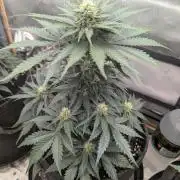
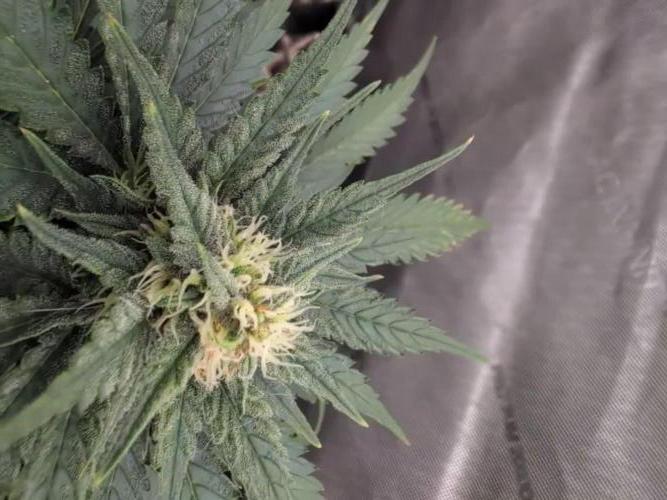
The bigger plant is pumping well although it could do better given its indica genetics but that's okay... I think they do not give their best because of the lighting that does not reflect well D:, next cycle I will gear up a little bit better


@Vince_Van_Grogh
Follow
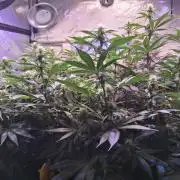
One of those weeks where they get watered three times instead of 2 -- I water every 3 days or so are os needed. To grow these cannabis - cabbages phenotypes is not easy but I am excited for the pink buds regardless! So far, for better and for worse, these are the MOST indica plants I have grown 😎🌿
Day 35, 15 Feb, Sun ♥️💛💚
Each got 2400 mL
1/L of Tiger Bloom and 0.5/L GrowBig
1.0 ml/L of CalMag and Lots of 1.5 ml/L of Big Bloom.
Day 38 18 Feb, Wed ♥️💛💚
Each got 2500 mL
Added some Recharge to this 6.4 pH water.
Day 41 21 Feb, Sat ♥️💛💚
Each got 2500 mL
1/L of Tiger Bloom and 0.5/L GrowBig
1.0 ml/L of CalMag and Lots of 1.5 ml/L of Big Bloom.




@Ultraviolet_
Follow
Remember that, however you are played, or by whom, your soul is in your keeping alone. Even though those who presume to play you be kings or men of power, when you stand before God, you cannot say, 'But I was told by others to do thus,' or that virtue was not convenient at the time. This will not suffice. Remember that.
Day:18
84°F and 65% RH (VPD) for the vegetative stage. Approximately 1.15kPa(assuming leaf temperature is about 2°F cooler than the air), which falls right into the ideal vegetative sweet spot (0.8kPa to 1.2kPa). At 1.15kPa, plants can draw water and nutrients efficiently without risking stress or wilting. It keeps the leaf pores (stomata) open, allowing for ideal carbon dioxide intake and maximizing vegetative growth. VPD is determined by the leaf's temperature, not just the ambient air. Because leaves usually run 1° to 3°F cooler than room air under bright grow lights, my actual VPD will be slightly lower, closer to the 1.0kPa mark. As she transitions from vegetative growth to flowering, one can gradually lower the humidity (to around 45–60%) and drop temperatures slightly to prevent disease from settling inside dense buds when they appear.
Night:6
At 70°F and 60% relative humidity, Vapor Pressure Deficit (VPD) is 0.86 kPa. This is right on the cusp of whats optimal for the vegetative stage. During the nighttime, plants generally close their stomata and undergo cellular respiration rather than photosynthesis. Transpiration slows to a near stop, making VPD less critical at night than during the day. However, maintaining a nighttime VPD between 0.8 and 1.0 kPa is highly beneficial in that it ensures the air is dry enough to prevent powdery mildew or bud rot, but moist enough to keep the plant from undergoing unnecessary stress. This range keeps the environment comfortable for cellular processes and prevents large atmospheric swings. Keeping it all flowing.
(Not pushing them yet, these are photoperiods)
The optimal soil (root zone) temperature for cellular root respiration and nutrient uptake in cannabis is between 68F & 72F This narrow range balances biological energy production (cellular respiration) with the dissolved oxygen levels in the soil, maximizing plant growth and health. Warmer soils hold significantly less dissolved oxygen. When soil temperature exceeds 74F oxygen depletion occurs, inhibiting cellular respiration almost entirely, At 68-72F root cells generate optimal adenosine triphosphate (ATP) via respiration to power root-tip elongation and the active transport of water and nutrients.
Too Hot (Above 78F) Root respiration increases, demanding more oxygen, while the water's oxygen-carrying capacity drops. This creates a prime environment for anaerobic pathogens and Pythium (root rot).
Too Cold (Below 60F) Root metabolism and cellular respiration slow to a crawl. This severely impairs nutrient and water absorption, leading to yellowing, wilting, and phosphorus deficiencies.
A lot depends on whether it's automatic or photoperiod; with photoperiod, there is not as much of a need to push "hard" as the real countdown only begins once the flower is initiated. Automatics, on the other hand, the chronological "clock" begins ticking the moment the seed germinates. It is of critical importance that the seedling growth gets off to the races, understanding that early growth is like compound interest, which will pay off come harvest. This reality is why getting autoflowers "off to the races" early on yields such exponential benefits. The "compound interest" is directly related to the surface area of the leaves. Larger, faster-growing seedlings process more light and build bigger root networks early on, which translates into an explosion of vertical and lateral growth during their short vegetative window.
The margins for error are so thin with autoflowers; this early-stage momentum depends on several critical practices. Seedlings exposed to increased atmospheric CO2 levels early in life will develop at an increased rate. To effectively "extend" or optimize the capacity of Photosystem II (PSII) for increased photosynthetic efficiency. In standard oxygenic photosynthesis, Photosystem II (PSII) is naturally limited to the red-light spectrum, peaking at 680nm. Extending its light-harvesting capacity past 700nm into the far-red region requires bypassing the natural limits of standard chlorophyll a. Adding 730 nm (far-red) LEDs alongside standard red/blue lights has been shown to increase canopy photosynthesis by 20–30% in several crops by acting synergistically with shorter wavelengths. However, the limitation is that excessive, pure IR/Far-red light (without accompanying red light) can trigger the "shade avoidance response," causing plants to grow tall, weak, and spindly rather than robust. Utilizing infrared light (specifically the 700-750 nm far-red range) is a viable method to boost photosynthetic efficiency. It acts as a bridge to allow PSII to utilize a broader spectrum of light, breaking the traditional 700 nm barrier. UVR8-mediated signaling (often in conjunction with CRY proteins) triggers protective mechanisms that maintain the stability of the photosynthetic apparatus (including LHCII and reaction center proteins), thus ensuring that the efficiency of Photosystem II remains higher in UV-B-exposed plants compared to plants lacking this receptor. ΦPSII indictates the rate of electron transfer from water to plastoquinone, which drives the production of ATP and NADPH. There is a close link between ΦPSII and the true rate of CO2 fixation (Φ*co2).
ETR stands for Electron Transport Rate. It measures the speed at which electrons are moved through the thylakoid membranes in a plant's chloroplasts during the light-dependent reactions of photosynthesis. Infrared light (particularly Near-Infrared or NIR) improves cellular energy by interacting directly with the electron transport chain (ETC) in mitochondria. This process boosts adenosine triphosphate production, which acts as a metabolic coefficient multiplier by accelerating enzyme activity dramatically.
Extend then multiply.
Far-Red photons interact with plant photoreceptors to accelerate the plant’s biological "clock" or trigger a shade-avoidance response. Autoflowers don't use the plant's biological clock, although the IR will initiate a shade avoidance and make them stretchy. You can just add equal measures of 660nm-680nm to negate the shade avoidance effect. Replacing nights' "darkness" with a combination of IR+ and 660nm. Because autoflowers don't require a dark period to flower, many growers just blast them with light. 18/6 24/0. However, this ignores the plant's metabolic rhythms, where daytime photosynthesis (light reactions) must be perfectly balanced with nighttime carbon fixation and assimilation (Calvin cycle) to avoid bottlenecking plant development. Cellular respiration is a 24/7 process, but it can only function while the plant has the free oxidative capacity to do so. A 100% photosynthetically active leaf cannot perform cellular respiration. The viral trend of defoliation of every leaf that isn't "getting enough light" is of great detriment overall, putting 100% of the cellular respiratory "workload" and responsibility on the 0/4/6 hours of darkness in sub-optimal conditions for enzymatic activity. Photosynthesis captures nearly 100% of the initial energy as carbon, while cellular respiration is the process that unlocks 90% of that captured energy into usable ATP so the plant can use it. Respiration is considered only roughly 30% to 40% efficient. It captures enough of the potential energy in glucose to synthesize around 30 to 38 ATP molecules per glucose molecule. The remaining 60% to 70% of the energy in the sugar is not captured in ATP; instead, it naturally escapes into the environment as heat, which helps regulate plant temperature. In plants, the primary enzymes of the Electron Transport Chain (ETC) and the ATP synthase complexes are typically adapted to function optimally in warmer temperatures (roughly 77°F to 95°F, depending on the specific plant strain). As temperatures rise within this physiological range, molecular collisions increase, speeding up respiration and ATP production. The cannabis plant has a branched respiratory pathway. During heat or cold stress, plants activate Alternative Oxidase (AOX). AOX burns sugars to dissipate energy as heat rather than coupling it to ATP production. This pathway actually functions optimally at elevated temperatures to help protect the cell from the damaging build-up of Reactive Oxygen Species (ROS) during heat stress. Enzyme activity generally scales with heat; there is a strict biological limit. If canopy temperatures in a grow room exceed 104°F, the enzymes and their supporting lipid membranes lose stability. Not saying you need to go crazy, just optimize nights the same as we optimize days.
Phosphorus is the driving force behind early seedling development. It acts as the "energy hub" of the plant, directly driving cell division, robust root growth, and the creation of DNA. Without an adequate, easily accessible supply early on, the plant's overall growth potential and final yield can suffer permanently.


@UrbanFarmer61
Follow
1-16-2023 Pups are really growing pace is fast. Raised the smaller pup with a plant stand. Still on 20 light schedule More LST Was done to even out canopy everything is OK. So what you think 3''plant stand was good idea. More PK less N in the coming weeks.Warm water flush 1-16-23 to remove salt for new Nutrient solution on 1-18-23 more bloom less growth they love ❤️ Nutes.......!


@cheetah844
Follow
Sadly OG Kush didn't survive the kitty attack ⚰️
I did put in an extra REG Blueberry OG when I first started all of the seeds so I will replace this journal & updates with that 2nd Blueberry OG. I'll update with that starting next week, it is the same age as all these other plants.
I just have a feeling it's going to be a male though, it's running for the sky very early on versus the other Blueberry OG.