


Likes
Comments
Share


@Nassmou
Follow
Hello,
This week has been relatively calm, there has not been a big change before I do a watering with fertilizer every other time and I noticed that the new leaves at the top with the tips a little burnt so I will reduce the quantities of fertilizer instead of watering once in two I will water once in three with fertilizer.
This week there was watering again.
Temperatures range from 30° during the day to 19° at night.
Next week there will be more photos.
see you soon


Likes
2
Share

@REDSTUMPZz
Follow
*** SS.3 WEEK 3
- RS 11 # 1
- RS 11 # 2
- GRAPE SLURRI (CLONE) # 1
- GRAPE SLURRI (CLONE) # 2
- GODFATHER * PLCG S1 SHE SMELL LIKE COCOA NIBS


Likes
10
Share



Likes
20
Share


@eldruida_lamota
Follow
Que pasa familia, ya estamos de vuelta, y traemos la 3 semana de crecimiento, la verdad que pronto toca ya trasplantar, me sorprende los espacios entre nudos, el led no solo hace si función si no que mejora bastante el crecimiento de los ejemplares.
Ph regulado, echamos poca cantidad de nutrientes pero en nada cuando trasplantemos cambiaremos la alimentación.
Temperatura ideal, humedad algo baja pero sin problema alguno, ya va quedando menos para el cambio a floración también.
Www.mars-hydro.com
web: http://bit.ly/2uJAjgy
ts600: http://bit.ly/3cnv0Ev
code: an420
un saludo fumetillas y buenos humos.

Likes
14
Share


@Nuggetnerd_420
Follow
My own blended recycled living soil water passion love & respect only.
...... added soil biology includes Wallace wonder organics myco fungi .. extreme gardening AZOS ... and synergro ... along with my own farmed castings also inoculated.500wQB running at 300w

Processing
Likes
19
Share


@MadeInGermany
Follow
Hi everyone 🤗.
They continued to develop well this week 👍.
Slowly they stop growing and put their energy into flower production.
So that this energy is not wasted, the lowest shoots on which only popcorn buds grow anyway have been removed.
Next week the new update will follow as usual, stay healthy 🙏🏻 and let it grow 🌱
You can buy this Strain at :
https://greenhouseseeds.nl/
Type:
Wonder Pie
☝️🏼
Genetics:
Wedding Cake x OG Kush
👍😍
Vega lamp: 2 x Todogrow Led
Quantum Board 100 W
💡
Flower Lamp : 2 x Todogrow Led
Cxb 3590 COB 3500 K 205 W
💡💡☝️🏼
Earth: Canna Bio
☝️🏼
Fertilizer: Canna Bio
☝️🏼🌱
Water: Osmosis water mixed with normal water (24 hours stale that the chlorine evaporates) to 0.2 EC. Add Cal / Mag to 0.4 Ec Ph with Organic Ph - to 6.0

Likes
42
Share


@rhodes68
Follow
Chew Mee - 1390 grams wet - 221 grams dry
Dink - 1040 grams wet - in dry- dry yield 182 grams


Likes
49
Share


@Guerilla_Jack
Follow
Hello growers!!
Its end of third week of flowering.. girls looks really nice..💚this week i will add Green Sensation ...have a nice day people!!😃


Likes
11
Share


@ArizonaGrower
Follow
Random bagseed I found, was my first plant. Even though I messed up a lot and this plant didn't turn out as I had hoped, it was an invaluable learning experience and I look forward to using what I learned to make my future plants greater.
Wet Trimmed and placed in jars in the mini-fridge to dry.

Likes
6
Share


@Flex1
Follow
Day 54 from spout: Did a 4gal compost tea on 4/13 of worm castings, molasses, craft blend (bigger handful), build a flower (smaller amount), and frass for both plants. light/medium amount of defoliation every so often. I am trying not to take too much off at once to limit stress. After seeing how the plant did with topping, i think just bending (LST) branches will have similar results so i dont think i will top again. Scrog net will be on once it gets a little taller so i can really spread her out. Super bushy. Both plants. I feel bad for the one left in a small pot in the corner. I really like how it performed during veg so i might take clones of it a bit more than the main girl. A lot of bending an tucking almost daily. I think i will step up defoliation once the scrog goes on in a week or 2. I am trying to fight impatience but i cannot wait to see what the girls look like in flower.
temps stable at high 70s tp 81 or 82F. Humidity i am keeping at mid/high 60s. 30Gal pot doesnt need much watering after the first correction or the last feeding i just did. the smaller potted plant i water once dry (every other day or 2).

Likes
17
Share


@ganzigunnu
Follow
runoff ec measured 2.0 this week. they went to bathroom and now they are around 1.5


Likes
12
Share
@Trinidad
Follow
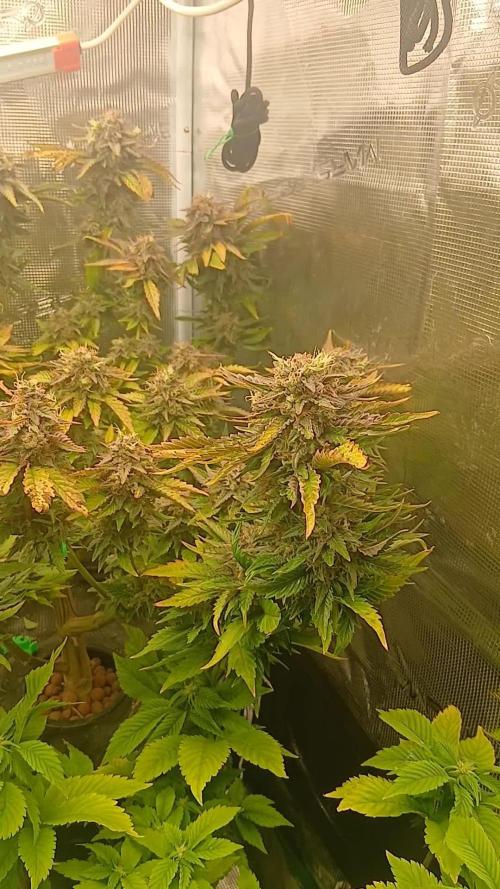
156 days (22.2 weeks) from germination to cure. Baddazz og cheese is very resienous and sticky. She give high yeild of wax when pressed. This is my 1st cheese weed so smell is new to me, very pleasant, almost like the Fahrenheit perfume from Dior. I did smoke maybe a branch and a half while drying.
As for the big budda cheese, she is almost finished with about a week or 2 again. Her buds are very big and she has lots of thricomes. The blue cheese is struggling as this one was transfered from soil to hydro.


Likes
5
Share


@AK1210
Follow
This lady is growing in height at an astonishing rate, the buds sites are already chunky and coated in tricomes.
I'm glad I topped this lady when I did as otherwise she could have reached a hight that would certainly give the neighbors something else to moan about. 😀


Likes
18
Share


@Dunk_Junk
Follow
Stick a fork in her, she's done.
Look at the timelapse how she goes yellow very quickly!
Shortly after these pics she was harvested.
I note she is VERY sticky.

Likes
10
Share


@HazeyBobby
Follow
Week started 27/09
Still losing lots of leaves per day (due to yellowing). #3 doesn't have anymore fan leaves and some bud leaves are looking droopy.
I'm hoping they will make it through to harvest without the need to spray Neem. Getting some Nematodes this week to put into the soil in case it turns out I have root aphids.
The indoor setup was complete this week and the plants are now growing indoors full time. Still having problems maintaining heat in the tent without the humidity rising very high. I'm stopping the extraction fan at various intervals to raise the temp of the room but the humidity levels shoot towards 90% with the lights on.
#1
30/09 - 25ml/5L Flores at pH6.3.
03/10 - 25ml/5L Flores and PK 13/14 at pH6.5
#2
28/09 - 25ml/5L Flores at pH6.1. Runoff measured at pH5.9, EC 1.11ms
03/10 - 25ml/5L Flores and PK 13/14 at pH6.5
- developing some nice colas.
#3
30/09 - 25ml/5L Flores at pH6.3.
03/10 - 25ml/5L Flores and PK 13/14 at pH6.5
- whilst it has lost a majority of its leaves, there is a nice cola forming at the top.
#4
30/09 - 25ml/5L Flores at pH6.3.
03/10 - 25ml/5L Flores and PK 13/14 at pH6.5
The White Widow looks like will be ready in a couple of weeks. That was the last feed.

Likes
10
Share


@Gutismoke102
Follow
Just feed the girls some compost tea and overall they look healthy growing stronger by the day... she has a lot of bud sites and is getting thicker by the day


