


Likes
Comments
Share


@kingcola384
Follow
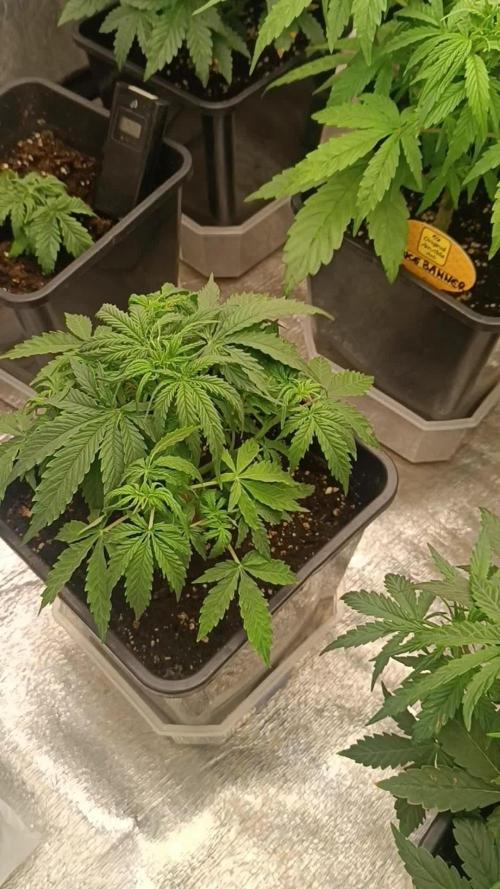
This is the only picture I have of week 4 but all the girls are looking good I'm starting to see signs of pre-flower I started to low stress train them during week 3 I'm pretty much doing nothing but watering the soil is full of the nutrients she need the light is that a good distance I currently have them at 500 par


Likes
28
Share


@Southofheaven
Follow
Just started this journal, this is my 3rd grow in this box, experimenting with 3 toppings for 8 main colas

Likes
25
Share


@Mr2toke
Follow
Day 7 - 21/09/23
🌳 OG Kush is growing well. a nice healthy shade of green, and a decent height too.
although the first leaves are a little odd looking to me. maybe its a phenotype thing? 🤔
Day 10 - 24/09/23
ok so i saw this growth on my OG Kush, which was not there last night...
mold? mycelium? what the hell is this?
65W LED hanging at 14" running at 80%, 18/6 light schedule.
Just using water to keep substrate around seedling hydrated. roughly using around 200ml every 24hrs.

Likes
13
Share


@Robeeriegenetics
Follow
First week of flowering in the bag, trying out a new deep voice in my videos does it sound sexy? Let me know in the comments. seeing a little bit of stress on the leaves, but nothing major. The new developing growth is green so everything seems to be going well. I’m gonna give it another week and then I’ll defoliate. So far so good. having a little trouble reversing the wrath rock, candy icy cuts. but I’m not worried. I have backups of the mothers and I have backups of those backups so I’ll definitely still be able to take another shot after seeing the results from this grow ….


Processing
Likes
6
Share


@Silverback_Guerilla
Follow
SUNDAY 4/28:
She's still my garden star.😍
I plucked off some dead leaves and did some leaf-tucking. She's trying to take over the garden..branches everywhere it seems.
Daytime temps are still hovering around 87-90f, but I've got her sitting in 70-72f temps for 6 hours of darkness now.😁
I did a little video today and I'll take a few "glamour shots" tomorrow.
MONDAY:
I watered her with about 1/2 gallon of properly ph'd water including calimagic, boomerang, bud candy, terpinator, and her last dose of beastie bloomz. She'll get Cha Ching from here on out-
TUESDAY:
Not much time for gardening today. I changed out the carbon filters and did some cleaning.
WEDNESDAY:
I plucked some dead leaves and took photos today-
She's a beaut😍
I have some sort of contagion in the big tent..leaves suddenly getting brown and crispy overnight on a few plants...she's still not been affected...fingers crossed...
THURSDAY:
The 'contagion' seems to be spreading through the garden...but she's still okay..
I'm thinking maybe I completely PHuktup the ph when I added silica last time and didn't correct it??
FRIDAY:
I plucked some dead leaves and misted everybody with perfectly PH adjusted spring water and increased airflow in the tent. Also decreased the dehumidifier to 45% RH.
SATURDAY:
I fed her today and started her on Cha Ching.

Likes
7
Share


@Salokin
Follow
Hi growmies,
The plants are in full flower now and have been defoliated after the hst of last week and seems like she has recovered. I had removed the filter and vent from the box and have the vent suck the air out of the box into the carbon filter, which gave me another 10 cm to play with. The plant consumes around 2 l of nutrient solution in 24 hours. This whole experience is howling me that I have to change the system in the box as I loose to much height with the grow table and the rockwool blocks. Will probably run a 20 l DWC in it, that I am currently working on.

Likes
23
Share


@LokaGass
Follow
I can't chose nutrien as i use natural seeds to give extra nutrients. I add npk mix and now i keep an eye on it i do a video to have a better look.
Thanks

Likes
3
Share


@FrostyBudzzz
Follow
Just switched her 😎💚🔥
Picking leaves daily stopped now until day 21 for heavy defoliation 🙏🏽😊💚🔥


Likes
4
Share


@DocGreenjeans
Follow
It's all about the soil. I love my soil I've cultivated it and in turn it cultivates my ye yo's


Likes
8
Share


@sativa_thc
Follow
esta semana hay ido mejor aun con unos saltamontes por ahi q habian aparecido y pulgones que ya soluciones facilmente con bag x5 y bang x3 de cannaboom la temperatura del tiempo aun gace calor y el frio no llega
Likes
Comments
Share

@DogDoctorOfficial
Follow
🌸 Pink Rosay Auto by Zamnesia | Pheno B | Week 6 (Early Flower)
🌱 Small in Size, Huge in Character
Not every plant dreams of touching the ceiling.
Some choose a different path.
While her sister reached upward with remarkable speed, this little Pink Rosay has quietly remained true to herself, growing into one of the most compact plants inside the entire Project Blue Tent.
At first glance, some growers might overlook her.
I certainly won't.
Sometimes the smallest plant ends up telling the biggest story.
Running under my ongoing 12/12 From Seed experiment, she has spent her entire life making every decision beneath flowering hours. Instead of investing energy into vertical growth, she has poured everything into building a sturdy framework filled with healthy branches, tight internodes, and an abundance of developing flower sites.
She's proof that size has never been the only measure of success.
🌸 Week 6 – Every Flower Has Its Place
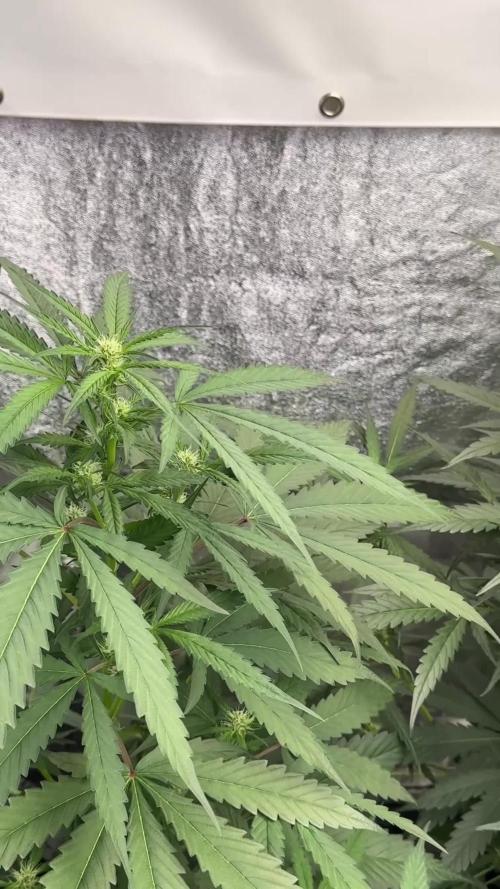
This week her flowering really began to shine.
Those brilliant white pistils are everywhere.
Every branch is crowned with fresh clusters that seem to grow larger each day, creating dozens of little stars scattered throughout the canopy. These delicate white hairs are the plant's first invitation to reproduction, reaching outward in search of pollen in nature. Indoors, without pollination, they become the foundation upon which each flower will continue to build.
Watching them emerge is always one of my favourite stages.
It's the moment when potential becomes visible.
The buds are still young, but they already carry that wonderful promise of everything that's still to come.
🌿 Structure & Growth
Standing at approximately 55 cm, Pink Rosay remains the smallest plant in the tent.
Yet nothing about her feels underdeveloped.
Quite the opposite.
Her compact architecture has produced incredibly tight node spacing, allowing flower sites to form almost one above another. Instead of long stretches between branches, nearly every centimetre of stem contributes to future flower production.
Gentle Low Stress Training has opened the canopy just enough for light to reach deep into the plant while maintaining her naturally balanced form.
She isn't trying to become the tallest.
She's simply becoming herself.
🍃 Plant Health
Health continues to be absolutely exceptional.
The foliage displays a rich emerald-green colour from top to bottom, with beautiful leaf posture and excellent turgor throughout the plant.
There are no signs of nutrient stress, deficiencies or excesses.
Everything looks relaxed.
Comfortable.
Balanced.
Even with rapid flower formation underway, she continues producing vigorous new growth while maintaining the kind of healthy appearance every grower hopes to see when opening the tent each morning.
Sometimes perfect health is quiet.
This plant is a wonderful example of that.
💧 Hand Watering & Nutrition
Like her sister, Pink Rosay continues to be hand-watered rather than connected to the AutoPot system, allowing close daily observation and precise control over her feeding.
Current feeding:
• Terra Bloom — 1.9 ml/L
• Pure Zym — 1 ml/L
• Sugar Royal — 1 ml/L
• Power Buds — 1 ml/L
• Green Sensation — 1 ml/L
Maintaining:
• EC: 1.78 mS/cm
• pH: 6.0
She's responding beautifully, maintaining outstanding colour and steady flower development without asking for anything more than consistency.
🌡️ Environment
The environment remains stable, allowing every phenotype to express its own personality without unnecessary stress.
Current conditions:
• Day temperature: 29°C
• Night temperature: 25°C
• Relative humidity: 60%
• Solution temperature: 21°C
• Root zone temperature: 21°C
• CO₂: approximately 639 ppm
Even during the warmer summer days, the room continues providing the consistency that allows healthy genetics to perform at their best.
🌼 A Lesson in Phenotypes
One of my favourite parts of growing multiple plants from the same strain is watching nature write different stories from the same genetic book.
If I had only grown this Pink Rosay, I might describe the variety as naturally compact.
If I had only grown her sister, I might say she stretches enthusiastically.
Both observations would be true.
Neither would tell the whole story.
That's the beauty of phenotypes.
Every seed carries the same family name, but each one develops its own personality, its own rhythm, and its own way of expressing those shared genetics.
This little lady reminds me that sometimes the quietest plants have the most interesting stories to tell.
👀 Looking Ahead
With the stretch now largely behind her, the next few weeks should be all about building flowers.
Her incredibly tight node spacing could become one of her greatest strengths, allowing individual flower sites to merge into dense, beautifully stacked colas.
She may never be the largest harvest in the room.
But I have a feeling she'll produce something very special.
Sometimes the plants that ask for the least attention end up becoming the jars you reach for most often.
🙏 Final Thoughts
This little Pink Rosay has become one of my favourite reminders that gardening isn't about chasing uniformity.
It's about giving every plant the opportunity to become exactly what it was meant to be.
She may be the smallest plant inside the tent, but every day she stands there with remarkable health, vibrant colour, flawless structure and flowers that continue to multiply beneath a crown of brilliant white pistils.
Some growers measure success in height.
Others measure it in yield.
I'm learning, once again, that true success is watching a plant express its own personality while thriving from beginning to end.
A huge thank you to Zamnesia for these wonderful genetics, Plagron for providing the nutrition that keeps these plants thriving, Future of Grow for the outstanding lighting, TrolMaster for maintaining such a stable environment, and to everyone following this journey here on GrowDiaries.
Your support, encouragement, questions, and shared passion for growing continue to make this adventure even more rewarding.
Small in stature.
Beautiful in every detail.
And quietly preparing to surprise us all.
Growers Love and happy growing! 🌱💚

Likes
2
Share


@Comfrey
Follow
Diese Sorte brauchte neun Tage zum Trocknen. Curing in Weckgläsern mit Boveda 62% für mindestens fünf Wochen.

Likes
7
Share


@Oyziphar
Follow
👉 This year, RQS launched 5 new regular strains. The seeds are packed with10 pieces. 38 seeds out of 50 turned out beautiful (see my previous diaries).
👉 Before I put the plants into bloom, I took 2 cuttings from each plant. As soon as I knew which were the female plants, I deleted the male plants and the corresponding clones.
👉 Now I am going to raise the cuttings and flower the female plants in 5 new diaries. This diary is about the Mango Crunches #1, #2, #3, #6, #7.

Likes
70
Share


@Santica_Garden
Follow
So this is how things are looking for the Dark Phoenix at the end of Week 8 of Flower. I have uploaded a video for you guys with all the information you need, any questions just ask away 👍🏾🌱💚

Likes
7
Share


@AJ10ll
Follow
It's a slow grower after the last and deflation of the plant at near 10 weeks no sign of buds
Likes
144
Share


@TOTEM
Follow
So far so good! I think stretch is now over. Flowers are getting bigger. Humidity is a bit high at the moment. Last defo is on schedule for next week!


Likes
53
Share


@SativaSteve88
Follow
First of all id just like to thank barneys farm for sending me some new strains to run, have added just a couple of pics and a little video for the time being, once dried and cured i will come back and do a full report on the weights and strains, thanks to all who have followed liked and commented along the way see you soon when i come back to give an update 👍✌️
Dos si dos auto ( Another new release from Barneys) and amnesia haze next up so be sure to keep an eye out for them diarys thanks again and see you all soon when i update my reviews and add more pics of the final cured buds 👍✌️
