




Likes
78
Share


@Basementganja
Follow
Gave her a heavy defoliation! She's growing very strong, and needed a little thinning out!
The defoliation promotes the lower buds growth, by allowing more light penetration!
The defoliation also ensures that airflow throughout the plant is strong!

Likes
21
Share


@Charly_grower
Follow
Feliz por esta cosecha tan esperada para mi la ak 47 es unas de las más ricas y si le sumamos el toque a limón es un sueño hecho realidad.. 😋
Charly grower 👨🌾
Likes
113
Share


@Anonymous_2022
Follow
Thanks for stopping by.. Please hit the like button if you like what you see and ill be sure to check you out too Growmies 🌱
First of all would like to give a BIG shout out to my sponsors for providing me with the necessary items for this grow 👍
🌟🌟🌟🌟Mars Hydro FC4800🌟🌟🌟🌟
Powered By Samsung LM301B Diodes: The Mars Hydro FC 4800 480-watt LED grow light is installed with high-performance Samsung LM301B chips, the top-bin horticultural diodes, to provide a high Photosynthetic photon efficacy efficiency of 2.85 μmol/j and a long-lasting color rendering capability, supporting indoor plants to grow and thrive.
High PPF Output and Uniform Light Distribution: FC4800 provides a high PPF of 1,366 μmol/S. The multi-light bar design and the dense diode layout facilitate an even distribution of grow lighting making PPFD optimized for Photosynthesis to achieve consistent growth in every part of the coverage range.
Exclusive Recipe Of Full Spectrum Lighting: The full spectrum is enhanced with blue and red light, in which the blue light stimulates plant growth and promotes the accumulation of plant-based phytochemicals; the abundant red light improves the maturing process and flower quality of the plants.
🌟🌟🌟 FastBuds Purple Lemonade FF ⭐️ ⭐️⭐️
Arising from a cross between purple and citrus Cali genetics, Purple Lemonade FF (Fastflowering) offers a complex high made up of perfectly balanced cerebral and body effects that are ideal for daytime use. Expect an extremely enjoyable high that boosts your mood while deeply relaxing your whole body and getting rid of muscle pain. This meticulous cross produces up to 550 g/m2 of some of the most beautiful purple buds, with pinkish and reddish hues that will catch everyone’s attention. The beautiful purple buds are ready for harvest in 7-8 weeks and come hand-in-hand with unbelievably sugary citrus terps that are just as refreshing as a cold lemonade on a hot Summer day. It’s the ideal variety for the sweet-tooth stoner seeking strains that deliver both in quality and quantity of resin
——————————————————————————————
👊👊👊👊Down to Business 👊👊👊👊
Week 8 from seed and week 3 flower
So shes moving beautifully and already starting to get abit of frost 😎
Cant wait to see if she throws out some pretty colours 🤞
No complaints at all with this girl all is good and she smells sweet like candy 🍭
Thanks for stopping bye 🙏🙏🙏
Likes
2
Share

@Canda
Follow
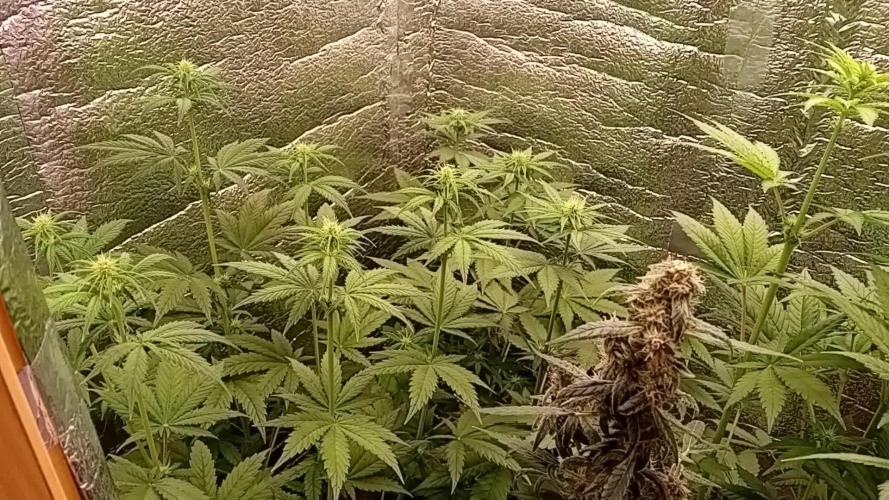
Kyneme blizny skoro všechny hnede ale trichomy zatim sklenene ale zato jich tam je tri prdele..

Likes
17
Share


@CCSAUTOVGROW
Follow
End of week 3 Flower. She is spectacular!!! Buds are starting to ripen and the sweet grape aroma is heavenly. Added a few pictures. The ones under the lights weren’t doing her justice.

Likes
28
Share


@GodZilla_Owner
Follow
The Bruce Banner showed a nutrient deficiency (potassium) this week.
I have just learned that organic fertilizer should always be applied at 100% of the recommended rate and not at 50% as I did in the first few weeks.
However, it doesn't look too bad yet and I have now increased the fertilization.
Next I discovered 2-3 small pollen sacks on S.A.D. #3 & #4... I don't know why both plants were slightly twittering but I simply removed these bananas :-)
We will see!

Likes
149
Share


@CBD_Sweden
Follow
Hi all the happy people here in GrowDiaries.
This is my second cultivation ever and it will be fun to try a bigger space than my closet grow.
First, I'm just going to say I'm done with the construction of my new growroom.
I put some pictures on the construction here in week one.
The room is 2.14 meters by 1.7 meters and has a ceiling height of 2 meters.
It provides a floor area of 3.6 square meters.
I use a 54 Watt Lightwawe T5 for germination and 2 Pcs 400 Watt HPS lamps.
I have a channel fan that replaces the room air about 40 times an hour to get a comfortable theme in the room, the air enters a fresh air intake from the outside.
The air is purified through a carbon filter to then leave the room to the rest of the basement.
Then I use that heat to heat the rest of the basement.
I will use 8 pcs 15 liter Autopots to grow with and a 100 liter water tank that supplies the pots of water and nutrition.
I will grow completely organically in soil and will watercure my buds to get the best possible medicine for me.
But there are no cultivation rooms to be displayed here, so I continue with what is most important.
Today I have put my seeds in my moisture dome and hope the seeds have germinated within a few days.
I am very excited to see how the new growroom will work and how this Blue cheese Auto from Royal queen seeds will turn out.
Blue Cheese automatic cannabis seeds are a cross of Blueberry Automatic and Cheese Automatic that has been perfected over five years of breeding and careful selection. The result is a feminized, autoflowering strain with superior yield, flavor, and effects to either of its distinguished parent strains.
THC: 16%
CBD: Low
Yield Indoor : 325 - 375 gr/m2
Yield Outdoor: 60 - 110 gr/plant
Height Indoor: 40 - 70 cm
Height Outdoor: 60 - 110 cm
Flowering: 7 - 8 weeks
Harvest month: 9-10 weeks after planting
Genetic Background: Blueberry x Cheese x Ruderalis
Type: Sa 35% In 40% Ru 25%
Effect: Cerebral and uplifting
Climate: Mild
..............................................................................................................................................................................................................................................................................................................................................
Update 2017-08-15. All 4 seeds have germinated and planted in small pots inside the humidity dome.
I'm so glad it worked so well and now it's just hoping they'll start growing and become 4 big healthy girls :)
...............................................................................................................................................................................................................................................................................................................................................
Update 2017-08-16. I have mixed my own soil today. Its 40% sieved peat harrow H2-H4 0-30 mm, 45% sieved peat harrow H4-H6 0-30 mm. 5% sand and 10% of compost soil. And i use 15% of perilite and mix it all together.
................................................................................................................................................................................................................................................................................................................................................
Update 2017-08.20. Nr1 and 2 grow and thrive.
Number 3 just got rid of the seedpod and is folding out the sheets.
Number 4 is a bit shy and can only be seen if you look carefully into the soil.
.........................................................................................................................................................................................................................................................................................................................................
Update 2017-08-21. Nr 1 and 2 is doing well. Nr3 is trying to catch up and Nr4 is still shy.
--------------------------------------------------------------------------------------------------------------------------------------------------------------------------------------------------------
2017-08-23. Transplanted 2 girls from humidity dome and the small germinating pots to 15 liter autopots. The other 2 girls have to wait a little more before transplant to the autopots.
................................................................................................................................................................................................................................................................................................................................................................................
2017-08-27. The girls have settled in to there new home of the 15 liters autopot after a little transplant chock. Now the real week 1 starts for me and the girls.
--------------------------------------------------------------------------------------------------------------------------------------------------------------------------------------------------------
2017-08-28. New pic and movies.
---------------------------------------------------------------------------------------------------------------------------------------------------------------------------------------
2017-08-28. Nr3 is transplanted in 15 liter autopot.
-------------------------------------------------------------------------------------------------------------------------------------------------------------------------------
2017-08-29. New movie of the girls. Its no water for 3 days now for Nr1 and 2 so the roots develop more and match the plant above the soil. The temp controlled fan is awesome, its easy to set what temp you like to have in the room. Right now its 28 celcius. And humidity is 56%.
------------------------------------------------------------------------------------------------------------------------------------------------------------------------------------------
2017-08-29.
Hello to you who read my diary, I just want to say that I am pleased that you have chosen to check in with me and in my diary.
I just want to say that I do this for myself and for a steady flow of my medicine.
Everything you read and see in my diary is 100% honest and I will never distort or beautify anything here.
I document my crops so that I can learn from my mistakes and also to look back at those different crops.
I try to update with pictures every day and with text if something special has happened in the garden.
This is my strainhunt for the best medicine and the beginning of my journey with cannabis and the cultivation of it.
-----------------------------------------------------------------------------------------------------------------------------------------------------------------------
2017-08-30. Cleaned the room this morning, just vacuuming and cleaning with chlorine solution. Im testing the fan to control temp and humidity, it works great.
Added some pics with measurements and movie. Everything is looking great right now.
---------------------------------------------------------------------------------------------------------------------------------------------------------------------------
2017-08-31. New pics and videos.
---------------------------------------------------------------------------------------------------------------------------------------------------------------------------------
2017-09-01. New pics and videos. Gave each of the girls with 2 ml Alg-A-Mic, 4ml Bio-Grow, 4ml Bio-Heaven and 10 ml Formulex mixed in 2 liters of water.
I hope they like it :)
-------------------------------------------------------------------------------------------------------------------------------------------------------------------------------------------------------------------------------------------
2017-09-02. New pics and the girls liked the water and nutrients yesterday.
-------------------------------------------------------------------------------------------------------------
2017-09-03. New videos of the girls this morning. Nr1 and 3 looks great and nr 2 is looking a little funny, maby a little stressed.
Kl. 16.00. Did some defoliation on the girls. Added video.
Kl.. 23.00. New videos, defoliation and leaftucking.
-----------------------------------------------------------------------------------------------------------------
Likes
10
Share


@Lodzik
Follow
Maybe next week a 14-day flush will begin. The G13 smells very interesting ;).

Likes
42
Share


@MrJoint
Follow
✌️🎃 Thank you for checking my cultivation.
🤤 She's surprising me, how she's getting fat!
Likes
18
Share


@Grow4Releaf
Follow
These two have been grooving.
The bigger Bush plant vegged almost a week longer then the other.
Only change was raised the nutrients to 1/2 dose. And increasing how often I need to water.its about to be a daily thing . They are hungry.
I'm not complaining lol.
But let's see how they fill out over the next 21days.
Roughly at day 55 as of oct 25th !!
Appreciate anyone checking in here.
If u can leave a comment/like so I can check out what ur growing!!
Likes
10
Share


@ChitaMoMo
Follow
Woche 7
Ramona musste leider in ein größeres Zelt umziehen.
Der vorherige gebastelte Schrank ist nur 120cm hoch, zwischen Pflanze (höchster Bud) und Lampe waren nur noch 24cm Platz. Viel zu wenig und die Lampe war schon auf die maximale Höhe eingestellt die möglich war. Nun hat sie wieder Platz :) Das Zelt ist 80x80x180cm :D
Ramona hat auch ganz schön Durst. 3L Wasser schluckt nun weg.
Week 7
Unfortunately, Ramona had to move to a larger tent. The selfmade cabinet before is only 120cm high, and there was only 24cm of space between the plant (tallest bud) and the lamp. Far too little and the lamp was already set to the maximum height that was possible. Now she has space again :) The tent is 80x80x180cm :D Ramona is also really thirsty. She swallows 3L water now.


Likes
10
Share


Processing
Likes
13
Share


@GrowGuy97
Follow
Day 7 - This lady is doing great so far can’t wait to see how she turns out! Thanks for following & happy growing friends!✌️🏼🌱
Day 8 - Looking great!
Day 9 - Fed with 4 tsp of big bloom at 6.5 PH
Day 10 - Added a tie for extra supper when the fans come around! Looking great though!
Day 11 - ✌️🏼🌱
Day 12 - Plain water, doing good👍🏼
Day 13 - End of week two, couldn’t be happier!
Processing
Likes
4
Share


@Skillgrower
Follow
A meio da 6° semana, fiz o primeiro lolipop antes da floração, dar uns dias pra curar bem e trocar o ciclo de luz 12/12h, vamos ver como estas meninas se comportam na floração!

Likes
1
Share


@OB-GYN-Kenobi
Follow
Broke one of the original 8 growth tips early on, but she's grown nicely into her heptagon shape. Living soil still seems to have too much nitrogen for her, hopefully vegging her a few more weeks before flipping will burn through some of it.
I've had to "mow the lawn" of clover a couple times now just to keep good airflow, and that fallen cover crop is starting to make a nice mulch...which in turn makes watering in coco a little less stressful.
We're in late veg now, so tent is holding steady at:
- PPFD = 600
- VPD = 1.0
- Temp = 82 F (28 C)
Likes
40
Share


@valiotoro
Follow
Hello everyone week 7 has passed ☀️
They are very well growing at fast pace and with a beautiful green colour on the leaves🤩a lot of buds everywhere🍋
The weather is perfect this year a lot of sun,not too High temperature and the humidity around 50%😎
Some defoliation just 2 leaves max to let the sun penetrate the lower buds✂️
Homemade nutrient 100% bio🍌
I force the plants to flower in my garage 100% lightproof😎
So every morning and every night i remove all the plants from my garage at the same hours 💪
See you next week 🤩


Likes
12
Share


@420Germany
Follow
1. Topping
2. LST
3. Nothing (small plant which came late)
Going strong thus far, looking forward to using the plagron stuff, at the moment they not rdy for it yet since it is strong in PK.
Likes
48
Share


@Suemchen
Follow
Sanlight evo at 100%
Day 64: flushed yesterday. One week now and then 72 hours of darkness. Looks and smells really good🤙
Day 67: Looks really good 👍 a couple of days now and then darkness 🤙
Day 69: well, that's IT🤗 The Journey Has come to an end.... 😢 Today I turned off the lights, sprayed purolyt. She will get 48 hours of darkness and then cut and hung..
Get 15% Off Fast Buds with Code: FBSUMO
https://2fast4buds.com/
Likes
53
Share


@Pr3m_85
Follow
More than a day in the drying tent and I'll give you the report on the weight, the taste and the effects!
‐-----------------------------------------------------------------------------
FINAL WEIGHT : 153,5 g
Effect : very pleasant. I have the impression of being in a cotton field.
Taste : cream berries 🍓🍓🍓🍓
Peace to all ✌️🏽✌️🏾✌️✌️🏿✌️🏻✌️🏼
------------------------------------------------------------------------------
✔️Pheno 1 : the appearance of the flower is much more purple than the other two phenotypes. Her effect is much more sativa as well.
✔️Pheno 2 : The strawberry taste is much more pronounced. In this phenotype, there is a not at all unpleasant mint aftertaste !!
✔️Pheno 3 : the effect is felt very quickly. In a few seconds, you find yourself in a state of joy. It's very nice !!!!