The Grow Awards 2026 🏆 









Likes
Comments
Share
@UnorthadoxDude
Follow
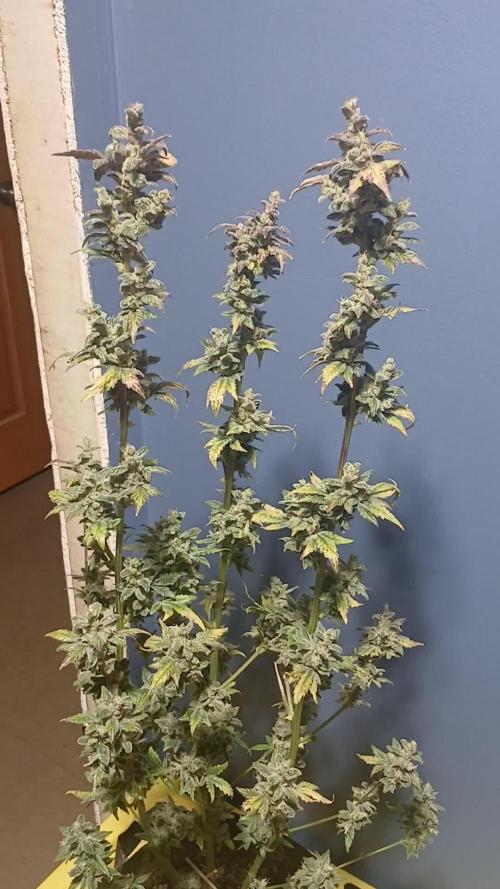
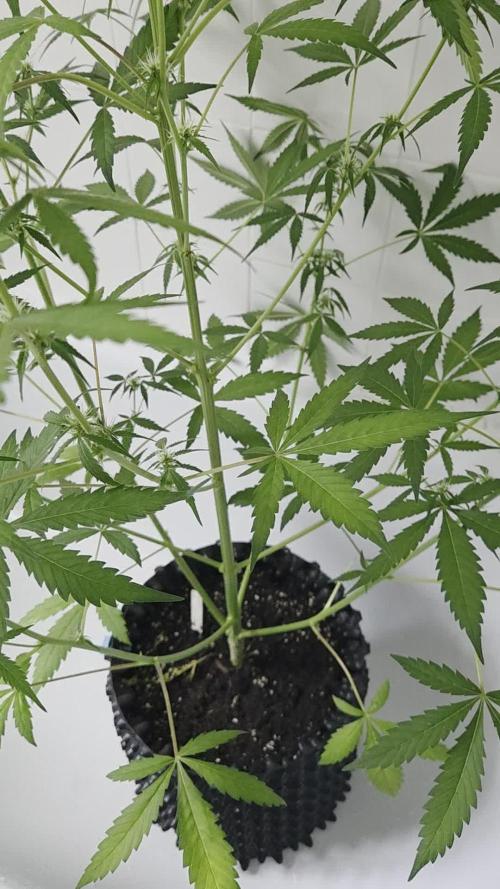
Hey! Welcome to week 8! Karen is mid way through her flowering stretch. Please check back to last week as I update daily so the week is now complete. I count about 20 colas now.
Day 51: Have reconfigured the tent, see video. Karen is now 36cm and still stretching. Karen has more light now. Smell is still there hits you when you open the tent. Fertigated 2l.
Day 52: Height: 39cm. Karen's scent is heavenly. I have reconfigured again and installed some upgrades. Better reflector. Much bigger carbon filter. Increased airflow. Better config. More efficient pot layout. Karen is lovely.
I am grateful to her and for her, so I wrote her a little poem, I hope she liked it.
"Karen! Oh Karen! The phoenix of flowers,
Three lowly weeks she struggled in vain,
Shadowed and starved for five hundred hours,
He slowly wept to witness her pain.
Karen! Oh Karen! I P-H'd your showers,
and in the fourth week you started to gain,
Hallowed and hard you survived as you cowered,
I thought you meek, I was wrong once again.
Karen! Oh Karen! Forgave me my howlers.
She set a pace, a pace she maintained,
Now shes a girl at the peak of her powers,
And so I'm a geek, with buds on the brain."
Day 53: Approx 48h into a simulated dry spell.
Alright I think it is time for Karen to get her first MAJOR defoliation. I will update shortly with photos and info. I will also be doing some gentle LST to separate the colas a bit.
Day 53.5: Defoliation and LST. Finally got chance to photograph that bunda. Enjoy!
Day 53.75: Bit of a fail. Messed up the timer and the lights ended up being off for about 3 or 4 hours. Because I was cooling the room (open window) to keep temperature in the tent down, without any light the temperatures absolutely plummeted as it is sub-zero outside. By the time I realised and turned the lights on, the temp in the main tent had dropped to 14 degrees celsius. Whoops! How is that for mistreating your girl? Defoliated about 80% of her leaves, 4 nodes, significant LST, then stuck her in the cold and dark for 1/6 of a day. Not to mention she is now almost 3 days into a "dry spell". There do not seem to be ill effects, and Karen has already begun to respond to the LST; all the colas that had been changed in angle are now upright again.
The dry spell I keep mentioning, there is a method behind my madness, I have spotted one or two small flies and I think they may be fungus gnats. I am starting to suspect that the 2nd seedling in the Purple OG Punch Auto grow was actually beheaded by fungus gnat larvae. So I am drying out the mediums as much as I dare. I am closely monitoring the plants, so far the only one I have had to break the drought for is Enigma; all the girls in big pots haven't even noticed it's dry yet. How far am I going to push it? Well I will judge it on a plant by plant basis, but quite honestly I am hoping to see physical signs of thirst before I breakdrought. Of all the plants the two I think will respond most strongly to this will be Karen and Bertha, because of where they are. Karen here is actually probably 4 weeks into flowering rather than two, so about now is a good time to give her a little hydration stress. I do not think I will push it past 5 days, as RH is 34%. By now all the plants will be compensating for the lack of moisture and the high temperatures and low humidity. They will be taking more and more moisture out of the coco, and as the coco dries further and further down, those plants that have space will start desperately growing roots to find moisture. Mark my words, 24 hours after I end this drought, every plant in the tent will throw out crazy growth.
Day 54: Ended drought and fertigated 6l, no run off, I will re-fertigate tomorrow. Karen is still stretching her height post LST is now 37cm. The two tallest colas seem to have stopped but the other colas are still stretching.
Day 55: Alright so it has been 5 hours since lights on, and Karen is looking in good shape, all her drooping leaves have perked back up and she has added quite a bit of foliar growth. The colas are all still rising, except perhaps the two tallest. This girl is absolutely loaded with pistils, I'm starting to see trichomes on the sugar leaves, but trich production hasn't started in earnest yet. She has a least 20 colas, and 6 of them are thicker/taller than the primary cola at her tip. Every one of her nodes has reinforced itself with a bulbous growth and these cola branches are swelling rapidly. I am increasingly of the opinion that, all being well, this girl is going to surprise us all with her yield. My first grow, which was just mucking about really, I got 60-70g of the two main plants, and they were just bare sticks with 2 colas. Although her height is less than theirs was, 2/3 of their height was bare stick... whereas every mm of her is befoliaged and living. So in terms of the height of the actual cola I think they were about comparable in usable space on a per cola basis. The main difference being that Karen has 20+ colas whereas they had 2 primary and 2 lower. I know that it is probably unrealistic to expect more than 70g from a single auto grown indoors. Nevertheless my gut tells me this baby could achieve at least 100g, perhaps as much as 150g. The next few weeks will determine that, but given where we were in week 3 I will be grateful for any yield of quality bud. I have dropped the lights down to 18/6 from 'tonight' onwards.
I really have no idea how long we have left for Karen. According the the "brochure" she flowers for 7-8 weeks, with a total crop time of 9 weeks. The problem is I don't know what a total crop time is? Does that mean from seed to finish? If so Karen is clearly not going to be anywhere near that timescale.I am going to go ahead an assume that, for my plant anyway, the first 4 weeks were veg weeks. I think it is fair to count week 5 and 6 as flowering because pistils were popping out very early in week 5 if not before. So that makes this week four of flowering. I am going to assume 8 weeks rather than 7, so I think we have another 4 full weeks give or take a week. On that basis I am expect harvest week to be around week 12 or so. I am not fixed on this though, I am determined not to harvest this girl early.
Day 55: Photos taken 00:00 9/3/23 Strong 24h of veg growth as predicted.
Day 56: Existing leaves continue to swell. Stretch appears to be slowing. I've taken so many media this week that I cannot scroll down far enough to select a recent thumbnail. Probably Karen's biggest week in terms of changes. She is looking like she is going to impress. Height 39cm.

Likes
57
Share
@MadeInGermany
Follow
Hey everyone :-)
We arrived in the last week before the harvest 😍😍😍.
I can hardly wait because both are beautiful and smell extremely good 👍😃.
Let's start with the weekly overview:
Flowering day 56
Both were poured with 1.2 l each and checked for their health.
Flowering day 57
Today the tent was cleaned and the humidifier refilled.
The trichomes have been checked and are about 80% milky and 20% amber.
Flowering day 58
Both were checked, and the technology was checked for functionality.
Flowering day 59
Today both were checked and fresh osmosis water was left in the tank.
Flowering day 60
Again, both were poured with 1 liter.
Flowering day 61
Today was a pure control day.
The trichomes are now 30% amber and 70% milky (a few days until harvest).
Flowering day 62
Today the whole tent was cleaned.
And got the darkroom ready. In the next few days we will go to the darkroom.
Of course, there will be a harvest update before the last update.
Until then, I wish you all the best, stay healthy 🙏🏻 and let it grow 🍀
You can buy this Strain at :
https://sweetseeds.es/de/red-mandarine-f1-fast-version/
Type:
Red Mandarine F1 Fast Version
☝️🏼
Genetics:
Red Poison Auto®️ (SWS39)
X
Tangie (California Orange x Hybrid Skunk)
👍
Vega lamp:
2 x Todogrow Led
Quantum Board 100 W
💡
Bloom Lamp :
2 x Todogrow Led
Cxb 3590 COB 3500 K 205W
💡💡☝️🏼
Soil :
Canna Coco Professional +
☝️🏼
Fertilizer:
Green House Powder Feeding
☝️🏼🌱
Water:
Osmosis water mixed with normal water (24 hours stale that the chlorine evaporates) to 0.2 EC. Add Cal / Mag to 0.4 Ec Ph with Organic Ph - to 5.5 - 5.8 .

Likes
13
Share
@PopsFarm
Follow
Last few days - Day 65
Here you can see the Runtz Auto from @kannabiaglobal / @kannabiaseedsfr / @kannabiaseedsde / @kannabiaseedsint @kannabiaseedsus
Nutrients: @atami_deutschland / @atami.international / @stefan_atami / @daniel_atami
Soil: @promixgrowers_eur / @promixgrowers_global / @promixgrowers_unfiltered / @promixmitch
LED: @powerlux_spain
Tent: @secretjardin_
Thank you to everyone who follows and supports my work 🙏🏻💚
This means a lot to me and you should know you are a part of it and only with you all this is possible, you are the best community 😎
Growers love, love for everyone


Likes
78
Share
@AsNoriu
Follow
Day 172. Some strains ended up frosty, smelly and nuggy, so I already have 76 g from first Strawberry, rest should bring some buds too, couple plants will go untrimmed to my friends as presents, one was already given away ... Think I will have like 300 g easy, and my friends got same amount as presents. Not a bad project, with loads of issues, happily almost no care was given or needed, so I count it as a result achieved :
1. I know that Hermie is bringing other hermies.
2. UK weather is only for autos, that lesson should be learnt long time ago, but I still hope to find mold resilient strain...
No updates or other strain harvests will be done, have no time to play ...
Happy Growing !!!
Likes
Comments
Share
@BlunthumbMD
Follow
She grew easy and smells great. Chopped at day 91 after 48 hours of darkness, ended up with 37 grams of dried and cured nuggets. Very interesting bud structure, very dense, first time I saw literal dripping. The smell is sweet, skittles, tropical fruit. The flavor on the smoke hasn't tasted as pronounced, still tasty. The high is good for a sativa, still somewhat motivated. RQS has sold me some great genetics so far, and the cheapest as well.


Likes
35
Share
@hannabis420
Follow
7/26 can't believe my old pump tested at 1 watt!! when advertised for 5 gal tank, anyways upgraded to 4 watt, keeping the inch between basket and water, flower nutrients dyed everything brown, res ppm stays around 600-700 lower temps 80-90 degrees ph 5 doing a lot of tucking of fan leaves, some stalks are stretching higher then others, adjusting light as needed, keeping light around 12 inches from canopy
7/30 lots of new growth, having to refill res 2-3 times a week about
Processing
Likes
16
Share


Likes
3
Share
@stonedkoala
Follow
- Raised cal mag from 3 to 5 because I thought plant was lacking cal mag
- Upped nutes but it may have led to nute burn in the next few weeks (see pics)
- ~350-400 ppm for half nutes
- buds starting to form nicely


Likes
14
Share
@SkunkyDog
Follow
Hallo zusammen 🤙.
Sie wächst sehr schön und macht keine Probleme.
Sie fängt an zu riechen 🤤

Likes
8
Share
@Midwest_X_Mayhem
Follow
This week the GSCE hasnt really done much strechin but buds are filling in nice and starting to get sticcckkyyy. There isnt much smell coming from the llant but trimmed LARF smelt very fruity. Both the BB and GG4 have outgrown the GSCE by far with the BB actually being the largest. The BB could use a little more lollipopping i believe but dont wanna over do it. GG4 has lots of bud sites as well but has a lot more airflow. Have just basically been doing minor leaf stripping when needed.

Likes
4
Share
@Papadubz
Follow
Well!!! These girls are incredible Zup 2 is already getting very sticky and smells like lime cordial amazing 😋 . Zup 1 is a few days behind, yet is coming along just the same.
They both have a huge appetite and are drinking very quickly.
Likes
66
Share
@Experimentgreen
Follow
Getting ready for the flowering flip. I'm interested to see what their stretch will be like, this is my first time doing extensive LST....hopefully it helped out. I'm glad to see the plants are at least pretty even in height.
There's roots popping out of every piece of the fabric pots....i really wish i did a 5 gallon...i don't want to try to transplant them cause it's real difficult using a fabric pot or i have to cut the fabric.
Both plants have had more yellow pale bottom leaves so I think they must be some hungry little hippos or possibly the organic nutrients need a slightly heavier dose than recommended.
Happy holidays!

Likes
Comments
Share
@LokalGrenz
Follow
The bottom watering worked for the week I think as away happy with results think I might just bottom water regularly and feed the tea from top every other changing
2/8
I did a good clean up and some pining Monday 2/10 I will filp to flower I also added power bloom today 2/8


Likes
1
Share
@CannaBreeze
Follow
Unfortunately, one of the two seedlings succumbed to the intense sunlight exposure of a single day and exhibited classic signs of stress and stem damage, succumbing within the first week. With only one seedling remaining, I decided to proceed by faithfully following the established nutrient schedule.
Here are the nutrients administered:
May 8th:
250ml of water
0.5ml of RootJuice
0.5ml of BioHeaven
0.5ml of Activera
EC: 450 nS
pH: 6.5
May 10th:
350ml of water
1ml of RootJuice
1ml of FishMix
1ml of BioHeaven
1ml of Activera
EC: 850 nS
pH: 6.5
Processing
Likes
23
Share
@HanzGrowz
Follow
More lessons learned. Temps in the tent were hard to keep below 26-27, so I followed the VPD chart to see that early vegging plants can thrive in the 70-75% RH range under those temperatures. They did quite well for a while, and I was seeing some very very promising growth vs. what I had going on in previous weeks. However, they continued to grow closer and closer to my new (and more powerful than my past) LEDs. I was gone for 36hrs and by the time I came back to my plants I noticed widespread light burn on the leaf tips of ALL my plants (helping me eliminate a lot of possibilities).

Likes
17
Share
@Broedt
Follow
Day 78 of flowering
Stopped adding nutritions to the water after day 71. The plants started to get a bit shady after that, by shady I mean that they been hanging and slowly turning yellow, and getting some spots on the leaves.
I almost had an heart attack when i saw that one plant had during 30ish hours turned brown and dried all out - See the pictures. I couldn't see any mold or any thing, so i chopped the top of the plant off. None of the others had anything like this..
The buds are getting so fat that the plants are starting to have a hard time holding the weight pf the buds.
Im planing on harvesting during the next week.

Likes
99
Share
@BudXs
Follow
GHL STRAIN REVIEW!!!!!!!
Shout out to @GreenHouseLab for sending me an amazing package!
Return package on the way!!!!
So stoked to have six shooter AND 2 fkn new untried cheeses to fuck with in 2021!!
See vids


