


Likes
Comments
Share


@Kloud9gardenz
Follow
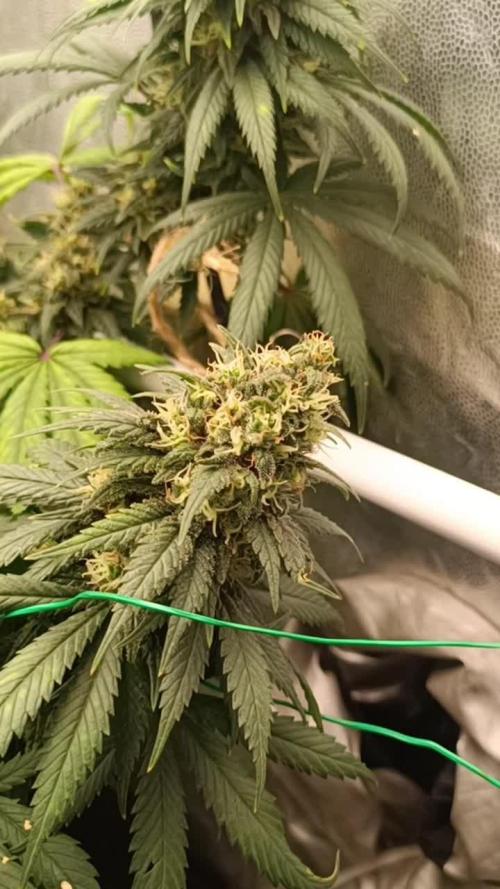
Plant fuckin enormous especially if you look back at how it started. Node spacing is pretty wide and it's not a leafy plant BC the fan leaves are literally there on each bud site, light penetration clearly isn't an issue just gotta feed this amazon and pray at this point. She also smells like lemons


Likes
16
Share


@AutoCrazy
Follow
Well this colourful popcorn queen will be ready to take down in a couple of days. She won’t be a big yielder but what she will lack in yield she seems to make up for in smell and trichomes. The smell she gives off is a sweet orange smell 🍊🍭. I can wait to sample her after she has cured for a couple weeks.
😎

Likes
19
Share


@sirstickyfingers
Follow
Day 42 from sprout. I been torn on if I'm going to transplant again. I know that since i am doing an organic grow its all about that soil and its microbes. I feel I been doing pretty good with these 3 gallon pots so far and only got a 2x4x6 to grow in. That being said I did top dress today 2-11 with my gaia green fertilizers and did a bit of defoliation. They lookin like their 60 year old blind Auntie cut their hair and look mangled but I just defoliated an hr before I took these pics. I am considering on transplanting to 5 gal before i flip to flower in about a month but not sure yet.


Processing
Likes
8
Share


@Max1973
Follow
Day 42 - changing into flower, maybe 1 male/female... idk, yet....
adjust a little, here, there, add abit of water, and 6.2 PH and 1400 ppm ... been watchin the temps..
heading into summer so it'll be 33oC outside the tent tomorrow..... the tent is keepin below 26oC atm,
gotta watch the weather, lol........ keep the water in the tanks below 22oC if i can.....
goin to stock fridge and freezer with chilled frozen water/ice ... for the tanks on hot days.....
been bending them abit, they've fully recovered from the trim, i'll let em go now till they need a final mid flower trim.....
not much to report... "monitor, adjust" part of the grow...
👍😎


Likes
10
Share

@Klyaksa
Follow
78 день от каски и 43 от перевода 12/12
Сегодня влил ещё по 1200ppm компот,теперь хватит точно,дренаж вышел 1600+ и 1700+
Набиваются,пахнут очень сильно)
На 82 день от каски и 47 от переключения 12/12 был полив,думал,что смогу пролить их чистой водой+fulvic 205ppm,но ошибся!Дренаж вышел 800ppm,я такого аппетита ещё не встречал,я удивлён
В итоге после воды влил ещё по пару литров компота 1100ppm,дренаж вышел 1400+- у обоих,жесть конечно аппетит:)
Запах поменялся.Пахнут ооочень сильно, NLB пахнут кокаколой,я такого запаха ещё не встречал, прикольно,вернее не кокаколой,а раньше были такие желейные конфеты в виде бутылочки и со вкусом колы,вот запах 1 в 1:)
Быстро цветут,уже почти все трихомы мутные,но шишки ещё растут,со след полива начну давать ripen
Mazar идёт ровно,без отклонений,толстеет на глазах,пахнет шампунем)
На видео 83 день от каски и 48 от переключения 12/12
Осталось ждать пару недель:)


Likes
9
Share


@wheedtobeus420
Follow
Day 46 for this pretty lady. She’s so big and bushy and full. I’m just in awe of how she turned out. Very very excited for her she’s full of life and vigor. Nothing I’ve thrown at her has seemed to matter. Idk what Russian means but hey who cares when they look like this. Hello beautiful. Can’t wait to see her full and bulk out.
Likes
10
Share


@DeepRootsGrowTrees
Follow
ROYAL QUEEN CBG AUTO
ROYAL QUEEN SEEDS
Week #4 overall
Week #3 Veg
This week she really took off stretched along with side growth she's doing well in the organic soil and with the FOOP nutrient line. This strain is great for cancer patients as far dealing with symptoms and not getting the high.
Stay Growing!!
ROYAL QUEEN CBG AUTO

Likes
48
Share


@PrairieFrostGrow
Follow
This was the first run of a FastBuds strain and I appeared to have picked a strain that works well with my grow style. She had nice wide indica leaves at the start of her growth and by two weeks over the sides of the pot. 3 gal seems to be a good pot size given her life span and her size. She flipped to flower as expected in week 4. From there she steadily gained weight in flower and was a struggle to keep her tied down with LST. Removing the lower bud sites on the side branches would also have helped to fill in her top colas so don’t be worried that she won’t fill in and you talk yourself into leaving them......cut them off😃👍She sets into a nice yellow fade on the leaves and the edges take on a purple colour. Add in red and orange hairs with everything covered in trichomes and she is a beautiful girl🤩🤩 Flush was over two weeks so expect a smooth smoke 🤞
Will follow up with more as she progresses through drying. In the box with temp at 62 to 66 degrees and humidity at 60%. Branches are not that long so I am expecting dry should be around 7 to 10 days.
*******Updated Mar 7/20*********
Dry went okay and she was in there for 9 day dry, Feb 25 to Mar 5th. Will be waiting until she has roughly a three week cure before I sample anymore. Did a little for not just to test her out.
Further notes from dry and trim........
Should have fed her another week for increased density. Smoke is smooth so far, I don’t mind sacrificing weight for smooth smoke but not sure it was a needed trade off with this girl. Find out next run of her, which will be very soon😀👍
Her high is nice and strong. Not much sampled so far........rather say more to come in a few weeks......sweet and impressive so far!!!!
Again a real pleasure to grow and I see more opportunity to do better with this girl😃 Very excited to go again and will definitely be in the next auto run again. Love how she grew and looked!
Already ordered more FastBuds genetics and will see Girl Scout Cookies with another Zkittlez for sure!!!
More to come in a few more weeks..........cheers fellow growmies and much grower love to you all!!
Likes
36
Share


@TheGreenLeopard
Follow
The flush week! Seemed ok - def had nitrogen toxicity in one purple berry kush - maybe too much ripener before. But we’re here - will give them the 24 now and chop. We’re out of time on this run. 90^% of the crop are where I want them to be however I thought I would have more droopy leaves. Will do the harvests on Monday anyways. Have a great week. Tried to edit best j could to do them justice. We were taking pics for the v1 so I brought them all out for a dance. Aroma strong 😂. Take care everyone. Just keep going and keep on bloomin


Likes
9
Share


@Grrrower
Follow
just put in the other growbox where I can keep the humidity lower
the pH meter has stopped working so now I can only rely on the "pH perfect tecnology" until I get the litmus papers 😕
the flowers are starting to grow and become covered with resin ... seeing it grow gives a wonderful feeling 😍
Likes
101
Share


@Ferenc
Follow
Day 46, 30th of October 2020:
Crazy... I went on holiday only for 6 days so my friend looked after them....
Guys... They fucking grew 20 cm it is crazy look at them I had to do LST and now giving them darkness one day and switch the lamp to 12/12....
They went totally crazy....
The smell is coming as well I bought extraction fan system with filter as well....
It is not a question all good and everything will continue the same way well from next week pump a lot of nutrition ;)
Cheers!

Likes
11
Share


@BudBeezy
Follow
A lot has happened this week. After I watered the nettle manure, some of the leaves turned a little yellow. There seems to have been enough nitrogen left in the soil, so this week there was only pure water. Unfortunately, my supply of rainwater is pretty empty, so I topped up the tank with tap water. After I noticed that the roots were already coming out of the drainage holes, I thought it was time for another repotting. As you can see, the roots have spread well. This time the plant will be planted in the 55-litre end pot. I'm using a fabric pot from the brand Gronest. The soil is the same as for the first repotting. Here is the nutrient profile again.
Floragard TKS 2
N 210 mg/L - P 240 mg/L - K 270 mg/L - Mg 70 mg/L - S 150mg/L
After repotting, I defoliated the plant a little and attached plant hooks. I have looked for inspiration on the Internet and am trying to build up a good basic structure. As the pot size has changed, the watering quantity also had to be increased. I tried 8 litres this time every 2 to 3 days and nothing leaked out at the bottom.
The weather was better again this week. The daytime temperatures fluctuate between 17 and 22 degrees. I'm happy with the weather so far, but it could still get a bit warmer. Especially at night.


Likes
3
Share


@Orchard
Follow
&&&&&__ WEEK 4 VEG / FINAL TRANSPLANT COMPLETE___&&&&&
***!!!!FOGGER WORKS AWESOME!!!!***
Introduced and created the ultra sonic fogger humidifier. This thing rocks it works so damn well. Being in Arizona we have ZERO humidity plus if you have AC to cool it just takes the humidity out anyways. This thing only effects the tent and its hooked up to a constant supply line and float so zero hassle. No... if your wondering it doesnt soak anything inside the tent it leaves ZERO water marks moisture or residue absolutely no spotting on anything including the lights. ---->👌I HIGHLY RECCOMEND THIS SETUP FOR ANYONE IN A LOW HUMIDITY SITUATION. 👌<----INSPIRATION AND CREDIT : 👽 This on https://allgrowers.grobo.io/t/everything-flora-flex/4636/1192. The original poster is a freaking sweet genius AUSSIE that change my desert dwelling life. Here is the original how to and with a few tweaks what I use. https://youtu.be/vmiO6Z_HLCE
+++ 03.08.2021 +++
<---NOTES--->
Notes: Week 4 Start Final Transplant from SOLO cups to 2 Gal 8" FloraFlex Pots with 8" Caps. Medium is COCO hybrid mix (Coco60%,Perlite25%,Hydroton15%) using FloraFlex V1 & V2 @ 3g / Gal each. Week 4 Nutes. !!!SWITCHED TO ALL LIGHTS!!! TOOK LIGHTS BACK TO 30" --- !!!VENTALATION ON TO LOW!!!--- Topped off with full week 4 nutes.
(((((((((((((((((((((((( CONDITIONS )))))))))))))))))))))))
*Nutes: CaliMagic GHE 2ml / Gal, FloraFlex V1 1 tsp/gal, FloraFlex V2 1tsp/ gal, pH Down
*Ph: 5.9
*Ec: 2.1
*Light: Mieemclux 1500W LED Veg+Bloom@ 30" 18/6; Mieemclux1500W LED Veg+Bloom@ 30" 18/6; Parfactworks RA1000W LED@ 26" 18/6
*Rh: 65%
*Temp: 78F
<-------- END -------->
+++ 03.10.2021 +++
<---NOTES--->
Notes:
(((((((((((((((((((((((( CONDITIONS )))))))))))))))))))))))
*Nutes: CaliMagic GHE 2ml / Gal, FloraFlex V1 1 tsp/gal, FloraFlex V2 1tsp/ gal, pH Down
*Ph: 5.9
*Ec: 2.1
*Light: Mieemclux 1500W LED Veg+Bloom@ 30" 18/6; Mieemclux1500W LED Veg+Bloom@ 30" 18/6; Parfactworks RA1000W LED@ 26" 18/6
*Rh: 65%
*Temp: 78F
<-------- END -------->
+++ 03.13.2021 +++
<---NOTES--->
Notes: All plants enjoying new humidity and fog. Checkup add pics.
(((((((((((((((((((((((( CONDITIONS )))))))))))))))))))))))
*Nutes: CaliMagic GHE 2ml / Gal, FloraFlex V1 1 tsp/gal, FloraFlex V2 1tsp/ gal, pH Down
*Ph: 5.9
*Ec: 2.1
*Light: Mieemclux 1500W LED Veg+Bloom@ 30" 18/6; Mieemclux1500W LED Veg+Bloom@ 30" 18/6; Parfactworks RA1000W LED@ 26" 18/6
*Rh: 65%
*Temp: 78F
<-------- END -------->

Likes
30
Share


@cricri
Follow
anche questa settimana è andata abbastanza bene ieri il tempo di pioggia a bagnato un pochino la ragazza, questo è il momento più critico inquanto i buds stanno maturando è ci vorrebbe sole e e tempo secco, non 80% di umidità, speriamo bene

Likes
Comments
Share


@MG2009
Follow
Everything went well More pics of her coming along with weight. I decided that since seeds are popping out, found a couple seeds on the floor, and no need to wait for the fade she served her purpose well. And she brings forth the next Generation !
Red Sky Cake !


Processing
Likes
5
Share


@GrowXown
Follow
Seeing some great growth within these CBD Critical XXL and excited for this journey! Soon I’ll be reporting these babies into bigger 5lt pots
