The Grow Awards 2026 🏆 






Likes
Comments
Share
@CannaTrope
Follow
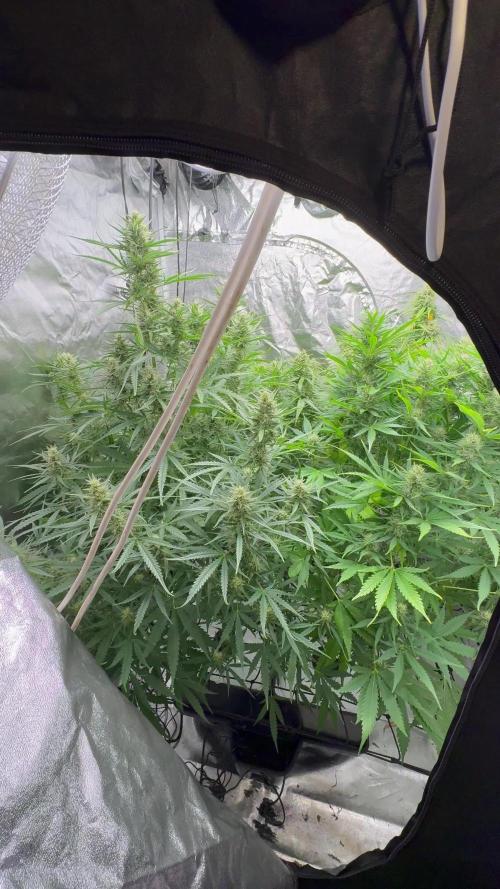
I tried to tie down and make an even canopy with FBT2311 and 2312. These two plants are now starting to fill in nicely with pistils and hopefully are nearing the end of stretching
FBT2313 is a very stout plant. I beleive that my lights were turned too high and the fan blew too hard, causing a phenotypic response. Much further into flower development then 2311 and 2312. A much smaller plant means ot needs less nutes, but the soil was amended with organic inputs at the beginning of the grow and I didn't cut back on supplement feeding enough, so it seems to have more P and/or K then it needs. I did not need to tie down but I used the trellis as a way to open the canopy some for air flow and light penetraion.
FBT2314 ended up slightly larger and stretched a little more then 2313. Flowers are developing nicely and some signs of deficiencies and possible light burn. Otherwise going pretty good. It's difficult to trim the back part of the grow tent so I am letting these ride and see what happens.


Processing
Likes
15
Share
@MG2009
Follow
05/19/2020
All going well, have to grow in containers this season, I might be moving before harvest so only veggies in the ground.
But all are adjusting well 😊
I will give more details on individual plants shortly
#1 is10" tall new growth looks good getting thick.
#2 is 11.5" tall
#4 is 7" tall but healthy
#5 is 16"
Processing
Likes
3
Share
@Dico29
Follow
Day 120
Smells good buds are fatter and looking better then I thought last week, I flushed but I think I may have caused nutrient burn or nitrogen since my stems have turned purple also along the buds and tips or ideas of what I should try thanks
Day 127 photos at the bottom


Likes
10
Share
@GrowerGaz
Follow
Great strain all three phenos are really greasy and high in resin. Two phenos are very kushy gassy , one has more citrus than the other. The third pheno is a the super frosty #1 more sweet and a little funkier than the other two


Processing
Likes
24
Share
@PrairieFrostGrow
Follow
***** Week 10 growth - February 6 to 12, 2021 - Week 1 Flower *****
Here we go.......on to flower now. Last week was transition week and bud sites are setting on the girls now.
Lights flipped a week ago to 12/12.......typical flower.
Stretch is starting this week now. Last week was marginal height growth.
Nutrients switched over to flower schedule and following week 1 again this week. Next week will move up the ppm more and start on bud enhancers. More microbes and sweetener this week. Silica ppm also increasing now as not looking to bend branches much more now.
Decided to throw Scottie Real some support and Recharge arrived this week so switching microbes for the rest of the run👍💪
Have a hole in the canopy that I am just going to need to live with. GSCHB and MM2 did not growth as expected. They are not reaching up as tall as the others and stretch is slow. Not looking like they will catch up in next couple of days☹️☹️☹️ Also thinking of increasing some fulvic acid for this girl and see if it helps her stretch....Gold Storm.
Little more detail.......
Feb 6/21 - Day 1
- been drying for 2 days now so water day with some supplements
- 3L with CalMag @ 2ml, AN B52 @ 1.5ml (using up an old bottle to finish), Enzymes @ 1ml
- 575ppm and 5.9pH
- Need to start increasing silica. Using up some B52 which has some silica in it.......and other vitamins so its all good😀
Feb 7/21 - Day 2
- Leaves up today and praying nicely.
- dry out day
- stretch is going now and the girls are growing hard.....this girl is still working on setting buds
Feb 8/21 - Day 3
- Feed day again, going to stay with week 1 flower nutrients, same as last week.
- IPP Grow @ 1ml, Micro @ 2ml, Bloom @ 2ml, Black Storm @ 3ml, Sea Storm @ 5ml, B+ @ 0.5ml, Red Sun @ 0.5gr, Carbs @ 1ml, Natures Candy @ 1ml, Piranha @ 1ml, Microbes @ 2ml.
- 4L.......yeah, took a little longer to mix up this feed😀
- 1350ppm and 5.9pH
- no run off from the girls today......little light on the water, they should have had 5L each.
- last feed with bud starter, Red Sun, next will be Bud Fusion for bud booster next week.
Feb 9/21 - Day 4
- no run off yesterday so adding more water today......plain tap water.....no additives
- 5L for each girl. 225ppm and 6.0pH
- good run off today.
Feb 10/21 - Day 5
- Nothing today......watered two days in a row
- ready for more silica!! Branches need to firm up.......this girl has some very soft branches still!!!
Feb 11/21 - Day 6
- Recharge arrived today!!!!!! Time for more microbes and sweetener😀💪
- purple stripes on main stems so adding more magnesium through Epsom salts
- 4L mixture for the girls with Epsom Salts @ 0.5Tbsp, Silica @ 1.5ml, IPP Carbs @ 1ml, Recharge @ 1 tsp
- 1,000ppm and 5.9pH
- different microbes now and excited!
Feb 12/21 - Day 7
- Nothing again today.......give them watering tomorrow morning.
- Wondering if their leaves are a little dark........consider bring down ppm next week.......it was hard this week at 1300ppm........water is 250 on its own so around 1100ppm nutes added.
- she is not stretching much but looking very happy......suspect she will have large colas......hopefully👊
Looking good ETS......the girls are doing very well overall. This girl is very happy and looking healthy, branching a little soft, stretch has been minimal so far but might take off more next week with silica being increased. She grows some HUGE fan leaves😀😀
Likes
111
Share
@Salokin
Follow
Hey Growmies,
she has bounced back phenomenally, so much that she has gotten extremely hungry. The feed shown here is the already the strong feeding suggestion, but I first saw a few leaves with a nitrogen deficiency, when I decided to up the veg nutes to pre flower levels, I now started to see signs of magnesium deficiency. I decided to add 10 ml more if calmag to the mix and will see if that’ll fix the issue.
Other than that, she has started to develop a massive rootball and almost stretched by 12 cm. Will probably veg her for another 2 weeks by the looks of it and then flip her once she has filled the scrog. She is already starting to smell quite strong for her not even being in pre flower.
I also want to point people in the direction of the photone app, a very helpful little helper that’ll help you getting a good guess of the ppms at your canopy.
Big shout out to Patricia at Zamnesia for given me the chance to try this amazing strain.
Here is the code that’ll give you 20% in Zamnesia‘s online store, just input ZAMMIGD2023 at checkout.
Thanks for stepping by and until next week!

Processing
Likes
5
Share
@Bloom_Room_By_Jared
Follow
4/17: More of the same as usual.......l can only imagine what she would’ve been doing with the needed light instead of 12/12
4/18: For the remaining time until I harvest her in like a week or 2 I’m going to take her out the tent during light off period so she can receive much more needed light

Likes
18
Share
@eldruida_lamota
Follow
Que pasa familia, vamos con la sexta semana de floración de estas Tropicana Cookies Fast Flowering, de FastBuds.
Los ejemplares tienen muy buen color han cedido muy uniformes y las flores están progresando a muy buen ritmo.
El ph se controla en 6.2 , la temperatura la tenemos entre 21/24 grados y la humedad ronda el 50%.
Van llenándose las flores de resina y van hinchando las flores, veremos estas próximas semanas como avanzan.
Mars hydro:
Code discount: EL420
https://www.mars-hydro.com/
Agrobeta:
https://www.agrobeta.com/agrobetatiendaonline/36-abonos-canamo
Hasta aquí todo, Buenos humos 💨💨💨
Likes
149
Share
@DevilsBud
Follow
New week for the contest headshot from Seeds Mafia
She looking really good still trying to widen here out try not to break shit but so far so good . I want a mighty Bush out this one so boosted here nutrients up she looking healthy so far
So other then that have great grow and good luck Growmies made video today and had just use it for this theme capicé
visit www.marshydro.eu
for your best gear and use the PROMO CODE: DEVILSBUD
Some handy info about the
marshydro TS-1000
Increase Yield&Crop Quality in Led Grow
Newest SMD Led technology provides the highest Par/Lumen output, makes you get 30% higher yield compare old led lights, can get up to 2.5g/watt yied.
High Efficiency Energy Saving Plant Light
Only 150 watts true output with so you don't have to check your light bill every month 😎 342 pcs LEDs, more scientifically and energy-efficient! Perfect for 3'x3' (100x100cm) veg stage and 2'x2' (60x60cm) bloom stage, higher intensity in a Mars Hydro grow tent.
Sunlike Full Spectrum Led Indoor Growing
Infinite close to natural sunlight, suit for all plants whole satge indoor growing, rapid plant response from seed to flower, achieve maximum quality and quantity, much better than traditional HPS grow systems.
High Reflective&Noise Free Fanless Led Grow System
Quickly heat dispersing material aluminum reducing light lost to aisles and walls, increase the light intensity up to 20%, allowing your plants to receive more energy and without burning your plants for maximum headroom

Likes
11
Share
@LapsekiliTayfur
Follow
Day in and exit fan 15 min off 15 min on Van is full on
Night in and exit fan 30 min off 15 min on Van is full on
10 ML Rhizitonic 5 ML Humic 5 ML Cannazym 5 ML Cal Mag 3 Gr Grow @ 5 Liter Day 22
10 ML Rhizitonic 5 ML Humic 5 ML Cannazym 5 ML Cal Mag 3 Gr Grow @ 5 Liter Day 24
22 ML Rhizitonic 22 ML Humic 20 ML Cannazym 11 ML Cal Mag 7 Gr Grow @ 11 Litre Day 26
Likes
3
Share
@High_Grade_Dadli
Follow
Set 1&2 are out the green house in an outdoor setting but still under light....did some transplanting gonna do the rest in the upcoming week hopefully n maybe take some cuts other than that everything else running smooth
Harvest the mother tree at the beginning of the week with would be about 6 weeks....took a few samples n she's hitting to say only dry a few days scent, flavor and effect are on point....still curing her out


Likes
5
Share
@Satax
Follow
A good week has passed now. The light is at full power. The flowers are starting to bulk up. I’m trying to manage everything as best as I can. The plants are starting to get really heavy..


Processing
Likes
10
Share
@StarletBud21
Follow
The week has been going very well plants are reacting good to nutrients and seem to be happily growing , haven’t fiddled around too much this week as starting to get the hang of things slowly ! The grow so far has been quite smooth And haven’t run into any Major problems all plants have been topped and will continue lst throughout I believe they look quite healthy haha ?
First timers luck 😉🤨 we hope so
Good end to the week next week I shall trim and see how that goes
Happy growing 💎

Likes
5
Share
@GrowinMyOwn
Follow
I like my grows to be simple, clean and efficient. The Mars 2000 plus RQS top-shelf genetics, combined with the super-simple RQS organic "Easy" line of nutes is making this beautiful grow! 6 strains, 6 healthy, thriving girls. I intentionally set 2 seeds at 3-4 intervals so I can rotate air space and have 2 harvested every 4 weeks.
The organic Easy line of nutes is simple to use, clean, organic and delivers lush, healthy growth. No more mixing liquids. I feed sparingly but always give cal/mag with all waterings/feedings. I pH down water ONLY at the beginning (before feeding starts) or in between if pH runs high and I won't be feeding within 2-3 days. Feeding drops pH in coco and as nutes are consumed pH rises back to coco's neutral 7.0. Simple. I rarely water "till runoff". Lighter feedings mean less buildup. Clean. Abundant, tasty, smooth harvests is my goal and this combo delivers! I'm still enjoying last Fall's harvest of Green Gelato 😎


