


Likes
Comments
Share


@Stickygreens420
Follow
2/21/2023 - Day 50: Starting pre-bloom this week. Changed the light from 18/6 to 16/8. Also, started adding my bloom nutrients. Watered about 3.5 gallons and threw a little bit of everything in today. Started with Jay Plantspeaker Quillaja as a wetting agent, then added Rootwise Micro Complete, Enzyme Elixer, and Bio-Phos, BuildASoil Big 6, BuildABloom, Coconut Powder, Pure Protein Dry, Yah-Whey, Fermented Comfrey and Fermented Peach. Also top dressed with some BuildAFlower.
2/23/2023 - Day 52: not much to report. Plants are doing great, and seem to like the slightly cooler temps lately. Mainly just been tucking branches under the scrog screen and doing some super cropping in an attempt to keep my canopy even.
2/24/2023 - Day 53: gave the plants their weekly IPM, with a foliar spray at lights out of warm distilled water and BuildASoil EM-5. This is also to clean the leaves in preparation for the flip to flower next week.
2/26/2023 - Day 55: last day of veg. Officially flipping to flower tomorrow. The scrog screen is pretty full, other than the Frozen White Runtz, which is barely reaching the screen. Hoping it will catch up more during stretch. Also, plan to put a second layer of trellis on.

Likes
100
Share


@AsNoriu
Follow
Day 111. First is ready, second week behind, third maybe even 3 weeks behind ....
Plus they are LEAFY ,!!!!
Trim jail ...
Wet trim for all of them - no doubts !!!
Day 115. Still hanging, slowly drying and result should be decent at the end ... A week more I guess, very humid in UK ...
Day 118. First trimmed - 175 g. Other is chopped ! One still grows ...
Day 136. Chop day for the last one !!! Long run ....
Happy Growing !!!

Likes
44
Share


@rudiak
Follow
The growth on the girls continues to stagger me! We have had a less drastic week this week then last everything gone smoothly!
Took the LST off on day 16 to allow the girls to continue growing upwards, already bushy enough and only so much space in my tent, but as you can see from the vid the stems and canopy looking great! So many potential bud sites! Been doing lots of leaf tucking, fortunatly nodes nice and close together so it makes my life simple can optimise the light penetration very easily!
The feed has been increased to 1.5ml/l of vega and 0.9ml/l of calmag, doing feed feed water. Girls drinking alot now and giving each around 1.5-2L per sitting every couple of days!
Stem diameter just below first node - 16mm
Getting around 1.5-2 inch of growth a day currently.
The girl that had the transplant is loving life and really filled out her pot showing little signs of being stunted, few slightly crinkly leaves but at the time it was like -3 outside and wasn't ideal situation to be doing transplant in, but no obvious signs of being stunted!
The first signs of flowering on day 21 but its very early should be more obvious tomorrow! The good times are about to begin :)
These girls are so big now its kind of lucky we broke one and dropped to 4 plants not sure there is room for a 5th in there!
Let me know what you think of the progress and drop your estimated yields below see who gets the closest as we go through the grow!
Don't forget to follow me on insta guys if you want daily updates! @rudigrows

Likes
19
Share


@LittleBigTrees
Follow
They've stretched through the net a fair bit , all different heights.
Defoliated reasonably hard on day 20 .
Started sugar royal at half dose this week.
Will start green sensation also from plagron from week 4 as recommended.


Processing
Likes
15
Share


Likes
6
Share

@GoodTimesOrganics
Follow
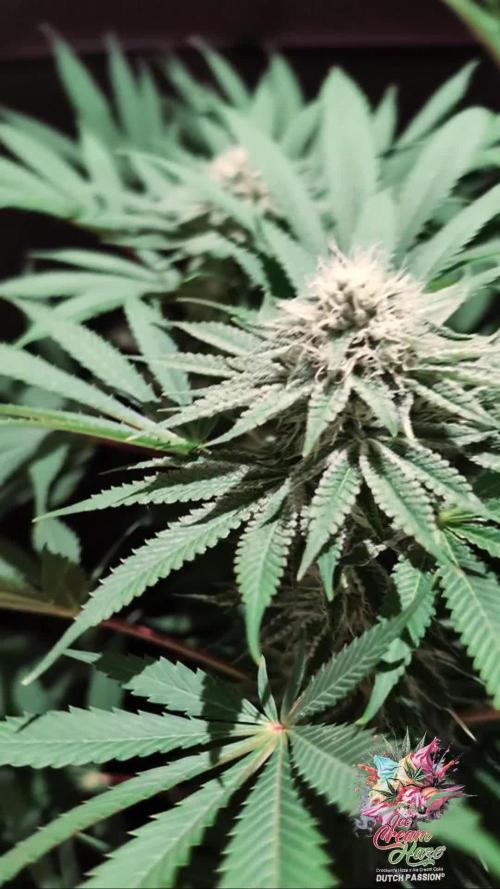
Hi liebe Community! 💚 Nach der vierten Blütewoche bilden sich die Trichome nun richtig schön aus.
Ein Dichter Tepich aus Stigmen überzieht die Blütenansätze und es fängt langsam an überall Frosty zu werden.
Die Blütenstruktur zieht sich nun den Großteil des Stammes entlang und es entsteht ein dich besiedelter Blütenteppich.
Insgesamt ist die Pflanze sehr Vital und hat eine sehr schöne Wuchsform und eine schöne Blütenstruktur😉
Die Wachstumsbedingungen im Growzelt sind weiterhin am Optimum und Stabil:
———————
🌞 Temp: 24,3°C
🌚 Temp: 20 °C
💨 RH: 56%
VPD: 0,97 kPa
😎PPFD: 830 mqm
———————
Stay Tuned! 💚

Likes
9
Share


@TragicTerps
Follow
Adjusted the pH range and watered when needed. That will continue to be the case from now til the end of flower. I can hardly wait for harvest. It's going to be great.
The zkittlez is getting plump and is already dense as the PCD I grew. It doesn't quite have the smell profile I was hoping for but the frost factor is crazy.
The Liberty Haze is smelling great and is fantastic in structure the colas are about 12-17" long. It's great! Stoked for the last half of flower.
The forbidden fruit is being neglected but it's managing to hang in there.


Likes
3
Share


@Gram_Solo
Follow
All 3 apple strudle popped up and looking good and healthy. May need to add support soon to the stem if they get any taller , lowered the light to help this also.
I have now moved the seedlings into a 3x3 tent with a 650w philzon LED light
Just until late veg early flower then they are going back under the Spider Farmer for the Full MOT and Output lol
Humidity has been easy to deal with luckily . I have been spraying around the solo cups and near the stem with plain water to keep it moist and Humid. Seem to be loving it so far 👌
Next step is wait til these are reaching edge of solo cup and transplant into bigger pots.
Germination was a success 🙌
Party time now
❤️👌
Likes
422
Share


@Crashoverite
Follow
Hi all 😁
Hope everyone keeping well and having a wonderful week!
Thank you all for such amazing support on this bananas journey 💚💚💚
Will be updating this week journal daily so please remember to revisit to see full week content.
So far this grow it's going great. Girls are stretching by hour. Great health, nice green colours, more and more squares taken on the netting, flowering nicely progressing, I'm very happy 😁
Planning to apply more selective defoliation, especially to Xena. No changes to nutes except few extra drops of calmag just in case and will try to fill the net entirely.
Week 7
Nov 27- Dec 3
Nov 27
Selective defoliation applied on Xena. 8-10 mainly small fan leaves. She is still a bit shy to open as much as her sister. No rush my girl. You still doing great!
Nov 28
First watering for this week.
7ltr beetwen them both with 4h spread. Runoffs. Xena 300ml PH 6.1 Athena 250ml PH 6.4 😁. So far the largest amount of my magic mixture consumed by my 🍌💜👊 girls. Well done👏
Nov 29-30
Leaves tucking and joyful observation🤓
Dec 1
Selective defoliation and first stage of lolipopping on both girls. Decided to go a bit heavier as tomorrow heading for trip and wont see my girls until Tuesday! They will be all alone without any supervision so hopefully they will behave and I will be nicely surprised of their development on my return. Watered with 2tr mixture and sprayed with water and fish mix solution right after defoliation. Planning to feed them tomorrow as much possible 6-7ltr before heading off to our voyage to Amsterdam 😎 do anyone know ls if any of coffeeshops have Fastbuds strains available? Would love to try 🍌💜👊🤤😋
Dec 2
Girls watered as above and both PH 6.4 on runoffs.
Dec 3
Girls are unsupervised until December 5th.
Thank you all for such amazing support on this journey 😊 love you all!!, 💚💚💚
Stay tuned for upcoming week update right after my return.
Peace and love brothers and sisters ✌️💚
Likes
10
Share


@CampaCavallo
Follow
7ª settimana di fioritura💐
I bud della bella BLACK MUFFIN di SweetSeeds 💚🐘💚 adesso scoppiano di gioia sotto il sole della MARS HYDRO TSL 2000 🌞
Il raccolto è alle porte🍁🍂✂️ e per la ragazza c'è da bere solo acqua piovan💦💦

Likes
104
Share


@Hou_Stone
Follow
Harvested on day 94 / flowering 61
21 Grams of buds after manicure and drying.
------------------------------------------------------------
🎪Harvest report in my 1M² box with 16 plants (5 strains):
Total 291 grams of dry, manicured buds. I set myself a goal of at least 300 grams. So I'm not entirely satisfied on this point. I think in the next grow I will use other techniques , like LST, topping and larger pots to try to improve my yield!✌️☮️
------------------------------------------------------------
🔥❄️Drying :
In my 1M² box
8 Days in the dark
Temperature : 14-18°C
Humidity : 50-75%
Extractor+ carbon filter ON 24/24h
------------------------------------------------------------
📜Links :
🌱Zamnesia Gelato seeds :
https://www.zamnesia.fr/5671-zamnesia-seeds-gelato-feminisee.html
Food for your plants 🔥🔥👍
https://www.greenhousefeeding.com/
👨🚀My Instagram 🌱❤️️:
https://www.instagram.com/hou_stone420/
---------------------------------
☮️Thanks for your visit ! 💚☮️

Likes
8
Share


@Gardens_of_Of
Follow
Toped 20 gr more at the end of the week to Mimosa Evo considering the planned 10 week flower time.
2nd week of Flower is over without any issue.
Rearranged pots.
Top Left: Wonder Pie (GHSC)
Top Right: Lemon Orange (GHSC)
Middle: Mimosa Evo (Barney’s - Clone)
Bottom Left: Runtz (Barney’s - Clone)
Bottom Right: Exotic Runtz (Exotic Seed)

Likes
22
Share


@Fatnastyz
Follow
10-18
She hasnt even acted like I bent her top!
Recovered nicely. Her buds have turned upwards to welcome the light! 😁
10-19
Water, noticed some slight burn, will flush her next day or so. She looks pretty good other.
Spaced some branches just just a tad. Cleanin up, while she fattens!
Has a minty smell.
I know Im rough, very grateful for these beans Weedseedsexpress!💚😻
Ill get my shit together! 💪🤘
.


Likes
17
Share


@MoneyGrowup
Follow
Currently have my first Grow finishing up, two bag seeds was told they were Pink kush and death Bubba they are coming out looking as the strains are supposed to. Lights will be switched to 18/6 in a week or so
Likes
11
Share


@BelgianBudtender
Follow
Hey hey growmies!
I've fallen ill with a respiratory bug, as a result my plants and the diaries have suffered somewhat.
at the end of week 4 I left this diary with a super droopy plant, now, this little runtz lady has not only bounced back, but is thriving.
I am leaving on a trip to New York in 2 and a half weeks, which leaves this lady in an awkward spot, I cannot flip her to flower and she's growing fiercely, I can obviously also not bring her from Belgium to the United States of America (Even though New York is a legal state :P)
because Ganja is the devil in the eyes of our governments, as we all know.
So she will continue to veg untill I get back the 25th of november, a whole ass month from now. This Runtz will be anything but a runt, but she has shown me some very strong genetic traits already, she takes a fucking beating this strain. So if her smoke is decent, and her flowers pretty, I'm keeping her around.
Its always nice if a plant is tough enough to roll with the punches, and look at her, she's rolling. So thats the plan! Veg her out into a monster, take lots of cuttings and clean up her canopy. Hope we have mommy material, if not, I'm still going to try and grow a cutting from her, its a skill I need to build for when I do find a mom.
That's it for now Growmies,
Thanks for checking out my diary.
Would you like to grow Runtz by Zamnesia yourself? Be sure to use the Growdiaries discount code "GROWITGD" on their website for 10% off. 😉
this is a sister diary to my Zamnesia Wedding Cake Automatic grow over here: https://growdiaries.com/diaries/121785-grow-journal-by-belgianbaboon
Likes
65
Share


@Grow4Releaf
Follow
_____----*Jan 13th added photos*----_____
_-** Jan16th added photos **-_
She's still chugging along entering week 3 now..
Just gave alil recharge so far , besides having some water issues here (tap got funky funky) but had some rv water filters plopped onto the tap and all is in range ec/ph wise now.
Issue averted atleast i caught it, got in the habit of checking PPM of the tap everytime just to be sure (I aerate 5gal of tap water as I use it to mix whicheve stuff I maybe using aswell.
That's about the only major thingy that really happened.
I am seeing some leaf variegation I hope it's nothing more serious havnt had any tmv before so I'll be keeping a tight eye.
Fingers crossed tho, I do have a second started that was gonna ne ran without plagron but if she's sick I got a back up.
Hoping it's nothing tho, 🙏
Until the next update , I'll throw more photos up as the week gets going.
Thanks again for checking in, best of luck to anyone that's involved in this contest !! Been fun watching all ur plants get going !
Processing
Likes
41
Share


@Frosty_farm
Follow
Week 2 of flowers started, gave her a nutrients feeding. She's loving life. This plant is going to be much bigger than my first grow. I'm excited, I'm using half the amount of nutrients suggested on the bottles. I don't know if it's the breeder or the nutrients. But I'll continue doing what I'm doing. I'll post more pictures during the week. Why are the white hairs already starting to get brown?
Day44.....this plant keeps growing, I'm getting worried lol. She's actually 24inches tall and there are buds everywhere 😊. Day 46....seems like she eased up on the vertical growth. I guess it time to fatten up.
Day 47......thank God I didn't do 2 gsc plants. I would have definitely needed a dehumidifier. She's doing very well, I have no complains. I hope she will be ready to harvest in 3week because I will be going out of town for at least 4 days and she drinks at least a gallon in 2 days. Lat day of week 2 of flower day 48..... she's doing very well and keeps growing. Finished up this week with a nice fat feeding. Can't wait to see these buds swell up, I think I might end up having to support her buds.
Likes
4
Share


@Maincard
Follow
Soaked in distilled water for 24 hours and planted in the ground In a few hours they were out. Watered every other day with 0,1 l

