The Grow Awards 2026 🏆
Processing
Likes
Comments
Share
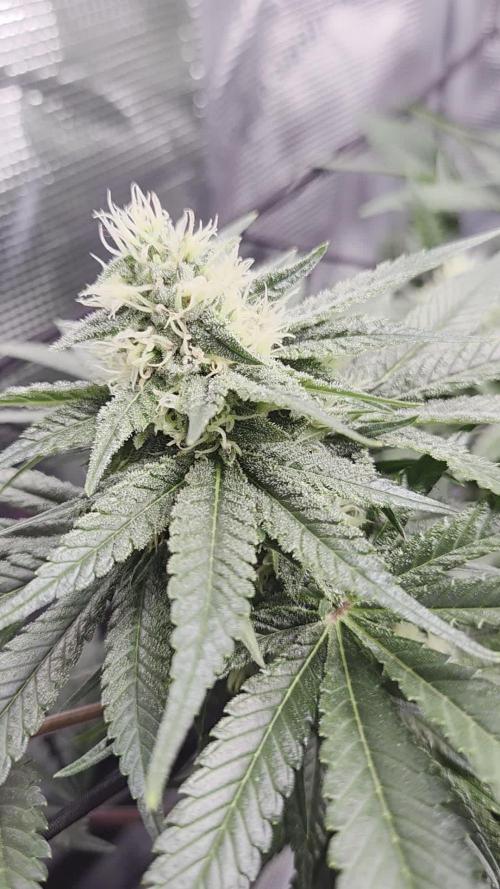
D43. The third week of flower starts, and the girls are rocking it in the tent. They are bushier than a 70s pornstar, and the first girl has doubled in height in the last week. The second girl is only now starting to go into flower, so I expect her to soon begin stretching. She isn't far behind in height, so I suspect she will eventually be taller. There are a few yellow tips on new leaves on the first girl. It probably won't become a problem; it is only minor so far, but I will continue to monitor it. I slightly defoliated the girls below the canopy to promote better airflow, but I will wait until the stretch is done before a more substantial defoliation. ------------------------------ D46. The girls are raging in the tent. The first girl has stretched over 8 cm in three days, and the second girl is keeping pace, although she still has yet to go into full flower. I'm concerned regarding the first girl, as new leaves at the top of the canopy are thin and displaying interveinal chlorosis. Fresh leaves further down look fine, as do older leaves. The stretch and the increased light might have something to do with it. We'll see. I checked the DLI; it was around 53, which is way high this early in flower. I raised and dimmed the light to a DLI of 48, which is still high but should be more appropriate. ------------------------------ D49. So, I have a tent-sized jungle on my hand. Three weeks ago, I nearly cut down these plants because they had a rocky start, and I feared they got stunted. I have no idea what happened since, but HOLY SHIT! These girls have blown up. The second girl stretched over 25 cm this week and turned into a beast, which is funny, considering she was the smallest one from day one. She will continue to stretch longer as she is only starting to flower. The first girl is further along and is showing proper pompoms and will remain shorter than the second girl. Still, I hope that the difference in canopy height will be manageable. I will clean up the lower canopy in the coming week. The first girl is ready to shave her legs, but the second girl still needs a few days to settle into flower. ------------------------------
Likes
7
Share
2/6/2023 - Day 35: After the watering yesterday the girls perked up, but they were already getting dry again. I was originally planning on waiting longer to transplant, but I felt like they were out growing their 1 gallon pots. Also, after checking their roots I could tell they were ready, so I transplanted today. Watered in with about 1.5 gallons at 6.4 ph. I know they say you don't need to ph water in a large bed like this, but my water is really bad here. At times it can be over 8 ph out of the tap. Mixed my water with Jay Plantspeaker Quillaja, Rootwise Micro Complete, Rootwise Bio-Catalyst, fresh aloa juice from my garden, and BuildASoil Big 6 Micro nutrients. 2/10/2023 - Day 39 Veg: now that the plants are in the 3x3 bed, there is much less maintenance. I'm using an Ecowitt to track the soul moister. It started at 33% when I watered on Monday, and is at 33% today. I want to let it drop below 30% before watering again. I did do my weekly IPM spray today, using Dr. Zymes Eliminator. Also, I noticed some slight leaf discoloration, so I added some Pure Protein Dry and BuildASoil Big 6 micronutrients to the foliar spray, which I sprayed at lights out. A had a small amout of the mix left after all plants were sprayed, so i used it to slightly mist the top soil. Not sure I'd the discoloration is the start of a deficiency or just left over from the under watering last week. Figured the foliar feeding wouldn't hurt either way. 2/12/2022 - Day 41: Soil moisture dropped to 30% today, so I watered with a worm casting tea. Added some Rootwise Micro Complete, Rootwise Bio-Catalyst, and Jay Plantspeaker Quillaja. Watered about 8 liters and gave the plants a foliar feed with the tea as well. All of the plants look pretty good. The Grand Prix 2 has some leaf curl and I'm not sure what is causing it, since the other 3 aren't showing similar symptoms. Thought it might be light or heat stress, since it is the tallest plant, so I raised the light and dropped the high temp down a few degrees. Also, the Frozen White Runtz is the smallest of all 4 and seems to be growing slow. We'll have to see how they all respond to the tea.
Likes
43
Share
Week 4 update - through the first week of the stretch and all is developing well. It’s really only the one strong male that’s started showing significantly. Most of the females have trace pistils and are still rapid vegging as expected. Every plant continues showing excellent hybrid vigour and there are literally zero noticeable deficiencies. Currently, the count is at about 2/3 males + about 2/3 indica dominant fem phenos. We took clones of everything female this week so that we can bud em out proper in the dutchy cabinet once the pollen subsides. That’s where we’ll get a real look at the bid quality👌. They’re all quite young at only 3/4 weeks from seed but still look hardy and strong. Rigged up a new drip ring delivery system so that we could take off for a couple days and make watering easier for my mother in-law. Anyone wants the skinny on those, just throw me a dm - super easy design and save a ton of cash and time. All told - were well on our way to the final finish of this generation and the punnet squaring should be interesting once we’re done. End of the day, the grower in me is just giddy for the next cycle. Finally gonna have the option to grow a bunch of different fems for a shit ton o bud👍👌💪. Background This project has been a year in strain selection (and another year in the actual making) to get to this point with a viable potential cross. It’ll be a true polyhybrid with a mix of sativa and indica leaning properties for each. We’ve combined an especially powerful hybrid sativa strain of Strawberry with an equally manageable and hard hitting strain of indica dominant Skywalker OG. The hope has always been to combine them and boil out the best characteristics of each. The strawberry is phenomenal in terms of terp profile and a mix of strong head and body effects while the Skywalker is a mind bending, body butter kind of indica with that earthy Kush profile and flowery undertones. The strawberry is prone to botrytis and fasciation but features excellent terps and yields if grown correctly. She’s Also stretchy and somewhat unruly when she gets going. The Skywalker is a contrast in growth characteristics with a squat structure, medium sized buds and excellent resilience and resistance. The plan is to seed out the available females and take cuts of what we can post-stretch to get a closer look at any differing phenos. Still very much early stages for a stabilized new strain but we’ve got the right foundation of solid genetics. Now we just gotta get it off the ground to the next generation👍. We’re predominantly focused on the plants that demonstrate that hybrid vigour and wasting no time with any problem plants or runts. Stay tuned - with a little luck, this cross is gonna be straight 🔥😎👌.
Likes
7
Share
@NSABND
Follow
Day 57 😁👌all the queens are ok 🙏 Day 58 the queens got some fertilizer 💪😃👍
Likes
2
Share
Likes
6
Share
added Co2 and they have shown significant growth! No purple yet!!
Likes
3
Share
@Joaka
Follow
se ve un crecimiento rapido de ambas cepas, se espera que antes de terminar la 3ra semana se aplique el apical a cada una.
Likes
25
Share
@DrGanj
Follow
Started flush now. I'm adding Nature Delight Active Sugar Boost as it's been recommended to boost terpene production. No idea if it will work this late into flower but trying anyway as apparently it has no need to be flushed and is fully organic.
Likes
13
Share
@Nazgul420
Follow
Těším se přátelé. Tento kmen jsem měl jednou venku a byla to chuťovka. 😁😁😁
Likes
13
Share
@NSABND
Follow
Let´s start Day 43 😎 some sun and cloudy with rain again 😳 Day44 cloudy and rain and cold 😡 Day45 rain and cloudy 😡 temp 16C/60F .. WTF it´s summer 😡😖😱 Day46 no rain litle bit sun and cloudy 22C/71F still not a real summer 😩
Likes
16
Share
Die Super Skunk befinden sich jetzt in der 3Woche und wurden in ihre Endtöpfe umgetopft
Likes
10
Share
Rainbow belts are down and now it's just the landraces. Zed black is looking to show some toxicities from the flowering feed I use once a week. I definitely think it's an overfeed of nitrogen. In the future I'll keep note. Other than some minor tox the plants are doing great. Some foxtailing is beginning but so far nothing major Hash plants are chugging along perfectly fine. No toxicities or issues. Very easy plants to grow. A few of these are also giving me a really nice yield.
Likes
14
Share
Very easy plant to harvest, didn't have too much leaves, so very easy to take out fan leaves and prepare to dry.
Likes
6
Share
10/29 - the injured plants growth has slowed and I'm starting to worry. I will watch it for another two weeks to determine if its worth growing. The second plant is doing well under LST and leaf tucking. Im trying my best to avoid defoliating as I do not like performing this training method. LST method is being further expanded by training the plant to grow in a spiral. Nutrient addition is on every 3rd feed. 10/31 - today marks the 31st day. I'm impressed with the development and growth from these Skywalkers.
Likes
12
Share
@L_Choppa
Follow
the gorilla cookies came out really good i wish i couldve done more lol the buds were a little air but the potency is really strong im satisfied with this strain i do plain on doin this one again
Likes
55
Share
What's in the soil? What's not in the soil would be an easier question to answer. 16-18 DLI @ the minute. +++ as she grows. Probably not recommended, but to get to where it needs to be, I need to start now. Vegetative @1400ppm 0.8–1.2 kPa 80–86°F (26.7–30°C) 65–75%, LST Day 10, Fim'd Day 11 CEC (Cation Exchange Capacity): This is a measure of a soil's ability to hold and exchange positively charged nutrients, like calcium, magnesium, and potassium. Soils with high CEC (more clay and organic matter) have more negative charges that attract and hold these essential nutrients, preventing them from leaching away. Biochar is highly efficient at increasing cation exchange capacity (CEC) compared to many other amendments. Biochar's high CEC potential stems from its negatively charged functional groups, and studies show it can increase CEC by over 90%. Amendments like compost also increase CEC but are often more prone to rapid biodegradation, which can make biochar's effect more long-lasting. biochar acts as a long-lasting Cation Exchange Capacity (CEC) enhancer because its porous, carbon-rich structure provides sites for nutrients to bind to, effectively improving nutrient retention in soil without relying on the short-term benefits of fresh organic matter like compost or manure. Biochar's stability means these benefits last much longer than those from traditional organic amendments, making it a sustainable way to improve soil fertility, water retention, and structure over time. Needs to be charged first, similar to Coco, or it will immobilize cations, but at a much higher ratio. a high cation exchange capacity (CEC) results in a high buffer protection, meaning the soil can better resist changes in pH and nutrient availability. This is because a high CEC soil has more negatively charged sites to hold onto essential positively charged nutrients, like calcium and magnesium, and to buffer against acid ions, such as hydrogen. EC (Electrical Conductivity): This measures the amount of soluble salts in the soil. High EC levels indicate a high concentration of dissolved salts and can be a sign of potential salinity issues that can harm plants. The stored cations associated with a medium's cation exchange capacity (CEC) do not directly contribute to a real-time electrical conductivity (EC) reading. A real-time EC measurement reflects only the concentration of free, dissolved salt ions in the water solution within the medium. 98% of a plants nutrients comes directly from the water solution. 2% come directly from soil particles. CEC is a mediums storage capacity for cations. These stored cations do not contribute to a mediums EC directly. Electrical Conductivity (EC) does not measure salt ions adsorbed (stored) onto a Cation Exchange Capacity (CEC) site, as EC measures the conductivity of ions in solution within a soil or water sample, not those held on soil particles. A medium releases stored cations to water by ion exchange, where a new, more desirable ion from the water solution temporarily displaces the stored cation from the medium's surface, a process also seen in plants absorbing nutrients via mass flow. For example, in water softeners, sodium ions are released from resin beads to bond with the medium's surface, displacing calcium and magnesium ions which then enter the water. This same principle applies when plants take up nutrients from the soil solution: the cations are released from the soil particles into the water in response to a concentration equilibrium, and then moved to the root surface via mass flow. An example of ion exchange within the context of Cation Exchange Capacity (CEC) is a soil particle with a negative charge attracting and holding positively charged nutrient ions, like potassium (K+) or calcium (Ca2+), and then exchanging them for other positive ions present in the soil solution. For instance, a negatively charged clay particle in soil can hold a K+ ion and later release it to a plant's roots when a different cation, such as calcium (Ca2+), is abundant and replaces the potassium. This process of holding and swapping positively charged ions is fundamental to soil fertility, as it provides plants with essential nutrients. Negative charges on soil particles: Soil particles, particularly clay and organic matter, have negatively charged surfaces due to their chemical structure. Attraction of cations: These negative charges attract and hold positively charged ions, or cations, such as: Potassium (K+) Calcium (Ca2+) Magnesium (Mg2+) Sodium (Na+) Ammonium (NH4+) Plant roots excrete hydrogen ions (H+) through the action of proton pumps embedded in the root cell membranes, which use ATP (energy) to actively transport H+ ions from inside the root cell into the surrounding soil. This process lowers the pH of the soil, which helps to make certain mineral nutrients, such as iron, more available for uptake by the plant. Mechanism of H+ Excretion Proton Pumps: Root cells contain specialized proteins called proton pumps (H+-ATPases) in their cell membranes. Active Transport: These proton pumps use energy from ATP to actively move H+ ions from the cytoplasm of the root cell into the soil, against their concentration gradient. Role in pH Regulation: This active excretion of H+ is a major way plants regulate their internal cytoplasmic pH. Nutrient Availability: The resulting decrease in soil pH makes certain essential mineral nutrients, like iron, more soluble and available for the root cells to absorb. Ion Exchange: The H+ ions also displace positively charged mineral cations from the soil particles, making them available for uptake. Iron Uptake: In response to iron deficiency stress, plants enhance H+ excretion and reductant release to lower the pH and convert Fe3+ to the more available form Fe2+. The altered pH can influence the activity and composition of beneficial microbes in the soil. The H+ gradient created by the proton pumps can also be used for other vital cell functions, such as ATP synthesis and the transport of other solutes. The hydrogen ions (H+) excreted during photosynthesis come from the splitting of water molecules. This splitting, called photolysis, occurs in Photosystem II to replace the electrons used in the light-dependent reactions. The released hydrogen ions are then pumped into the thylakoid lumen, creating a proton gradient that drives ATP synthesis. Plants release hydrogen ions (H+) from their roots into the soil, a process that occurs in conjunction with nutrient uptake and photosynthesis. These H+ ions compete with mineral cations for the negatively charged sites on soil particles, a phenomenon known as cation exchange. By displacing beneficial mineral cations, the excreted H+ ions make these nutrients available for the plant to absorb, which can also lower the soil pH and indirectly affect its Cation Exchange Capacity (CEC) by altering the pool of exchangeable cations in the soil solution. Plants use proton (H+) exudation, driven by the H+-ATPase enzyme, to release H+ ions into the soil, creating a more acidic rhizosphere, which enhances nutrient availability and influences nutrient cycling processes. This acidification mobilizes insoluble nutrients like iron (Fe) by breaking them down, while also facilitating the activity of beneficial microbes involved in the nutrient cycle. Therefore, H+ exudation is a critical plant strategy for nutrient acquisition and management, allowing plants to improve their access to essential elements from the soil. A lack of water splitting during photosynthesis can affect iron uptake because the resulting energy imbalance disrupts the plant's ability to produce ATP and NADPH, which are crucial for overall photosynthetic energy conversion and can trigger a deficiency in iron homeostasis pathways. While photosynthesis uses hydrogen ions produced from water splitting for the Calvin cycle, not to create a hydrogen gas deficiency, the overall process is sensitive to nutrient availability, and iron is essential for chloroplast function. In photosynthesis, water is split to provide electrons to replace those lost in Photosystem II, which is triggered by light absorption. These electrons then travel along a transport chain to generate ATP (energy currency) and NADPH (reducing power). Carbon Fixation: The generated ATP and NADPH are then used to convert carbon dioxide into carbohydrates in the Calvin cycle. Impaired water splitting (via water in or out) breaks the chain reaction of photosynthesis. This leads to an imbalance in ATP and NADPH levels, which disrupts the Calvin cycle and overall energy production in the plant. Plants require a sufficient supply of essential mineral elements like iron for photosynthesis. Iron is vital for chlorophyll formation and plays a crucial role in electron transport within the chloroplasts. The complex relationship between nutrient status and photosynthesis is evident when iron deficiency can be reverted by depleting other micronutrients like manganese. This highlights how nutrient homeostasis influences photosynthetic function. A lack of adequate energy and reducing power from photosynthesis, which is directly linked to water splitting, can trigger complex adaptive responses in the plant's iron uptake and distribution systems. Plants possess receptors called transceptors that can directly detect specific nutrient concentrations in the soil or within the plant's tissues. These receptors trigger signaling pathways, sometimes involving calcium influx or changes in protein complex activity, that then influence nutrient uptake by the roots. Plants use this information to make long-term adjustments, such as Increasing root biomass to explore more soil for nutrients. Modifying metabolic pathways to make better use of available resources. Adjusting the rate of nutrient transport into the roots. That's why I keep a high EC. Abundance resonates Abundance.
Likes
18
Share
@Strainguy
Follow
Plants look good, getting super bushy. Still quite hot, cant go full power, also not able to use under canopy because if it. Waiting for colder weather :) Lights running: 55% Added a timelaps, hope you like it. If yes, I will try to make even better ones :)