The Grow Awards 2026 🏆
Likes
Comments
Share
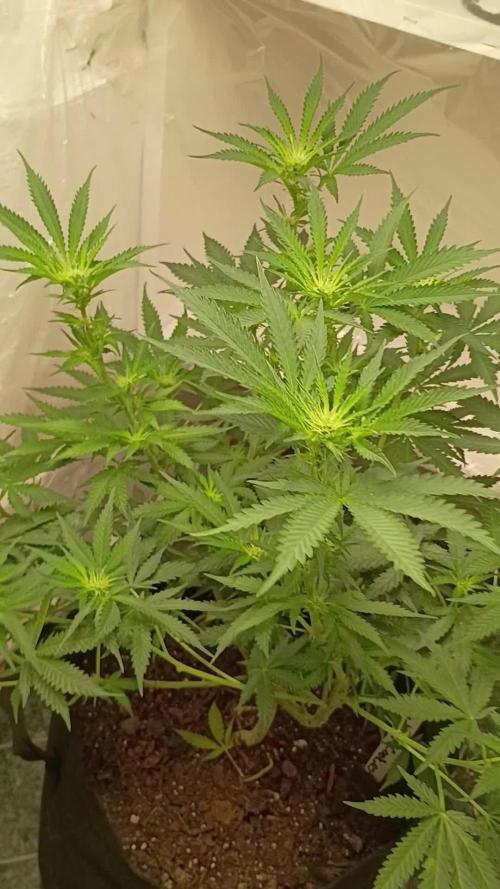
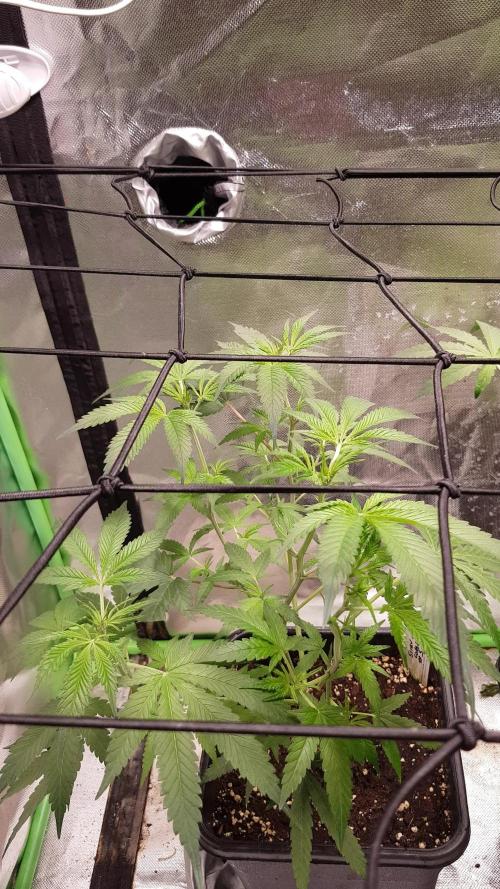
The girl seems to be ok. She's going into flowering mode in a few days from now. I let her recover from defolation first.
Likes
9
Share
📆 Semana 8 La Mental Rainbow entra en el último tramo afinando cada detalle. Los cogollos se compactan todavía más, cubiertos por una capa gruesa de tricomas que le da ese aspecto cristalino tan característico. Los pistilos comienzan a oscurecer y los cálices se hinchan, marcando una maduración clara. El aroma sube de intensidad: dulce, terroso y con un punto profundo que anuncia el cierre perfecto. Has controlado bien la ventilación después de la brotitis puntual, y la planta responde sin frenar el ritmo. Ahora toca dejarla limpia por dentro. 💧 Semana de lavado de raíz: solo agua ajustada de pH para que termine con un sabor puro y una combustión más fina. ¡Seguimos creciendo fuerte 💪!
Likes
5
Share
@Newbe01
Follow
one plant is way smaller than the other, probably a bad seed, startet with some first time LST on the small one too se if it gives some result, looks like the smalles one is about to go into flower pretty soon, hope they flower in a bout the same time as i only have one tent and need to switch to flowering lights when they start flowering. looks like they are happy in there though, another week done! Utdatert: they both started flowering during week 5, switched to flower lights now and just waiting for the good stuff
Likes
36
Share
@SAC87
Follow
Day 14 flower Hey Growers So day 14 of flower, I decided to defoliate as the tent was getting so overgrown. They are drying out quickly and the media is dense with roots. They are going to require daily watering very shortly. They seem quite happy and doing well. You can see in one of the pictures, the leaf edge is raised, which idk exactly what that is. I’ve decreased the light to 70% until I know how they’ll react. Other than that just put in the trellis to support the tops. Happy Growing 🌱
Likes
2
Share
Likes
59
Share
(12/09-12/15, days 42 to 48) Hope everyone enjoys the pictures. I will try to add a video and black back or cover pics by end of week every week. Week 5 Notes & Observations: Topped both plants and starved for 11 days. The idea being that I want the roots to search out new space and expose more root growth to the nutes in the soil to better help in the growth after the training rather than just the recovery. I made a decision on P2 and decided to keep both sides for a total of 8 colas on each plant since but topping day P2 was looking way better and showing nice re-growth. I recognize that growth will be stunted on the damaged side, but I want to see by how much in case I do it again in the future. Neither plant broke on this last training and bot seem in good health. I am however monitoring a possible calcium deficit and treating with CaliMagic. - inspected defoliated fan leaves and discovered Spider Mites - treated with Captain Jack's Deadbug concentrate mixed into 1 cup of purified water - sprayed tops and bottoms of leaves on all plants inside that tent. Will have to retreat again in 3 days, and possibly again after that. ***from label*** LAWNS AND ORNAMENTALS: Use Site Pests Controlled Comments outdoor ornamentals (herbaceous and woody plants) emerald ash borer gall midges leaf feeding beetles leafminers sawfly larvae spider mites1 thrips worms, including loopers, webworms, bagworms, gypsy moth, and tent caterpillars Uniformly spray foliage to point of runoff. Uniform coverage of upper and lower leaf surfaces is essential for effective insect control. Apply when spider mites are first observed prior to webbing and before mite populations have become severe. Reapply after 7 to 10 days (3 to 5 days in greenhouses and structures that can be altered to be closed or open) to contact newly hatched nymphs and repeat until infestation is managed. Uniform coverage of both upper and lower leaf surfaces is critical. VPD and PPFD: This week I will hold the humidity in the tent to about 70-75% and temps will be monitored for 70- 75F daytime and 66-71F overnight. Im adjusting my lights and look to control them at ~400ppfd max. Meaning slight increase over last week but mostly just growth increase. Feed & Monitor: ***All feeds with nutes use either a whole ratio or combination of "Veg Mix" and "Bloom Mix"concentrates DILUTED in water until a total ppm of add-in is reached using a (Total Dissolved Solids) TDS Meter measured in PPM (parts per million). The "Veg Mix" concentrate will eventually be added in smaller ratios and "Bloom Mix" concentrate will eventually replace the "Veg Mix" concentrate entirely. The ppm and ratios of each feed will be listed when I feed. Veg mix recipe is on week 2. Bloom Mix recipe is on week 5.*** Day 44 (last feed was day 34) Tested and Calibrated my ph pens. Starting weight from each pot was 18 lbs and 8 oz, both P1 and P2 weighed 11lbs 2oz before feed. Each plant got 1.5 gallon of purified water with 362ppm Veg Mix concentrate (recipe on week 2) and 106ppm Bloom Mix concentrate (recipe on week 5). The ph on this feed was balanced to 6.1ph to combat the original higher runoff ph from the previous runoff feed tests. After feed, both P1 and P2 weighed 19lbs 2oz after feed this time (P1 was 22lbs 3oz and P2 weighed 21lbs 14oz after last feed). I got about 8cups of runoff on both P1 and P2 this time (both plants gave up 5 cups of runoff last feed). Runoff for P1 ph was 6.3 with 906ppm (6.45 with 1170ppm last feed) and P2 was 6.4 with 814ppm 6.45 with 1230ppm last feed). Top soil tested at: P1 6.23,6.21,6.26,6.27 for an avg of 6.24 (6.327 avg after last feed) and P2 tested at 6.4,6.39,6.25,6.46 avg 6.37 (6.402avg after last feed) - next feed will be 6.3ph as Im liking where the ph is now and I dont see any issues from feed or training.
Likes
45
Share
Hello guys! So it’s the end of week 2 of flowering and all is going well. Been watering every 2 days and, as you can see, we have white pistils and small buds in every plant Not much to say, the ladys are green, stretching and growing buds as it should Yesterday i’ve defoliated one of the critical + 2.0 clone and next week I’m going to defoliate the rest of the plants. Just wanted to test when it is better to do the defoliation so it’s kind of an experiment Tell me what do you think of how this is going
Processing
Likes
10
Share
@yaron
Follow
Week 8!After a rainy week and a half with some sunlight and alot of clouds and 20 degrees celsius the girls look like this. For the coming week we have more sun so they are going to love it. Cheers! Once again to little sunlight these past few days and it is going to rain this weekend so that's a bummer. Hopefully its getting sunnier Cheers!
Processing
Likes
8
Share
She is really packing on the weight. She smells strong like gas and cookie. I can also see hints of purple starting to come out. She is now getting a big dose of koolbloom as well as a co2 supplement thanks to TnB Naturals.
Processing
Likes
6
Share
@ladyjane
Follow
Gave the ladies their first dose of nutrients. I made sure they were very diluted. they loved it. When I came to check on them, they were all praying. Yay.
Likes
5
Share
Both growing under and in exactly the same conditions and substrates and nutes. Ones so much larger both are topped.
Likes
47
Share
What's in the soil? What's not in the soil would be an easier question to answer. 16-18 DLI @ the minute. +++ as she grows. Probably not recommended, but to get to where it needs to be, I need to start now. Vegetative @1400ppm 0.8–1.2 kPa 80–86°F (26.7–30°C) 65–75%, LST Day 10, Fim'd Day 11 CEC (Cation Exchange Capacity): This is a measure of a soil's ability to hold and exchange positively charged nutrients, like calcium, magnesium, and potassium. Soils with high CEC (more clay and organic matter) have more negative charges that attract and hold these essential nutrients, preventing them from leaching away. Biochar is highly efficient at increasing cation exchange capacity (CEC) compared to many other amendments. Biochar's high CEC potential stems from its negatively charged functional groups, and studies show it can increase CEC by over 90%. Amendments like compost also increase CEC but are often more prone to rapid biodegradation, which can make biochar's effect more long-lasting. biochar acts as a long-lasting Cation Exchange Capacity (CEC) enhancer because its porous, carbon-rich structure provides sites for nutrients to bind to, effectively improving nutrient retention in soil without relying on the short-term benefits of fresh organic matter like compost or manure. Biochar's stability means these benefits last much longer than those from traditional organic amendments, making it a sustainable way to improve soil fertility, water retention, and structure over time. Needs to be charged first, similar to Coco, or it will immobilize cations, but at a much higher ratio. a high cation exchange capacity (CEC) results in a high buffer protection, meaning the soil can better resist changes in pH and nutrient availability. This is because a high CEC soil has more negatively charged sites to hold onto essential positively charged nutrients, like calcium and magnesium, and to buffer against acid ions, such as hydrogen. EC (Electrical Conductivity): This measures the amount of soluble salts in the soil. High EC levels indicate a high concentration of dissolved salts and can be a sign of potential salinity issues that can harm plants. The stored cations associated with a medium's cation exchange capacity (CEC) do not directly contribute to a real-time electrical conductivity (EC) reading. A real-time EC measurement reflects only the concentration of free, dissolved salt ions in the water solution within the medium. 98% of a plants nutrients comes directly from the water solution. 2% come directly from soil particles. CEC is a mediums storage capacity for cations. These stored cations do not contribute to a mediums EC directly. Electrical Conductivity (EC) does not measure salt ions adsorbed (stored) onto a Cation Exchange Capacity (CEC) site, as EC measures the conductivity of ions in solution within a soil or water sample, not those held on soil particles. A medium releases stored cations to water by ion exchange, where a new, more desirable ion from the water solution temporarily displaces the stored cation from the medium's surface, a process also seen in plants absorbing nutrients via mass flow. For example, in water softeners, sodium ions are released from resin beads to bond with the medium's surface, displacing calcium and magnesium ions which then enter the water. This same principle applies when plants take up nutrients from the soil solution: the cations are released from the soil particles into the water in response to a concentration equilibrium, and then moved to the root surface via mass flow. An example of ion exchange within the context of Cation Exchange Capacity (CEC) is a soil particle with a negative charge attracting and holding positively charged nutrient ions, like potassium (K+) or calcium (Ca2+), and then exchanging them for other positive ions present in the soil solution. For instance, a negatively charged clay particle in soil can hold a K+ ion and later release it to a plant's roots when a different cation, such as calcium (Ca2+), is abundant and replaces the potassium. This process of holding and swapping positively charged ions is fundamental to soil fertility, as it provides plants with essential nutrients. Negative charges on soil particles: Soil particles, particularly clay and organic matter, have negatively charged surfaces due to their chemical structure. Attraction of cations: These negative charges attract and hold positively charged ions, or cations, such as: Potassium (K+) Calcium (Ca2+) Magnesium (Mg2+) Sodium (Na+) Ammonium (NH4+) Plant roots excrete hydrogen ions (H+) through the action of proton pumps embedded in the root cell membranes, which use ATP (energy) to actively transport H+ ions from inside the root cell into the surrounding soil. This process lowers the pH of the soil, which helps to make certain mineral nutrients, such as iron, more available for uptake by the plant. Mechanism of H+ Excretion Proton Pumps: Root cells contain specialized proteins called proton pumps (H+-ATPases) in their cell membranes. Active Transport: These proton pumps use energy from ATP to actively move H+ ions from the cytoplasm of the root cell into the soil, against their concentration gradient. Role in pH Regulation: This active excretion of H+ is a major way plants regulate their internal cytoplasmic pH. Nutrient Availability: The resulting decrease in soil pH makes certain essential mineral nutrients, like iron, more soluble and available for the root cells to absorb. Ion Exchange: The H+ ions also displace positively charged mineral cations from the soil particles, making them available for uptake. Iron Uptake: In response to iron deficiency stress, plants enhance H+ excretion and reductant release to lower the pH and convert Fe3+ to the more available form Fe2+. The altered pH can influence the activity and composition of beneficial microbes in the soil. The H+ gradient created by the proton pumps can also be used for other vital cell functions, such as ATP synthesis and the transport of other solutes. The hydrogen ions (H+) excreted during photosynthesis come from the splitting of water molecules. This splitting, called photolysis, occurs in Photosystem II to replace the electrons used in the light-dependent reactions. The released hydrogen ions are then pumped into the thylakoid lumen, creating a proton gradient that drives ATP synthesis. Plants release hydrogen ions (H+) from their roots into the soil, a process that occurs in conjunction with nutrient uptake and photosynthesis. These H+ ions compete with mineral cations for the negatively charged sites on soil particles, a phenomenon known as cation exchange. By displacing beneficial mineral cations, the excreted H+ ions make these nutrients available for the plant to absorb, which can also lower the soil pH and indirectly affect its Cation Exchange Capacity (CEC) by altering the pool of exchangeable cations in the soil solution. Plants use proton (H+) exudation, driven by the H+-ATPase enzyme, to release H+ ions into the soil, creating a more acidic rhizosphere, which enhances nutrient availability and influences nutrient cycling processes. This acidification mobilizes insoluble nutrients like iron (Fe) by breaking them down, while also facilitating the activity of beneficial microbes involved in the nutrient cycle. Therefore, H+ exudation is a critical plant strategy for nutrient acquisition and management, allowing plants to improve their access to essential elements from the soil. A lack of water splitting during photosynthesis can affect iron uptake because the resulting energy imbalance disrupts the plant's ability to produce ATP and NADPH, which are crucial for overall photosynthetic energy conversion and can trigger a deficiency in iron homeostasis pathways. While photosynthesis uses hydrogen ions produced from water splitting for the Calvin cycle, not to create a hydrogen gas deficiency, the overall process is sensitive to nutrient availability, and iron is essential for chloroplast function. In photosynthesis, water is split to provide electrons to replace those lost in Photosystem II, which is triggered by light absorption. These electrons then travel along a transport chain to generate ATP (energy currency) and NADPH (reducing power). Carbon Fixation: The generated ATP and NADPH are then used to convert carbon dioxide into carbohydrates in the Calvin cycle. Impaired water splitting (via water in or out) breaks the chain reaction of photosynthesis. This leads to an imbalance in ATP and NADPH levels, which disrupts the Calvin cycle and overall energy production in the plant. Plants require a sufficient supply of essential mineral elements like iron for photosynthesis. Iron is vital for chlorophyll formation and plays a crucial role in electron transport within the chloroplasts. The complex relationship between nutrient status and photosynthesis is evident when iron deficiency can be reverted by depleting other micronutrients like manganese. This highlights how nutrient homeostasis influences photosynthetic function. A lack of adequate energy and reducing power from photosynthesis, which is directly linked to water splitting, can trigger complex adaptive responses in the plant's iron uptake and distribution systems. Plants possess receptors called transceptors that can directly detect specific nutrient concentrations in the soil or within the plant's tissues. These receptors trigger signaling pathways, sometimes involving calcium influx or changes in protein complex activity, that then influence nutrient uptake by the roots. Plants use this information to make long-term adjustments, such as Increasing root biomass to explore more soil for nutrients. Modifying metabolic pathways to make better use of available resources. Adjusting the rate of nutrient transport into the roots. That's why I keep a high EC. Abundance resonates Abundance.
Likes
38
Share
Hi guys So end of week 4 and entering week 5 now. Few issues this week with the feeding of the plants. Dark phoenix are hungry well half of the plants are anyway 🤔🤷‍♂️ so I upped the feed to 1200ppm the dark phoenix didnt mind it as it needed it but my blue cheese suffered and has significant burnt tips on every leaf 😅 I will disconnect this from the auto feeder and flush and add half nutes by hand in a few days. Othere than that the plants buds are growing and getting frosty. Thanks for looking and happy growing guys👌💪💚 Day 37 flower I changed the marshydro tsl2000 to a 400watt hps to finish the job on the scrog along with the bloomplus bp2500 250watt led light. So cheese got burnt quite bad I totally disconnected it from auto pot system and feeding ph 6.5 water only for a week. Dark phoenix is really frosty now still loads of pistils standing on end and filling out now and smells amazing. The next 2 weeks I will keep feeding bloom and top max then I will start the flush on them. Happy growing guys.
Likes
38
Share
I took the tiny plant out of the tent due to state laws. She is happily sitting in a window... we'll see what happens with her! Massive growth for both plants this week! They both doubled in size! I don't know whether to call my plants vegging, pre-flowering or flowering. I figured this was the last week of veg and next week is full on flowering!! They both stink! Gassy for sure! I'll need to turn start using my carbon filter soon... I caught a few cool time lapse videos this week. Especially after feeding them last night!! I fed them twice this week. The first time was at a third recommended dose and I jumped it to half yesterday. The leaves are clawing at the top of the plants... I think it is a lack of phosphorus due to me only watering them the last 2 weeks. Any thoughts out there? I'd love advice about defoliating... I have a couple massive fan leaves I could remove to open the canopy for flowers... I just don't want to stunt the plant or rob the main cola of a major energy source... Thoughts are definitely welcome! I tried my hand at LST... I think a few are working and a few aren't doing the job... Definitely need to figure this out! Again advice is welcome! If you've made it this far... thanks!! Cheers!
Likes
3
Share
@Mimbra
Follow
Ya van por la 3 semana de flora y empiezan a salirle pelos ,la poison es hembra menos mal que no le salían pelos ,ahora tengo otro problema se me están poniendo las hojas grandes amarillas ,imagino que nitrógeno hoy las he regado con celta nueve y con alga grow por si acaso era defi de nitrógeno como las veis ????antes de este riego estaba hechando crecimiento Bloom de Bloom notrients y tuvieron una sobrealimentación por nitrógeno ,le hice lavado de raízes y parece que me pide nitrógeno
Likes
42
Share
Deliciously grow, without problems - super fine and satisfactory result. Unfortunately I forgot to weigh it wet, but I will update with the dry weight as soon as it is dry - but a good bet is that it has been about 200+ grams wet and there will probably be about 50 grams dry. I have added some videos from before and after, the top cola was cut - and some close up photos 😘 Update: 42 grams in total 😍 She taste so damn nice, super great !!