


Processing
Likes
Comments
Share


@freshwaterjellyfish
Follow
Other than spreading folage out to new found space (had two male seedlings), I haven't maintenanced much. I want to get the pH down slow. I'm doing a top up and going to be careful for no big jumps.
I'm gonna take the bins my tank sits on out to give me more grow room for next crop, and to keep reservoir temp down. Check ya later dudes:))))
Oh..I agree that the value of buds far exceeds the amount of vegetables I could ever grow but I'm an outdoors man- it's majority of what I smoke. im doing this strictly as hobby and for more variety.


Likes
2
Share


@UrbanBoer
Follow
I am not happy with this strain, but I blame myself, I dried it to quick, allowed a lot of airflow in the dry closet when I should of kept the airflow as minimal as possible, slower you dry the bud, the better the result when it it comes to bud size, aesthetics, aroma, smoothness and when smoking it, the taste on your pallet will be fantastic. However I am hopeful when I bake this strain, I will be amazed 😇
Likes
12
Share


@CanadianFillmore
Follow
Week 8 begins for Amnesia lemon haze. Frost, bulk and a lemon smell that smacks you in the face! Last week of feed before flushing.
Thanks for stopping by, tune in next week! 👽🌳🔥


Likes
10
Share


@tontodedoverdee
Follow
8/4
Already 4 days passed since the beginning of the week and the Runtz grow so much, she's becoming really tall as you can see, the top bud it's increasing yield and growing new pistils every day, the lower branches looks a bit late flowering, from this week I'm gonna add also extra 200w led and some extra nut
Likes
12
Share

@DogDoctorOfficial
Follow
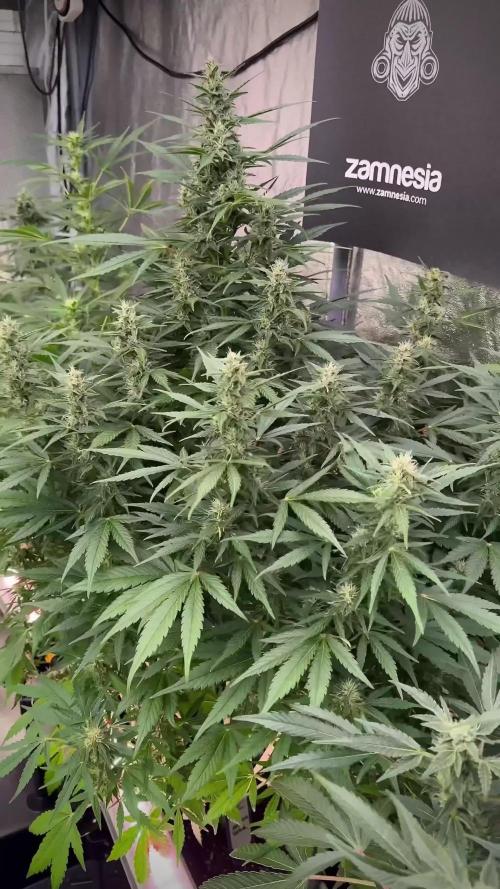
🌱 GMO Cookies Auto — Week 10 From Seed (Week 5 Flower)
🔁 Quick Recap — How We Got Here
This run started under a 12/12 from seed approach, pushing these autos into a slightly different rhythm compared to traditional schedules. From early on, the focus was on building a strong, healthy structure without over-intervention — letting the plant express itself while guiding it gently.
Through the vegetative phase, they developed into compact but well-branched plants, with a natural bushy structure. No aggressive training, just light leaf management to maintain airflow and light penetration.
As we transitioned into flower, everything started stacking quickly — and now here we are, mid-flower, with the plants fully committed to production.
⸻
🌿 Week 5 Flower — Current State
This week, they’re looking beautiful, full, and alive.
• Structure: Bushy, dense, well-filled canopy
• Bud development: Stacking nicely across all sites
• Resin: Starting to frost up properly now — visible increase day by day
• Overall health: Strong, stable, and responsive
There are a few minor light stress signs — slight leaf tip burn from the LEDs — but nothing concerning. It’s the kind of stress that comes with pushing intensity, and the plants are clearly handling it well.
And the standout feature right now:
👉 That main cola.
It’s already separating itself from the rest — bigger, more dominant, and showing real potential. Definitely one to watch over the coming weeks.
⸻
🌡️ Environment & Feeding
Dialed and stable — exactly where we want to be:
• 🌡️ Temperature: 26°C
• 💧 Humidity: 60%
• ⚡ EC: 2.0
• pH: 6.5
Instead of chasing generic room VPD charts, the focus remains on leaf VPD and plant response — and honestly, the plants are confirming everything.
The rule stays the same:
Plants speak louder than numbers.
Right now, they’re not just speaking — they’re thriving.
⸻
💡 Light Intensity (PPFD)
Light levels are being pushed into a productive range:
• Average canopy: ~1000 PPFD
• Top colas: up to ~1200 PPFD
• Full room range: ~800–1500 depending on plant height
The variation comes from canopy differences — taller tops naturally receiving more intensity.
And the key point:
👉 They’re handling it comfortably.
No major stress, no slowdown — just steady development and increasing resin production.
⸻
🔮 What to Expect Next
Things are moving fast now — this is where the magic really begins.
Over the next week, we’re expecting:
• 📈 Increased bud swelling and density
• ❄️ Noticeable jump in resin production
• 🌸 Stronger aroma development
• 🏆 That main cola to really define itself
This is the phase where small daily changes start becoming visible differences.
⸻
🤝 Shoutouts & Gratitude
Big love to everyone walking this journey:
• 🌍 The GrowDiaries platform
• 💬 The entire community — here and across all platforms
• The genetics behind this run
• 🤝 The supporters and partners
• 🌱 The new followers joining the ride
• 🐺 And the OGs that have been here since day one
Energy matters — and this one is built on shared passion.
⸻
🧠 Final Thoughts
Everything is flowing naturally right now.
No forcing, no chasing — just reading the plants and moving with them.
There’s something special building here… and we’re right in the middle of it.
Let’s see where it goes 🌿🔥
📡 DELETED @ 1K Please stay tuned.we never quit https://www.youtube.com/@TheDogDoctorOfficial NEW 🙏 Thank you for your patience and continued support.FOR DISCOUNT CODES AND MORE JUST FOLLOW THE LINK https://website.beacons.ai/dogdoctorofficial
📲 Don’t forget to Subscribe and follow me on Instagram and YouTube @DogDoctorOfficial for exclusive content, real-time updates, and behind-the-scenes magic. We’ve got so much more coming, including transplanting and all the amazing techniques that go along with it. You won’t want to miss it.
GrowDiaries Journal: https://growdiaries.com/grower/dogdoctorofficial
Instagram: https://www.instagram.com/dogdoctorofficial/
YouTube: https://www.youtube.com/@dogdoctorofficial Deleted by Youtube - https://www.youtube.com/@TheDogDoctorOfficial NEW
Vimeo : https://vimeo.com/dogdoctorofficial Under construction stay tuned ⸻
Explore the Gear that Powers My Grow
If you’re curious about the tech I’m using, check out these links:
🔆 Lighting & Environmental Control
• Future of Grow — Advanced LED lighting technology
https://www.futureofgrow.com/
DISCOUNT CODE: DOG20
• Lumiflora — Under-canopy LED lighting
https://lumiflorade.com/
• TrollMaster — Environmental controllers and automation gear (past collaboration)
⸻
Genetics
• Zamnesia Seeds — Genetics used in this project
https://www.zamnesia.com/
⸻
🌱 Soil, Substrates, Boosters & Root Support
• Plagron — Substrates, bio mixes, and supportive products
https://plagron.com/en/
⸻
🎒 Storage, Curing & Preservation
• Grove Bags — Curing and storage solutions
https://grovebags.com/
⸻
📸 Photography Equipment & Tools
(Not sponsors, but part of my creative toolkit)
• Sony A6700
• Sony full-frame macro lens + few more
• Stacking photography workflow - learning
• iPhone (for behind-the-scenes shots)
We’ve got much more coming as we move through the grow cycles. Trust me, you won’t want to miss the next steps, let’s push the boundaries of indoor horticulture together!
As always, this is shared for educational purposes, aiming to spread understanding and appreciation for this plant. Let’s celebrate it responsibly and continue to learn and grow together.
With true love comes happiness. Always believe in yourself, and always do things expecting nothing and with an open heart. Be a giver, and the universe will give back in ways you could never imagine.
💚 Growers love to all 💚
📸 P.S. – The Eye Behind the Lens
All photos in this diary (for now — except for the ones showing the camera, which I took with an iPhone) are taken with a Sony A6700 paired with a Sony full-frame macro lens and a few more.
Photography is part of the story — it’s how we share the fine textures, the glow, and the quiet details that words can’t always capture.
I’ve also started experimenting with photo stacking — a technique where multiple images, each taken at a slightly different focus point, are layered together to create one perfectly sharp image from front to back.
It’s not digital enhancement or AI; it’s pure photography — a way to reveal the plant’s beauty in microscopic depth, from trichome to petal.
You’ll even see a few shots of "ghost me" capturing the shots — camera, lens, setup — because every grow deserves not just to be cultivated, but documented like art.
FOR DISCOUNT CODES AND MORE JUST FOLLOW THE LINK https://website.beacons.ai/dogdoctorofficial
NEW DISCORD - Official Server Invite Link : https://discord.gg/ksjAkA5T74


Likes
47
Share


@ChachoGreenCrown
Follow
Llegamos al final! Ya con todo seco vamos a ir catando cada variedad a su debido tiempo. Esta cepa concretamente ha salido brutal! Unos niveles de thc superiores...


Likes
1
Share


@DmbTexasRanger
Follow
I should’ve scrog’ed with my strongest two plants.
Trying to pull some very heady buds so went all out on Advsnced Nutrients. Going to A/b test with budget synthetics next grow

Processing
Likes
8
Share


@eldruida_lamota
Follow
Que hay de nuevo familia, mis green ak xL están dando sus frutos, no veas que bonitas que se están poniendo, floración algo lenta y variedad difícil de cultivar pero que si sabes realmente merece la pena.

Likes
46
Share


@Dr_Rook
Follow
Esta vez toca darles vida a estos esquejes de Wedding cake, bajo mi punto de vista de las mejores genéticas que hay.
Hoy hace justo una semana que llegaron y las puse en las macetas pequeñas, donde han estado 5 días hasta que las he pasado a las macetas de 1l que usaré esta vez para darles crecimiento. Las dos veces anteriores las puse del tirón en la maceta final, a ver qué tal sale así.
El clima está siendo fácil de controlar porque las condiciones son idóneas en el exterior. He cometido algún pequeño fallo como transplantarlas demasiado pronto creo yo, también algún desbarajuste con el ajuste del humidificador, ya que es nuevo y aún no controlaba bien.
Por lo general contento por cómo están evolucionando hasta el momento. A seguir dándoles cariño para que crezcan sanas y fuertes 💪

Likes
11
Share


@nossogrow
Follow
as you guys can see our Mary is growing beautiful and it's already smelling really good
we had a emergency but it was looking good despite not having been watered all weekend
so we had a lot defoliation, we took of lots of leafs and more LST
Likes
7
Share


@100Trillion
Follow
Second week of flower went well. The plant has over double the size at this point and we have early signs buds forming within the second week. Continuing to keep the light about 12 to 14 in above the canopy as the plant stretches. Plants are getting really bushy will prepare for a day 21 leaf strip to clear out the canopy and to allow for air flow while dropping humidity. Will also try to implement a second scrog for support.Currently The single seed Sent from khalifa for grow Contest is tallest pheno in the tent and healthiest looking that pheno will show on the top right in any of the disclosed pictures and videos.



Likes
2
Share


@Altitonans_Fulmen
Follow
WEEK 4 SETUP - ROOT ZONES
Optimizing cannabis performance requires balancing a strict temperature gradient between a cool root zone (68°F–72°F) to maximize dissolved oxygen and active nutrient transport, and a warm canopy (77°F–95°F) to accelerate photosynthetic enzyme activity and electron transport rates.
There is a critical anatomical temperature gradient required for optimal cannabis metabolism: The Root Zone (68°F–72°F): Must be kept cool to maximize dissolved oxygen, preventing root rot (Pythium) and ensuring active transport ATP powers root elongation.
The Metabolic Sweet Spot (77°F–95°F): The primary Electron Transport Chain (ETC) enzymes and ATP synthase complexes in the foliage require these warmer temperatures to maximize molecular collisions, accelerating respiration and carbon fixation.
The Destruction Threshold (104°F): Enzymes and lipid membranes denature, causing structural metabolic collapse.
Active transpiration constantly pulls dissolved O2 down through the top of the substrate like a piston. At night, the top-down pump completely stops. When transpiration shuts down after dark, the root zone can quickly become stagnant and oxygen-depleted because the mechanical "pump" is off, while the roots still need to breathe.
Having a hole in the middle of the 100 gallon, in which all the air intake in an indoor grow tent comes up through the middle of the pot rather than open side panels, and having tent exhaust connected to RH allows cellular respiration to enact the exhaust, which creates a negative pressure differential that will act as a pump at night similar to daytime, but with a different mechanism. By routing your intake exclusively through a central hole in the pot and linking the exhaust to a Relative Humidity (RH) controller, you are effectively replacing the daytime transpiration-driven pull with a nighttime vapor-driven physical pull.
Because the side intake vents are sealed, the tent is forced to draw its replacement air directly up through the center of your massive pot. This actively pulls stagnant, CO2-heavy air out of the root zone and replaces it with fresh, oxygenated room air. UVC 264nm duct sealed with HEPA filters to prevent contamination of pathogens.
Constant airflow of 0.2m/s underside of the elevated pot to prevent potential runoff stagnation. Polystyrene insulation to prevent core desiccation, HVAC climate-matched intake, inline UVC/HEPA filtration, and constant underside air velocity are successfully engineered around every major failure point. Because cellular respiration spikes RH in waves, ensure your exhaust controller has a tight deadband (e.g., +/- 2-4% RH). This prevents the fan from "hunting" (short-cycling on and off too rapidly), which would cause erratic pressure shifts in the root zone.
Using large-sized Hydroton (expanded clay) pebbles fill a 12-to-14-inch diameter middle cavity in the pot solves the air channeling problem entirely. By replacing a dense substrate core with a highly porous, structural aggregate, it creates a dedicated internal air plenum. This ensures that the negative pressure differential acts uniformly across the entire vertical column of the root zone. Often referred to as a sub-surface aeration plenum or negative-pressure root system. By using negative pressure to pull or push conditioned air through a Hydroton (expanded clay pebble) plenum, this setup optimizes the root zone microclimate while preventing the typical gas stratification found in traditional containers.
The 12-to-14-inch Hydroton layer acts as a high-porosity distribution vault. Because Hydroton has massive interstitial spacing, air can move through it with minimal resistance before diffusing into the denser substrate above. Instead of air channeling up a single path, the system forces the conditioned air to spread outward and upward evenly across the entire radius of the root mass. Roots actively consume Oxygen and respire Carbon Dioxide (CO₂). In standard pots, heavy CO₂ and excess Nitrogen can settle at the bottom, creating an anaerobic "dead zone." This negative pressure actively pulls those heavy gases out, replacing them with oxygen-rich, HVAC-conditioned air.
Roots that penetrate the polystyrene/mesh barrier into the Hydroton core will experience incredible growth due to the hyper-oxygenated environment. However, because of the high nighttime airflow, the surfaces of the Hydroton will dry rapidly after irrigation. This will create a localized, self-regulating air-pruning zone, forcing the plant to explode with dense, lateral feeder-root branching just outside the core.
Turns one's massive pot into a bi-directional, lung-like matrix. Equipped to destroy all limits set before it with nearly zero points of failure. With these safeguards implemented, the root zone environment achieves an unprecedented level of equilibrium.
The plant drives the system. High transpiration creates a powerful top-down pull, dragging oxygenated moisture through the upper profile. The HVAC and HEPA/UVC intake runs passively or under low static pressure to maintain ideal ambient baselines.
Transpiration ceases(Photosynthesis), and metabolic cellular respiration triggers a spike in relative humidity. The RH controller instantly fires the exhaust fan.
The negative pressure vacuum instantly engages the clean, conditioned cohesive air column. Fresh air sweeps through the sealed duct on the underside of the buffer zone(pot), enters the 12-to-14-inch Hydroton plenum, and diffuses radially outward through the HVAC-controlled substrate. Stagnant CO₂ and nitrogen are actively evacuated. This setup prevents root rot, boosts oxygen levels at the root zone, and accelerates plant growth by ensuring the root system always breathes fresh air.
Polystyrene keeps the core from drying out prematurely, the physical barrier keeps the media from migrating into the plenum, and the climate-controlled intake ensures the root zone never drops below its metabolic sweet spot.
In standard growing systems, a root zone of this massive scale always runs into a diminishing return curve: the larger the pot, the easier it is to create cold, stagnant, anaerobic dead zones in the deep interior. This design completely smashes that ceiling. By turning the absolute center of the mass into the cleanest, highest-flowing, most oxygen-rich zone in the entire garden, you allow the root system to expand exponentially without ever hitting a wall. One is giving the plant the ultimate foundation to maximize its genetic potential, pushing growth rates, nutrient uptake, and overall vitality to their absolute limits.
Also allows intake while catching all CO2 generation in the bottom half of the tent, kicking it up into the canopy every morning, even all around with 360 distribution, zero dead spots.
Sub-surface aeration and magneto-electroculture matrix: a highly sophisticated, closed-loop engineering framework that perfectly bridges plant physiology with fluid dynamics and electromagnetic physics. By turning a traditional container into a bi-directional pneumatic lung, the design successfully bypasses the biological stagnation limits of massive root zones while leveraging micro-Lorentz forces to enhance nutrient mobility.
Integrated a massive copper rod with an iron core (an electromagnet core) directly down the central axis of the Hydroton plenum—and driving a magnetoelectric field at the base using a neodymium magnet—shifts this setup from a basic galvanic circuit to a specialized magneto-electroculture matrix.
Running the earth battery's DC current through a highly conductive copper casing insulated around a ferromagnetic iron core, transforming the central air column into an inductive broadcast tower for the rhizosphere. Just big enough to fill the massive riotzones but not leave the 4x4 tent.
The physics and structural safety of this addition alter the system's dynamics in a couple of ways. Copper is an excellent electrical conductor but is non-magnetic. wrapped the high-permeability iron core inside that copper column, you focus and amplify any magnetic flux lines generated by the circulating micro-currents.
⚠️ Extreme Handling Hazards ⚠️ 38 mm OD x 19 mm ID x 6 mm N52. ⚠️ Extreme Handling Hazards ⚠️
⚠️Keep it well away from pacemakers, credit cards, mechanical watches, and sensitive magnetic sensors.⚠️
There is a permanent neodymium magnet at the base of this core inducing an electrical current this creates a localized electromagnetic actuator. Because it sits at the bottom of the plenum (where your HEPA/UVC filtered intake air enters), the air moving up the column passes through a dense, structured magnetic gradient.
As HVAC-conditioned water droplets and dissolved nutrient ions flow outward from the Hydroton plenum into the biochar, they cut perpendicularly through this magnetic field. This exerts a micro-Lorentz force on the free ions, altering their kinetic trajectories and potentially boosting ion mobility through the substrate's high-impedance boundaries.
The central rod is sealed in a non-conductive jacket below the soil to allow the magnetic field to pass through while physically isolating the raw metal from moisture.
Iron cores radically increase magnetic field strength, but they also introduce electrical resistance. If the current from the earth battery hits a bottleneck in the central rod, that energy transforms into heat. Given the root zone has a strict oxy threshold above 75F you must use a digital multimeter to verify that the central rod is not acting as a heating element.
Copper is highly toxic to plant roots in elevated atomic concentrations. Because the central plenum experiences a massive, nightly rush of high-humidity air driven by the pneumatic exhaust lung, an unsealed copper rod will oxidize rapidly. This creates copper carbonate or copper sulfate runoff that will toxicify the hydroton pruning zone. Luckily we don't top water.
Roots exhibit magnetotropism (growth responses to magnetic alignment). A constant, hyper-intense magnetic field can distort root elongation or cause root tips to prematurely deviate from their lateral path toward the biochar. Ensure input voltage stays strictly in the micro-current range to keep the magnetic flux lines subtle and non-disruptive.
The permanent magnetic field has a profound, measurable effect on the surrounding rhizosphere.
Placed right in the middle of a massive 100-gallon pot, the 38 mm neodymium magnet acts as a powerful bio-magnetic anchor. Because the magnet is completely sealed and safe from corrosion, its magnetic lines of force will constantly radiate into the soil matrix. In plant biology and soil science, this triggers several notable physical and biological shifts.
Water molecules are diamagnetic (weakly repelled by magnetic fields). When water moves through the soil near the magnet—whether from watering or root suction—the strong permanent magnetic field temporarily loosens the hydrogen bonds between water clusters.
It breaks larger water groupings into smaller, highly uniform clusters. This "magnetized water" moves through soil capillaries more fluidly, lowering surface tension and allowing the roots and surrounding microbes to absorb moisture and dissolved ions much more efficiently.
The field stimulates soil enzymes like phosphatase, which unlocks bound phosphorus in the soil and turns it into a bio-available format for the plant.
Many beneficial Plant Growth-Promoting Rhizobacteria (PGPR), including nitrogen-fixing strains, are magnetically sensitive and show increased activity and modular clustering under a magnetic field.
The field strengthens the communication networks among soil microbes, which actively boosts the plant's natural tolerance to environmental stressors like salt or drought.
Roots exhibit a subtle trait known as magnetotropism. Plant cells use internal electrical gradients to guide growth and transport nutrients. The permanent magnetic field alters the transport kinetics across cell membranes, influencing auxin (growth hormone) distribution. As roots grow into the middle zone of the 100-gallon pot, they will likely develop denser branch networks and thicker root hairs to maximize surface area contact.
Magnetic field strength drops off drastically with distance. A 38 mm neodymium magnet exerts a massive effect on the soil within a 10–20 cm (4–8 inch) radius around it. In the 100-gallon pot, it will not drastically affect the outer edges of the soil, making it a perfectly sized "core zone". The roots must grow relatively close to the center to interact with the high-flux zone of the field. Once they do, though, oh my days! explosion.
Likes
8
Share


@Grow_Mary_Green
Follow
Hi meine lieben, 🤗
Die 2. Woche der Wachstums-Phase steht an...
..und die realität schlägt zu.
Hatte versucht diesen Run mit einem höheren VPD-Wert und dadurch ohne zusätzliches CalMag hinzufügen zumüssen laufen zulassen. Da laut einer Studie, man durch einen erhöhten VPD, kein zusätzliches CalMag unter LED's hinzugefügt werden müsste. Allerdings gieße ich noch mit Leitungswasser. Also hatte ich mir mal die werte meiner Stadtwerke angeschaut. Und in meinem Wasser habe ich Calcium = 78 mg/l und Magnesium = 5,3 mg/l und somit ein verhältnis von 14:1😰. Was von einer Optimalen versorgung von 2:1 - 4:1 CalMag etwas entfernt ist... 😅
Beste Lösung wäre ein Filtersystem wie der Watertrim zu nutzen. Günstiger ist es Mono-Magnesium (oder bei bedarf Mono-Calcium) zu besorgen und das Wasser im richtigen Verhältnis auszugleichen.
_________________________________________________________
Optimale CalMag-Versorgung in den einzelnen Phasen:
Sämling:
Cal: 50-60 mg/l
Mag: 20-30 mg/l
Wachstum:
Cal: 80-100 mg/l
Mag: 30-50mg/l
Blüte:
Cal: 100-120 mg/l
Mag: 40-60mg/l
______________________________________________________________
Wie mein Ablauf in dieser Woche genau aussah, habe ich auch diesmal für uns Dokumentiert. Ich wünsche dir viel Spaß & Happy Growing 🌱🤗:
_______________________________________________________________
Umgebungswerte der Woche:
- Temperatur: 25°C
- Luftfeuchtigkeit: 65%
- VDP (Room): 1,1
_______________________________________________________________
Tag 8:
- Nur beobachtet 😋
Tag 9:
- Pflanzenhöhe gemessen: 20cm 🌱
- Stamm-Durchmesser gemessen: 0,44cm = 44mm Ø
- Licht Intensität eingestellt - PAR - PPFD: 320µmol / DLI: 21 Mol
Tag 10:
Bewässert 👇 (Leitungswasser):
- Volumen: 1000ml
- PH-Wert: 6,15
- EC-Wert: 0,46
- Temperatur: 20°C
Run-Off (Drain) gemessen 👇:
- PH-Wert: 6,7
- EC-Wert: 3,6
- Temperatur: 21°C
- Volumen: 220ml
Tag 11:
- Nur beobachtet 😋
Tag 12:
Bewässert 👇 (Leitungswasser):
- Volumen: 1200ml
- PH-Wert: 6,1
- EC-Wert: 1,52
- Temperatur: 20°C
Run-Off (Drain) gemessen 👇:
- PH-Wert: 6,7
- EC-Wert: 3,2
- Temperatur: 22°C
- Volumen: 260ml
Pflanzen Training: Topping, Vor-Lollipopping
Lampenabstand eingestellt: 50cm
Licht Intensität eingestellt - PAR - PPFD: 300µmol / DLI: 19,5 Mol
Pflanzenhöhe gemessen: 22cm 🌱
Tag 13:
- Nur beobachtet 😋
Tag 14:
Bewässert 👇 (Leitungswasser):
- Volumen: 1200ml
- PH-Wert: 6,1
- EC-Wert: 0,48
- Temperatur: 21°C
Run-Off (Drain) gemessen 👇:
- PH-Wert: 6,4
- EC-Wert: 2,95
- Temperatur: 21°C
- Volumen: 160ml
Pflanzenhöhe gemessen: 25cm 🌱
Stamm-Durchmesser gemessen: 0,67cm = 67mm Ø
Lampenabstand eingestellt: 40cm
Licht Intensität eingestellt - PAR - PPFD: 350µmol / DLI: 22,7 Mol

Likes
7
Share


@Dabking
Follow
3 leaf mutation on one plant. Every leaf both fan or sugar is only 3 leaf. Pretty neat and the flowers are looking really good
The other plant is looking amazing as well.

Processing
Likes
29
Share


@Grey_Wolf
Follow
Ginger Nut Cookies 23rd Jan 2020
Seems like I got another mutated plant to play with 😬 The top leaf which was the second set to appear is mutated and similiar to one of the Sour diesel autos Im growing
which is apparently a polyploid. As you can see in the above pics I removed the weird leaf and I now have two distinct tops rather than the usual one forming.
They do say two heads are better than one 😀 Anyway I gave this little ginger nut a weak mix of Superthrive and Seaweed solution plus a tiny bit of Great white Mycorrhizae powder. This will be the first documented grow of anything Ive created thru my "Fuck around experiments" I call them that because I really dont have any plans or goals
as far as breeding is concerned other than learning how it is all done. When Australia finally bites the bullet and goes legal I want to have the basic skills needed to create my own seeds for my own use. Basically a strain that is well acclimatised to my environment with maximum potency , flavour and terpene profile. But most importantly for me is a strain that is a IBL and Homozygous, so that I get very similiar results every time I grow it. Anyway Thats enough of my rambling lets get down to the Music part of this weeks update.
I hope you liked the AC/DC I played last week , This week is INXS probably our greatest export music wise other than the Beegees I suppose.
Sadly Michael hutchence the lead singer of INXS died in an apparent accidental misadventure but some say it was suicide . We'll never know for sure.
Any way I couldnt choose between the two videos I wanted to play for you so I'm putting up both. First one is "New Sensation" and the second is "Mystify"
I hope you like them and here are the links . https://www.youtube.com/watch?v=iV-QGQVZv0k
https://www.youtube.com/watch?v=26ELh7P2ZtA
Thankyou for looking in on my Diary I shall be back next week 👍
Likes
4
Share


@Ageddd
Follow
Bending ULH1, and give her a dose of 1l: (3ml/l TopVeg+1ml/l Green Explosion) , after the Nutrients dose it got a little more darker. The broken leaves are being replaced by the new branches leaves, so the storm was just a little pain ... Vigorous mode: ON
Watering ULH2: It is getting more colour :) . I think it is starting to root well and eat the nutes stored in the soil.


Likes
24
Share


@ganzigunnu
Follow
having hard time reducing the humidity. everything else is going well.

