


Likes
Comments
Share


@Chucky324
Follow
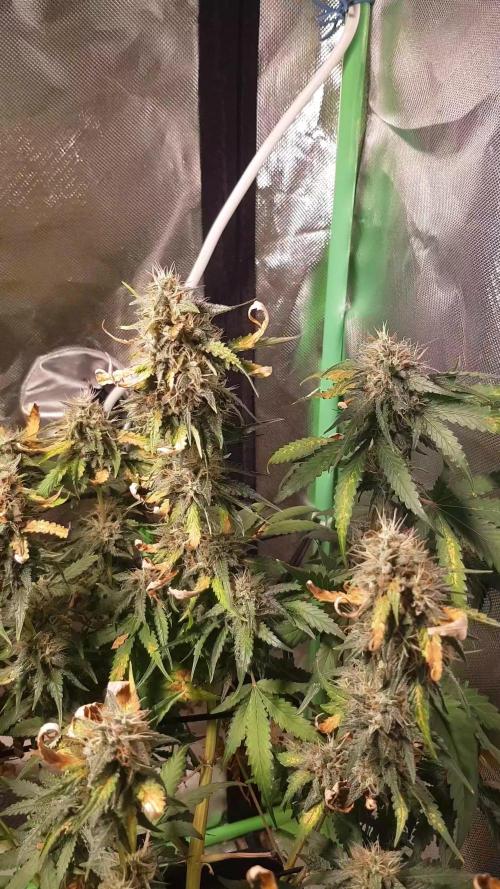
Hello. This is the end of week 8 and the beginning of week 9 of flowering.
This is the start of flushing for these lovely plants. I'll flower these plants to 10 weeks. I also like a few days of dark just before harvest.
There's still food left in the medium, so the plants won't starve. I've found measuring the runoff that the first flush is around 750 ppm and the second flush is around 450 ppm and the third flush is around 250 ppm. The plants use up most of the food in the pots and have pulled alot from their leaves. Then it's time to harvest the very clean buds. There is no chemical taste if you flush and you get nice white ash when smoked.
I got to say - look at the differences in the plants, wow, looks like 4 different strains. They all smell similar but look quite different. That is a common question on the questions page, why do my plants look so different from the same strain.
Keep growing straight.
Chuck.

Likes
6
Share


@LittleBigTrees
Follow
Had to take them down on day 60 .
Very happy with the results, last time I left it an extra week.

Likes
20
Share


@Bread_n_Buds
Follow
We have reached the second week of flowering for our beautiful photoperiod ladies of Zamnesia. Born 1 September now at day 45 amazing.
---- The general environmental conditions are good, there is always a little too much heat from next week we should have just enough for the resining a sharp drop in temperatures that could also give us beautiful foliage for this period.
--- Our Runtz are two very stable and regular plants that will give us great satisfaction. They are not very big and although we do not have a couple of not very tall growboxes it is very good, they flower quite quickly, there are already some buds formed unlike others. Like its auto and f1 version it eats a lot of fertilizer especially in the initial and medium flowering phase you need to give it fuel. Our two are very healthy let's be clear but it is one of those plants that eats food a little more than the others. I’m only defoliating and pruning and lollipopping in lower side of the plant no LST because i need to save space, yes very nice tecnique but not very good to save space.
--- Fertilization program - The fertilizers are always Plagron and I am following the table that I generated on the site depending on the chosen substrate. Create your own card and follow it, never be presumptuous my friend as I have been in the past, follow the card and look at the plants, not all need the same amount of fertilizer. We have reached the moment of giving a good dose of iron in the first weeks of flowering on the advice of Plagron directly foliar and I am at the end of the second week of flowering. It had started a little quietly but now it is proving to be among the best.
---- https://plagron.com/en
- Power Roots - 1 ml/l
- Alga Bloom - 4 ml/l
- Pure Zym - 1 ml/l
- Sugar Royal - 1 ml/l
- Vita Race - 5 ml/l
--- The Plagron 100% Organic pack is available on Zamnesia at: https://www.zamnesia.io/en/11457 -pla gron-easy-pack-natural.html
--- The dehumidifier now works between 50% and 55%
// Strain Description // Guys, we have really reached a turning point! Our breeders have recreated one of the most sought-after strains by Californians: the very powerful and exquisitely delicious Runtz. This cross between Gelato and Zkittlez is everything you could want from a cannabis strain: tasty, powerful, balanced, productive and fast flowering. Buy the seeds and try it yourself!
- Get a seed of this fantastic strain --- https://www.zamnesia.io/it/6000-zamnesia-seeds-runtz-femminizzato.html
- Soil and Fertilizers entirely organic --- https://plagron.com/en buy on www.zamnesia.io
- Growbox and air sistem --- https://www.secretjardin.com/
- Light - Sp3000 - https://marshydro.eu/
- Music and sound --- I made my girls listen to 432hz frequencies and music from www.radionula.com
- Z --- You can find these seeds, much more from the world of cannabis, mushrooms and an incredible series of accessories and gadgets on the reference site not only mine but of many growers
—— https://www .zamnesia.com

Likes
18
Share


@BudXs
Follow
This mother is gonna be grown out to see what she can do. Transplanted into 5 gallon container following the clone cuts. Will look for some stretch and try to get her 4+ feet tall.
Happy growing, growmies

Likes
209
Share


@BioBuds
Follow
Great to see you and I missed you, I had some time so I created a video to thank our lovely foster company, who were so kind to let us try their light in return for a review. Now, most of you don't know I'm also into making music, mostly Techno but I also love HipHop and Gangster rap, mainly 90's Westcoast, although I'm fond of East Coast and a little dirty South, so this was an excellent time to showcase one of my tracks.
So please check my Autumn-themed, not commissioned, or approved by Mars Hydro, visualization video in thanks for @MarsHydroLED.
The grow has been going great! If you don't count the about a thousand fungus gnats I have been fighting. I'm manually manifolding and training the girls, into the desired shape, which is a bit hands-on but I see it as a collaboration more than a 50 shades approach to training. You can't just bust out a rope and domination on girls like that. We ease it in there, going to the limit every time, making them stretch and curl underneath the touch of our tender but firm hands. And when they are used to a little groping and fixation, we might bring out a few ropes here and there to spice it up a little. Anywaaaays.... I'm getting carried away here, back to the grow.
I had bought some coco-peat, after leaving none for the top layer as I suggested to all of you in the previous weeks of my grow (if you missed it, click one week back for a full recipe (the yellow image) for everyone in Europe) left me with enormous amounts of fungus gnats.
Its seems to alleviate the problem already. As it did with my previous grow the Gelato 33 Golden Canopy from Heaven.
In the meantime I notice my temperatures going down so Im trying to fix that too. All in all it had been a good week and this Orange Hill Special is promising to become something special!
Thanks for visiting again, see you soon!

Processing
Likes
15
Share


@eldruida_lamota
Follow
Que pasa familia, como podéis comprobar tienen un pequeño exceso de nutrientes, algunas hojas doblan hacia abajo, no obstante , esta variedad está empezando apestar con un olor bastante peculiar.
Es una variedad que como te descuides también crece bastante, controlamos los parámetros de la temperatura y la humedad en lo establecido, 0 problemas en ese aspecto.
Veremos cómo reaccionas esta próxima semana al overdrive y si notamos ya las diferencias.


Likes
248
Share


@Ju_Bps
Follow
Hello my friends 👨🌾👩🌾,
Out of Jail 😋😋
Week was good, plant continued his maturation.
I've stopped fertilizer,
Harvest in around 7/10 days.
Woow smeel is really strong, I can't guess with a very biggest plants 😁.
💦 I've given 3x 2 l/plant
Water + terra flores + cannaboost
Water + Cannazym
Water + Cannazym
PH@6
Lamp @75%
See you next week and have a good week end my friends 🔥👨🌾👩🌾
Thank to Mars Hydro and @marshydrococo2 for sponsoring the FC3000 ❤️❤️, as well as @Fast_Buds for sponsoring the Seeds ❤️❤️
If you want a litle discount on your Mars Hydro order, add this coupon to your cart,
"Ju_Bps"
Thanks community for follow, likes, comments, always a pleasure 👩🌾👨🌾❤️🌲
Mars Hydro - FC3000
https://www.mars-hydro.com/fc-3000-samsung-lm301b-led-grow-light
42 Fast Buds - BANANA PURPLE PUNCH🍌🌲
https://2fast4buds.com/seeds/banana-purple-punch-auto

Likes
10
Share


@Geili_Seili_fireinfireout
Follow
Seit anfang woche 4 in blüte is sie nur mehr am explodieren.
I love this cut🔥
Die besten umd vitalsten stecklinge (weil im labor getestet) findet ihr wie immer bei ROOTS-FARMS österreich. The best in austria maybe europe

Likes
9
Share


@MuzzFuzz
Follow
Definitely 2 different phenotypes with the Girl Scout cookies, one is
Oozing great with nice big well stacked buds the others are spindly and airy. Hoping they will thicken up over the next 3 weeks. The white widows are all looking ok. Had a valve blockage on one of the pots which I luckily found early. The Autopots always seem to give me grief in the flowering stage! Blocked lines blocked valves, flooding. I’m now making sure I take out the valves and reservoir and give them a good clean and rinse every 2 weeks.
Likes
2
Share


@GreenEldritchGardens
Follow
This week Bloom should start, pre flowers seems to be appearing and today was cleaning day. So I decided to switch nutrients to Bloom.
Small defoliation on bottom to prepare for lollipop and leaftucking. I'll leave a big defoliation for 2 week Bloom.
Those auto critical does not seem that beautiful for me in veg in all my grows, this not different. But blooming is another story with her big sense buds and amazing effects.

Likes
167
Share


@PapaNugs
Follow
This was a great run overall. Nothing to complain about once she got into the pot and tent but herself. She flourished and did great with topping. Hoping she smokes real good.
Lights now off.
Here are the lights details:
Medic Grow Mini Sun-2 150W LED
Model: MN150-022
Spectrum mode: V1
Efficacy: 2.8 umol/J
Thanks for stopping by!
You can find the light on Grow Diaries:
https://growdiaries.com/grow-lights/medic-grow/mini-sun-2-150-watts
You can find the light on Medic Grow's website:
https://medicgrow.com/

Likes
8
Share

@GERGrowDesigns
Follow
Privat Problems
Im Back soon stay tuned for more New Upcoming Content
Just doing a little break because theyrse much to do and solve behind the scenes
Finishing up the Diaries as good as Possible, theyre got harvested some weeks Ago
Likes
22
Share


@Coopmc
Follow
Pulled the shorter of the 2 Sater day week 11 flower the tall one I’ll flush next week and give her 2 weeks for 13 weeks of flower total!
Found one seed on the branch I pollenated with FW10 on the short one I have drying !!
Likes
110
Share


@Green_Man_420
Follow
⭐️⭐️⭐️⭐️https://www.royalqueenseeds.com/uk/f1-hybrid-cannabis-seeds/621-medusa-f1.html ⭐️ ⭐️⭐️⭐️
Well here we are Day 36. Took loads of these ladies now going to sit back and watch the show. They have come along really nicely. ✌️ will water and feed tonight.
Day 37, Gave the girls a good drink last night. 1 ltr per plant they seem to have taken it well. Fed too. ✌️
Day 38, nothing to report. ✌️
Day 39, water tonight. Looking good happy Green man ✌️
Day 40, Couple of bud shots. Watered and fed last night.
Day 41, nothing to report. ✌️
Day 42, the cold air is with us. Will see how these ladies fair may have to go to 20/4 light if it gets too water tonight ✌️


Likes
6
Share


@bubatz420
Follow
Im Zelt stehen noch die 3 Lemon Cherry Gelato und die 1 Strawberry Lemonade
hab jetzt heute die Blüte eingeleitet :)
Likes
4
Share

@Bread_n_Buds
Follow
Our Watermelon Candy #1 has been left to grow freely and beautifully, just as Mother Nature intended. It's truly beautiful, stunning, with beautiful, well-aligned side flowers and a stunning main stem. It's truly a large plant. It's taking on color, and it's going to flush soon.
Look at the flowers, they're beautifully swollen.
Techniques chosen: here, just a little bit of trimming at the bottom to boost the flowers at the top: a truly successful operation.
We're 100% organic and 1000% Plagron, as always.
The soil we've chosen is the recently launched Plagron Bio LightMix, which will allow us to get off to a smoother and more reliable start, without the sudden changes that liquid fertilizers can cause. A week of soil is enough, so don't overdo it.
We're intensively flushing, as I said.
Choose your favorite style and calculate your results on the website:
www.plagron.com
Visit the new Growshop area on the Zamnesia website:
Z - https://www.zamnesia.io/it/531-growshop
A fantastic strain, not too tall but very bushy! Give it a try!
Z - https://www.zamnesia.io/it/7484-zamnesia-watermelon-candy-automatic-semi-seeds.html
Z - This feminized strain boasts everything you've come to know and love about the original cultivar, but with some welcome improvements. Combining Watermelon x Candy Kush with a pinch of ruderalis genetics, the result is a strain you won't want to miss, we promise.
Being an autoflowering strain, the growing options are practically endless. So, whether you choose to grow her indoors or outdoors, one thing is certain: she'll be extremely easy to grow. Otherwise, she'll take care of herself without requiring any special maintenance. With a little general care and pruning, you'll be able to control its growth all the way to harvest. It's perfect for beginners growing indoors, as well as more experienced growers looking for easy-to-grow, high-yielding plants.
Although it's not a particularly tall plant, its size can be easily controlled with LST, to which it responds positively. So, if you're interested in experimenting with this technique, don't be afraid to try Watermelon Candy Auto.
In just 9-10 weeks from seed to harvest, this strain grows rapidly and, just like the original, will display a bushy canopy completely covered in large buds. Regardless of the growing environment, you can expect impressive yields. Indoor plants produce 350-400 g/m², while plants left to flower outdoors produce 50-100 g/plant. These are quite substantial yields for an autoflowering strain.
With a THC level of 20%, Watermelon Candy Auto is a 50/50 sativa/indica hybrid, offering users the best of both worlds. After a few hits, you'll feel more optimistic, and even the most stoic smokers won't be able to suppress a smile. After a few minutes, a deep sense of relaxation will take over, perfect for welcoming you home after a long day.
Overall, Watermelon Candy Auto builds on the qualities that made the original so popular, but it also has other qualities that make it a much simpler and more practical option.
You know it, but I recommend it. You'll find so much beauty here, essentially "the best that nature has to offer."
Z - www.zamnesia.com
Music // www.radionula.com
+ Feng Shui Music
+ Frequency 432
Likes
26
Share


@B4niTa
Follow
Day 14 time for transplantation 🤗 first time with auto, but F1 should be resistant💪
Likes
10
Share


@HideAndFly420
Follow
Day 29, I’ve been slowing a little bit with fer too loser as I m going into flow and I used an all mix soil from biobizz that’s already charged with an high ec, I don’t wanna risk any over, I left it for one week with just water and regulator, the development of roots will help to absorbs the ec present in the soil so I will restart to fertilise next week.
I’m using the complete line from aptus and I’m really satisfied I see how healthy the littles are.
I will have my lamp 40 cm for this week and I’ll
Move to 33 at the end of this week
Day 32 this OS is flowering supersoeedy, I can already see buds, i had one of last lst just give her a more clean structure.
I stopped to fertilise in the last 5 days, I just gave ph controlled water and yesterday 0.5 lt of water with just regulator and calmag. I wanted the plant to eat all the nutrients I gave during veg, I think this worked pretty well as I I saw her growing every day and I can. See an healthy nice green on leaves .
I think that max tomorrow I’ll start again with fertiliser.
Day 33 the orange sherbert is really running fast.
I restarted feeding her today, flowering feedings started.
Let’s goo
Let’s goo!!