


@MisterFlavonoid
Follow
This one was Baked in Paris by PerfectTreeSeeds, grown with AptusPlantTech only! Check the other weeks to see the ones with GreenPlanetNutrients!
Great gassy notes, awesome structure, beautiful colours. I know this one came out a little too early, but I was having problems with humidity and also with smell so I decided to take 'em all out at the same time.
Forgot to take pictures of her on the drying screen, will update soon (:


@TheBulldozerSicily
Follow
Pronti per iniziare un nuovo ciclo aspettando che queste siano pronte per fumarle... questa sera mi sentirò un po più solo, dato che non andrò a visitare le mie cucciole e non controllero ec e ph... Inizio al più presto.. la pianta é vita!


@MadeInGermany
Follow
Hey everyone 😊.
This week there was a bit of Pk 13/14 and the buds are starting to explode 😅.
Lots of shoots with nice, big buds 😍.
In the coming weeks, the nutrients will be reduced piece by piece.
Until then, I hope you enjoy the update and stay healthy 🙏🏻🍀
You can buy this Strain at :
https://www.barneysfarm.com
Strain :
Blue gelato 41 clone from mother (Barney's Farm)
☝️
Genetics:
Blueberry x Thin Mint Girl Scout Cookies x Sunset Sherbert
👍
Vega lamp:
2 x
Todogrow LED HLG Quantum Board 100 W ( 200 W )
💡
Flower lamp:
2x Todogrow LED CXB3590 205 W = ( 410 W )
💡 ☝️
Soil : Canna Terra Professional +
☝️
Fertilizer:
Canna Terra Vega , Canna Terra Flores , Rizotonic, Cannazym, CANNA Boost, Pk 13/14, Canna Cal / Mag, Canna Ph - Grow, Canna Ph-Bloom
☝️🌱
Water:
Osmosis water mixed with normal water (24 hours stale that the chlorine evaporates) to 0.2 EG. Add Cal / Mag to 0.4 Ec Ph with Ph - to 6.0 - 6.3
💦 💧




@Ultraviolet_
Follow
Turned off IR @ nights
Red wigglers (Eisenia fetida) are highly beneficial. They are considered an ideal choice for "no-till" or container-based organic growing because they live in the upper layers of soil, feeding on organic mulch rather than the plant's root system. Red wigglers accelerate the breakdown of organic amendments and produce high-quality, nutrient-dense worm castings directly in the root zone. Clover is another exceptional component of an organic rhizosphere, offering a sustainable, self-sustaining alternative to synthetic nitrogen fertilizers produced via the energy-intensive Haber-Bosch process. By forming a symbiotic relationship with Rhizobia bacteria, clover converts atmospheric nitrogen N2 into ammonium NH4, providing a steady, slow-release nutrient source that enhances soil health and reduces environmental impacts. Red clover offers superior nitrogen fixation and biomass production compared to white or yellow clover, making it the premier choice for maximum soil vitality, particularly for improving soil structure and providing a high-volume nitrogen credit for subsequent crops.
If it is fully functional and efficient soil, the rhizophagy cycle is far superior long-term than any synthetic delivery when it comes to preventing deficiencies, not because it's "better," per se. The medium will require a very high CEC to make it to harvest without re-fertilization. The rhizosphere acts as a dynamic, interactive exchange where plants and soil microbes trade resources based on immediate needs. When a plant lacks a specific nutrient, it changes its physiology and releases specialized chemical cocktails—root exudates—into the surrounding soil. These exudates, which include sugars, amino acids, and organic acids, serve as a "shopping list" to attract specific microorganisms, which in turn return higher levels of desired nutrients. There is nothing in comparison to synthetic delivery, which causes plants to stop producing exudates, effectively "starving" the beneficial soil life, over time turning the soil barren and void of microbial life. Responsible use, applying the right amount at the right time, can minimize these negative effects. Relying solely on synthetic fertilizers without replenishing organic matter is what typically leads to exhausted soil. The use of synthetic fertilizers can utilize the Cation Exchange Capacity (CEC) of the soil, but without a robust rhizosphere and active microorganisms, the efficiency of this process is significantly reduced. This makes synthetic growing more difficult to prevent deficiencies overall compared to an efficient organic living soil with a robust rhizophagy cycle, as there is no "one size, fits all" when it comes to different nutrient profiles of strains/genetics, making it trickier to "guess" and prevent creeping deficiencies.
CEC does not contribute towards EC. Add more CEC using biochar, problem solved. If you keep pH between 6.3 and 6.7, hydrogen is exudated to cycle the medium's CEC for its needs. Keeping the pH between 6.3 and 6.7 creates an environment where plants release H+ to displace positively charged nutrients (like Ca2+, Mg2+, K+ held on soil particles or within artificial media this cycle through nutrients via the medium's Cation Exchange Capacity (CEC)
Microorganisms generate a stable potential of approximately 0.5 V EC. The rhizosphere creates its own food, similarly to chelation, using 1000's of varying combinations to create its own food.
Start to finish, just add water. Eventually, more materials will need to be added at the beginning of each new grow, but very attainable to go from seed to harvest without ever fertilizing, regenerative cultivation.
ATP is king above all else when it comes to biomass accumulation. Cellular root respiration and cellular respiration are essentially the same biological process, the breakdown of glucose to create usable energy (ATP) in the presence of oxygen, just taking place in different parts of the plant. Synthetic (salt-based) grows have significantly lower levels of total rhizosphere respiration, often referred to as root-zone activity, compared to organic living soil grows. While the plant roots themselves may respire in both systems, the surrounding soil ecosystem in a living soil setup is vastly more active, teeming with bacteria, fungi, and beneficial microorganisms.
2 pools of ATP, it won't double in growth buuuut, but improving root respiration by ensuring high oxygen in the soil is crucial. Good aeration ensures roots can fully utilize glucose to generate the ATP necessary for nutrient uptake, leading to healthier and more productive plants, even if growth isn't exactly doubled. The ATP created using root respiration is dedicated to rootzone growth; the ATP created using regular cellular respiration in a synthetic system would have to dedicate a lot of ATP to the roots when there is little or no root respiration. It's true that there is less of an initial ATP cost in breakdown when nutrients are already in their final form (synthetic), but you lose a solid chunk of ATP when the entire plant is reliant on cellular respiration alone; a large portion of ATP is dedicated to root zones for "forced" (active) nutrient uptake. Making it overall less efficient, even if the initial cost of breakdown is higher. If that makes sense. Oxygen is of critical importance when growing in living soil compared to synthetic methods because it supports the metabolic needs of the microbial, fungal, and insect ecosystem, rather than just the root respiration required by the plant itself. While synthetic grows can survive in lower-oxygen environments with precise mineral feeding, living soil systems rely on aerobic microbes to decompose organic matter (microbial mineralization) to create plant-available nutrients, which is an oxygen-intensive process. While a specific fair percentage is difficult to guess, my experience points to a massive, compound difference between the two methods and the amount of oxygen required. All the ATP spared is used on more biomass, not only that, but the extra root respiration can achieve a much higher CO2 compensation point naturally than you could with synthetic and atmospheric CO2 alone.
As a plant grows faster and increases in size, its demand for nutrients to support that growth increases, requiring a higher rate of nutrient uptake. As plants enter phases of rapid vegetative/floral growth, their metabolic demand for nutrients increases exponentially. Without a robust buffer zone—whether in the soil (cation exchange capacity) or in a hydroponic reservoir—deficiencies will occur rapidly because the instantaneous demand for specific nutrients can quickly exceed the rate of supply.
A growing body of evidence suggests that organic living soil provides superior long-term soil health and environmental benefits compared to synthetic fertilizers, which are often criticized for promoting a cycle of dependency and degradation. While synthetic fertilizers offer short-term convenience and high yields, they often come at the expense of long-term soil health, sustainability, and increased corporate control over growers/ farmers. Organic living soil, while slower and requiring more care to establish, creates a sustainable, resilient, and, ultimately, more fertile environment.
We don't grow; we facilitate energy conversions.
Once all water is removed, approximately 95% to 97% of a plant’s dry matter consists of carbon, oxygen, and hydrogen. These three elements form the structural backbone of all plants. Corporate interest sells you the other 3-5% NPK & all the rest in RATIOS! Why not throw the 3-5% in a pot, and focus your energy on the other 95-97%?
Indigenous Amazonians created, or at least significantly enhanced, the fertile, dark soil known as Terra Preta de Índio (Portuguese for "Indian Black Earth") by incorporating biochar and other organic materials into the soil. This anthropogenic (human-made) soil technique, which dates back roughly 2,500 to 8,000 years, allowed ancient civilizations to flourish in regions with naturally poor, acidic, and nutrient-poor tropical soils.


@BOMbolenath
Follow
The plant is ready to flower. I covered the soil with inputs and did a little defoliation. It is developing well. I needed to do supercropping to match the height with the other plants in the grow.


@MMVSS
Follow
Way Behind But Back On Track! The Plants Are Ready The DWC Is Ready! Am I!? 😆 Going About This COMPLETELY Different.
Last Time I Washed The Soil Off And Stuck Them Roots And All Raw Dog Into The Hydro.
They Did Well At First!
But It Didn't Last They Barely Had ROOTS!
This Time We're Following Some New Found Knowledge And Advice, Keeping Lots Of Healthy Bacteria In Our Res With LAB
And Keeping Our Plants In Soil!
I Will Feed Both The Res And Through Top Water! Wish ME Luck!


@KCChiefers
Follow
Day 58 Update: Watered both plants with 3/4gal until runoff. Water was dosed with Terpinator at 15ml/gal. I will start the flush on Plant #1 next watering. Added a stake and a plant yoyo to Plant #2 to support the heavier branches.
Day 62 Update: Starting flush on Plant #1. Watered both plants with almost a gallon until runoff. Plant #2's water was dosed with 3/4tsp of Big Bloom, 1/4tsp of Grow Big, and 1/4tsp of Tiger Bloom. Plant #1's water is just plain pH balanced water. I will start watering every 3 days now. I will start the flush on Plant #2 after one more nutrient watering.




@DogDoctorOfficial
Follow
💙 Project Blue Tent – Week 13
🌿 Blue Waffle F1 – Pheno B
🌱 Same Genetics, Different Expression – A Beautiful Fade into Lighter Greens
Hello everyone, and welcome back to another chapter of Project Blue Tent! 💙🌱
My friends, we're back with another individual report, and this time it's all about our beautiful Blue Waffle F1 Pheno B!
And honestly, what can I say?
These girls are amazing! 😂💙
We've reached another interesting stage of flowering, and while all four plants are sharing the same environment, the same reservoir, the same irrigation system, and the same general cultivation approach, each one continues to show us her own individual characteristics.
Last week, we talked about the beautiful development of our Blue Waffle F1 girls and the incredible details we've been capturing through photography and focus stacking.
This week, we're continuing that journey.
The room is moving towards the final stage of flowering. We're gradually reducing temperatures, lowering the nutrient concentrations, and beginning to decrease the output of the overhead LEDs.
The two LumiFlora under-canopy fixtures remain part of the experiment, and the irrigation system continues supporting all four plants.
But today, we're not simply repeating the room update.
We're looking at what makes this particular girl different.
Because even when plants share the same genetics, that doesn't mean they will express themselves in exactly the same way.
And Pheno B is giving us a beautiful example of that.
Her structure is a little different from her sister's. Her flower development has its own character, and her colours are moving more towards lighter shades of green rather than the more pronounced blues, purples, and reddish tones we've been admiring on Pheno A.
She's still compact. She's still beautiful. And the aroma?
Absolutely incredible!
Let's take a closer look. 💙🌿
🌸 WEEK 13 – MOVING TOWARDS THE FINISH
We're now in Week 13 of flowering, and the entire room is gradually moving towards the final stage of the journey.
The major structural work has already been completed.
The plants have been trained, topped, managed through the stretch, and supported with the SCROG system. The second layer of support remains in place, and the under-canopy lighting experiment continues.
At this stage, we're concentrating on maintaining a stable environment and observing how each plant develops.
We're not looking to make unnecessary structural changes just because another week has passed.
Instead, we're watching the flowers, the changing foliage, the overall structure, and the characteristics each phenotype is expressing.
And this is where things become particularly interesting.
Pheno A and Pheno B share the same cultivar, but they aren't identical copies of one another.
They have their own morphology, their own individual appearance, and their own way of progressing through flowering.
Pheno B is now showing us a different side of Blue Waffle F1.
And I'm really enjoying seeing those differences develop!
🌿 SAME GENETICS, DIFFERENT MORPHOLOGY
One of the most interesting things about documenting individual plants is that it gives us the opportunity to observe differences that might otherwise be overlooked.
Our two Blue Waffle F1 plants share the same cultivar, but each comes from a different seed.
And although they share the same growing environment, their physical expression isn't identical.
Pheno B has a different overall structure from her sister.
The way her flowers are developing, the way the plant presents itself, and the colours she's expressing are all slightly different.
We're still seeing that compact appearance, but the overall morphology isn't exactly the same.
It's a reminder that a cultivar name doesn't guarantee that every individual plant will look identical throughout its life cycle.
Genetics provide the potential for particular characteristics, but individual plants can express that potential differently.
Environmental conditions can also influence how plants develop, so we shouldn't automatically attribute every difference to genetics alone.
And that's precisely why we document these plants separately.
We're not trying to force them into the same description.
We're observing what each one actually shows us.
Pheno A has her own personality.
Pheno B has hers.
And both deserve their own spotlight! 💙🌱
🌱 A DIFFERENT STRUCTURE, BUT STILL BEAUTIFULLY COMPACT
Let's talk about the structure of this girl.
Pheno B remains compact and beautifully developed, but when I compare her with Pheno A, I can see differences in the way the plants have expressed themselves.
The overall morphology is slightly different, and the flower formation isn't quite the same.
It's difficult to say exactly why those differences have developed.
It could be down to individual genetic expression, environmental influences, or a combination of factors.
Even though the plants share the same tent, they don't necessarily experience every condition in precisely the same way at every point across the canopy.
Light distribution, local airflow, and individual plant characteristics can all contribute to differences in development.
However, we don't have enough evidence to identify one specific cause here.
And that's perfectly fine.
We're documenting the observations rather than inventing an explanation.
What matters is that Pheno B has developed her own structure, and we're now able to appreciate that individual expression as flowering progresses.
She's looking beautiful, and I'm happy with what we're seeing.
🌸 FLOWER FORMATION – HER OWN WAY OF DOING THINGS
The flower formation is another area where I notice differences between the sisters.
Although both plants remain compact and are progressing through the same general flowering stage, their flowers don't present themselves in exactly the same way.
Pheno B has her own pattern of development, and this is something I'm particularly interested in following as we move closer to the finish.
Was it something about the environment?
Was it simply the individual expression of this plant?
Could it be a combination of factors?
At this point, I can't give you a definitive answer.
And I don't want to pretend otherwise.
Sometimes, when we're growing several plants together, we see differences that are easy to observe but much harder to explain with certainty.
That's part of the learning process.
We record what we see, compare the plants, and continue observing as they mature.
The important thing is that Pheno B is developing beautifully, and her individual characteristics are becoming increasingly clear.
Her sister might be showing a more colourful expression, but Pheno B has her own charm.
And that's exactly why I love keeping separate phenotype diaries.
🌿🌈 THE COLOURS – A DIFFERENT KIND OF BEAUTY
Now, this is where Pheno B really separates herself from her sister.
While Pheno A has been showing us a more pronounced mixture of blues, purples, reddish tones, and greens, Pheno B is moving towards lighter shades of green.
Her fade is different.
It's less about those strong contrasting colours and more about the changing green tones we're seeing throughout the plant.
And honestly, my friends, there's absolutely nothing wrong with that!
😂💚
Not every plant needs to develop the same colours to be beautiful.
Different phenotypes can express different pigmentation patterns, even when they share the same cultivar.
Genetics can influence those characteristics, while environmental conditions and the stage of maturity can also play a role.
We're seeing Pheno B move towards a lighter, greener appearance as she progresses through flowering.
That's what the plant is showing us, and that's what we're documenting.
I'm not going to claim that the cooler temperatures alone caused this particular fade, because we can't establish that from our observations.
Instead, we'll continue watching her colours develop alongside the other signs of maturity.
And I have to say, I really like seeing the contrast between the two sisters.
One is showing a more colourful palette.
The other is expressing herself through lighter greens.
Same cultivar. Same room. Different individual expression.
That's what makes this comparison so interesting! 💙🌿
❄️ COMPACT FLOWERS AND PLENTY OF DETAILS TO OBSERVE
Despite the differences in colour and structure, Pheno B remains compact and attractive.
The photographs give us a closer look at her flowering sites and the details developing across the plant.
And this is another reason I enjoy documenting each phenotype individually.
When we look at the whole tent, it's easy to concentrate on the general appearance of the canopy.
But once we start looking at individual plants, we can appreciate their particular characteristics much more clearly.
The flower structure.
The arrangement of the flowering sites.
The way the plant presents its foliage.
The changing colours.
And the small differences that make one phenotype distinct from another.
We're continuing to observe the flowers and the developing trichomes as the plant progresses.
The pistils are also changing as flowering advances, but their appearance alone doesn't tell us everything about maturity.
We'll keep looking at the overall development rather than relying on a single visual indicator.
For now, Pheno B is looking beautiful, and I'm excited to continue documenting her progress.
📸 PHOTO STACKING – LOOKING CLOSER AT THE DETAILS
Photography remains an important part of Project Blue Tent.
This week, we've continued capturing photographs of the plants and documenting the flowering sites through close-ups and focus stacking.
As many of you already know, focus stacking combines multiple images captured at different focus distances to create a final photograph with greater depth of field.
It's a fantastic technique for showing intricate details that can be difficult to capture in a single frame.
The process also takes time.
We need to set up the camera, choose the composition, capture the individual frames, and then process the stack.
And when we're working inside the grow room rather than in a dedicated studio, we have to work with the conditions available to us.
But that's part of the process, too.
The aim is to document the plants as accurately and clearly as possible, while giving everyone following the diary a closer look at what we're seeing.
For Pheno B, these photographs help us appreciate her individual flower formation and the differences between her and her sister.
They're not just pictures for the sake of taking pictures.
They're part of the record of this grow.
And I genuinely enjoy sharing that process with the community. 📸💙
🌡️ THE SHARED ROOM – LOWER TEMPERATURES FOR THE FINAL STAGE
Now let's return to the wider environment, because everything we've been doing in the room applies to Pheno B as well.
We're gradually lowering both daytime and nighttime temperatures as we move towards the final stage of flowering.
The current daytime air temperature is approximately 25°C.
During the night, when the plants are resting, the temperature drops to around 19–20°C.
We've also brought the solution temperature and substrate temperature down to approximately 21°C.
These adjustments are part of our approach to the finishing stage.
We're interested in observing how the plants respond as the environment changes and how their natural characteristics develop over time.
Cooler conditions can influence colour expression in some cultivars, but the response depends on the genetics and the overall environment.
We're not assuming that every plant will respond in the same way.
And Pheno B is a perfect example of why individual observation matters.
Despite sharing the same room with Pheno A, she's expressing a different colour pattern.
We'll continue watching both plants and documenting what happens as they approach the finish.
💧 HUMIDITY – UNDERSTANDING THE READINGS
Our normal relative humidity is approximately 55%.
You may notice that some photographs show higher readings, particularly when I'm working inside the tent.
When I'm moving around, taking photographs, checking equipment, and breathing inside the room, the humidity can rise temporarily.
Even with the air conditioning running, the readings can change while I'm working.
That's why it's important to distinguish between a temporary measurement during maintenance and the normal operating conditions we're aiming to maintain.
For this report, we're recording approximately 55% relative humidity under normal room conditions.
The aim is to keep the environment stable while monitoring the plants throughout this stage.
🌱 NUTRITION – LOWERING HYDRO A AND B
We've also started reducing the nutritional concentration as the plants move towards the final stage.
The new recorded recipe is:
PLAGRON Hydro A – 1.8 ml/L
PLAGRON Hydro B – 1.8 ml/L
PLAGRON Power Buds – 1 ml/L
PLAGRON pH Plus – as required
PLAGRON pH Minus – as required
The recorded pH is approximately 5.96, while the EC is around 1.86 mS/cm.
By reducing Hydro A and Hydro B, we've also reduced the overall nutrient concentration, which is reflected in the lower EC and TDS readings.
The pH can also shift as the composition of the solution changes, although its response isn't always predictable.
Our target is to keep the pH close to 6, allowing for small variations above or below that point.
As long as the reading remains within our intended range, we avoid unnecessary adjustments.
We're not chasing a perfectly fixed number every minute.
We're observing the solution, keeping the system stable, and making changes when there's a reason to do so.
The same nutritional program is being used across the shared reservoir, so Pheno B is receiving the same general solution as her sister and the two Pickle Lemon Haze F1 plants.
Keeping this consistent also helps us compare the plants without introducing unnecessary differences in the feeding program.
💡 LIGHTING – REDUCING THE OVERHEAD POWER GRADUALLY
The overhead LED output is now approximately 90%.
From here, we're planning to reduce the output gradually, by around one or two percentage points per day, as we move closer to the end.
We're not switching everything off or making a sudden change.
We're taking a gradual approach while observing the plants and maintaining the overall environmental balance.
The goal is to keep the lighting appropriate for this stage rather than simply running the equipment at maximum power.
Light intensity, temperature, humidity, and plant response all need to be considered together.
And that brings us to another interesting part of the project.
💡 TWO LUMIFLORA FIXTURES – LIGHT FROM BELOW
The two LumiFlora 150W full-spectrum under-canopy fixtures remain in place beneath the canopy, arranged in an X-cross configuration.
We're keeping their output around 90–95% for now, with the possibility of reducing it closer to the finish.
The overhead LEDs provide the main lighting, while the under-canopy fixtures supplement the lower portions of the plants.
We're interested in observing how the lower flowering sites develop under this arrangement.
One of our goals is to see whether this lighting balance helps the flowers across different parts of the plant progress more uniformly.
However, we won't assume that the additional lighting automatically produces that result.
We'll continue monitoring the plants and documenting what we see.
The lighting arrangement is part of the experiment, and the individual phenotype reports allow us to keep track of the differences between the plants as they develop.
💧 IRRIGATION AND DRAINAGE – THE SYSTEM CONTINUES WORKING
The automatic irrigation and drainage system remains an important part of the Project Blue Tent ecosystem.
All four plants share the same reservoir, and the system helps us maintain consistency throughout the room.
The recorded watering volume is approximately 1.6 litres per plant per 24 hours.
As always, the actual water requirements of an individual plant can depend on its development and the conditions around it, so we continue observing the system rather than assuming that every plant necessarily uses water at exactly the same rate.
The aim is to keep everything working smoothly while we concentrate on the plants themselves.
And that's one of the advantages of having an established system.
When the equipment is operating as expected, we can focus on observing, photographing, and documenting the plants without making unnecessary changes.
🌿 FOUR PLANTS, TWO CULTIVARS, ONE SHARED ENVIRONMENT
This is one of the most interesting parts of Project Blue Tent.
We have four plants sharing the same room, representing two cultivars: Blue Waffle F1 and Pickle Lemon Haze F1.
They share the same general environment, the same reservoir, and the same lighting setup.
Yet each plant has her own characteristics.
And when we compare Blue Waffle F1 Pheno A with Pheno B, those differences become particularly interesting.
Pheno A is showing more pronounced blues, purples, reddish tones, and contrasting colours.
Pheno B is moving towards lighter greens.
Their structures are also slightly different, and the flower formation isn't identical.
At the same time, both remain compact, both are progressing through flowering, and both are producing an aroma that I absolutely love.
The similarities are just as interesting as the differences.
Their shared genetics provide a starting point for comparison, but they don't mean that every characteristic will be expressed identically.
That's why these individual diaries are so valuable.
We're not trying to make the plants look the same on paper.
We're recording what makes each one unique.
And I'm really enjoying seeing these differences emerge as the girls approach the finish.
👃 THE AROMA – INCREDIBLE, AND VERY SIMILAR TO HER SISTER
Now, one thing that seems remarkably similar between the two Blue Waffle F1 girls is the aroma.
The whole room smells amazing!
😂🌸
Despite their differences in structure and colour, the aroma coming from these plants is very similar, and it's becoming increasingly noticeable as flowering progresses.
It's another interesting point of comparison.
Their visual expression differs, but the overall aromatic impression is remarkably alike.
I'm not going to assign a detailed terpene profile or invent specific aroma notes that we haven't documented.
For now, what I can say is that the smell is strong, beautiful, and very similar between the sisters.
And honestly, it's one of those things that makes spending time in the room such an enjoyable experience.
The photographs can show us their colours and structure.
The video can give you a closer look at the garden.
But the aroma?
You'll have to take my word for it!
😂💙🌿
🔭 WHAT I'M WATCHING NEXT
As we continue towards the end of flowering, I'll be paying particular attention to Pheno B's changing colours and overall development.
I'm interested in seeing how her lighter green fade progresses.
I'll continue observing the flower structure and the developing trichomes, alongside the overall condition of the plant.
I'll also keep comparing her with Pheno A, because their differences are becoming an increasingly interesting part of this project.
We're maintaining the same general environmental approach across the room, gradually reducing the overhead LED output, keeping the under-canopy fixtures in place, and lowering the nutrient concentrations.
Now we give the plants time to respond.
There's no need to rush to a conclusion or assume that the sisters will finish in exactly the same way.
We'll keep observing, photographing, and documenting their individual journeys.
And that's what this project has always been about.
💙 FINAL THOUGHTS – DIFFERENT EXPRESSION, EQUALLY BEAUTIFUL
My friends, Blue Waffle F1 Pheno B is looking beautiful.
She's compact, she's developing her own flower structure, and she's moving towards a lighter green expression as flowering progresses.
Her sister has been showing us more pronounced blues, purples, and reddish tones, while Pheno B is taking a different visual path.
And I love that.
We have the same cultivar, the same shared environment, and the same general cultivation approach, yet the individual plants aren't expressing themselves identically.
It's a great reminder that growing is about observing what actually happens rather than expecting every plant to follow exactly the same pattern.
We can make comparisons.
We can record measurements.
We can photograph the differences.
But we should also be honest when we don't know exactly why a particular characteristic has developed.
That's part of learning.
And it's one of the reasons I enjoy documenting the entire journey, including the weeks when the changes are subtle rather than dramatic.
The room is gradually getting cooler.
The solution and substrate temperatures are around 21°C.
The nutrient concentrations have been reduced.
The overhead LED output is now around 90%, with gradual reductions planned.
The under-canopy lights remain part of the experiment.
And the irrigation system continues supporting all four plants.
Meanwhile, Pheno B is showing us her own beautiful expression of Blue Waffle F1.
Different structure.
Different colours.
Very similar aroma.
And a beautiful plant continuing towards the finish.
I'm genuinely happy with what we're seeing.
Let's keep observing, keep learning, and see what the next chapter brings!
🌿💙🌈
💬 COME JOIN THE DOGDOCTOROFFICIAL DISCORD COMMUNITY!
Before we wrap things up, I want to invite everyone to join our Discord community.
If you're already a member, you know how much fun we have together.
And if you're new, you're more than welcome!
We have a fantastic community where growers can share experiences, exchange ideas, show their gardens, ask questions, and enjoy the hobby together.
No level required.
You don't need to be an expert.
You don't need the biggest setup.
Everyone is welcome.
We also organize giveaways and photo championships, with prizes for the winners.
It's a wonderful place to meet other growers, learn from one another, share photographs, and become part of a community that feels like family.
So come and join us!
💙 DogDoctorOfficial Discord:
https://discord.gg/dogdoctorofficial
Introduce yourself, share your garden, and say hello.
We'd love to see you there!
🙏 A HUGE THANK YOU
A huge thank you to Zamnesia for making Project Blue Tent possible and giving us the opportunity to document these beautiful Blue Waffle F1 and Pickle Lemon Haze F1 plants.
Thank you to PLAGRON for the Hydro nutrient line supporting the girls throughout this journey.
A massive thank you to Zamnesia for the Phytonaut LED lighting, curved scissors, and clip fans that have become important parts of this ecosystem.
Thank you to Mars Hydro for the irrigation and drainage equipment helping us maintain consistency throughout the room.
And a special thank you to LumiFlora for the 150W full-spectrum under-canopy fixtures that we're using to explore supplemental lighting beneath the canopy.
Thank you to GrowDiaries for giving us the platform to document the journey, share the photographs, compare the plants, and record what we learn along the way.
And, of course, thank you to everyone following Project Blue Tent!
Your support and your comments make these diaries even more enjoyable to put together.
We're continuing to observe, experiment, photograph, and learn, one week at a time.
Until next week, my friends...
More flowers.
More observations.
More photographs.
More learning.
And hopefully, even more beautiful details to share with you.
Growers Love, happy growing, and take care everyone! 🌱💙🌸



@SamDo
Follow
Grow Journal – Week 4
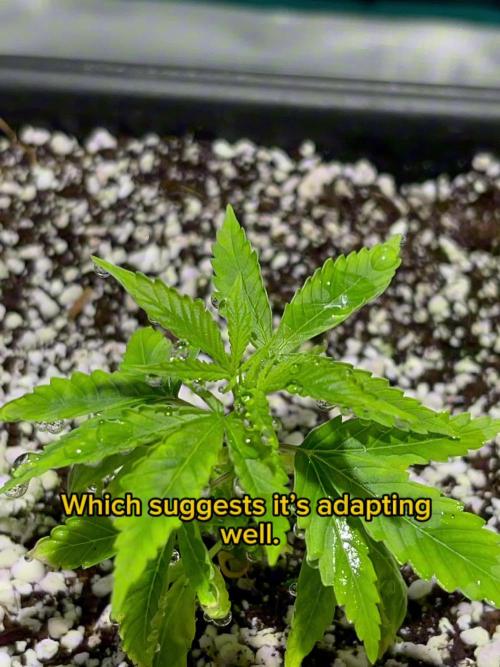
Week 4 of veg. After last week’s transplant, the plant is showing its first signs of recovery: a new set of leaves is forming, which suggests it has likely adapted well to its new substrate. I had kept the dome closed until now, but slightly opened it to lower humidity, and the plant seems to be responding well to the change.
Inside the grow box, humidity stays between 50 and 55%, with temperatures ranging from 25 to 30 degrees Celsius. Higher peaks are expected next week, which may make it harder to keep the climate stable, already a bit inconsistent at the moment.
For feeding, I’m continuing with the Athena line. Current doses are:
• Athena Grow A: 1.5 ml/L
• Athena Grow B: 1.5 ml/L
• Athena CalMag: 1.2 ml/L
• Athena Cleanse: 1 ml/L
EC is holding at around 1.3–1.4, with a target pH between 5.8 and 6. I’ve noticed a few pH drops this week, possibly due to working with small 5 L volumes.
The main highlight for this week is the visible vegetative growth recovery, an encouraging sign for what’s ahead. The goal now is to keep monitoring closely, especially with the upcoming temperature fluctuations, to keep the plant in the best possible conditions.


@MotasKush
Follow
Happy healthy plants, i love you my ladys. Grow Your Own!💚🍁💜🙌 Ripper seeds, limited edition, strain Sunset Sherbet x Purple Punch.💜🤩 Best limited seeds!


@MadeInGermany
Follow
Hi everyone 🤗.
It was rinsed slightly 3 days ago and now only gets water with 0.4 EC.
From tomorrow on she won't get any Canna Boost anymore, because I'm not the fan of giving it to the end :-)
It always looks more beautiful and more beautiful 😍. You can see how she removes the last nutrients from the leaves and slowly comes to an end 😇.
From next week the trichome pictures will also be added 👍. I can't wait to try them 🤣
I wish you all a nice week, stay healthy 🙏🏻 and let it grow 🌱
You can buy this Strain at :
https://sweetseeds.es/
Sweet Seeds Cup 🏆
Type:
San Fernando Lemon Kush
☝️🏼
Genetics:
OG Kush x Kosher Kush
👍
Vega lamp: 2 x Todogrow Led
Quantum Board 100 W
💡
Bloom Lamp : 2 x Todogrow Led
Cxb 3590 COB 3500 K 205W
💡💡☝️🏼
Earth: Canna Bio
☝️🏼
Fertilizer: Canna Bio
☝️🏼🌱
Water: Osmosis water mixed with normal water (24 hours stale that the chlorine evaporates) to 0.2 EC. Add Cal / Mag to 0.4 Ec Ph with Organic Ph - to 6.0 - 6.3
💦💧

shorts_status_processing


@Mr_nugs_lover_David
Follow
Beautiful pair of phenos of Badaz og cheese very excited about what strain is gonna offer me in terms of quality buds, so excited to see what is every of this 2 phenos gonna be like, I really hope that both of them have the exact terpenes profile and the same potency! Let's keep on working! We'll the ladies have been Transplanted on February 2nd after 17 days since planted, they were very big and the pot was completely conquered by strong roots as you can see, now both of them are in their new 11l pot home let's see how they keep developing! 💛❤️💚🔝💎




@Cannabinatek
Follow
Início da 1ª semana de floração começa hoje com a alteração do ciclo de luz para 12/12. Lets Grow. 💚💚💚😍


@CervantiS
Follow
March 28
Diy Growbox: 60*60*160 cm
Light: 150w led
Light Cycle: 12/12
Soil: CocoPerlite in diy Hydrobucket
Extractor: 120mm PC vent Running 24/7
Dear Growdiary,
Day 110:
Drainwater 185ppm @6.23Ph
Fresh feeding 750ppm @6.05Ph


@eldruida_lamota
Follow
Vamos familia, actualizamos la octava semana de floración de estas Thunder Banana de Seedstockers, salieron las 3 de 3, 100% ratio éxito.
Aplicamos varios productos de Agrobeta, que son increíbles para aportar una buena alimentación a las plantas.
Temperatura y humedad dentro de los rangos correctos dentro de la etapa de floración.
La tierra utilizada es al mix top crop, por cambiar.
De 3 ejemplares seleccioné los 2 mejores para completar el indoor, cambié el fotoperiodo a 12/12 y también apliqué una poda de bajos, se ven bien sanas las plantas, tienen un buen color progresan a muy buen ritmo por el momento, las flores han tricomado que da miedo.
Agrobeta:
https://www.agrobeta.com/agrobetatiendaonline/36-abonos-canamo
Hasta aquí todo, Buenos humos 💨💨💨.


@AsNoriu
Follow
Day 43. All is good, heavy training session, trimmed sometimes almost half of the plant.
It will be 16 girls with different needs and heights, watering, cycle time ... Huge pain, but as it is my LAST of ALL LAST grow, so I just want to get few ounces max from each and do it fast !
Girls last week spent on BioHeaven, Silica and CalMag spray, so leaf colour went a lot better, maybe at the end of week I will feed them heavily. Today and next watering - just 6.3 water.
I took last NL away and now humidity and lightning are a lot better. Will drop lights down in few days, but not a lot ... 16 girls again in one room ;))))
I changed names of diaries, because I will try to finish them indoors ...
@MarsHydro @Susie420 @eleen , the first light that you gave me is moving to other city and I won't document results under her from now on. She served well for my friend, did magic at mines and I honestly would recommend her to any single plant grower ! Great stuff, it was privilege to test her for almost two years. Now she will serve for one more new grower !
Not the best retirement photo , but still ;))))
Happy Growing !!!