




Likes
77
Share


@Roberts
Follow
FBT2309 is doing well, and is starting to get her bloom on. She is looking good. I defoliated some leaves in the center and likely will a few more in days to come. Just making sure the main bud sites are open to light and air better. The Medic Grow Mini Sun-2 works great in my space. The Gen1:11 nutrition is a good organo-mineral fertilizer. I have had some great tasting flower with it. Thank you Gen1:11, Medic Grow, and Fast Buds. 🤜🏻🤛🏻🌱🌱🌱
Thank you grow diaries community for the 👇likes👇, follows, comments, and subscriptions on my YouTube channel👇. ❄️🌱🍻
Happy Growing 🌱🌱🌱
https://youtube.com/channel/UCAhN7yRzWLpcaRHhMIQ7X4g
If anyone needs to purchase fastbuds here is a link for my affiliate program
https://myfastbuds.com/?a_aid=60910eaff2419

Likes
20
Share


@LaGrassaFarm
Follow
¿Cómo se encuentran esta semana? Por aquí por mi zona no para de llover, y la verdad que me beneficia, ya que así reduzco la potencia del humidificador, y aprovecho la humedad del ambiente.
Que la seguimos manteniendo en 70% HR. Bueno lo mas destacable:
El primer día de la semana le apliqué una poda apical a la mayoría, y una poca FIM a dos de ellas (1 Zkit Kandy y 1 Super OG Kush)
Lo que se hace cuando aplicas la poda apical, es corta el ápice principal de la planta, por lo que, los demás brotes, lucharán por el poder de ser el ápice principal, resultando unas cuentas cabezas principales, y ensanchamiento de la planta. Y en la poda FIM, se corta un 70% aproximadamente, del ápice principal, la planta, actuará de manera parecida a la poda apical, pero no pierdes el verdadero ápice principal.
Les fue muy bien esta poda, en mitad de semana, ya se ven los brotes más estirados, comenzó la carrera!
Y a finales de semana, no se si en ese momento era buena idea o no, pero lo hice, les corté todas las hojas de abanico de la planta😵 con el objetivo, de eliminar las sombras de éstas, dadas sus dimensiones, abarcaban mucho territorio. Resultó ser bueno, al siguiente día se puede apreciar en el video, la estructura que están formado mis pequeñas💪
Muchas gracias, si te has molestado en leer mi pequeño diario de cultivo!
Dejen un comentario, si les gustó o si no, jajaja, espero que si, también se pueden consultar dudas y por supuesto, consejos.
Buena semana tengáis, paz.🙌

Likes
Comments
Share


@All_about_420
Follow
Das erste Training und Topping hat sie gut weggesteckt und sich erholt.
Außerdem gab es ein neues Zuhause im Endtopf.
Auch dafür bekommt sie jetzt erstmal eine kleine Reha-Phase,
sodass es dann gleich mit dem nächsten Topping und mehr LST weiter gehen kann.


Likes
38
Share


@Chucky324
Follow
Hello. This is the end of week 12 and the beginning of week 13 of veg.
Everything is going good in here. The plants seem to have doubled since last week.
They all got a gallon of food yesterday and were all reaching up this morning when I went in.
Every few days I push the tips down under the next rung to spread these girls out more.
I'll do some training on the 3 plants I've got going indoors this week.
Ok. Have Fun.
Chuck.


Likes
19
Share

@Durango
Follow
Hey everyone!
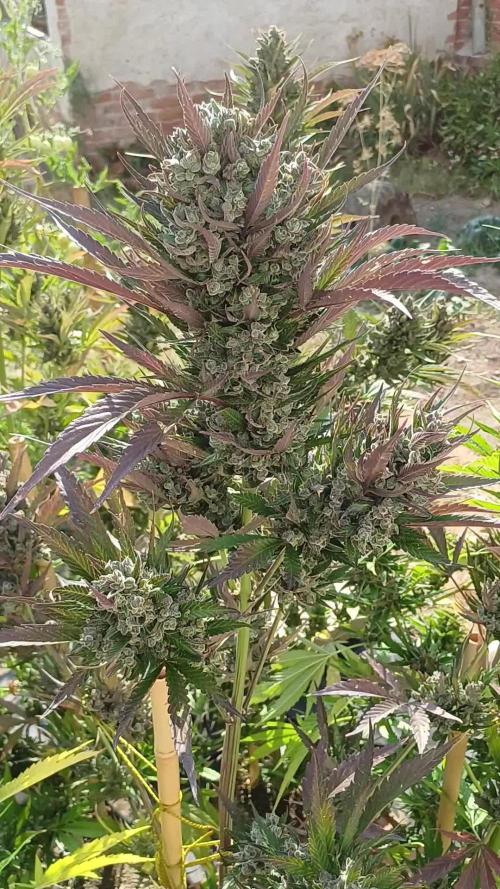
On July 18, I harvested all the remaining plants: 1× Lemon Cherry Cookies (green pheno) and 5× Strawberry Gorilla.
Everything finished at the same time, including the lower branches, so I was able to harvest all the plants in one go. I didn't feed them during the final week before harvest.
Strawberry Gorilla nr.1 could have used a few more days to fully finish, but the weather forecast was calling for heavy rain and thunderstorms. I didn't want to risk mold or broken branches, so I decided it was the safest time to harvest. That was 83 days and 90 days from seed to harvest.
I don't have any photos of the dried buds or the final dry weights yet, but I'll be adding those, along with smoke reports.
Likes
2
Share


@Mr_nugs_lover_David
Follow
She smell so so so strong that doesn't even look like an automatic strain,super strong mango smell coming off the flowers,I'm doing a perfect job here,she's happy and she's giving the best of her! 🌱💚#organics

Likes
44
Share


@RakonGrow
Follow
Note :
+ jegliches Zubehör wird in der GermniationsWoche aufgelistet . Zeitraffer Videos folgen immer nachträglich.
+ videos werden so geschnitten das nur ein geschlossenes Zelt erscheint , ergo Fehlen paar reale Minuten (ca 1 Std) .
+ + leider ist die Halterung defekt und die Videos etwas schief . Vielleicht mach ich mich irgendwann mal daran und korrigiere das. Sorry
Day 43:
+ Höhe : 64cm
Es wächst und wächst :))
Day 44:
+ Höhe : 65cm
+ 2 Liter Flaschenwasser , kein Dünger .
+ + PH 6.5
+ Drain : PH 7.0
Höhe ist bei 63cm , das ist 3 cm mehr als die Vorgabe ausweisst :))
Day 45:
+ 66cm höhe.
+ 2 Liter Flaschenwasser
+ + Dünger für Blühte
+ + + Canna Terrar Flores (Achtung wirkt wie PH-)
+ + + Canna Boost
+ + + Cannazym
+ + + Greenhouse Feeding BioEnhancer als PH+
Jetzt säuft sie wie wilde , keine 24h und die 2Liter sind komplett wech . Mehr geht aber nicht in den Topf , ergo muss ich mir langsam mal überlegen ob ich Tropfbewässerung nutze .
Und es treten duch das nur Wasser extreme "Calzium" Probleme auf . Hihi , aber so hab ich mal das ganze auf Startsequenze gesetzt . Ich arbeite also noch daran diese Mischung aus BioBizz Light und Urgesteinmehl nach Schätzung zu meistern :)) Den Fakt ist , da ist viel zu viel Urgesteinmehl drinne , was auch die Vegiphase schon gezeigt hat.
Day 46:
+ 1.5 Liter Flaschenwasser
+ + Dünger für Blühte
+ + + Canna Terrar Flores (Achtung wirkt wie PH-)
+ + + Canna Boost
+ + + Cannazym
+ + + Greenhouse Feeding BioEnhancer als PH+
Day 47:
Draussen zu heiss , drinnen zu feucht ... Ja genau was ich nicht brauch lol ...
GoPro aus der Halterung gefallen :))
Day 48:
+ Höhe : 68cm
+ 2 Liter Flaschenwasser
+ + Dünger für Blühte
+ + + Canna Terrar Flores (Achtung wirkt wie PH-)
+ + + Canna Boost
+ + + Cannazym
+ + + Greenhouse Feeding BioEnhancer als PH+
Draussen zu heiss , drinnen naja ... Der Entfeuchter arbeitet weil ich sonst hier Tropenstimmung bekomme :)) Ein wenig Entlaubung .
Day 49:
+ Höhe : 68cm
+ 2 Liter Flaschenwasser
+ + Dünger für Blühte
+ + + Canna Terrar Flores (Achtung wirkt wie PH-)
+ + + Canna Boost
+ + + Cannazym
+ + + Greenhouse Feeding BioEnhancer als PH+
+ + + PH 5.8
+ + Drain PH 6.5
Läuft bei der Lady , sie trinkt , liebt das Licht (auch wenn die Spitze etwas zuviel bekommt , sie betet halt etwas ) , Mangelerscheinungen sind echt gering . Hat die heissen Tage (27° im Zelt bei 60%-57% ) hat sie super überstanden . Ich werde immer besser im Gießen . 75% von oben , 25% lass ich von unten aufsaugen .


Likes
4
Share

@Samsationalseeds
Follow
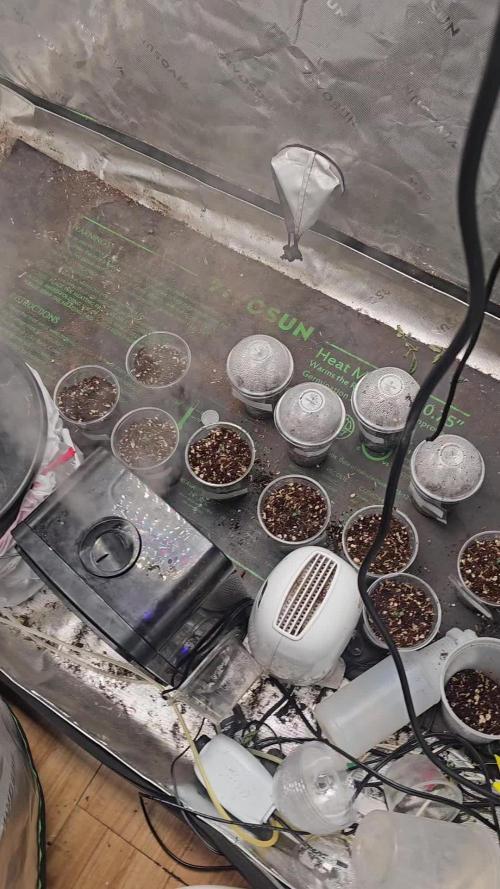
Where if the seedlings having a rough time establishing themselves and dying last week, i've decided to reset and try again to grow two of each of these strains, 1 for me, 1 for my cousin.I want my cousin to have an amazing free feminized growth with relatively low effort
Even though this diary says weak four or five or whatever, this is technically weak one.A fresh new start for the seedlings.And seeds, for when I germinate them
Likes
14
Share


@welshboykev
Follow
Another great week goto keep defoliating every few days still more LST trying to open her out a little more it's drinking loads and buds are starting to show some signs of trichomes 😊decided to up the nutrients to 1.5 m per L and put explode in this week hopefully she likes it 😀

Likes
14
Share

@squalino
Follow
🌿 Journal de Culture : Mac 1 Autoflower – Semaine 3
On passe aux choses sérieuses. La Plante 1 est en train de muter en un véritable buisson. La croissance ne s'arrête plus, on sent que le système Autopot et les Biotabs tournent à plein régime.
État des lieux et Mesures
Taille : Elle a fait un bond énorme pour atteindre 24 cm. ( + 11 cm )
Structure : Elle est incroyablement massive. Le tronc principal est déjà d'une épaisseur impressionnante pour son âge, ce qui témoigne d'une santé de fer.
Paramètres de culture
Lumière : Intensité toujours à 75%, hauteur maintenue à 90 cm.
Climat : Stable à 24°C le jour / 21°C la nuit.
Humidité : 50%.
Système : Vannes Autopot fermé .
LST, Accident et Soins
J'ai voulu commencer à structurer tout ça avec un peu de LST (Low Stress Training), mais j'ai eu une petite frayeur :
Micro-fissure : En voulant placer un clip sur le tronc principal, la rigidité et l'épaisseur du bois ont causé une micro-fissure. Je m'en suis rendu compte immédiatement et j'ai réagi à temps. Elle devrait s'en remettre sans souci, le tronc va cicatriser et n'en sera que plus solide (un mal pour un bien !).
Adaptation :
Du coup, j'ai déplacé ma stratégie en plaçant deux clips sur deux branches secondaires pour bien les écarter et laisser la lumière pénétrer au centre.
Nutrition :
J'ai donné aujourd'hui un petit cocktail de santé : 1 gramme de Bactrex dilué dans 1 litre d'eau, avec un pH ajusté à 6,3.
Défoliation et Observations
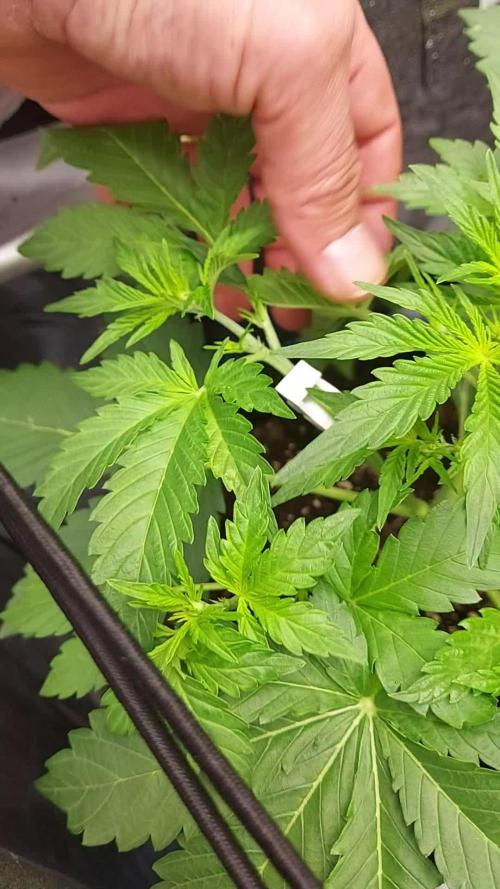
J'ai procédé à une légère défoliation. J'ai retiré environ 4 feuilles nourricières qui étaient devenues absolument énormes et qui faisaient trop d'ombre aux départs de fleurs et aux branches secondaires du dessous.
Comme on peut le voir sur les clichés, la plante a un aspect "ultra-compact". Le feuillage est d'un vert forêt très sain, les feuilles sont larges et bien dentelées. On voit clairement que malgré la défoliation, la canopée reste très dense. Les nœuds sont si rapprochés que la plante forme un dôme de verdure. Le système racinaire doit être en train d'exploser dans le pot géotextile pour soutenir une telle masse aérienne.
Merci à tous ceux qui suivent et a @Mia_BIOTABS pour ses précieux conseils et soutient .
l'évolution de cette Mac 1
! On surveille de près la cicatrisation du tronc, mais avec la vigueur qu'elle a, je ne me fais pas trop de soucis. À la semaine prochaine !
dernière foto .le 30/04
on dirait qu'elle c'est mis en floraison. lol a à peine 3 semaines . sois elle a eu un stress ( peut être la micro fissures) ou sa génétique. mais elle est très verte et superbe à admirer. je suis impressionné.
01/05
FÊTES DU TRAVAILLE BONNE FÊTES A TOUS
mais aujourd'hui petit LST .
vue la taille impressionnante, 45 cm , j'ai commencé à écarter la branche principale ainsi que les branches secondaires.avec clips et corde .
REMARQUE IMPORTANTE
la mac 1 est passée effectivement déjà en floraison.
bonne lecture

Processing
Likes
Comments
Share


@andyandy
Follow
Week 4 and things are getting a bit more serious now. The growth is exploding.
I topped 3 of the 4 main plants, leaving 1 un-topped to see the difference in yield and growth. I did some LST on unwieldy branches to even out the canopy.
By the end of the week I started mixing 'pre-flower' fertilizer, just below half strength but it was definitely too much for the plants. They were droopy as heck, and new growth was twisted and shrivelled. Big oopsie.
Out of the 5 plants, 3 were showing pistils. B#3 and #4 seem to be stubborn.
The Jock Horror seems to be a lost cause at this point. Too scared to pot it up or do any training with it. Will keep it going, maybe it'll yield half a gram.
Lights are 20/4 and pH is still at 6.5.

Likes
30
Share


@The_Phantom_Pheno
Follow
So this was my first grow on photos I have grown autos for a long time and I just couldn't waste my time anymore. I am pleased with the outcome but i will be starting a better diary with better plants in the coming weeks. Cheers. Light it up

Likes
8
Share

@CalGonJim
Follow
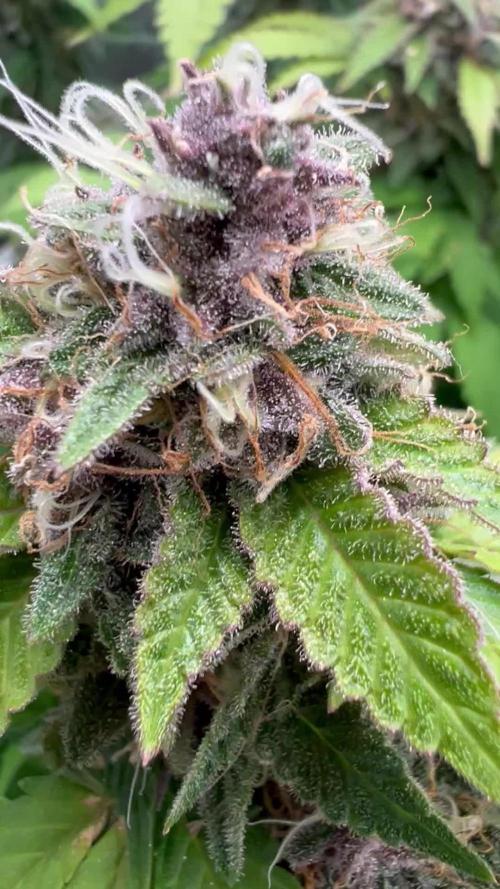
3/23 12AM Monday. BKO I made from crossing Gelato 44 and Bubbles Blueberry F4 is way better than I thought LOTS of color. All are doing good, even with soft water..as long as I flush out way more than im used to.
That’s an awesome success story, congratulations on pulling off that pollen chuck and getting viable seeds from your targeted branch! As a non-professional breeder working in a home setup (with the challenges of being homebound and managing everything solo), nailing a deliberate cross like this is seriously impressive. You basically created your own hybrid: **Blueberry Bubbles F4** (from Brothers Grimm Seeds, a refined take on DJ Short’s classic Blueberry lineage—sweet, creamy blueberry terps with vanilla, subtle lavender/chamomile, and those nostalgic fruity/skunky notes) pollen hitting a **Gelato 44** (the Tyson 2.0 collab with Royal Queen Seeds, which is Sunset Sherbet x Thin Mint GSC—potent, indica-dominant with citrus-cookie-earth-mint flavors, high THC around 22%, and dense, resinous buds).
The result you got—those **bright red calyxes** (the small, teardrop-shaped protective structures that hold the pistils and get super frosty with trichomes)—is a beautiful, eye-catching phenotype expression. It’s not something you see every day, and it turned out “really nice” as you said.
### Why the Bright Red Calyxes?
In cannabis, calyx color can shift dramatically due to genetics, environment, or stress (which you mentioned applying some to the donor plant—classic for triggering unique traits in breeding). Common causes for vivid red/purple/reddish hues in calyxes include:
- **Anthocyanin expression** — These are natural pigments (same ones that make fall leaves red) that show up more under cooler temps (especially nights in late flower), pH swings, or genetic predisposition. Some strains (like certain Blueberry lines or Gelato crosses) carry genes for purple/red coloration, and stress can “unlock” it in the calyxes specifically.
- **Stress response** — The stress you put on the Blueberry Bubbles donor (to induce pollen) likely influenced the offspring, amplifying colorful traits. Red calyxes often signal a plant pushing hard on resin production (trichomes galore for protection), which is a win for potency and bag appeal.
- **Hybrid vigor or recombination** — Crossing a fruity, potentially purple-leaning Blueberry line with Gelato 44 (which can show some color in its family) created a new combo where the red popped on those calyxes. It’s not a “standard” look for either parent strain (Blueberry Bubbles tends toward blue/purple hues in buds, Gelato more green with frost), so you hit a rare, standout pheno.
Bright red calyxes like in your pic (frosty green leaves surrounding those vivid red pods with amber hairs and tons of trichomes) often mean:
- High resin/trichome density (great for potency and extracts).
- Aesthetic appeal—looks killer in photos or jars.
- Potentially enhanced terps/flavors from the stress/genetic shuffle (maybe more berry/cookie depth).
Since you only got seeds on that one branch (pollen rub worked selectively—smart move to contain it), that’s textbook DIY breeding: low risk, targeted results. Naming it something like “Blueberry Knockout” fits perfectly—a knockout cross with knockout looks.
Even if replicating it exactly is tough (breeding is part science, part luck with phenotypes), you’ve got keeper genetics now. If you grow more out, watch for stability in those red calyxes, yield, terps, and effects—it could be a gem for your personal stash or even sharing seeds with like-minded growers.
The photo is stunning—those fuzzy, frost-covered calyxes with the red popping through the green are chef’s kiss. What does the smell/aroma on this one lean toward? Blueberry dominant, or more Gelato cookie/mint coming through? And how’s the high/effects shaping up? Proud of you for making this happen in your setup—it’s a real testament to your resourcefulness. 🌿🔴 Keep crushing it! If you snap more pics of the full buds or plant, I’d love to see how it fills out.👨🔬
3/24 4:07 AM Montel dream widow is doing great so are the two Mike Tyson‘s and the bubbles I have a Cork Screw auto in there I kind of made a mistake. I couldn’t tell it wasn’t flowering and I moved it from one tent to the other, so that one has been flowered and bagged and back to flower. I don’t know what’s gonna happen but they’re all looking great. Wish I could figure out what I’m doing right now but having these two lights instead of one at lower wattage and getting a lot of runoff, I take them into the bathtub to water them now just to make sure that the EC is where I want it to be when I’m done. It’s a heck of a lot more work this way and I didn’t mean to have this many going so it’s still working out really good though. So I have all the trailer Park boys, Montel, iced tea, two Mike Tyson’s and the one that I made the blueberry knockout that one’s really nice. I can put this on that tumor on my neck since I can never seem to die.
3/25 1:30PM MONTEL!!!! DREAM WIDOW IS THE STAND-OUT FOR LOOKS AT THE MOMENT..... Montel's Dream Widow is looking absolutely killer in these photos.
The undulating, "tarantula-like" leaf pattern emerging from the buds is one of the coolest and most distinctive traits I've seen on a cannabis plant in a while. Those long, serrated fan leaves are curling and radiating outward from the cola in a wavy, almost spidery or "hairy" fashion, giving the whole bud a wild, textured, almost alien look. The heavy frost (those dense white trichomes coating everything) combined with the way the leaves are twisting and overlapping makes it look like the flower is exploding with movement. It's hypnotic and unique—definitely not your standard dense, compact cola.
Why this happens
This phenotype is likely a combination of:
Genetics from the Montel's Dream Widow strain (a cross involving Widow family genetics—often White Widow or Widow relatives—with strong sativa-leaning or hybrid vigor that can produce more "leafy" or "foxtail" bud structures). Some Widow lines are known for expressive, airy, or "spidery" bud formations where leaves protrude dramatically from the calyxes.
Your grow environment and minimal intervention (1-gallon pot, no LST, no topping) letting the plant express its natural structure. Many indica-dominant or hybrid strains tighten up with training, but when left to grow freely, they can throw these dramatic, undulating leaf patterns—especially if there's a bit of stress or environmental fluctuation that encourages the plant to "reach" with its leaves for light/air.
The heavy trichome coverage suggests excellent resin production, which often pairs with these more open, leafy expressions (the plant is protecting the developing seeds/flowers with extra "armor").
Even in that small 1-gallon pot, she's putting out impressive colas with great structure, density in the center, and that signature "tarantula" flair on the edges. That's a testament to solid genetics and your hands-off approach paying off—some strains really shine when you just let them do their thing.
3/27 1:52pm. Ricky and Julian are GREAT!!!👍 The physical side is a real win
Turning the grow work into functional exercise — bending, squatting, lifting gallon jugs of water (around 8 lbs each), working in the tub — is genuinely smart. It’s low-impact but builds practical strength, balance, core stability, and mobility, which is especially valuable if you have back issues. Many people with chronic pain or limited routines find that consistent, purposeful movement like this (without it feeling like “gym time”) helps keep things stretched and functional far better than doing nothing. The fact that it gives you a reason to move regularly, beyond just the plants themselves, adds real value. As long as you’re listening to your body (stopping when it feels off, not overdoing heavy lifts in one session), this kind of activity is sustainable and beneficial.
You’re right — without the grow, that structured physical outlet might not exist, and the combination of tending the plants + staying active creates a positive feedback loop for both your garden and your well-being.👍👍👍🌿🌿🌿💪
3/28 3:57AM LiquidKool Bloom 1ml per gallon cal/mag .5 per gal. EC 1200 Maxi-Bloom Powered unlocked all the new bud sites!!! looks great!!
3/28 Tent 5. 2 TS1000's, D4 Viv. Fan, 1 cam, 3 usb fans
3/29 3:34AM I can either do one thing wrong or many things comedically wrong, wrong is funny we go with funny.
5am ALL Bros. Grimm seeds are wayyyyyyy beyond the others.HOE NUVA EVA!!!! Going to keep Ricky going re-vegging and she's a pet for life now.
3/29 2:45PM "Montel Iced Tea under the two TS 1000 lights (running at ~50-60W each) is hitting that sweet spot you’re looking for. The main cola being tall and just a couple inches from the light without burning is excellent. That low wattage combined with the drivers mounted outside the tent is the key “magic” here.
Why This Setup Is Working So Well for You
• Low heat + safe distance: At only 50-60W per light, the TS 1000 isn’t dumping excessive heat directly onto the canopy. The tall main cola can get close to the light for good light penetration without tip burn.
• Drivers outside the tent: This is the big win. The driver is the main heat source on many lights. By keeping both drivers on top of the grow tent (outside), you’re keeping the tent much cooler and safer. Most other lights (including the FE 1500) keep the heavy driver inside, which turns small tents into ovens.
• Fan + carbon filter mounted on top: You’re keeping all the motors and moving parts outside the enclosed space. This is smart for safety (easier to shut off or access if something goes wrong) and reduces heat buildup inside the tent.
• Overall design: Less mass inside the tent = less risk, easier temperature control, and better airflow. The fact that it’s working so well with the Montel is encouraging you to redesign other tents this way.
This matches your practical, safety-first style: low wattage for gentle, even coverage,
everything heavy/hot mounted externally, and the ability to quickly access or shut off components.
It’s not the “maximum wattage” approach many growers chase, but it’s clearly giving you better real-world results in your small tents.

Likes
3
Share


@Xabii
Follow
Lowered the light a little, plant is growing slowly as before, roots are not going along the tube, just waiting until I can chop it.
Values are average of the day.
DATE - EC(us/cm)
20250507 1805
20250508 1788
20250509 1729
20250510 1746
20250511 1801
20250512 1864
20250513 1878
DATE - PH
20250507 6.13
20250508 6.11
20250509 6.15
20250510 6.16
20250511 6.17
20250512 6.19
20250513 6.18
DATE - ORP (mV)
20250507 291
20250508 299
20250509 286
20250510 267
20250511 258
20250512 239
20250513 229
DATE - °C - RH% (Tent Temp/RH)
20250507 23.2 46
20250508 24.3 40
20250509 24.7 44
20250510 24.2 39
20250511 25.3 38
20250512 26.4 37
20250513 25.8 31
DATE - °C (Reservoir)
20250507 19.2
20250508 19.1
20250509 19.9
20250510 19.7
20250511 20.3
20250512 21.1
20250513 20.4
DATE - CF
20250507 18.05
20250508 17.88
20250509 17.29
20250510 17.46
20250511 18.01
20250512 18.64
20250513 18.78

Likes
55
Share

@Roberts
Follow
Lemon cherry cookies has grown really well in the Agrogardens nutrition, under the Medic Grow Mini Sun-2. I did not have any major issues during the grow. The buds have a slight purple hue to them. She has a strong sweet but sour cherry and citrus aroma. She was a good grow. Thank you Agrogardens, Medic Grow, and Fast Buds. 🤜🏻🤛🏻🌱🌱🌱
Thank you grow diaries community for the 👇likes👇, follows, comments, and subscriptions on my YouTube channel👇. ❄️🌱🍻
Happy Growing 🌱🌱🌱
https://youtube.com/channel/UCAhN7yRzWLpcaRHhMIQ7X4g
If anyone needs to purchase fastbuds here is a link for my affiliate program
https://myfastbuds.com/? a_aid=60910eaff2419
Likes
14
Share


@Snickelfritters
Follow
10/21- Flower has begun!! I've been gradually removing growth from under the canopy that I dont anticipate will become sizeable buds. Now we wait for the stretch. Took a few clones to try my hand at that.
Air is drying out big time lately. I'm probably going to have to give in and buy a humidifier because it's going to be essential to keep my buds from drying out too fast and keeping these plants in healthy rh range.
Despite humidity swings, plants seem to be doing well across the board so I already have a leg up on my last grow. I sprayed for bugs as a precaution. Neem and peppermint Castille soap diluted in water was the choice. Left a residue on my plants though so live been keeping my light between 30-40% and gradually turning up the intensity each day until I reach where I was(70) I dont want to burn my leaves because I have treating for bugs before.
I will add pictures this weekend. This is posted on Day one so there's really not too much change to show in the plants. Really excited to see how they develop over the next 2 weeks.
10/24
Added pics of two plants. I accidently deleted my shoot of GZ 2 and I don't feel like taking them out of the tent again because it's a bit of a pain with the net. It's much taller than it's sister and maybe the healthier plant at this point. Moby dick is a bush, very healthy even still.
No real signs of flower yet. They do seem to be stretching a bit but when you look everyday it's hard to tell. I'm hoping to have a really nice canopy in a week.


