


@Paflucy
Follow
Hello everybody :)
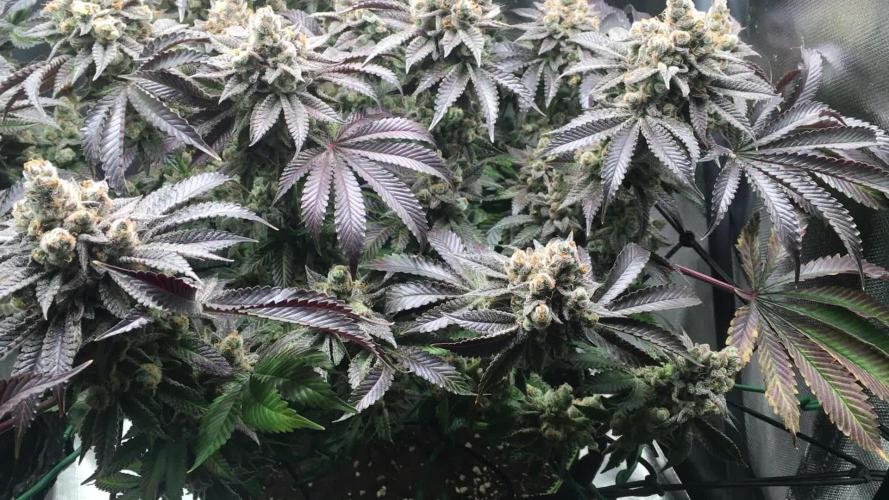
End of the ninth week of flowering.
Some of the lady's change color slightly. Probably next week will be the las for Power Plant, Wild Thailand and Critical Haze - yeaap they are almost ready for harvest :)
The rest definitely need two more weeks.
Due to the fact that we have here mainly sativas, including powerful haze genetics, they are not very dense, but still very oily and sticky :)





@Northerngrowers
Follow
Primera semana de floración.
Las niñas crecen en condiciones óptimas y recién hecha limpieza de bajos.
Se ve que son muy buenas genéticas ya en la fase vegetativa.


@Mr_Dior21
Follow
Man this week has been taking forever, my theory is it will only get slower relative to harvest just because my excitement.
I top dressed with about 2 inches of worm castings with an eyeballed mix of 2tbps of bone meal (3-14-0, bloom fert.), 1.5-2tbps of Gaia green all purp.(4-4-4, I don’t have an actual potassium fert. Like leingbenite So I use this), 3tbps of dr earth kelp meal (1-.05-2 has many different vitamins, amino acids, carbohydrates) and 2tbps of mykos (for microbiology inoculation and nutrient uptake/upkeep).
So I every time I water I have this old 2gallon water tin that I usually fill up about a quarter to half way full. Using this amount of water and the 5 gallon bucket of my soil mix makes my watering schedule once every 3 days (on average). I do use bottle nutrients but it’s mainly for the supplementing. For feeding I use 2-3ml to half a gallon for all bottle nutrients, I have never gone over, and I have never had deficiency’s that can hinder plant development.
Deficiency's: PSA: Now if anyone happens to read and actually look at my plants please do look closely and maybe let me know if you see something that I have missed since I’m still very new. I noticed my plant was having a cal mag issue so that’s why I top dressed with worm castings, I also top dressed with about 3tbps of azomite (I feel using azomite it may help with all those unnoticeable deficiency’s that a new grower might miss). I’ve been noticing on some of the leaves the very tips are showing discoloring, since the color is still so vibrant mostly I can rule out nitrogen, phosphorus, Iron, manganese, and sulphuric. It’s still very early stage so I did an extremely light foliage feeding (in the dark to prevent UV damage) of 2ml of big bud, big bloom, and tiger bloom, mixed into half a liter of water, I then emptied the spray bottle and sprayed with tap water just to make sure there’s no nute burning. Today I fed the plant through water amendments with 3ml of big bud, 3ml of bud candy, 3ml of big bloom, and 2ml of tiger bloom;(my theory is hopefully the nutrient deficiency’s will go away)
My soil mix is pretty basic. 40% coco, 10% perlite, 10% well composted chicken manure, 20% black gold compost, 20% worm castings. I’m not going to put the fertilizer amendment percentage to be honest I eye ball it but there’s a rough general measurements that I do.


@KushAllDayLong
Follow
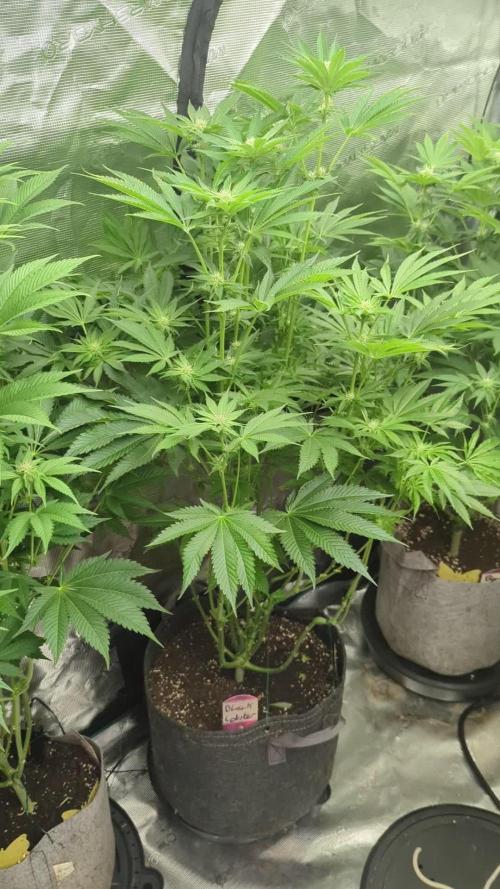
Alright Growmies!! So this Purple Ice Water is a bag seed I got from an amazing strain i had and was lucky enough to find hidden gem inside one if the beautiful nugs!! I think I have a photo in my Google photos I'll look for a picture of the flower the seed came from!!
Anyway, I was going to enter the 16oz solo cup challenge but I didn't realize time was running out and so i had already planted the seed by then and of course she popped and I grow attached to them when that happens so here we are!! Not to mention, this is my first indoor grow and so I'm not thinking or planning as I should be and so guess what problem I ran into next...well my tent was now in flower so lights were kn 12/12...so 3 days into the new seed I planted, i need more hours of light for her and so you'll see my solution in the photo or video..my lady thought it was hilarious when she walked into the bathroom to get ready in the morning and a baby cannabis plant was handing from the light fixture lmao!! 🤣🤣🤣🤣 this is only temporary fix and she is only hanging up there for a few hours then I place her back into the tent to give her that much needed light!! I could always do the window trick but hey this was too fun!!
1st week is going amazing, as it can go lmao!!
Between day 5 and 6 I added some rain water. It rained for almost 3 days straight here in Arizona so it was nice to be able to capture some rain water for my girls for once! Those days are few and far between unfortunately!!


@PapaTerps
Follow
Black Lobster - Cipher Genetics
Week 3 of Bloom
🌸 She has finished her stretch and is working hard of developing her flower! No real scent just yet, hopefully that comes in over the next few days. She has strong lateral stems and looks really healthy, so all good so far 🙌🏻
✂️ I've lollipopped her again, removing all leaves stems and budsites below the top 6-7 nodes from the canopy - these lower branches won't develop into anything and will more than likely cause problems later down the line. I've also removed a couple of the larger fan leaves from her center, to improve airflow and light penetration 💪🏻
💧 Watered every three days with 5L of RO water, with nutrients mixed individually, in order and then finally, I pH'd the solution to 6.3. I've increased some of her nutrients and added the Alg-A-Mix as a precaution to any temperature fluctuating that might occur this time of year.
💡 PPFD: ~740
♒ VPD: 1.34kPa
🌱 Days from seed: 78
🌸 Days in Bloom: 19


@1Right_Angle
Follow
July 16th
- Fed the plant 2 gallons over the Morning. (see last weeks menu, rain prevented its use) Next meal posted above
- real growth on this sucker as it fills out nicely. Well, only the ends of the branchs really.
But its hapnin
- 2 days without Rain, it was Time to feed this guy before the next storm rolls in. Getting slammed with rain here in Southern Ontario. Moisture meter was at least on-scale and Left of middle = GO
17th
- plant looks great as we head towards Flower.
One more regular feed, around mid-week, with close to maximum Veg food. Then I’m going to introduce a little Bloom Nutrient into the mix next week. Feed the transition so to speak. ( I’m also talking a 25% bloom dose to start, in the reg veg mix ) All the action, Its right around the corner
- Foliar spray tonight
July 20th,
- the weather is going to let me feed Jack this morning. Her last 100% meal of Veg Nutes.
***That was my plan till I saw all the activity on the ends of my branches. I have added a small taste of Bloom nutes to this meal today!
- 3 gallons over a 4 hour period and the goal is to let Jack dry out after this feed ~ 4-5 days would be ideal.
- Might even be seen as a little nutrient Push…
22nd
- finishing the week strong with a couple days of Sunshine. Go figure


@russrahl
Follow
These girls are monsters. Lol they kinda got away on me this week as I got bit busy, and I was forced to turn down my light to 750w to keep my D.P.I. In check. All good though now and things are ramping up. Not much else to say really, just keeping things rolling along. Some strains are just easy...lol Stay tuned for more next week! Cheers 💨


@Arcadium
Follow
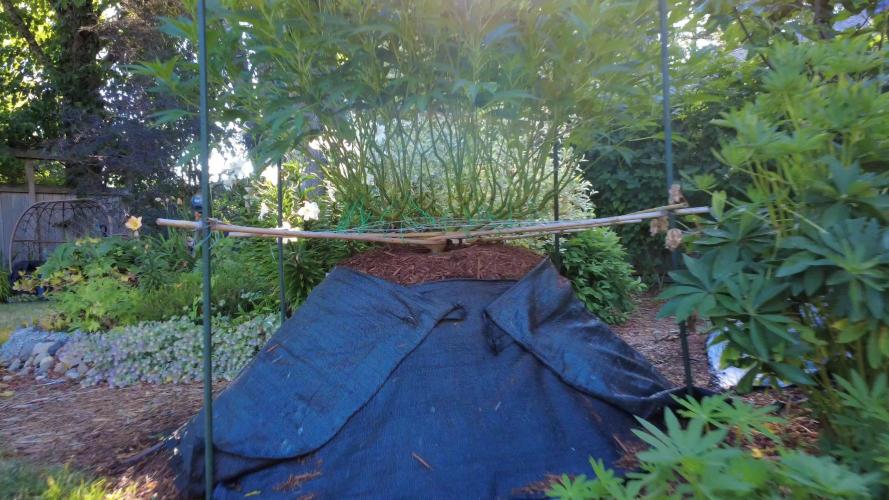
Smooth sailing this week, little rain (8mm) wind, cooler temperatures but she's powering through it. Height control this year is much better, seems like the aggressive 64 cola manifold really spreads out the vertical growth. Pistils already! So she should stretch pretty aggressively over the next 2 weeks. I'd say pistils are showing a few weeks earlier then last year Blueberry Pie F1 Fast, which is great. Not sure if this sativa leaning hybrid will need a little more time though.
Did another top dress, upped by 50% from the last run, 30 tablespoons of Gaia Green 70% All Purpose / 30% Power Bloom. I mix my dry ammendments with around 6 cups of beautiful homemade compost before top dress and remulch with local hemlock bark mulch. I had to peel the drip irrigation hose out of the feeder roots which were wildly aggressive eating every bit of the last top dress. This is the first year I've been using Monster Maxx, super impressed.
So many soil creatures, thousands of millipedes breaking down every bit of that Gaia Green, compost and mulch. Found a massive mushroom at the base of the Hugel a few weeks ago, awesome indication of a thriving soil food web.
Light defoliating of the inside and bottom third, still removing any nodes below the top 3 and using bud clips to even out the cannopy.
10g airport still struggling to push into full flower, heights stopped, more and more pistils every day, and tightening of nodes, so she'll get there soon enough.
Drip irrigation, silica, monster maxx, and weekly spray of LCPT and that's a wrap!


@Canadian
Follow
I use all 3 General hydroponic nutrients and they are two different pot sizes the Moby Dick is in 30 liter and the blue amnesia is in 18 liters has a very strong odor and blue amnesia is maturing at a faster rate then the Moby Dick.
a scrog net is being used in order to give support to the upcoming buds.
I am also actually on week 4 I just made a mistake calculating the week.
this is my first grow ever.
also I'm not sure if using the scroll net it's a good idea for support rather than tying those branches up .
I am watering every two days feeding nutes every single time at 900 to 1000 PPM ph at 6.2 the plans have not show any signs of stress but I am worried if it is too much nutrients the plant seems to grow very fast after every watering and seems to be loving it.
the blue Amnesia XXL Auto it's growing in soil with 30% Coco and the Moby Dick XXL auto it's growing in hydroponic soil.
the seeds were germinated on jiffy's and 100% germination rate plus the genetics seems to me very resilient to heat and everything else including lots of nutrients.
the moby Dick XXL auto are the two in the front closest to the camera the two farthest to the back of the tent are the two blue amnesiaXXL auto.
today day 31 i did some pruning actually lots of pruning hopefully don't cause stress to the plants or even worse cause them not to bud that nicely regardless the scrog net seems to be working just fine helping them access more light and making it easy for cutting leaves that are no longer needed.
32 yesterday after watering and sleeping today they have show no signs of stress in fact they starting to stretch in the buds that we're not getting sufficient light have start to grow also yesterday from the 16 liters I prepare instead of 3 ml of grow formula I add 6 1/2 to compensate for stress and the need of healing and having new grow stretch. also temperature has dropped dramatically outside making my house cold down from 24 degrees C to 19° at night internal temperature is remaining the same from 30 to 26 C.
Day 33 I have been raising the scrog net every day and the light everyday this plant is growing very fast I also notice that where the fan is hitting all the time that plant is bigger I have been moving the fan to other sections of the grow tent to see if any reaction happens and it looks like it makes the plant grow faster . I will not be moving the Scrog net any higher Rather I will introduce another one once they require more support .
Day34 notice some of the top leaves are showing a curving down like over-watering without actually over water I think they're showing signs of too much nitrogen .for the next water session I will hold back on nitrogen until I see signs of a fully recovering meaning leafs pointing up.
thank you for reading have a happy grow.

shorts_status_processing


@greenflipcali89
Follow
Wow, what a difference a week makes! Amazing growth of new stems and foliage. Continued to do LST. She is responding well to it and increased light power to 100%. Experienced a little light burn the first day, but raised it up to 18" again. She grew a few inches and didn't raise light accordingly. Trying to manifold and spread out, hopefully filling up as much space as possible. Did some light defoliation to open up the light to the lower area.


@Jack_Greenstalk
Follow
didn't finish the whole week of veg, stopped at 53/44 before switching to 12/12 light cycle, gave RO only final day and have switched feed to bud a and B. all photos are from day 53 and earlier. since this post and switching to flower I have taken 4 clones, 2 using clonex 2 using aloe vera. i have done a ton of lollipopping and defoliation since flip and they are stretching away! stayed tuned for week 1 flower updates :)


@LokalGrenz
Follow
Added some cal mag to the ro water besides that everything looking good so far
Added bloom 6/25


@Master_weeda
Follow
Bonjour à tous les padawans et les maîtres jedis
Pour cette semaine 3 au jour 19 ma plante fais 21 centimètres et son septième noeud apparaît je décide donc de pratiquer un LST sur ma plante.
Pour ce j'utilise du fil de fer galvanisé que je plante directement dans le substrat en faisant attention de ne pas endommagé les racines car n'oublions pas que ce qui pousse dessus pousse aussi dessous.
Jour 17 je pulvérise du une solution composé d'une cuillère à café de savon noir mou (marque briochin) dilué dans un demi litre d'eau en prévention d'éventuels nuisibles.
Pourquoi le savon noir mou ?
Savon noir : quelle utilisation pour le jardin ?
Le savon noir est un produit naturel dont les propriétés nettoyantes sont connues depuis l'Antiquité. Utilisé pour l'entretien de la maison et pour les soins corporels, ses vertus antibactériennes et insecticides en font un allié précieux pour le jardinier bio.
Le savon noir est fabriqué à partir de potasse et d'un corps gras de type huils végétale comme l'huile d'olive, de lin ou de maïs.
Produit naturel et biodégradable (s'il ne contient pas d'additifs, comme cela peut-être parfois le cas), c'est un très bon produit nettoyant, pour les sols, la cuisine, la vaisselle, le linge, etc... Très polyvalent, il est également économique, comparé aux multiples détergents classiques du commerce.
Le savon noir se trouve sous forme de pâte molle et brune ou sous forme liquide, dilué avec de l'eau. C'est du savon noir liquide dont on se sert généralement au jardin, car son utilisation est plus simple. Il s'achète dans les magasins bio ainsi qu'en grandes surfaces ou jardineries.
Attention : la recette du savon noir de ménage et celle du savon noir utilisé en cosmétique ne sont pas forcément les mêmes ; les savons noir de ménage (multi-usages) peuvent contenir davantage de potasse afin d'améliorer le pouvoir dégraissant (irritant ou desséchant pour la peau), voire même certains additifs chimiques.
Au jardin, ce sont en priorité les propriétés antiseptiques et insecticides du savon noir qui sont utilisées.
Le savon noir liquide est utilisé pour lutter contre les pucerons, les cochenilles, les araignées rouges, les aleurodes, les psylles et autres thrips. C'est un insecticide de contact ; il tue les larves et nettoie le miellat qui englue les feuilles.
La recette de l'insecticide à base de savon noir (mou pour ma par marque briochin) est simple à réaliser : une ou deux cuillères à café de savon noir mou (briochin) diluées dans 1 demi litre d'eau tiède (dilution à 5 %) ; une fois la préparation refroidie, pulvérisez-la sur les plantes atteintes, en prenant soin de ne pas oublier l'envers des feuilles. À renouveler 1 à 2 fois si nécessaire, pour être totalement débarrassé des indésirables.
Comme il est de mise pour la plupart des traitements, ne pulvérisez pas la solution à base de savon noir en pleine journée, sous le soleil (ni sous la pluie !) ; procédez le matin de bonne heure ou patientez jusqu'à la fin de journée, lorsque les températures sont en dessous de 20°C.
Jour 18 Je corrige mon LST suivant la pousse de ma plante ...
Pour ma par c'est la manière dont je procède mais petit rappel de la technique du LST
Quand commencer à appliquer la technique LST ?
De nombreux cultivateurs commencent la manipulation dés que les plantes possèdent entre 3 et 6 nœuds ou une paire de feuilles. Durant cette première étape de la croissance, le tronc encore flexible est pliable sans risque qu’il ne se casse, même si au fur et à mesure du développement de la plante il sera de plus en plus difficile de le plier. Nous pouvons continuer à guider la croissance des branches durant toute la culture, même durant la floraison, ce qui pour cette étape représente un grand avantage face à la taille, qui n’est pas du tout recommandé une fois que la formation des têtes commence, cela stressera en effet la plante, ce qui aura pour effet de retarder la récolte.
Comment appliquer la technique de guidage LST
Si nous sommes prudents, la flexibilité naturelle des fibres du cannabis permet de plier leur tronc et branches avec une relative facilitée, même durant la floraison des plantes.
En utilisant une corde fine, nous pouvons accrocher la pointe de la plante à la base du pot par exemple ou à un tuteur que nous aurons planté dans le substrat. Nous plierons le tronc avec précaution et nous le fixerons avec la corde, à partir de là, nous pouvons augmenter progressivement la tension de la corde, chaque jour un peu plus, jusqu’à obtenir la position souhaitée. Soyez attentif à la réaction de la plante, essayez de ne pas appliquer trop de pression sur la corde et rappelez-vous que la flexibilité des branches peut varier d’une plante à l’autre.
Pour obtenir de meilleurs résultats, il suffit de suivre quelques règles simples. Pour commencer, nous devons choisir une corde fine mais pas trop pour ne pas blesser les troncs au fur et à mesure qu’ils grandissent et qu’ils deviennent plus gros.
Nous pouvons utiliser des crochets en plastique souple ou de n’importe quelle autre matière flexible pour éviter d’endommager les plantes. Spécialement en intérieur, utiliser des cordons en plastique de couleur (voir les diaries de @Silky) est très pratique pour voir facilement les accroches et faciliter le travail au milieu du réseau formés par les cordes, les tuteurs, les mailles ou les supports que nous aurons dans la culture. Bien entendu, en culture extérieure et surtout en guerilla nous ferons juste le contraire et nous utiliserons des matériaux de couleur qui n’attirent pas l’attention pour que notre jardin reste discret.
Pour stresser les plantes au minimum, la mieux est de réaliser ces manipulations le soir ou juste après que les lampes en intérieur s’éteignent, ce qui leur permettra de se remettre durant la nuit. Normalement, le jour suivant nous pourrons observer comme les pointes des branches que nous avons pliées se dressent de nouveau vers le haut à la recherche d’une source de lumière.
Que la force soit avec vous💪



@MyLittleGarden
Follow
Blütewoche 4 – Amnesia Lemon
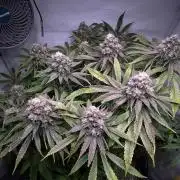
Blütewoche 4 ist nun abgeschlossen. Die Pflanze hat den Stretch weitestgehend beendet und ist nochmal ca. 7cm in die Höhe gewachsen. Der Fokus liegt nun klar auf der Blütenbildung. Wie auf den Bildern zu erkennen ist, haben sich die Budsites deutlich weiterentwickelt und beginnen langsam, an Volumen zuzulegen.
Insgesamt macht die Pflanze einen sehr vitalen und stabilen Eindruck. Die Blätter sind kräftig, satt dunkelgrün, an einzelnen Blattspitzen etwas heller, was vermutlich auf die Nähe zur LED zurückzuführen ist. Der Lampenabstand beträgt aktuell etwa 30 cm zur obersten Blütenebene, mehr Spielraum nach oben ist kaum noch vorhanden.
Das Klima im Zelt ist inzwischen gut eingependelt. Die Temperaturen liegen bei etwa 18–29 °C, die Luftfeuchtigkeit tagsüber bei ca. 54–74 % an den oberen Buds. Im unteren Bereich des Blattwerks ist die Luftfeuchtigkeit etwas höher, bewegt sich aber dank optimierter Abluft und Umluftventilatoren im akzeptablen Bereich. Der VPD-Wert liegt aktuell bei etwa 1,3–1,6 und damit im optimalen Fenster für diese Blütephase.
Angebaut wird weiterhin komplett ohne Dünger in einem 140 L Living-Soil-Beet. Bewässert wird über ein Blumat-Tropfsystem, kontrolliert mit einem Blumat Digital. Nach frischem Gießen und dem Ausbringen von Wurmfutter ist im Substrat deutlich Leben zu beobachten, was für eine aktive Bodenbiologie spricht. Zusätzlich wurde grober Hanfmulch ausgebracht, um die Feuchtigkeit gleichmäßiger im Boden zu halten.
In dieser Woche wurden vereinzelt Thripse festgestellt (helle Sprenkel auf den Blättern sowie einzelne fliegende Tiere). Befallene Blätter wurden umgehend entfernt und vernichtet, einzelne Blattunterseiten vorsichtig mechanisch gereinigt. Eine Bestellung von Nützlingen (Neoseiulus cucumeris) wurde bereits aufgegeben und soll zeitnah eintreffen, um den Befall biologisch zu regulieren.




@Ultraviolet_
Follow
Nirvana is interpreted as awakening from the illusion of separation and the limitations of time and space, effectively "seeing" the underlying code of existence. In Buddhism, Nirvana is described as the "unconditioned" (asankhata), a reality beyond dependent origination (cause and effect). This aligns with the concept of a fundamental, timeless "code" that exists before material manifestation. Some interpretations equate the stillness of Nirvana with the quantum vacuum, a state of "zero energy" which, however, holds unlimited potential for manifestation.
In quantum mechanics, a quantum system remains a "wave" of possibilities until observed. The "on-demand" aspect is often linked to the ability of a highly developed, enlightened consciousness (a "pure observer") to collapse this wave into a desired state, interacting directly with the underlying quantum reality. This view implies that by breaking free from the ego and mental conditioning, one gains mastery over the energetic, or vibrational, foundation of reality. The feeling of oneness in nirvana is explained through [quantum entanglement], suggesting all things are connected, and therefore, an enlightened mind can interact with any point in the universe. Traditionalists might argue that Nirvana is not about gaining control or having the power to "manifest on demand" (which can be a function of ego), but rather the total cessation of craving and the surrender of the ego, bringing an end to the desire to control reality.
The spiritual path is an evolution from being controlled by the "code" (samsara/suffering) to understanding the code and, eventually, becoming the author of one's own. With the awareness of how "code" functions, one takes full responsibility for their life, making conscious choices rather than reacting impulsively. Thoughts, words, and actions are purposefully aligned with higher values (truth, love, purpose), effectively rewriting one's destiny.
Humidity of the air dictates the moisture in the medium, which dictates the rate of pull from the terracotta stakes, 16 in total.
Soil-Plant-Atmosphere Continuum (SPAC): An ecological concept referring to the pathway of water moving from the soil, through the plant, and into the atmosphere.
Terracotta (unglazed, low-fired clay) is highly porous, acting as a breathable, permeable membrane that transports water based on the moisture gradient between the potting medium (soil) and the surrounding air. White terracotta and brown terracotta often have different pore sizes and overall porosity, primarily driven by differences in clay composition, impurities, and firing temperatures. While both are considered porous, brown terracotta often has higher iron content and impurities that behave as fluxes, affecting how the pores form during firing, while white terracotta is generally derived from more refined clays, with smaller pores making it more suited to pure water.
This mechanism is driven by capillary action and evaporation. When the surrounding soil is dry, the terracotta acts as a wick, pulling water out of the pot and into the soil. If the soil is very saturated, the terracotta absorbs water from the soil and allows it to evaporate from its outer surface, increasing the drying rate of the soil. Terracotta tends to keep the potting mix at an optimal saturation point, wicking up more water when the outside surface evaporates water into the air. The greater the difference in moisture between the soil and the outside air, the faster the water transfers through the ceramic. In low humidity and hot weather, the evaporation rate from the terracotta surface is high, creating a rapid drying effect. Newer terracotta pots often have a denser, lighter-toned structure that is less porous than traditional, red-orange terracotta, slowing down the moisture transfer rate. Over time, dissolved salts from fertilizer or tap water build up and block the pores, reducing the permeability of the clay. Water is all that is used or needed, thanks to the biochar and the massive storage bank of nutrients. Just waiting until something creeps up.
Clay pot irrigation (Ollas), an ancient farming practice, utilizes this property by burying unglazed jars in the soil, allowing water to slowly seep into the surrounding soil only when the soil dries out.



@MasterSkunk1
Follow
12.12.25 licht 30cm 100% ,XXX ppfd, RLF 60% temp 25°C bei tag , und RLF 61% temp 21°C bei nacht
13.12.25 licht 30cm 100% ,XXX ppfd, RLF 57% temp 25°C bei tag , und RLF 59% temp 21°C bei nacht
ca.3l wasser PH 6,8
,bio-bloom 6ml, top max 6ml, calmag 1,5ml
14.12.25 licht 30cm 100% ,XXX ppfd, RLF 58% temp 25°C bei tag , und RLF 62% temp 21°C bei nacht
15.12.25 licht 30cm 100% ,XXX ppfd, RLF 54% temp 25°C bei tag , und RLF 60% temp 21°C bei nacht
16.12.25 licht 30cm 100% ,XXX ppfd, RLF 55% temp 25°C bei tag , und RLF 59% temp 21°C bei nacht
17.12.25 licht 30cm 080% ,XXX ppfd, RLF 54% temp 25°C bei tag , und RLF 58% temp 21°C bei nacht
Licht auf 80%
18.12.25 licht 30cm 080% ,XXX ppfd, RLF 55% temp 25°C bei tag , und RLF 58% temp 21°C bei nacht


@Bobbybrown
Follow
Super hype to try, lowest yielding strain in the tent. But had the best smells. Buds look fairly dense with a lovely dark deep purple color.
