




Likes
24
Share


@PrairieFrostGrow
Follow
*****Week 17 growth – March 27 to Apr 2, 2021 – Week 8 flower ******
We are in the first full week of flush now. Color change time and more swelling😃👍 This girl has been a little smaller in bud mass but she has certainly been looking like fire little dense nugs on her💪👍😃 The smells coming off are increasing and getting some pine or lemon notes as well as woody. Buds are really dense but the lowers are going to end up in extracts as she has grown tight in a way and it’s been a little tough getting some light down lower in her.
The girls are drinking well with being watered almost everyday. Moving into the phase of letting the pots dry right out before adding more water to ensure they are finishing all the nutrients in the media. Again, really just keeping them watered when they want it and taking pictures at this point😎
Little more detail…..
Mar 27/21, Day 50
- 4L plain water at 6.0pH
- fade is starting but she just isn’t going to lighten up as much as I would like by the time we get to the end......all is good though.
Mar 28/21, Day 51
- 4L watering today with RO water.
- 30ppm and 6.1pH
Mar 29/21, Day 52
- cold in the tent today so turned the heater back on to brin up to 77 degrees. It was holding at 74, a little low.
- nothing watered.
Mar 30/21, Day 53
- 4L watering with tap water at 5.8pH
- leaf edges darkening and showing some fade😃
Mar 31/21, Day 54
- watered late in the day with only 3L of RO water
- 25ppm and 6.1 pH
Apr 1/21, Day 55
- dry out day
Apr 2/21, Day 56
- light power reduced again and down to 300 watts.
- plain water with tap.
- 3L each 280ppm and 6.1pH
Through week 8 and going into 9 now. Still some nutrient to keep working on in the leaves......give them a little more time💪👍
Likes
45
Share


@spirttomb
Follow
Supercropped one tall branch of the Red Mandarine #2.
Hope it doesn't hurt the yields. Plants have been recovering and are mostly green now. There's some serious stretch going on in this tent! Flowering is happening really quick especially with the Mandarines. I moved the lights after I discovered a lux meter app. I had as low as 10,000 in some places, so not only are the lights closer to the canopy but I angled them to get more light down to the shorter plants. Just reset the clone fridge and they were all looking healthy except two which I didn't put enough water in.


Likes
12
Share


@Terp_Djiny
Follow
Die Woche über hat sich die Pflanze gut entwickelt. Ein paar Triebe und Fächerblätter habe ich herausgeschnitten. Zum Ende der Woche habe ich das Cover Crop abgeschnitten; Kickflip, gemalzte Gerste, das CalMagic Kit und IMO4 eingearbeitet und anschließend wieder das Cover Crop als Mulchschicht aufgelegt. Wenn Ich das Bittersalz eingegossen habe werde ich hier noch Hanfmulch aufbringen.

Likes
20
Share


@THCanbisGrower
Follow
This Strain is from thai breeder call "Belgicanna". this Breeder have a nice one genetics that i think it's good and high yield.
so this is my first time to grow cannabis in this year. last year i just cancel from every plant because have a big problem and i'm so busy with my main jobs.
so it's time to come back and start everying again. let's growing this and happy to see how it grow. 🙏😇
(Thai Language)
สำหรับคนไทย สายพันธุ์จากค่าย Belgicanna สำหรับผม ยีนของแต่ละสายพันธุ์ ผลผลิตและกลิ่น สามารถเทียบเคียงค่ายใหญ่ๆ ได้เลย
ผมแนะนำเมล็ดจากค่ายนี้ เพราะ ปลูกง่าย กิ่งพันธุ์ก็แตกดีมาก ดีจน LST ลำบากเลย เพราะ มีกิ่งซ้อนจากด้านล่างจน ต้องเลือก/หาท่ายากในการ LST เลย ของเขาดีจริงๆ
ถ้ามีนักปลูกคนไทยผ่านมา ก็สามารถทักทายกันได้นะครับ เป็นกำลังใจให้นักปลูกทุกท่านครับ
😎😇



Processing
Likes
10
Share


@CreoWeed
Follow
Here we are in what it will be the final week... I am now at day 61 and I'm considering to cut at the end of this current week... in 2 days basically...
I recently bought a scope that allows me to check the trichomes and I can see all milky ones, I also posted some videos of it, please guys let me know your thoughts...
Beside this buds are hard like rocks and smell still pretty intense and I cannot wait to taste this short but bulky phenotype.
I'll keep you guys posted if I harvest or not this week hoping to read some of your comments.
So Stay tuned, stay high!
- - - - - - - - - - - - - -
Little update at Day 63.
I decided to give her few more days, so next week will be chopping her, this mostly cause I watered her last time on Day 61 and now I am basically just waiting for the soil to be dry.
I count to put her in the dark for 48 hours at Day 65 and finally chop her at day 67, I cannot wait to update you for the harvesting part.
I expect to reach 50/60 grams dry and I really hope to achieve that.
Keep you guys posted! Stay tuned, stay high!

Likes
5
Share


@ScarfaceGuerrilla
Follow
Knocked out lot's of friends ;) my favorite strain...easy to grow!!! She took high EC levels...heavy smell :PPP very very heavy :P


Likes
29
Share


@Grey_Wolf
Follow
Ginger Nut Cookies & Aussie Music Videos
Week 16 Harvest
17 th April 2020
This Entire feminised seed making and growing project was a very good learning experience for me. Right from the very start, when I successfully got a Cutting ,taken from a Barneys Farm Red diesel female plant to produce feminised pollen after treating it with a silver thiosulfate solution.
I then used it to pollinate a Fastbuds Girl scout cookies auto plant and let it grow to maturity.
This only produced 3 viable seeds one of which is the subject of this Diary.
I made up the name "Ginger nut cookies" after a variety of cookies we have here in Australia that are made with ginger. They are the same colour as the distinct red hairs on the red diesel buds.
And would you believe those same vivid red hairs were passed on to this plant
so I wasn't too far off the mark with the strain name.
Her flavour however is nothing like red diesel or girl scout cookies and infact as taken on a smell and aroma all of it's own.
She has a lovely tropical fruit like taste and the smell is a bit like fruit yoghurt. It has an unreal after taste on the exhale and the lingering second hand smoke smells very sweet and enticing.
She has a pretty well balanced high too not as potent as the GSC nor as energenic as the red diesel but just a
pleasant mix of the two.
It was a very easy to grow and undemanding plant that didn't seem to require a lot of extra feeding other
than the 100% organic nutrients that were within the soil and a few things like compost teas etc.
The other element of this diary was of course the weekly Aussie music videos
That I provided the links for and put up a little video clip preview of each Artists song.
Week 1 Dance Monkey
Week 2 Gotye
Week 3 AC/DC
Week 4 INXS
Week 5 Dire straits
Week 6 Yothu yindi and Midnight oil
Week 7 Divinyls
Week 8 Was Request week where I asked growers to pick and because only 3 growers put in a request I decided to choose all three which were
Kylie Minogue , Flume & Airbourne
Week 9 Paul Kelly
Week 10 Daddy Cool
Week 11 Cold chisel
Week 12 Jimmy Barnes
Week 13 The Angels
Week 14 Crowded House
Hoodoo gurus Mental as Anything
Week 15 Empire of the sun
Big Pig , Silverchair , Peking duk
Grinspoon , Hilltop hoods and the White stripes
And Finally for the last lot of music videos I have chosen another multi
list bonanza of Aussie Music with the artist/s name and Youtube link below.
So in no particular order here are my last choices for this Diary its been a fun grow with a steep learning curve.
John Williamson
True Blue
https://youtu.be/ceWKrsJX9N4
Nick Cave and Kylie Minogue
Where the wild roses grow https://youtu.be/lDpnjE1LUvE
John Farnham
Your the Voice
https://www.youtube.com/watch?v=tbkOZTSvrHs
Powderfinger
Pick you up
https://youtu.be/4Ha-dtNXTM8
Slim Dusty
Pub with no beer
https://www.youtube.com/watch?v=8E0aZ387M_I
Men At Work
Down Under
https://www.youtube.com/watch?v=XfR9iY5y94s
Icehouse
Great southern land
https://www.youtube.com/watch?v=3mkidP2OUCk
Before I go I'd like to thank all of you who read & like my diary updateseach week you are all awesome!! This is a great platform full of great growers and great people : 1:
The End.......


Likes
92
Share


@DogDoctorOfficial
Follow
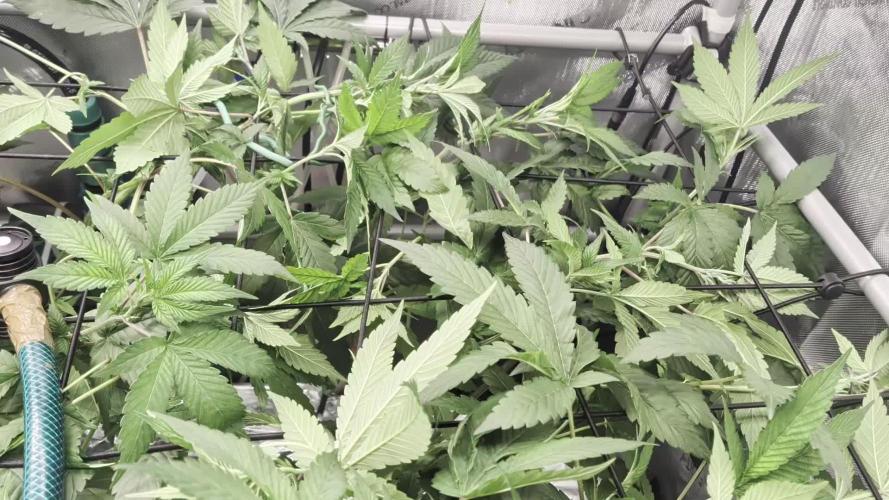
Week 13: Week 5 Flower—A Garden in Full Bloom 🌸✨
Hey, Grow Fam! 💚 We’re deep into Week 13, and this room is nothing short of mesmerizing. Each plant is unique, showcasing its trichome-coated beauty, with white hairs dancing in their distinct patterns. It’s the culmination of patience, hard work, and overcoming challenges. The two-layered canopy—thanks to some ambitious young ones—is a testament to adaptability and dedication. 🌱🌟
Feeding Update: Aptus Holland Breakout Powder
This week, we introduced Aptus Holland Breakout Powder into the feeding mix at 0.5g/L, alongside the nutrients already in use. This powerhouse additive is designed to promote robust flower development, enhancing both density and resin production. Breakout Powder brings that extra “oomph” to the table, helping the girls truly break out into their full flowering potential. 🌺💪
Combined with our existing recipe, the results are already starting to show. Buds are swelling, trichomes are shimmering, and the room smells heavenly. If you’ve ever wondered what a well-rounded feeding schedule can do, this week’s results are the answer!
TrolMaster Magic: Monitoring & Stability
I’ve included a few TrolMaster app prints to share my love for this system. It’s not just about controlling the environment; it’s about mastering it. The app provides real-time data, historical records, and an unmatched level of convenience. Whether I’m sipping coffee or working in the garden, the system keeps me in sync with my grow.
This week, I’m particularly thrilled about how stable the pH levels have become since transitioning to full mineral-based nutrients. Unlike the organic-mineral combo, which required frequent adjustments, the current setup is practically self-sufficient. This stability means happier roots, more consistent nutrient uptake, and ultimately, better plants. The data speaks for itself—check out the comparison print!
Comfort & Style: My Aptus Holland Pants
Oh, and can we talk about how comfortable my Aptus Holland pants are? These have become my go-to garden gear. Stylish, functional, and perfect for spending long hours among the plants. Let’s just say, my plants aren’t the only ones dressed to impress! 😂👖
Shoutouts & Gratitude
As always, a huge thank you to the amazing people and brands that make this journey possible:
• TrolMaster for the tech that keeps me connected to my grow.
• Aptus Holland for the nutrients that take my plants to the next level.
• Pro Mix for the growing medium that supports this foundation.
• Cannakan for ensuring my seeds get the perfect start.
• And of course, the seed banks for these incredible genetics.
A special shoutout to the community—followers, friends, supporters, and even the haters. You all bring energy to this space, and it’s all apprecialoved! Let’s keep growing stronger together. 💚
#TrolMaster #AptusHolland #GrowLife #CannabisCommunity #FlowerWeek4 #NeverGiveUp #GrowWithLove #IndoorHorticulture #Defoliation #PPFD #ControlledEnvironment #SCROGNet #DogDoctorOfficial
Discount Codes so you can save big on your next check out 💚💚💚
Kannabia - DOGDOCTOR 30% off
SeedsmanSeeds - DOGDOCTOR 10% off
CannaKan- DOGDOCTOR 15% off
terpyz.eu - DOCTOR 15% off
The Neutralizer - PORKIT5-DOG 15% off
Fast Buds - DOGDOCT 15% off
As always thank you all for stopping by, for the love and for it all , this journey of mine wold just not be the same without you guys, the love and support is very much appreciated and i fell honored and so joyful with you all in my life 🙏
With true love comes happiness 💚🙏 Always believe in your self and always do things expecting nothing and with an open heart , be a giver and the universe will give back to you in ways you could not even imagine so 💚
Friendly reminder all you see here is pure research and for educational purposes only
Growers Love to you all 💚💚💚




Processing
Likes
67
Share


@GreenZealand
Follow
OK, so we started the 6th week and the plant is showing some growing signals.
It's impressive how a plant that looks really bad, can actually keep growing and developing itself.
This week I've started to see some development on bud zone/spot, and I believe that even making some mistakes ate the beginning, I'll be able to taste some buds from this little girl.

Likes
14
Share


@LokalGrenz
Follow
Jan 13th ordered a Dehumidifier today should be here Monday need to get the humidity down for flower I can only get it down to 57% so Hopefully it will work
One of the amnesia haze plants have some type of deficiency not sure have brown spots on leaves
Got humidity some decent control but I’m sure amnesia haze 1 is dealing with PH issues the PH meter is cheap and I’m sure it’s been off a bit so I’m going to look for new one this week

Likes
38
Share


@PolishFarmer
Follow
Hi Guys! In last few days my ladies just shocked me. They growing up so quicke and i think are healthy and happy. :) so proud of them through they are higher than my last grow already :) i hang scrog gride this evening just over heads. I was forced to get rid of blue dream auto 😥 just no space in box but she do not bloomed yet the only one. Left 6 girls now and im hopefully that will stay like that to the end :) will back soon here! Bless
Likes
11
Share


@TheMadHasher
Follow
Whats up everybody cheers to another week of growth for everyone!
This week the ladies buds started showing signs of progress. You can see them produce more and more resin every day thanks to the cold weather its really easy to keep a pretty dry environment. Can’t wait to do my final defo next week! Until then stay green!


Likes
7
Share

@Ruthlez
Follow
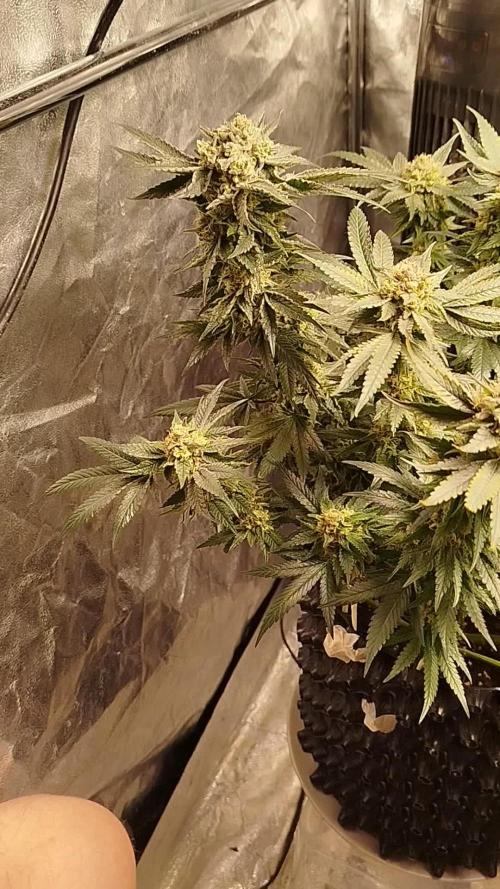
Blütetag 49.
Die linke Pflanze welche ich getoppt ist geht langsam in den Herbst und ist gefühlt schon etwas weiter als die rechte welche ich mit LST trainiert habe.
Beide entwickeln sehr starken Geruch und ihre typische lila Farbe. Die trichome sind unter dem Mikroskop bei diesem Pflanzen milchig,bei der rechten entstehen die ersten bernsteinfarbenen.
Noch ca. 1-2 Wochen bis Ernte
Processing
Likes
3
Share


@Reaper
Follow
week 7 flower:
big fanleaves start to die off and the purple/yellow colors appear on the plant. one more week before harvest
