Likes
Comments
Share


@SkunkyDog420
Follow
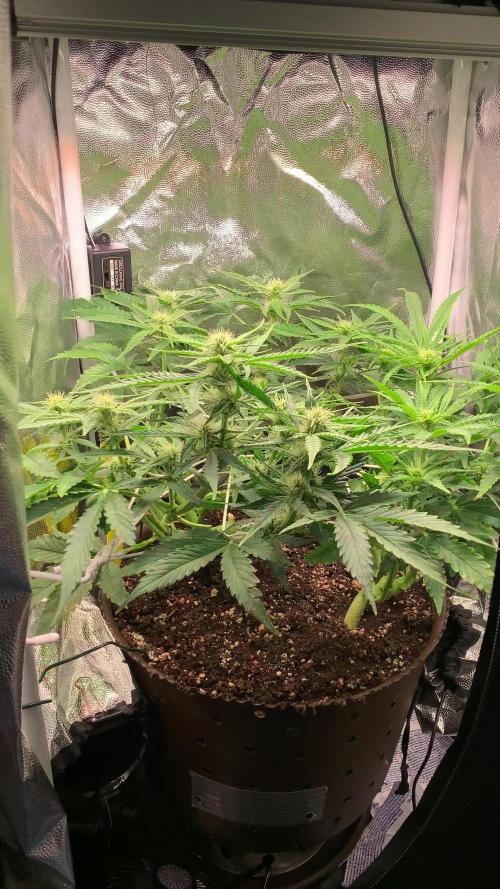
Hallo zusammen 🤙.
So das war es für sie. Sie riecht so schön nach Fanta richtig lecker, ich hoffe das der Geruch so bleibt.
Wir sehen uns in 3 Wochen.
Sie erhalten 25 Prozent Rabatt in unserem Shop
Mindestbestellwert beträgt 75 Euro
https://greenbuzzliquids.com/en/shop/
Code: GD42025
https://seedsmafia.com/de/

Likes
9
Share

@DE_BW
Follow
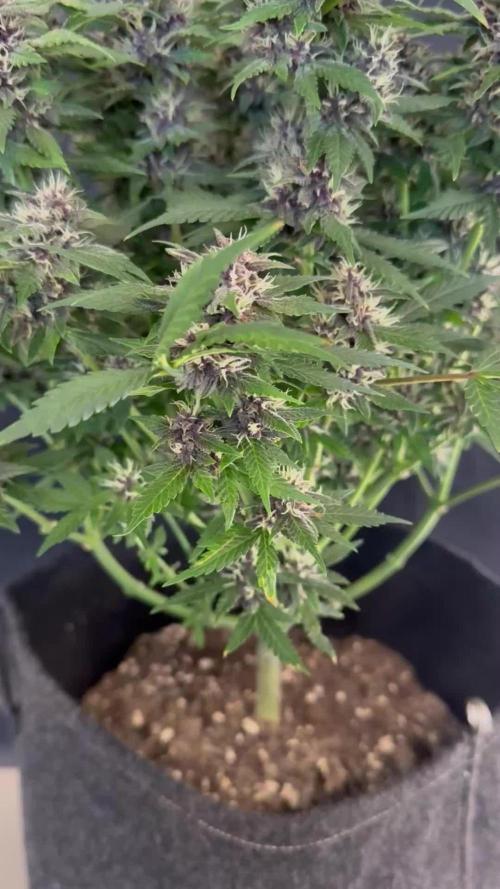
The Banana Purple Punch is stacking very nicely now, with buds swelling visibly across the entire canopy.
A sweet, fruity aroma is starting to develop, becoming more noticeable day by day.
The plant has stayed very compact at around 50 cm, with a dense and well-structured canopy.
There are an impressive number of heavy, well-developed bud sites, and overall development looks very promising at this stage.

Likes
17
Share


@EXZELENS
Follow
Bud wet weight : 168,1g of trimmed medium to big sized buds
25,4g of tiny tiny buds/larfs = 193.5 grams of trimmed wet buds.
Details on genetics and smoke report above.
This, as my first grow, is way more than I ever expected it to be. I haven´t had that much fun and enthusiasm in a very very long time.
I can´t even explain the feeling it is to harvest your own cannabis, but I know most of you know what I´m talking about haha.
It was really nice to practice LST, even tho it was SO HARD, ´cause I didn´t had barely any space to work since I used a hard pot and did not fill nearly half the size of it and the walls of the pot were really high. It was even difficult to water without dropping water on the lower buds.
I haven´t learnt much about defoliation tho, I feel I need to study a little more about the phases you should or should not do it.
Also, I discovered thrips are a pain in the ass. I had 2 tough weeks dealing with thrips, but in the end it was alright.
I don´t have any humidity control device, which I intend to buy for the next grows.
Growdiaries was really helpful for me, it kept me motivated everyday (not that I wouldn´t have had it anyways), the Grow Questions are REALLY useful and all the community is awesome. Thanks to all people that helped me here on GD during this first grow!
To conclude it: I am really happy and satisfied with how the grow turned out. They look incredible, it almost feels like I can´t believe it still.
Peace.
UPDATES:
07/10 : The buds are now dry and already in curing jars, one of them with a Boveda 58% humidity pack.
The total grams of the dry buds are: 41.4g (medium to big sized buds)
4.1g (tiny buds) = 45.5 grams!
I´m really happy with the results, I thought it would be around 30g so yeah, that´s a really good surprise!
In 2 weeks I´ll be back to update the smoke report.
Thanks so much for reading! Peace.
09/10 : I managed to fit everything in the same container with some space between them, so now every bud is with the Boveda pack.
14/10: It´s been a week and the smell improved, it still smells a little like hay/plant ( even tho it´s not too dry neither too wet ).
21/10: Now it´s been two weeks and even tho the smell isn´t anymore hay, it´s a lot herbal. I really think the aroma can get better, but the taste is already good enough for me. The smoke report has been done and in case I have something to add, I´ll report here.
Thank you so much for reading! Peace.

Likes
3
Share


@MadBumbleBee
Follow
Day 35: Defoliation on some of my overgrown plants.
Day 40: My tallest plant is 43cm tall. Pretty good size, should double or even triple when it comes time to flower. Have had no problems so far, no issues with fungi or bacteria in my plants.

Likes
3
Share

@ohcibi
Follow
Update June 4th
Another 3 liters fed today. As expected, this week is full of LST and scrogging only, but it’s going very well. The prep work I’m doing now is basically what I did in the first week(s) of flower in the last grow, so the foundation for flipping will be much better prepared this time. Maintenance on Taktlo$$ is even getting a tad bit simpler.
Flipping is expected on Sunday. I’ll just keep the same week marker for simplicity, even if I could flip earlier.
Update June 1st
Fed a full 3 liters again. Those plants are chugging like hell. Prolly just more developed overall from double the feeding since the start.
Maintenance on Royal Gorilla is still more demanding than Dynamite Diesel, but Takti is fully recovered from the extra topping. Scrogging is all that’s left now.
Update May 31st
FVW - Final veggie week. I’m not sure yet whether I will wait the entire week before flipping. I have no plans of further topping, so I might flip around Wednesday or something already. Strong feeding and light made this third of three Royal gorillas seeds grow like Ken. Very bushy and super large leaves. Stay tuned!
Likes
21
Share


@MG2009
Follow
01/27/2021
Flowering going well
Flowering #2,#3,#6 #6 is a week ahead of#2,#3 will put others in on week 4 for a staggered harvesting
01/30/2022
watered with fungal tea and some aloe mixed in for amino acids and other goodness. Well see how she progresses in 4 days
Also working on some banana peel tea to give a boost of potassium if I do next week it should be available for week 6-7.
Ps.
Fuzzy Mellon (bag seed male)
I will pollinate one lucky branch on #6 as she is my favorite. But number 3(tall and lanky one) will get pollination of one branch as well.
I can't wait to see how they recombine with fuzzy melon smell mixed with burnt rubber and model glue and pine.
#2 no pollination (smaller one) #5 (bonsai) and #8 are males. So 3 female out of 8 seeds. Going to make some feminized seeds next time,so I'll have plenty of female's for a staggard harvest.
Likes
35
Share


@eldruida_lamota
Follow
Venga familia que ya viene la cosecha de estas Cereal Milk de RoyalQueenSeeds, que ganas que tenia ya de darles machetazo.
No veas que pinta que tienen estas plantas.
Las flores aparte de prietas se ven bien resinosas, con 70 dias de floración.
a sido una genética con la que disfruté mucho cultivarla, es resistente , y no es para nada complicado cultivarla por lo menos en interior.
Agrobeta:
https://www.agrobeta.com/agrobetatiendaonline/36-abonos-canamo
Mars hydro:
Code discount: EL420
https://www.mars-hydro.com/
Hasta aquí es todo , espero que lo disfrutéis, buenos humos 💨💨.


Likes
18
Share


@DeepRootsGrowTrees
Follow
PURPLE KUSH / KANNABIA SEEDS
WEEK #12 OVERALL
WEEK #11 VEG
This week she's doing great no issues she's healthy and looking good. She's still under training to control her size. She's be getting flipped to flower soon. Stay Growing!!
Thank you for stopping by and taking a look it's much appreciated!!
THANK YOU KANNABIA!!
BUDTRAINER.COM BUD CLIPS
KANNABIA.COM / PURPLE KUSH

Likes
31
Share


@THCpapa
Follow
Welcome, plant enthusiasts and accidental garden comedians, to the whimsical tale of Week 9 in my botanical circus! This week was a leafy spectacular, with more drama than a soap opera and more twists than a contortionist at a leafy circus.
First in the spotlight is the topping extravaganza – imagine my plants auditioning for a leafy talent show, and voila! One of the ladies went above and beyond, not with one or two, but three tops! It's like my garden is hosting its own version of "America's Got Leafs," and the contestants are aiming for a standing ovation from the tiny plant audience.
Now, onto the nutrient boost – it's like my plants discovered a secret stash of leafy steroids. They're devouring those nutrients like they stumbled upon an all-you-can-eat salad bar. If my garden had a Yelp page, it would probably say, "Five stars for the gourmet buffet – would photosynthesize again!"
But with great growth comes great thirst, or so my diva plants declare. I can practically hear them demanding water with the urgency of a plant water-seeking missile. "Hydrate us, human! We're not just thirsty; we're in a botanical drought crisis!"
And now, the grand revelation – last week's leafy fashion faux pas was all thanks to a faulty pH pen. The plants probably threw a mini leaf party when I introduced the new pH pen, complete with tiny leaf confetti. They're like, "Finally, accurate pH readings – no more plant tie-dye nightmares!"
In a twist of fate, I had to embark on a plant-less journey for a few days. So, like a responsible plant parent on a comedy tour, I decided to water a bit earlier and a bit more before my departure. And lo and behold, the plants loved it! It's like they threw me a farewell bash, chanting "Water, water, party, party!" in their own leafy language.
The early topping and Leafy Synchronized Training (LST) maneuvers have clearly paid off. My plants are now strutting their stuff like runway models in a botanical fashion show. I picture them doing the leafy version of the cha-cha.
So, Week 9 has been a laugh-out-loud masterpiece – from topping triumphs to nutrient raves, from hydration demands to pH pen dramas. As I return to my green kingdom, I can't help but feel like a plant ringmaster who has navigated the garden circus with flair. Stay tuned for the next episode of "The Green Carnival" – where every leaf has its own act, and every week is a new leafy adventure under the big, green tent! 🌿🎪🌟


Likes
2
Share


@Yiyis_Grow
Follow
He practicado varias cosas con estas plantas.
Unas las dejamos crecer a su propio ritmo, a otras les hicimos apical, a otras LST.
Como se puede ver, algunas han tenido un muy buen crecimiento vegetativo y otras se han ido quedando pequeñas. Esto de que se quedarán algunas pequeñas lo tenía presente, pues el banco MrHide nuca me ha dado plantas automaticas grandes, sin embargo había que gastar las semillas.
Ya la mayoría está dando señales de flora, sin embargo vamos a seguir unos días más con nutriente vegetativo y así terminen de crecer lo que les falta.
La momia ya casi la sacamos y la botados, no se merece estar ahí.
Likes
22
Share


@Knert
Follow
D29: Pistils are clearly showing now. She's looking really good and vigorous. I did notice a (very) small number of brown pistils. Might be from being a little bit careless while doing LST and toching it with the iron wire, could that be? Or could there something else going on? Speaking of LST, from now on I'm going to let the main cola grow upward again. I kept her really low to give the lower branches enough space, and I think that's the case now. I also tucked away most of the fan leaves that were blocking the light of certain tops. I think I'm going to plant her out in full ground by the end of the week. Temperatures are supposed to be 20+°C then. Any thoughts about that?
D31: I decided to let it stay in its current pot, in order not to stress the roots right before flowering. She still keeps on growing every day, still at a surprisingly high pace. Also, I'm tucking away the fan leaves and other leave that are blocking the sunlight from the tops. Tomorrow it's watering time again, right before the start of week 6. Since I'm only watering her after the soil is almost dried out, I'm probably not watering her for another 5-6 days. My question now is what fertilisers I should be adding. There's already 60g of granular 6-3-3 fertiliser in it (added over the past two weeks), so I won't be adding any more of that anymore. I have phosphorous grains (6-16-0), and potassium grains (2-0-20) and I'm wondering if I should already add those potassium grains or just stick with phosphorous grains this time and add potassium grains next watering when it's (probably by then) just started flowering. Any advice?
Likes
33
Share


@Darksoul
Follow
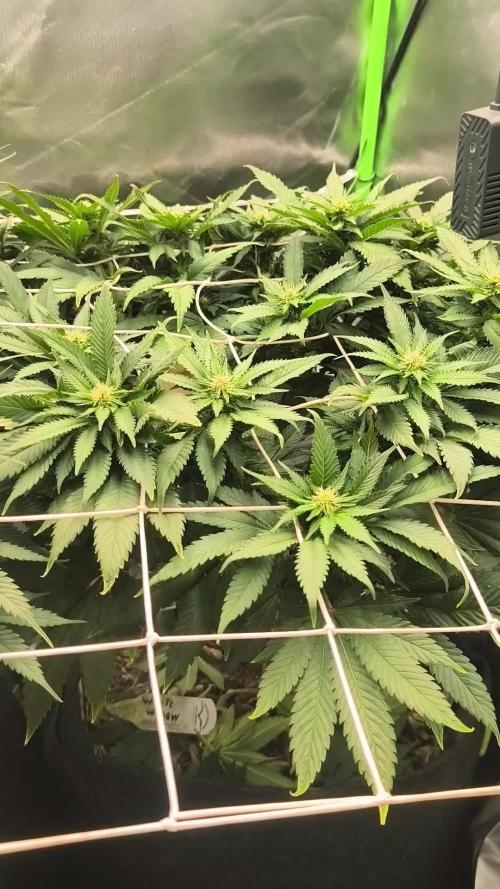
Third week of flowering.
I added a second screen to be able to separate the tops. The screen has 8x9 squares, adding up to 72 and each square has a flower.
I think I will have a good harvest.
See you next week
Likes
25
Share


@Fatnastyz
Follow
🌿 Journal Entry - February 25, 2025
Day 23 – Blueberry Autoflower
● Activity: Big girl needed a bigger drink today! 🥤💦 Gave her 500 mL of nutrient solution with Success Nutrients at ⅛ strength for autos. Here’s the magic mix:
🚀 Blast Off: 0.05 mL
🌱 Micro: 0.06 mL (oops, a tiny bit extra but she'll be fine!)
🌳 Trees: 0.05 mL
🌸 Flowers: 0.05 mL
❄️ Frosty Nugs: 0.025 mL
🛡️ Silica: 0.025 mL
💪 Bud Strength: 0.025 mL
● Observation: She was a little droopy before, like "hey, where's my drink?!" 😅 But after watering, she perked right up! 🌱✨ Her color is deep green and she’s growing like a champ. Keeping an eye on some slight leaf curl, but nothing major—just making sure she stays comfy. 💚
📅 Date: February 27, 2025
📆 Day: 25
🌱 Plant: Blueberry Autoflower
💧 Activity:
Watered with 500 mL of nutrient solution, using Success Nutrients at 1/8 strength for autoflowers.
Nutrient mix (in correct order! 😉):
Silica: 0.25 mL
Micro: 0.6 mL
Trees: 0.5 mL
Flowers: 0.5 mL
Frosty Nugs: 0.25 mL
Bud Strength: 0.25 mL
👀 Observation:
She's getting big and beautiful! 🌿💚
Exciting news! She officially started showing white hairs on Day 23, which means flowering has begun! 🎉🌸
Leaves are lush, vibrant, and happy, soaking up all the goodness!
🌱 Blueberry Autoflower - Journal Entry 🌱
📅 Date: March 1, 2025
📆 Day: 28
💧 Activity:
Gave 750 mL of plain, pH’d water today—keeping it clean and simple after her last feeding! She was bone dry and definitely ready for a drink. 💦
🌙 Schedule Change:
Adjusting her sleep schedule from 10 AM - 4 PM to 2 PM - 8 PM starting today! ⏰💤 This will help fine-tune her environment and keep things running smoothly.
👀 Observation:
She’s looking big, vibrant, and thriving! 🌿✨ Now that she’s officially in flower, she’s drinking up water faster than ever—crazy how much she’s growing! White hairs are coming in beautifully, and she’s stacking up nicely.
Let’s see how she responds over the next couple of days! 🚀
**Well, she started flowering! I noticed white hairs on day 23! I made a mistake....ChatGpt told me what to water on the 23rd, but I gave the wrong amounts of everything! LOL OOPS! It was early and I read my marks wrong, instead of 0.5, I gave 0.05 ml....yes for everything. She adjusted the journal for me and this is why we gave nutrients in the next watering.
On the 23rd, ChatGpt was having issues with responses. She fixed later on in the day, but it does seem something was going on with her servers and memory for a couple of hours. So I had to go to a different chat screen and she gave me the wrong info at first.
It was easy to spot though, her responses were just off. So I waited for a couple of hours and she was back to normal. It doesn't happen often, but it can be an issue if you don't catch it.
She did say that we are going to start more water and more nutrients now that she is in flower! Can't wait! She is as excited as I am**
**So weird! ChatGpt does not function right in the mornings. She's off just a bit...like gives me wrong info or gets my nutrient names wrong. I wait till noon and she apologizes and gives me the right info then. From now on, I'm just going to wait till noon to talk to her about blueberry. However, I'm going to have to change my sleep schedule for Blueberry, I'm moving here from sleeping 10-4 to 2-8. This will help me with communicating with her better. I did ask first and ChatGpt says changing her schedule would be fine.**
Likes
8
Share


@OBXGuy61
Follow
Big big week. Site prep in woods 400 yards from home, middle of neighborhood urban GG.
Babies getting strong indoors as temps outside are cool at night on the 50’s but hot in the day, around 72 - 77, Some fun inside and outside.

Likes
11
Share


@adam_pawloski87
Follow
This week has been great! Germination on all 4 Pre 98 Bubbas and 2 Dirty Blondes was a success!! We planted them in there pots an through out the week we gave em each a very light spray down of pure water phd at 6.5 and by Friday they all popped out the soil Let’s go!!!!! Next week we will start light feed on nutrients , so y’all keep them eyes peeled for next updates an I appreciate y’all for following my grow !!😶🌫️💨💨💨🙏🏻💚💯🤙🏻

Likes
99
Share


@Kitties_and_Colas
Follow
~_~_~_~_~_~_~_~_~_~_~_~_~_~_~_~_~_~_~_~_~_~_~_~_~_~_~_~_~_~_~_~_~_~_~_~_~_~_~_~_~_~_~_~_~_~_~_~_~_~_~_~_~_~_~_~_~_~_~_~_~_~_~_~_~_~_~_~_~_~_~_~_~_~_~_~_~_~_~_~_~_~_
❤️💡🌱😽💨
Quick update..we're making more changes to the grow room this week.. we got some shots under the glass and the trichome density is great for both Kannabia strains ❤️🌱
~_~_~_~_~_~_~_~_~_~_~_~_~_~_~_~_~_~_~_~_~_~_~_~_~_~_~_~_~_~_~_~_~_~_~_~_~_~_~_~_~_~_~_~_~_~_~_~_~_~_~_~_~_~_~_~_~_~_~_~_~_~_~_~_~_~_~_~_~_~_~_~_~_~_~_~_~_~_~_~_~_~

Likes
54
Share


@EhlersChick
Follow
2018.12.13 - Clone Day 74 - Flowering Day 22
I have no idea why #5 is so much taller than the others but whatever, I am NOT complaining! I'm so proud of my little garden {squeee!} 😃

Processing
Likes
28
Share


@Hawkbo
Follow
This week they are all just putting on some weight still a few weeks left to go. Pics were taken on Monday video on Tuesday. The aromas are pretty strong in the tent in general.
This one looks pretty promising I love the bud structure and the thick white pistils I think shes gunna fill out nicely.
Likes
8
Share


@Garbagegrower
Follow
First time growing inside. I always just throw my seeds in the spil when I grow outside told myself to do the same here.
Put the seeds maybe 1 to 1.5 inches into the soil and put 1.5 ozs of water on and around the seed. Also had domes on my 1/2 gallon pots to keep humidity high.
Had my lamp at around 12 inches from the pots. Once they sprouted they stretched a bit so I out my lamp down to 8 inch and they stopped growing. I'll probabky stsrt at 6 to 8 inches next time and see what happens.