The Grow Awards 2026 🏆 




Likes
Comments
Share
@RDWCGrowing
Follow
5/23/2023
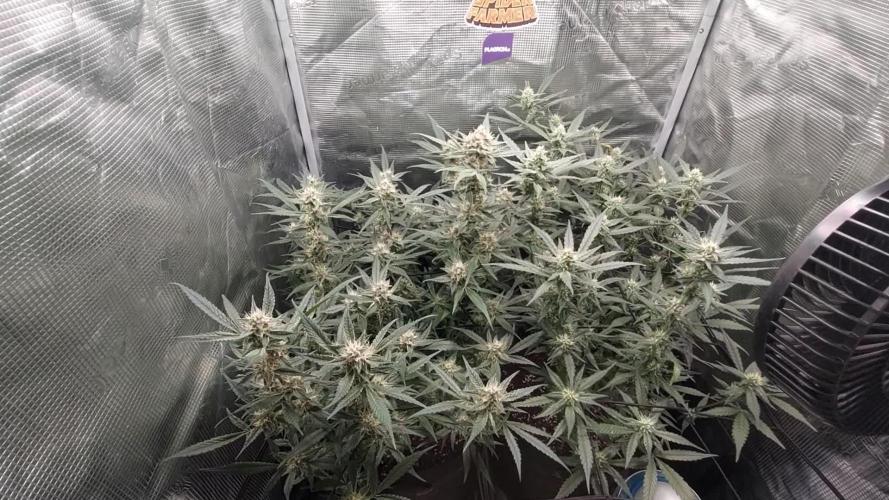
Week 7- Day 1 of Flower (Day 110 overall) (Day 49 of Flower)
There was a couple of small super small sucker buds on the lower stocks that needed to be cleaned off but that was it. Just watching them Flower!!
5/24/2023
Week 7- Day 2 of Flower (Day 111 overall)
Tucked a few fan leaves below lower buds but didn't see any blatant offenders that needed to be removed. I typically do start my checks in Week 8 but since this is a new strain I decided to go ahead and do a Trichome check just to see what was what.. Just as I thought nothing but clear glassy Trichomes. I will check again in one week....
5/25/2023
Week 7- Day 3 of Flower (Day 112 overall)
Just letting them grow today!! Smell is getting stronger I would say it is a hint of Pine and a heavier fruity smell.
5/26/2023
Week 7- Day 4 of Flower (Day 113 overall)
I did Nothing but took some pics and I enjoyed it!!!! It is nice to be able to just sit back and watch them on auto pilot.. :-) Tomorrow Water Change Day!!
5/27/2023
Week 7- Day 5 of Flower (Day 114 overall)
I admit it.. I had to defoliate a little bit.. I looked in while changing the water today and there were just a couple blatant offenders blocking the light from lower bud sites and those leaves they just had to go. Other than that I changed the water and this week is where I drop everything and start preparing them for this last phase of the grow. Loving a few of these buds they are starting to beef out very nicely.
I added 36 gallons
Mammoth Silica = .5Mil/Gal= 18Mil
Root DRIP = 1Mil/Gal= 36Mil
CalMag= .5Mil/Gal= 18Mil
FloraMicro = 3.8Mil/Gal= 137Mil
FloraGro= 2.8Mil/Gal= 100Mil
FLoraBloom= 4.6Mil/Gal= 166Mil
LiquidKoolBloom= 2.5Mil/Gal= 90Mil
TPS SIGNAL= 4.0Mil/Gal= 144Mil
ORCA = .5Mil/Gal= 18Mil
Water Temp= 70.1
Tent Temp= 76
Humidity =64 ** I have two dehumidifiers running on Ink bird controllers to try and keep the humidity down, In late in flower I like to keep the humidity above 45 but below 60.
5/28/2023
Week 7- Day 6 of Flower (Day 115 overall)
Opened the back of the tent today and boy did she need some defoliation love in the back. Other than that I took off a few little sucker buds trying to form. I did start to setup my Dry space as well as did a Trichome Check today and the brown tips are coming in nicely.
5/29/2023
Week 7- Day 7 of Flower (Day 116 overall)
Found a few baby sucker buds trying to form so I removed them. Other than that I am enjoying watching her mature.
I also started my Reverse of the Clone I took 6 weeks ago in Apr from #3. I am uploading footage of the reversing process for your viewing pleasure.

Processing
Likes
25
Share
@Kikiwindsurf
Follow
AQUI EMPIEZA EL CULTIVO DE 3 GORILLA GLUE DE FAST BUDS EN MACETAS ESPECIALES PARA AUTOMATICAS DE 25 LITROS CON SUSTRATO BIOBIZZ ALL MIX // HERE BEGINS THE BRIGHT OF 3 GORILLA GLUE FROM FAST BUDS 420 , USING 25 L POTS 100% SPANISHMADE SPECIAL DESING FOR AUTOMATIC STRAINS. BIO BIX ALL MIX.
dia 5 // day 5 : Se abre la primera GG // First GG opens.
dia 6 // day 6 : todas las semillas germinadas correctamente // all seeds germinated properly.
HEARING TO THE COMMUNITY , I SET UP A PROVISIONAL NIGHT ROOM TO BRING EXTRA LIGHT TO OUR BABYS. 8 HOURS DIRECT SUNLIGHT + IDK HOW MANNY HOURS OF CFL LIGHT... STAY TUNED !
ESCUCHANDO A LA COMUNIDAD , HE MONTADO UNA SALA PROVISIONAL PARA DAR MAS LUZ A NUESTRAS NENAS DURANTE LA NOCHE. 8 HORAS LUZ SOLAR + NIPUTAIDEA DE CFL... MANTENTE ATENTO PARA SABER MAS DETALLES EN LOS PROXIMOS DIAS

Likes
82
Share
@BigBadLion
Follow
Heeey guys!
A rather fast update this time, right? I was always 1 week late with the updates but decided to speed things up a little this time! 😋
And now, to summarize this week I'd say it was fun! 😃
While I was still unsure if I wanted to go for 8 colas or just stick with 4 (I wasn't 100% sure last week! I'm a very indecisive person!) and after taking into consideration all the pros/cons and my own skill level I decided to just stick to 4 for now. I don't want the buds to fight for light and since this is my first time doing main-lining I'm sure I might end screwing things up with 8 colas. 😗
Besides what I mentioned earlier I did a lot of trimming (had to cut the remaining branches and extra foliage!) and gave a friend some cuttings of my babies! (after all I had 8 spare ones from each plant!) I also went for a more aggressive with LST since I know I'll need more space between each in the future colas! 💪
I also moved Boomer to a new container, she was getting somewhat crowded in such a small space! (I'm so impressed she's growing so well right now!) 😍
You'll once again see two time lapses showing how my plants were growing, I hope you all will enjoy them! 😉
Probably I'll stick for one or two more weeks in veg (I want the plants to grow a bit more before going into flower) but so far most of the work is done.
Thanks everyone! 😊

Likes
18
Share
@cannasaxx
Follow
DIY system zum Anwurzeln gebaut aus den Teilen meines Mars Hydro DWC System. Was auch noch umgebaut werden muss 😄
#ichmachsmirselbst


Likes
Comments
Share


Likes
23
Share
@Mr_McNasty408
Follow
12/28/20
Nutes:
Veg A: 2.05 g/gal
Veg B: 1.38 g/gal
PPM: 570
Water temp: 64°F
pH: 5.9
12/29/20
Nutes:
Veg A: 3.07 g/gal
Veg B: 2.07 g/gal
PPM: 850
Water temp: 64°F
pH: 5.8
12/30/20
Nutes:
Veg A: 3.07 g/gal
Veg B: 2.07 g/gal
PPM: 850
Water temp: 64°F
pH: 5.8
12/31/20
Nutes:
Veg A: 3.07 g/gal
Veg B: 2.07 g/gal
PPM: 850
Water temp: 62°F
pH: 5.8
1/1/21
Nutes:
Veg A: 3.07 g/gal
Veg B: 2.07 g/gal
PPM: 860
Water temp: 62°F
pH: 5.8
1/2/21
Nutes:
Veg A: 3.07 g/gal
Veg B: 2.07 g/gal
PPM: 860
Water temp: 62°F
pH: 5.8
1/3/21
Nutes:
Veg A: 3.83 g/gal
Veg B: 2.58 g/gal
PPM: 1050
Water temp: 62°F
pH: 5.8
Likes
18
Share
@RickJames_Mcdank
Follow
So I had some internet issues so I couldn't upload. But now everything is alright.
This last week I only gave her water 2 times. first time I gave her 500 ml water and the second time only 250 ml water only.
And I took more fan leafs off her as you can see I only had to hang her up without trimming or anything.
After she is dried I am going to weigh her and see how much I got.
*****************************************************************************************************
As for grow report :
Blue kush is really easy to grow just make sure the temps optimal.
The buds grow really dense thats 1 of the parts I like about this strain.
She takes normal feeding.
Very strong genetics.
And she can take a few mistakes so this strain is perfect for beginners and in medium or expert hands she can get really nice with the colors and smell and taste.
Next week i will post the weight and the dried product.

Likes
15
Share
@TheHighNews
Follow
I did some mistakes but i was still setting everything up, still happy after 5 without growing a plant, pretty dense buds i will do better in the next grows.

Likes
28
Share
@Esoteric_growing
Follow
On next feed going to up the cal mag a small amount but pretty much letting them do their thing.
On day 23 I will defoliate. Second net is going to be used just as support

Likes
148
Share
@BioBuds
Follow
She truly might be becoming the Gorilla that was promised, huge leaves. Not as pungent or bushy as the Orange Hill beside her but she seems to get there. I'm finally seeing some exponential growth, I'm going to give them as much rest as I can coming weeks to maximize growth before flowering and to prevent (hopefully) them going hermie on me, which both Gorillas and Orange Hill Special are prone to.
I have made a video to thank them for letting me use their SP-3000. What a beast of a light!! Thanks again @MarsHydroLED for letting me test this awesome light!
I have made a new layer of topsoil made of organic coco-peat, which should help me prevent more fungus gnats. They already seem to hate it and are wandering around in agony trying to dig in... Good for them, freeloading beastards.
Now we go to flowering coming weeks, and I can't wait... Thanks for checking in and the likes and support!

Likes
17
Share
@EduardoLV885
Follow
Se hice el cambio de fotoperiodo a 12 horas de luz y 12 de oscuridad , se aplico tambien poda de bajos y se cortaron algunas hojas que estaban estorbando

Likes
5
Share
@PhatRobs
Follow
End if week 5. A little tip burn but no problem. She is looking stacked and ready! No smell really. 100% rooted out this 2.5 gallon bucket.

Processing
Likes
20
Share
@Silverback_Guerilla
Follow
2/10:
I watered today with about 3/4 gallon each, plus cal-mag, signal, bembe, armor si, a little open sesame, and their final dose of endoboost.
The short one is budding up nicely, but the taller one is still stretching. The short one looks to be considerably more indica than the other.
2/11:
Wife home sick today....postponing construction project to raise the lights.
2/12:
Today, I tackled the project to raise my ceiling another foot. In addition to that project, I installed and hooked up my new AC Infinity 6" intake fan. It's pulling in fresh air from the soffit vent on the eave of the attic, and currently feeding the garden with 46f fresh air. I'm able to easily maintain daytime temps in the lower 70f's now. I am able to drive the nighttime temps as low as I want. The only issue is that the outdoor RH varies quite a bit, so I ordered a 30-pint dehumidifier to put in the top of the closet.
I sprayed everybody with boomboom spray to try and mitigate the light burn damage that is likely to ensue.
2/13:
The taller one is still stretching a little bit, but the 2-footer is just budding up.
2/14:
I fed them today with about 3/4 gallon each including grow big, big bloom, tiger bloom, cal-mag, signal, bembe, humic acid, and I switched over from Open Sesame to Beastie Bloomz. Raised the lights another couple of inches. I did some training on them and defo'd a little bit.
2/15:
Installed the new dehumidifier and rigged the continuous drain on it...works great.
2/16:
I rotated the edge plants and removed some old leaves. I added another 22w 3000k 4' bar light under the canopy.
2/17:
I rearranged the garden and defoliated a little bit. That's it for week 8-


Likes
7
Share
@JoseTodoLoco
Follow
I didn't get that much yield and the buds were too fluffy do I decide to use all the buds and trim to do bubble hash, I really enjoyed the entire process.

Likes
21
Share
@Staffedition
Follow
Привет друзья. Моей растихе сегодня 112 дней
Паутинный клещь побеждаю, но до конца не вывел
Растение на много стало зеленее и пушистей.
20.10 перевёл свет в режим 12/12
Начал применять LST технику на 19 дне и продалжаю применять её через день, а 18 августа добавил ДЕФОЛИЗАЦИЮ
С 20.08 ДЕФОЛИЗАЦИЮ делаю каждые 3,4 дня
С 20.08 LST технику делаю каждые 4.6 дней
На сегодняшний день влажность 54%
5.09.2023 заметил высокий Ph 7.9
С 48 дня Ph не ниже 5.8
На сегодняшний день Ph 6.0
Начал кормить с 60 дня Canna Terra Vega
PPM 870
Всем мира и добра!
Не забудь поставить лайк❤️, если понравилась как прошла неделя
И читайте наш TELEGRAM: https://t.me/smail_seeds
#Smail_Seeds 😀
Likes
14
Share
@Bread_n_Buds
Follow
Our #15 or rather this new creation by Seeds Mafia that we are growing with love is starting to get serious.
It grows well and in a very regular way, the leaves are clean and it has a characteristic that makes the plants always very beautiful and special, it has low internodal distance, so don't top and let it go when you see autoflowering like this.
We have started with fertilizers for growth which we give in reduced doses together with the rooting agent for the entire vegetative phase.
Music of the week provided by Radio Nula from Slovenia.
https://radionula.com/
Thanks to friends of Seeds Mafia try this and their other creations
seeds > https://seedsmafia.com/en/
Light and tent > https://marshydro.eu/products/marshydro-sp3000-led/?lang=it