


Likes
Comments
Share


@Black_RastamaN
Follow
О, да, прошла неделя, как они подросли. Шли дожди, и я их перед дождями поливал с удобрением. Я не мог их посетить раньше, так как было грязно. Поэтому расхождение в неделях, и днях не правильно, +-2-3 дня. Я их не полил, там много воды, но если днем в течение 4-5 дней будет+27°я поеду их поливать.Я буду просто их поливать . Раз в два недели полив с удобрением. Биогумус жидкий.



Likes
32
Share


@AsNoriu
Follow
Day 57. And Mimosas are real sl@ts ..... No doubts, they all time were most picky and stupid, but big, very big ... Only two from 3. Last one is the smallest plant from all first wave. Very strange .
Smoothie's are nice, grow without big hiccups, maybe a bit of a runners, but all 3 looks very similar.
Purple Punch - both small, the one in best light is giving me hope that I will chop her before holidays and will make some space for the guy who will be watering them during my offs.
They are overfed a bit. So no feed all week. Just water.
Two biggest Mimosa's will be transplanted into bigger pots, they drink a lot, dry too quick and are sad in my mind, so I will cheer them up with bigger pots this week.
Still selective defoliation, some yo-yo, so ties and no spray anymore.
Smell is getting stronger, but didn't bother to try one or other. Still nothing special or super smelly yet ...
In the middle of the day Mimosa's finally happy, but before lights down - theirs leaves are down too. Overdrying them constantly too, can't wait to give them better house, that type of fight I hate.
Day 60. All work done ! Huge work !
All girls were cleaned, defoliated and pots toped up with BioBizz Worm Castings. Both Mimosas got new bigger pots too.
Happy Growing !!!
Likes
5
Share


@Lazuli
Follow
She has smaller flowers this time but more dense, purple fade at the end that indicates shes very blueberry
Likes
18
Share


@Ultraviolet
Follow
Green light is radiation with wavelengths between 520 and 560 nm and it affects photosynthesis, plant height, and flowering. Plants reflect green light and this is why they appear green to our eyes. As a result, some growers think that plants don’t use green wavelengths, but they actually do!
In fact, only around 5 – 10% of green light is reflected from leaves and the rest (90 – 95 %) is absorbed or transmitted to lower leaves [1].
Green wavelengths get used in photosynthesis. Chlorophyll pigments absorb small amounts of green wavelengths. Light that doesn’t get absorbed is transmitted to leaves that are shaded out from direct light. This means that leaves at the bottom of the canopy get more green light than leaves at the top. A high proportion of green wavelengths compared to other colors tells lower leaves that they are being shaded out, so they are able to react accordingly. Lower leaves may react by opening or closing their stomata or growing longer stems that help the leaves reach brighter light [1, 2, 3].
When it comes to growing cannabis, many cultivators are interested in the quality of light used for the flowering stage. In many plants, flowering is regulated by two main photoreceptors: cryptochrome and phytochrome. Both photoreceptors primarily respond to blue light but can also respond to green, although to a lesser extent. Green can accelerate the start of flowering in several species (although cannabis has yet to be tested) [1, 4, 5]. However, once flowering has begun, it’s important to provide plants with a “full spectrum” light that has high amounts of blue and red light, and moderate amounts of green, in order for photosynthesis to be optimized.
Green light mediates seed germination in some species. Seeds use green wavelengths to decide whether the environment is good for germination. Shade environments are enriched in green relative to red and blue light, so a plant can tell if it is shady or sunny. A seed that senses a shaded environment may stay dormant to avoid poor growing conditions [1]. Some examples of plant species where researchers have documented this response are: ryegrass (a grass that grows in tufts) and Chondrilla (a plant related to dandelion) [1, 6].
Although green wavelengths generally tell plants NOT to germinate, there are some exceptions! Surprisingly, green wavelengths can stimulate seed germination in some species like Aeschynomene, Tephrosia, Solidago, Cyrtopodium, and Atriplex [1, 6, 7].
Of course, light is not the only factor affecting seed germination – it’s a combination of many factors, such as soil moisture, soil type, temperature, photoperiod, and light quality.
When combined with red and blue light, green can really enhance plant growth [1, 8]. However, too much green light (more than 50% of the total light) can actually reduce plant growth [8]. Based on the most current research, the ideal ratio of green, red, and blue light is thought to be around 1:2:1 for green:blue:red [9]. When choosing a horticultural light, choose one that has high amounts of blue and red light and moderate amounts of green and other colors of light.
Not many studies can be found about the effect of green light on cannabis growth or metabolism. However, if one reads carefully, there are clues and data available even from the very early papers.
Mahlberg and Hemphill (1983) used colored filters in their study to alter the sunlight spectrum and study green light among others. They concluded that the green filter, which makes the environment green by cutting other wavelengths out, reduced the THC concentration significantly compared to the daylight control treatment. It has been demonstrated that green color can reduce secondary metabolite activity with other species as well. For example, the addition of green to a light spectrum decreases anthocyanin concentration in lettuce (Zhang and Folta 2012).
If green light only reverses the biosynthesis of some secondary metabolites, then why put green light into a growth spectrum at all? Well, there are a couple of good reasons. One is that green penetrates leaf layers effectively. Conversely red and blue light is almost completely absorbed by the first leaf layer.
Green travels through the first, second, and even third layers effectively (Figure 2). Lower leaf layers can utilize green light in photosynthesis and therefore produce yields as well.
Even though a green light-specific photoreceptor has not yet been found, it is known that green light has effects independent from the cryptochrome but then again, also cryptochrome-dependent ones, just like blue light. It is known that green light in low light intensity conditions can enhance far red stimulating secondary metabolite production in microgreens and then again, counteracts the production of these compounds in high-intensity light conditions (Kim et al. 2004). In many cases, green light promoted physiological changes in plants that are opposite to the actions of blue light. In the study by Kim et al. blue light-induced anthocyanin accumulation was inhibited by green light. In another study it has been found that blue light promotes stomatal opening whereas green light promotes stomatal closure (Frechilla et al. 2000). Blue light inhibits the early stem elongation in the seedling stage whereas green light promotes it (Folta 2004). Also, blue light results in flowering induction, and green light inhibits it (Banerjee et al., 2007). As you can see, green light works very closely with blue light, and therefore not only the amount of these two wavelengths separately is important but also the ratio (Blue: Green) between these two in the designed spectrum. Furthermore, green light has been found to affect the elongation of petioles and upward leaf reorientation with the model plant Arabidopsis thaliana both of which are a sign of shade avoidance symptoms (Zhang et al. 2011) and also gene expression in the same plant (Dhingra et al. 2006).
As mentioned before, green light produces shade avoidance symptoms which are quite intuitive if you consider the natural conditions where the plants grow. Not all the green light is reflected from the highest canopy leaves in nature but a lot of it (50-90%) has been estimated to penetrate the upper leaves at the plant level ((Terashima et al., 2009; Nishio, 2000). For the plant growing in the understory of the forest green light is a signal for the plant of being in the shade of a bigger plant. Then again, the plants growing under unobstructed sunlight can take advantage of the green photons that can more easily penetrate the upper leaves than the red and blue photons. From the photosynthetic pigments in higher plants, chlorophyll is crucial for plant growth. Dissolved chlorophyll and absorb maximally in the red (λ600–700 nm) and blue (λ400–500 nm) regions of the spectrum and not as easily in the green (λ500–600 nm) regions. Up to 80% of all green light is thought to be transmitted through the chloroplast (Terashima et al., 2009) and this allows more green photons to pass deeper into the leaf mesophyll layer than red and blue photons. When the green light is scattered in the vertical leaf profile its journey is lengthened and therefore photons have a higher chance of hitting and being absorbed by chloroplasts on their passage through the leaf to the lower leaves of the plant.
Photons of PPFD (photosynthetic photon flux density) are captured by chlorophyll causing an excitation of an electron to enter a higher energy state in which the energy is immediately passed on to the neighboring chlorophyll molecule by resonance transfer or released to the electron transport chain (PSII and PSI). Despite the low extinction coefficient of chlorophyll in the green 500–600 nm region it needs to be noted that the absorbance can be significant if the pigment (chlorophyll) concentration in the leaf is high enough.
The research available clearly shows that plants use green wavelengths to promote higher biomass and yield (photosynthetic activity), and that it is a crucial signal for long-term developmental and short-term dynamic acclimation (Blue:Green ratio) to the environment. It should not be dismissed but studied more because it brings more opportunities to control plant gene expression and physiology in plant production.
REFERENCES
Banerjee R., Schleicher E., Meier S. Viana R. M., Pokorny R., Ahmad M., Bittl R., Batschauer. 2007. The signaling state of Arabidopsis cryptochrome 2 contains flavin semiquinone. The Journal of Biological Chemistry 282, 14916–14922.
Dhingra, A., Bies, D. H., Lehner, K. R., and Folta, K. M. 2006. Green light adjusts the plastic transcriptome during early photomorphogenic development. Plant Physiol. 142, 1256-1266.
Folta, K. M. 2004. Green light stimulates early stem elongation, antagonizing light-mediated growth inhibition. Plant Physiol. 135, 1407-1416.
Frechilla, S., Talbott, L. D., Bogomolmi, R. A., and Zeiger, E. 2000. Reversal of blue light -stimulated stomatal opening by green light. Plant Cell Physiol. 41, 171-176.
Kim, H.H., Goins, G. D., Wheeler, R. M., and Sager, J. C. 2004.Green-light supplementation for enhanced lettuce growth under red- and blue-light emitting diodes. HortScience 39, 1617-1622.
Nishio, J.N. 2000. Why are higher plants green? Evolution of the higher plant photosynthetic pigment complement. Plant Cell and Environment 23, 539–548.
Terashima I., Fujita T., Inoue T., Chow W.S., Oguchi R. 2009. Green light drives leaf photosynthesis more efficiently than red light in strong white light: revisiting the enigmatic question of why leaves are green. Plant & Cell Physiology 50, 684–697.
Zhang, T., Maruhnich, S. A., and Folta, K. M. 2011. Green light induces shade avoidance symptoms. Plant Physiol. 157, 1528-156.
Wang, Y. & Folta, K. M. Contributions of green light to plant growth and development. Am. J. Bot. 100, 70–78 (2013).
Zhang, T. & Folta, K. M. Green light signaling and adaptive response. Plant Signal. Behav. 7, 75–78 (2012).
Johkan, M. et al. Blue light-emitting diode light irradiation of seedlings improves seedling quality and growth after transplanting in red leaf lettuce. HortScience 45, 1809–1814 (2010).
Kasajima, S., et al. Effect of Light Quality on Developmental Rate of Wheat under Continuous Light at a Constant Temperature. Plant Prod. Sci. 10, 286–291 (2007).
Banerjee, R. et al. The signaling state of Arabidopsis cryptochrome 2 contains flavin semiquinone. J. Biol. Chem. 282, 14916–14922 (2007).
Goggin, D. E. & Steadman, K. J. Blue and green are frequently seen: responses of seeds to short- and mid-wavelength light. Seed Sci. Res. 22, 27–35 (2012).
Mandák, B. & Pyšek, P. The effects of light quality, nitrate concentration and presence of bracteoles on germination of different fruit types in the heterocarpous Atriplex sagittata. J. Ecol. 89, 149–158 (2001).
Darko, E. et al. Photosynthesis under artificial light: the shift in primary and secondary metabolism. Philos. Trans. R. Soc. B Biol. Sci. 369 (2014).
Lu, N. et al. Effects of Supplemental Lighting with Light-Emitting Diodes (LEDs) on Tomato Yield and Quality of Single-Truss Tomato Plants Grown at High Planting Density. Environ. Control Biol. 50, 63–74 (2012).

Processing
Likes
154
Share


@CBD_Sweden
Follow
@FAST_BUDS,
Hi all the happy people here in GrowDiaries.
This is my second cultivation ever and it will be fun to try a bigger space than my closet grow.
First, I'm just going to say I'm done with the construction of my new growroom.
I put some pictures on the construction here in week one.
The room is 2.14 meters by 1.7 meters and has a ceiling height of 2 meters.
It provides a floor area of 3.6 square meters.
I use a 54 Watt Lightwawe T5 for germination and 2 Pcs 400 Watt HPS lamps.
I have a channel fan that replaces the room air about 40 times an hour to get a comfortable environment in the room, the air enters a fresh air intake from the outside.
The air is purified through a carbon filter to then leave the room to the rest of the basement.
Then I use that heat to heat the rest of the basement.
I will use 8 pcs 15 liter Autopots to grow with and a 100 liter water tank that supplies the pots of water and nutrition.
I will grow completely organically in soil and will watercure my buds to get the best possible medicine for me.
But there are no cultivation rooms to be displayed here, so I continue with what is most important.
Today I have put my seeds in my moisture dome and hope the seeds have germinated within a few days.
I am very excited to see how the new growroom will work and how this new secret CBD plant from @FAST_BUDS, will turn out.
..............................................................................................................................................................................................................................................................................................................................................
2017-09-11. Kl 12.00. Week 4 starts. I have cleaned the whole room for the new week and gave the girls water and nutes. Added videos and pics. Girl nr 1 is 27 cm high and girl nr 2 is 22 cm high.
-----------------------------------------------------------------------------------------
2017-09-12. Kl 10.00. New pics and video. Girl Nr1 has grown 5 cm in 23 hours, from 27 to 32 cm.😍
-------------------------------------------------------------------------------------
2017-09-13. Kl 22.00. Everything is looking great in the garden right now. Added new video.
--------------------------------------------------------------------------------------------------
2017-09-15. KL 10.00. New video added. Girls are looking great and they got 3 liters of water and nutes this morning. Girl Nr 1 is 38 cm high and Nr 2 is 28.
-----------------------------------------------------------------------------------------------------------------------------------------------------------------------------
2017-09-16. Kl 10.00. The girls grow like crazy, i have to defoliate about 20 leafs a day. Added 2 liters of water and nutes this morning and 2 new videos.
-------------------------------------------------------------------------------------------------------------
2017-09-17. This is the last day of week 4. Added a time laps from germ to week 4.
Likes
31
Share


@JeyGanesha
Follow
🦍 cookies ancora pochi giorni ed è cotta anche lei.. buonissima,!! Ha un profumo delizioso super.
I'attesa si fa lunga 🤣😉🤣😉
Likes
132
Share


@BudBoutique
Follow
Welcome to Bud Boutique Grow Diary - really appreciate all your love and support :)
Dont forget to check out my other current grows!
🗓️ This Week:
- buds getting to their final formation
- water uptake really slow now - extended feeding each 4th day instead of each 3rd
slowly coming to an end ✂️
___________________________________________
--- 🌱 Strain ---
🏷️ SWEET CHEESE by Sweet Seeds
https://sweetseeds.es/en/photoperiod-dependent-seeds/48-sweet-cheese.html
---💡 Lighting ---
💡LUMATEK ZEUS PRO 600
https://lumatek-lighting.com/zeus-600w-pro-29/
--- 🥗 Nutrients and Feeding
* 🍸 PLAGRON Algae Baseline grow/bloom + Additives: Power Roots, Sugar Royal, Pure Enzym, Silic Rock, Power Buds, Green Sensation
* 📅💪 baseline grow/bloow: 4ml/l & additives: 1ml/l each
https://plagron.com/de/hobby/produkte
--- 🏭 Grow Setup ---
* 🏠🌿 Indoor: Homebox 120x120x200cm (4x4)
* 📐🌀 PrimaKlima exhausting Fan 1180m3/h (running on 60-80%) & Can Light Filter 800m3/h & 1x Fanbox 1x Dyson fan for Air circulation
https://primaklima.com/de/shop/ventilatoren-de/ec-ventilatoren/pk160ec-tc/
https://canfilters.com/products/filters/
All Likes and comments are highly appreciated!!!
don't forget to check out my Instagram: budboutiquee
- Bud Boutique

Likes
27
Share


@adam_pawloski87
Follow
This week went really well ! Today we are at day 79 from seed an looking beautiful! One Forbiddin Runtz got chopped an hung to dry out an the rest are still flushing out through the rest of this week! Very nice looking fades coming along on the fan leafs from purple to green , so beautiful ! So happy with these genetics from @fastbuds_genetics! Super sticky an smell is so amazing, room full of purple punch’s an Forbiddin Runtz the smell you can’t beat, so many berries!!! Well stay tuned for next week! Cheers y’all
Likes
6
Share
@kevxyn
Follow
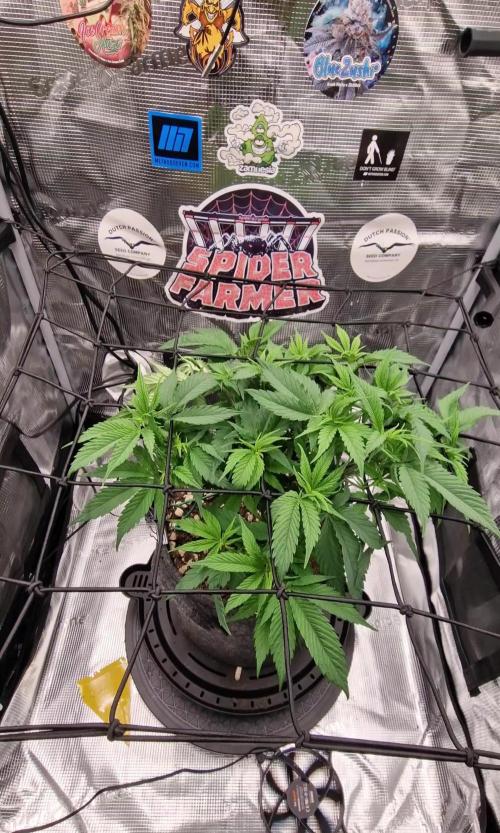
Die Kleine hat sich nach der Entlaubung letzte Woche wieder super gemacht! Ich lass sie noch ’ne Woche schieben, dann geht’s in die Blüte 😎🌱
Likes
76
Share


@BB_UK
Follow
Start by saying 2 are in flush now! (Black cream and sunset sherbet) I used flawless finish on them and then water from then on! Started to see some fades within a few days with the black cream and sunset sherbet leaves have lightened up, just awaiting some fades! And I’m watching under a 50x loupe to aim for the perfect harvest! The aromas are crazy in there got all sorts going on until I touch one and identify it’s aromas but as expected everything is going to be full of terps and resin! On the end road now! Flush next feeds for the purple punch and forbidden runtz! I’ve added a picture of the royal creamatic I took out as it’s just jumped into flower! Glad I took her out now too as she has some coverage and I wouldn’t want to lose no light at this stage! End result with dynomyco! IS… use it highly recommend. I’m using it in all my grows from now on! It’s a great additive providing your plants with a lot more beneficial bacteria that aid the myco and allow the plant to uptake nutrients better and gain a lot more stability so it’s a must! Contest or no contest I’m glad I got to use it or how would I have known! Thank you Ari 🙌🏽🙏🙏🙏💚
Likes
27
Share


@RDWCGrowing
Follow
3/25/2023
Week 6- Day 1 of Veg (Day 52 overall)
Added my first between changes SILICA Top offs. Was worried that when you add it to pre mixed Nutes that it can make the whole thing turn into a gummy looking substance. I was ready to drain the system and start it over for the week if needed, but no issues adding it to the tank. the Silica going into the Res didn't gummy the system up, it did drop my PH by quit a bit causing me to have to bring it back in balance.
36 Gallons in the Tank
Silica
Add .5mil/Gal = 18Mil
I topped some that needed to be topped, I defoliated some that needs to be defoliated. Since I have moved into Week 6 I have increased the light intensity up to just over 500 maxing it out for Veg Cycle. Next increase will be Week 1 of Flower.
3/26/2023
Week 6- Day 2 of Veg (Day 53 overall)
All conditions looked great. Other than me not putting one of the humidifiers back right which means it didn't work last night so Humidity was lower than I like. But got the Humidifier back on it's stand correctly and it is now pumping away. With that I decided to give the plants a day off from any stresses, no topping, no FIMing, no Defoliation for today. Just some good old soaking up the light rays and the ability to get all the Nutes they would like..
3/27/2023
Week 6- Day 3 of Veg (Day 54 overall)
Looking kind of Bushy today, so I defoliated some, and topped some.
3/28/2023
Week 6- Day 4 of Veg (Day 55 overall)
PH was a little lower than I like 5.74 so I added a few Mil of PH UP and brought it back up to 5.94.
Not much else at this stage, just I topped a little and I defoliated a little.
3/29/2023
Week 6- Day 5 of Veg (Day 56 overall)
Topped a little, Defoliated a little Watched them grow!!
3/30/2023
Week 6- Day 6 of Veg (Day 57 Overall)
Main action today was breaking down my old tent and setting up a new tent and getting my second RDWC system setup and ready for clones. I Topped a little, I Defoliated some and started taking a good look at what I would like to take for clones in the coming days. I have a few bottom branches that look every promising for my clone material on each.
3/31/2023
Week 6- Day 7 of Veg (Day 58 overall)
#3 is at 16" Tall
#2 is at 13" Tall

Likes
19
Share


@ArtisticGrown
Follow
Hello here we are now in flower! Start of the first week of flower and let me tell you we are ready!!!! I had so much fun training this plant! Ive decided im naming her patience cause shes definitely gave me a lot of patience learning, humbling me helping me thru some hard times I've had to go through. I'm blessed to grow and blessed to have the miss Guava Slushy - Green Bodhi Genetics.
As far as the tent goes things have been dialed in! Recently got my humidity down to roughly 45, 50 % humidity. With a roughly temp 70s thru the day and 60s to high 50's in the Am. Im beyond proud of this plant! Lets go guava Slushy welcome to the Bloom! Getting ready to feed her bloom nutrients thru advanced nutrients connoisseur line! Ive been flushing her this last week with irrated water ph 6.30 shes looking well! Much love happy growing
Likes
18
Share


@Manic
Follow
I feel like they could be more light green in color but they are growing really well. Alaskan purple seems to be growing a little lower than the blueberry but I'll bet it's just the genetics. Overall haven't been feeding them water til the soil is dry on top with the ffof, and they seem to respond well to it with no discoloration or burns. Haven't used any nutes and don't plan to til the week of flowering or a week after depending on how the transplant goes. Will add more pics throughout the week, if anyone notices anything I'm missing feel free to spill the beans.

Likes
96
Share


@DevilsBud
Follow
Day 56 of flowering of the CBD spliff Berry From Spliff Seeds
Getting to the end of the line of this beautiful 2 plants she frosty she smells absolutely amazing and the only thing that is still going on is flushing and i hope i can cut here down Sunday will see i want the ppm to go lower for fine end result i am not going to cut corners on this grow it's looking and going to good for that
23/12/21
Run off was 1600 ppm so almost there
25/12/21
Runoff is around 700 ppm
I will be now drying the pots out and then it's chop time for these 2
26/12/21
Day 58 flowering runoff 550 ppm 🤘🏻
There looking frosty smell absolutely 🔥🔥🔥 thricome are where i want them and has a day to go to dry out the soil and then light's out for 24 hours it was a perfect grow From beginning to end CBD SPLIFF BERRY From @spliffseeds
28/12/21
Chop chop 1 CBD spliff berry
I have decided to do one wet trim and one dry trim so will be trimming first one tomorrow and goes into dry reck
One left to chop good times
Happy holidays people hope you have some great days stay healthy take care of the one's around yeah and let next year be more weed and Less fucking corona so i can get my ass to Alberta Canada for month vacation to see if we could move there 🤘🏻🇨🇦🤘🏻
visit www.marshydro.eu
for your best gear and use the PROMO CODE: DEVILSBUD
Some info about the Marshydro FC-4800
Superb Quality LED Chips: The whole light is composed of 1206 pcs Samsung lm301b and Osram 660nm chips. More than two times as many LEDs are used to drive the grow lights at low currents and to avoid overdrive. Quality is guaranteed and efficiency is up to 2.8 μmol/j.
Even PAR Distribution and High PPFD Output: The multi-light bar design and the densely distributed light chips enable the LED grow lights to achieve the optimum PPFD required for plant growth over the entire effective coverage area.
Specifically Designed Spectrum: To ensure even plant growth, blue and red light are enhanced on the basis of a full spectrum combination. Not only does this accelerate plant growth, but it also improves the yield and quality of the plants at the same time.
Dimming Daisy Chain Function: The dimming function saves on electricity costs and enables brightness from 10% to 100% for the different stages of plant growth. A single master light can connect up to 30 lights in a daisy-chain system.
Business LED Grow Light: The light's wavy heat sink dissipates heat quickly and the IP65 waterproof allows the light to operate in humid conditions. 180° collapsible feature for easier installation. All these features provide favorable assistance for commercial cultivation.
And some tent info
●【Lock All Light Insid】MARS HYDRO Grow Tent Interior is made of diamond mylar. Non-toxic to the environment, no harm to plants. High-quality 1680D canvas being double stitched, (ALL OTHERS BRAND grow tent is 601D canvas) which is tear-proof for perfect light locking, No light leaks or rips at all.
●【Durability Grow Tent】Stable Metal corner adapters and poles are the trustful supporters of the tent. No rusting nor paint-falling. Quick easy tool-free installation. Carries strong heavy-duty SBS zippers, double layer lining to create a light-proof seal.
●【Easy Observation of your Plants】Special peeks window made by double layers of cloths. Observe the growing conditions of your plants without opening the tent and avoid disturbing plants. The peek window also serves to dissipate heat and ventilate air.
●【Removable Tray Keep Clean】The package includes a removable waterproof floor tray to hold soil and fallen leaves. The tray can be taken out easily to wash. Removable and water-proof makes cleaning easy.
●【Good Ventilation&Fast Assembly】 Circular double-sleeved vent holes with adjustable nylon strap for air circulation by exhaust fan, ducting, carbon filter, or reflector. Better allows proper light, heat, and airflow. Quick tool-free installation. Reinforced by a sturdy metal frame to ensure security and stability, supports up to 140lb. Perfectly safeguard your plants to thrive even in winter

Processing
Likes
10
Share


@levensfiets
Follow
The three girls are almost switching into flower, so this week i'll start with a low dosed flowering mix in terms of nutes
Differences between the three are huge, there is no doubt that the three different environments we've put them in are definetely putting their mark on the growth and overall character of the plants.
the signs of light deficiency on plant number 3 are showing clearly: its brittle and very wide spread, you can tell its looking for more light.
Number #2 gets the most light and is hardly stretching at all. it seems like a crop of lettuce.
Number #1 gets plenty light, not showing any signs of slowing down however i'm noticing that this one consumes less water (probably has to do with temp/RH levels being different due to the different lamp) than number #2.
Probably should give #2 some more straight water because its consuming so much water and i do not want to overfeed it. I think #1 is doing fine and can do with a little less water, but with nutrients.
#3 is hardly using any water it seems like, i'm thinking of moving it next to a radiator so it should be able to get a quicker absorbtion and vaporisation of water in its system, hopefully charging it with some more power.
Just did some LST on day 29 as well, including removal of 2 leafs of both #1 and #2. Not sure if it should be considered defoliation though.. Don't think so ;)
------------
end of week 5: i've flushed plants #1 and #2 as seen on a video on youtube. the idea behind this is to flush out any leftover grow nutes and start with a clean slate when the girls transition into flower.
as an added benefit i've discovered that it is much easier to maintain a beneficial VPD value when the earth is completely soaked once a week instead of watering it with smalller portions more often. The earth contains a lot more water and evaporates it into the climate, easily reaching a 60% RH without a humidifier in these fridges. I've even lowered the lamps to get the temps up, because the VPD was reaching values below 0.90.

Likes
57
Share


@Regenwurm
Follow
Ladie 1 wurde an Tag 68 gehackt. Man hat bei dieser Pflanze die allen anderen ca 14 Tage voraus ist gemerkt, dass Sie nicht sehr ertragreich ist. Alle anderen sind jetzt bei Tag 70. Die gemessenen Tage beginnen bei mir bei der Lichtumstellung auf 12/12, nicht bei der Vorblüte! So erkläre ich mir die längere Blütezeit. Die anderen Ladies legen an Volumen zu und entwickeln sich gut, aber Sie brauchen noch ein paar Tage bis zum flushen. Die Luftfeuchtigkeit habe ich jetzt zwischen 32 und 38 %RLF. Die Temperatur Nachts bei 17-18 Grad, Tags bei ca. 24 Grad. Die Tricome sind wie gesagt noch gar nicht Amber sondern zu ca. 75 % trüb. Der Geruch der Ladies ist stark, aber nicht extrem. Ich freue mich nach 2-3 Wochen fermentieren die ersten Buds zu testen ....✌️🏾

Likes
36
Share


@Ferenc
Follow
Day 58, 11th of November 2020:
I set the lamp 15 minutes shorter to switch off earlier so she receives 11:45 of darkness. I would like to imitate the nature when longer nights come with time till the 4th week (when she will receive 13 hours darkness a day 15 minutes minus 4 times = 1hour) so every week 15 min longer darkness for 4 weeks and then back to 12/12 to have bigger buds from the 4th week....
I am in love with this one just look at the structure so nice leaves bushy and the smell is great. Pistils are coming she is showing her sex ;)
Good job Zamnesia....
All good strech will end soon and she will think about more bud making lol...
Fertilization happens every 2nd day with the mix and ratio above.
Let's go ;)


