


Likes
Comments
Share


@ZweetZkittlez
Follow
Ya cambiamos al ambiente final! Se realizó una poda de bajos, una buena Defoliación y LST



Likes
24
Share


@SooSan
Follow
90x60x140 (Mars Hydro)
FC-E4800 (Mars Hydro)
Easy2go Aquavalve5 (Autopot)
Living Soil (Demetearth)
Bruce Banner (PEV Seed)
Gorilla GG4 (Ganja Farmer)
Cream Caramel (Sweet Seed)
Gorilla Gelato (Ganja Farmer)
Blueberry (00 Seed)
Kalini Asia (Zamnezia)
Biscotti Mintz (Barney's Farm)
Blackberry Cake (Sensi Seed)
Amsterdam Amnesia (Dutch Passion)
Gelato Cookie (Ganja Farmer)
Purple OG Punch (Ganja Farmer)
Sweet ZZ (RQS)
Rainbow Road (Paradise Seed)
Substrat ~50L:
30L Super Light Mix Biotechnologie
18L coco
2L perlite
1,7kg lombricompost
350g guano de chauve-souris
350g Zéolithe
350g Basalte
170g guano vers de farine
170g biochar
0,7g Endomychorise glomus intraradices
0,7g Bacillus Amyloliquefaciens
Paillage de luzerne alfalfa
Arrosage avec 2ml/L de mélasse de canne 1x par semaine
Pulvérisation avec 1% d’huile de neem jusqu'à la 2eme semaine de floraison


Likes
228
Share


@StarLorr
Follow
Welcome to my Pablø Escøbar diary.
In this diary:
Seeds: sponsored by Ðivine Șeeds
Media: Promix HP
Nutrients: Advanced Nutrients, Diablo Nutrients.
Light and Weather: Şun☀️and Mother Earth.🌎
___________________________
Feeding:
Tue 25Jun: 4L water not pH'd
Wed 26Jun: 5L nutrients pH'd 6.5
Thu 27Jun: 4L water not pH'd
Fri 28Jun: 4L water not pH'd
Sun 30Jun: 6L water not pH'd
Mon 01Jul: 4L water not pH'd
___________________________
Weather hasn't been that bad, a cloudy day, a fresh day and night then warm, rain Friday afternoon thru Sunday morning then Sunday afternoon 55 KPH wind gusts 💨
Anti-tilting device seem to hold them down for now😄
___________________________
Thanks for stopping by, likes and comments are appreciated!👊🏻😎
Keep on growin!
Keep on tokin!!!
😙💨💨💨💨💨

Likes
7
Share

@RBG
Follow
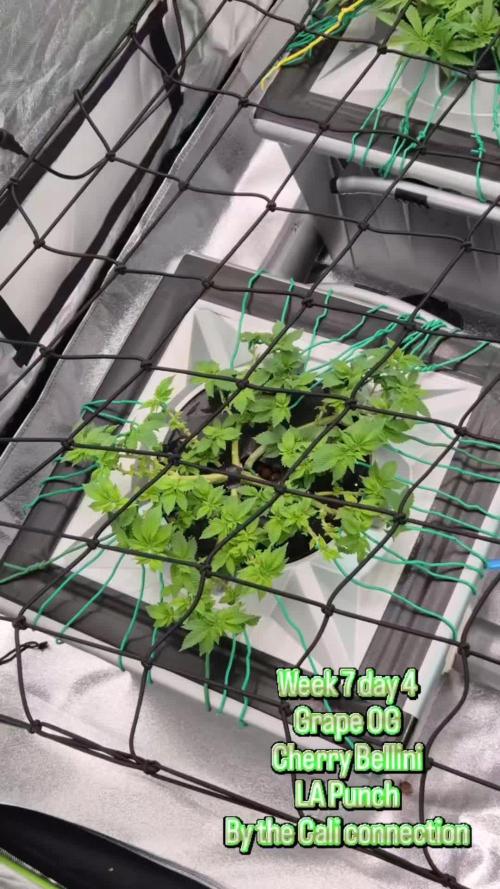
🌿 LA Punch by The Cali Connection 🌿
Week 7
Flower-day 2
16/10/2025
Nutrient change
Floramax veg 1: 1L
Floramax flowering enhancer: 400ml
Floramax organabud:400ml
Floramax rezin: 100ml ( around 1/4 dose)
Floramax cal mag: 100ml
Gp3 pro cal: 100ml ( unfortunately ran out and won't have any until next week )
Gp3 massive bloom: 100ml
Cyco platinum series silica: 200ml
Sleeps with the fishez: 400ml ( half dose system shock testing to see of this minimises/prevents problems per nutrients change like i was having )
Ph 5.9-6 - EC 2.2-2.3 ( Floramax wants e.c of 2.4, so I'm doing .1-.2 under for now to see how she responds
LST and Defoilation is finally done on her, LA punch might get another LST tweak and a couple more Defoils. Unsure yet she's staying very tight so its a little harder to gauge how she'll respond
I thought I should add, with the way I lst, I like to get as much defoilation out the way before flipping to flower that way all she does in flower is just get fat and lovely. Seemed to work well coming from only doing Autoflowers so just using that knowledge and implementing to my photo grows and tweaking it
Likes
46
Share


@Capo420
Follow
Week has had ups and downs🙃
Plants seem to be growing fine 🙂 But there is yellowing and spotting still that I cannot resolve.🙄
Day 22- Still having some kind of deficiency/issue. They are growing well, don't really seem to be stunted. I think I may have burnt them with nutes.🤧 Flushing may help. 🤷♂️😅
Run-off pH is at 6.08, PPM 266
I have flushed them, lowered feeding... I'm driving myself crazy. Hahaha
Update 119 Day 23- Things are looking better. I definitely have been overfeeding them.😅
They are responding well to half nutes.🙌
Issues seem to be getting much better.
Happy Growing!
🤙💚💪🌱😎🌱💪💚🤙

Likes
4
Share


@MXHerc
Follow
Up-potted the 4 weedlings, pink wooly is looking the best for non auto and chemdawg for auto. Kiwi x kiwi is still the smallest plant. They were all topped and foliar fed after being transplanted into a soil blend
Likes
22
Share


@GrowAndSmoke
Follow
Start of week 5, both are stretching now.
(Day 36)
Today i watered both 2.5L with nutrients (Day 37)
Watered 2000ml today and also did some LowStressTraining. It was a little to strong an girl #1 (Day 39)
Watered again 2500ml with nutrients. (Day 41)
Likes
46
Share


@Dreadnug
Follow
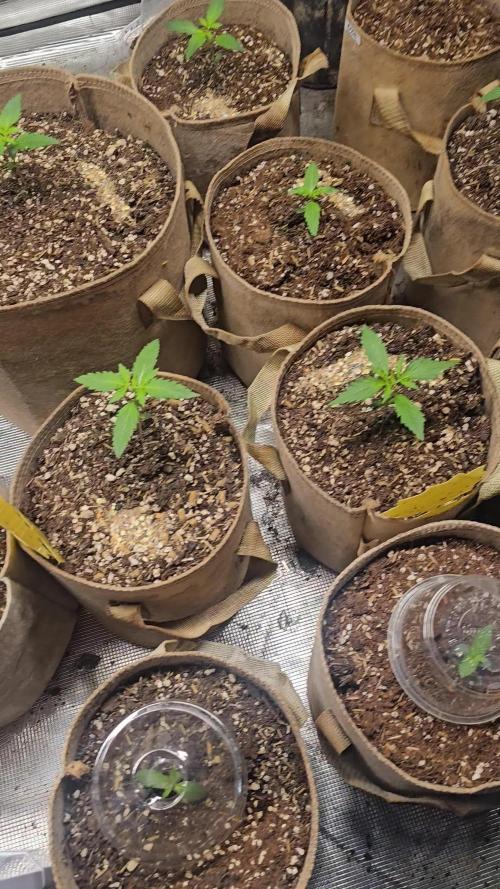
Two phenotypes - one purple and one white/green. The purple was very difficult to train and resulted in a couple inadvertent breaks - luckily it was repairable. The other trained very well, very flexible and worked very good for SCROG. Both produced heavily and are beautiful. The purple tends to be much more fluffy, with very long pistil hairs - the longest of any grow I have done. The white was super dense, very crystally and sticky. It will be very interesting to see how they smoke. Also, the purple tended to do very well with some nute mistakes I made as well as fluctuating pH in my water feeding. The white did not do as well in this regard but was able to get to harvest fine.
Wet bud weight is prior to trimming. The buds off of these plants were HUGE!!!!
Plant #1: (Purple): Wet weight - 76.58oz prior to trim; 15 colas; Terps: White - 60%, Clear - 20%, Amber - 20%
Plant #2: (White): Wet weight - 71.65oz prior to trim; 16 colas; Terps: White - 70%, Clear - 30%,
After 3 days of drying, took them down to trim for my jars.
After a few hours filled mostly quart jars 3/4 full but also tried an Infinity jar and a gallon mason jar to minimize the number of smaller jars.
Dry weights into jars:
Plant #1: 14.79 oz
Plant #2: 11.76oz
I did pull them after a day to dry rack them for 12 hours due to a little bit higher moisture content then I would have liked ( 70%rH). Re-jarred on 6/1/23 and now holding steady at around 60% rH.
Cure Check In (Week 2): 6/10 - 6/12/23: rH ~ 63 - 66%. Daily air exposure & fanning. Very smelly. Looking good - another couple weeks and will be ready.


Likes
11
Share


@TheNug
Follow
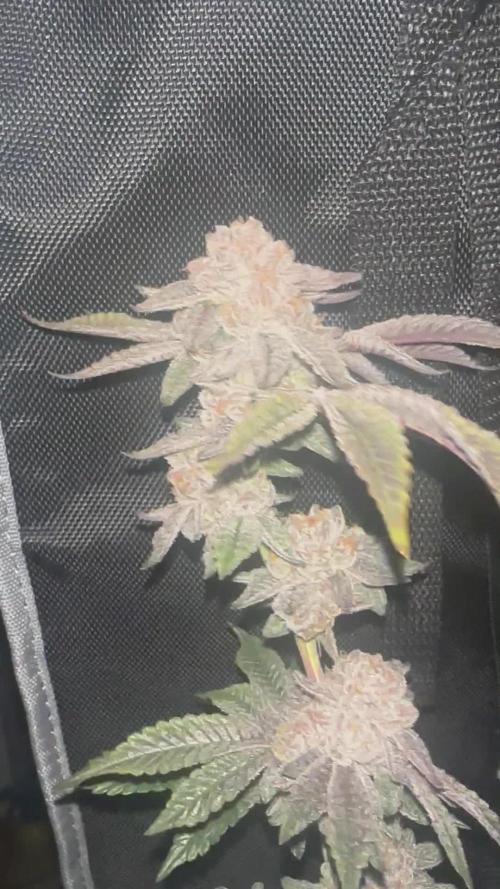
too keen for this strain she looks like a strong seedling coming into veg hard , no space between nodes which might be me and too much light, but damn i know they love it


Likes
26
Share


@B4niTa
Follow
Day 14 time for transplantation 🤗 first time with auto, but F1 should be resistant💪


Likes
14
Share


@danwho
Follow
8/31/2024
Both plants getting their first day of bloom spectrum lighting, red spectrum dominant. Already seeing signs of flowering on Plant A - the transition into flower must have been perfect. Otherwise, this plant might be an autoflower? DLI on canopy top around 30-32. Lights set to 70% intensity.
Reduced lung room humidity to 50% target. Lots of rain lately and the dehumidifier is working hard to keep up with 60-80% outdoor humidity. Tent humidity is hanging out around 60-65%
9/2/2024
Checking over both plants and doing light defoliation of larger fan leaves. Looking for more pre-flower signs on Plant B. Small nodules appearing on plant B. slightly odd formations compared to plant A. I will be keeping a close eye on this over the next few days.
Water level issues from last week are well within control. Since the fix was implemented the system requires about 2 fewer gallons to keep the system cycling as intended. Continuing to top the reservoir with fresh nutrient water with about 1 gallon of water per day. Still have not conducted a water change from the system. I will be planning one here closer to the end of this week when I have a little bit more free time at home.
9/3/2024
Plant A has a few signs of natural varieagation on fan leaves. Also found this cool leaf formation on a few of the larger fan leaves (see picture above). Plant B pre-flower signs still look odd, but monitoring closely.
9/6
Plant B still unconfirmed as a female. Preflower expressions are looking slightly more female, but no hairs yet. Both plants are looking healthy and doing well! The flow issues with the return line was due to a root mass making its way into the line and getting stuck. I was able to pump it out with some suction. Flow is completely returned and both buckets, back to stress free hydro for a few more days :D
Processing
Likes
4
Share


@Purkle
Follow
Week 8 is over and its starting to look like fall in the tent. Yellowing leaves galore on Pheno 2 and a god fade started on Pheno 1.
I have just been feeding with water when dry and keeping vigile of leaves that should come off.
Its important to stay aware of the yellowing leaves as they can cause mold issues when they decompose on the plant which in turn also raises humidity and can cause bud rot.
Ive had this issue once before when it was particularly humid but I learned to pluck the dead leaves as they are no more use to the plant anyway and also incorporated a de-humidifier. I would say its a must as far as equipment for grows go as you never know when you may need it particularly in humid areas such as where I live and depending on the type of plant, vigorous growth tends to cause more humidity. A flan is also important as it moves the air around the tent and eventually out through the ventilation.
Apart from leaf picking, I have just been admiring the tent and watching buds that may look like they will swell up to the point where the stalks cant hold the weight. Its inevitable and I will just tie them up as they start to fall.
Anyway only 2 more weeks to go (maybe 1 and a half epending on the last swell and trichome head colour).
Until next week
✌️

Likes
47
Share


@Hydro_Hiebs
Follow
🌱Welcome to my 2 x 4 ft autoflower tent. Here we Fast Buds tester 2210. We just finished the 1st week of flower with only a 3 week veg this should be a speedy grow. This week we top dressed with the first feedings of the grow.. I'm hoping they announce the name of this one as I get closer to harvest 😌💨
💧She has been receiving water every other day about 0.50 L of pH adjusted to 6.5.
✂️ TRAINING: N/A.
💡⚡Check Mars Hydro out on Instagram! @marshydro_aliexpress2 💡⚡
Processing
Likes
31
Share


@LockDownGrow
Follow
so the development on this lady has been VERY slow and has made very little bud production at all she also did not really stretch out at all from flower her buds are at the same stage at week 7 then the blackberry was at week 2 really , she is showing nor has all her life of any deficiencies what so ever , she has stay very short and stocky with good leave production " before i defoliated she was a real nice little bush " she smell amazing and the only was i can describe it when i touch her sugar leaves is exactly like chewing on the lemon "yellow" skittles sweet so can see exactly where the name came from for this strain.
she as you would expect has not been drinking a great deal and i am still able too only feed her 8 pint of feed per week where as her sisters are taking 14 pints ,
but other than her staying small and not wanting too really produce yet she has been easy too grow even for a newbie such as my self and has been trouble free ,
Likes
33
Share


@MrStryker
Follow
Welllllllllllllll last week of nutrients next two weeks will be watering with king crab molasses and flawless finish also cut down that early finished she just stinks so sweet lol so that will hang for a week or more !!! Going to start another grow this week which willl consist of Runtz Muffin again Sugar bomb punch , alien rock candy bruce banger Gelato O.g contemplating buying another 5x5 tent willl see what happens happy growing

