


Likes
Comments
Share


@Jays_Not_Here_Man
Follow
This was an easy grow, and had some amazing results. This is some of my best homegrown to date ❤️ the ladies were easy to manage, no PM, pests or disease. The root balls were enormous, wasn’t much soil to recover. They got heavy in the end from the weight but managed to stay upright for the most part. They were big stretchers , prepare for that, scrog was a good way to go but some of the eager beavers got away from me, which ended in some massive colas. Overall easy to grow, no surprises and you won’t regret the results! 10/10 ❤️👊🤤

Likes
8
Share


@LokalGrenz
Follow
have some type of deficiency have some spots on leaves but besides that things look okay they both need more water now not sure how long I can veg in the containers I’ll probably try get another week or two then up pot to 7 gallons
I broke a branch and new growth from topping today smh trying to bend it for training and was to rough so i put some tape on it hopefully they grow back in a week or two
Feb 25 getting one of them ready for transplant I’ll probably do it in two days I’m going to let the one with the broken branch heal for another week probably before I transplant
Feb 28
Did some trimming of the lower leafs
Almost time for one to be transplanted the cover crop have not grown in the 7gal yet I seen some growing but not a lot

Likes
9
Share


@HIAZ_urbanbudfarmer
Follow
Been a busy week getting the new setup going. She has been going really well , first week of flower , interested to see how she goes. She is a nice little plant problem free so far.

Likes
10
Share


@SnoopyShaggy
Follow
Super relieved to see flower signs from 2 of my hermie seeds. A big shout to the master MOUSE for giving a positive explanation about self pollination, upon hearing his feedbacks i waited and tadaa, both of my hermie seeds flowered which means MOUSE was 100% right, my previous AK47 did self pollinate and they became autoflowers thanks to mother nature. All my grows are in AC ran environment and i only grew autoflowers so the confidence of waiting patiently was worth it while some would say it is a waste of time to grow seeds from hermie.
3 of the Autoflowers are also preflowering and super thriving under 80% light intensity from the darling sf2000. Not giving any more scrogging to avoid stress to the plants coz all of them are in preflower stage.
Day 36 from seed.
As for the SF2000 performance, i am able to plant 5 seeds in 2x4tent in 5 gallon pots. I plan to get 4 gallon pots and maybe squeeze 6 to 8 pots would love to see the sf2k experience.
This current tent i am using is shitty in terms of tent height, you need to really train the plants short, looking at tent suggestions for a taller tent.
Likes
11
Share


@CanarianGrow92
Follow
Week 7 for the banana purple punch from fastbuds 420!!!
We gave the last week of xpert nutrients feeding and will continue now with only water, harvest time is soon and at the moment the buds are looking great, nice smell in the tent and the buds are nice and covered in trichomes!
The plants are not that big but of course i have quite some plants together in the tent
and 7 liter pots so they stayed a little smaller, next time i will do maybe less plants but with the bigger 420 fastbuds airpots!

Processing
Likes
51
Share


@Silverback_Guerilla
Follow
1/18:
Got my new 10t Dabpress...bout to get sticky up in here...
Built another DIY Co2 maker and put it in the bottom of the tiny tent with the other Co2 makers...that air is exhausted into the closet, so any CO2 not utilized in the tent has another chance at being used before being exhausted from the building.
Seems like the new UVB bulb is intense enough to stress the plants.👍
1/19:
Fed today. Added humic acid. Took some photos and video...ooh la la...😍
1/20:
Took photos of the ladies in the tiny tent....yowsa!

Likes
2
Share


@Comfrey
Follow
Drei Eiswasser Spülungen und etwas kühlere Nachttemperaturen haben zwar etwas an der FarbeRichtung bläulich geändert, allerdings blieb das erwartete Purple vollständig aus.
Die Blüten sind sehr klebrig und der Duft ist deutlich aber nicht besonders intensiv.
In der letzten Woche habe ich einige männliche Blüten heraus geknipst und mir sind auch ein paar Samen aufgefallen. Das selbe Problem hatte auch meine Hindu Kush.
An Tag 97 habe ich die Pflanze nach 48 Stunden Dunkelheit abgeschnitten und kopfüber aufgehängt.

Likes
376
Share


@Metatronix
Follow
Good day to all my friends and visitors here on GD.
At the end of this week EC is at 3.0 so first thing to do next week there will be reservoir change.
All goes well looks like the big Tropicanna plant is maturing so probably about two more weeks for her....better photographs will come next week.
I spray them every second day with CannaCure or a hydrogen peroxide solution to be safe from the moldy buds.
The SE7000 runs at 550 Watt and about 35cm from the canopy and is doing an astounding job.
For anyone who is interested in obtaining this efficient and affordable light fixture here's the link:
https://spider-farmer.com/products/spider-farmer-upgraded-se7000-730w-commercial-led-grow-light/
Also i included a unpacking recording of one of the packages Spider Farmer send me for the next grow, If you are interested in buying this 6" exhaust fan with filter here's the link: https://cutt.ly/gwjZIk9r
Thank you a lot Spider Farmer you guys rock 💚
That's it friends, I hope to see y'all next week.


Likes
Comments
Share

@HOME_GROWBOOK
Follow
Diese Woche geht es los wir drücken die Pflanze deutlich nach unten hinten in einem Bogen und fächern die Triebe weiter auf um sie gleichmäßig zu verteilen.
Likes
9
Share


@Siriuz
Follow
Yo, get ready cuz I aint got time for the
b!Tches - Sing with me go go go
High as f
Whats up my friends how is it going?
Im just happy I did some crazy stuff on this gorilla girl after having the accident with the main trunk thank God it healed and created other colas but since she was so bushy I went and defoliate her some more, she got bushy again but left her like that didnt fck with her no more until I had to for specific REASONS but before that I also went and literally stab two of her branches, you will see duct tape covering those, reason I did that was to force her to produce more flower thru those branches believing that HEALING redirects vitamins from living soil when feed in a schedule with the right nutes, she gets healed real fast plus she got real bud on those two branches that were stabbed.
IT was literally something to force her produce more bud and yes indeed it worked those bud suites right now are fully loades on tips are very dense thc yellowish and then white hairs and the main trunk has white hairs good size fattening up and yielding some more but still not so many yellow dark amber hairs like in those branches that were stabbed lol
I called that SiriuzShot lol
Hey guys whats up its just about getting creative, look at how green my leaves are and the nice nice bud is coming up
We at mid bloom right now brothers just switched schedule to 18/6 Flowering girls need resting time added fan for extra air flow and hopefully adds density to buds???
Yo give your tips suggestion anything related organically home made whats good lemme know so I can keep fattening up this ladies very well
Hey by the way added some molasses and banana tea with some other tea and sugary stuff they taking it well, no nute burnt no problems at all girls liked it x 100000
Good stuff organically
Lemme know if anything alright
Stay tuned for more
Check me out @cannagrowersiriuz
Take it easy son have fun
Happy growing


Likes
146
Share


@Haoss
Follow
The plant has undergone extreme defoliation and LST, easily copes with stress, I rest for a while to grow and i will scroging 🌱

Likes
31
Share


@MadeInGermany
Follow
Info:
Unfortunately, I had to find out that my account is used for fake pages in social media.
I am only active here on growdiaries.
I am not on facebook instagram twitter etc All accounts except this one are fake.
Have fun with the update.
Hey everyone :-)
quick update today.
She was further trimmed with topping.
It was poured twice with 1 l each time.
Everything was cleaned and checked.
Stay healthy 🙏🏻
You can buy this Strain at :
https://www.royalqueenseeds.de/feminisierte-hanfsamen/220-pineapple-kush.html
Type:
Pineapple Kush
☝️🏼
Genetics:
Pineapple x O.G. Kush
👍
Vega lamp:
2 x Todogrow Led
Quantum Board 100 W
💡
Bloom Lamp :
2 x Todogrow Led
Cxb 3590 COB 3500 K 205W
💡💡☝️🏼
Soil :
Canna Coco Professional +
☝️🏼
Fertilizer:
GHSC Powder Feeding Bio
☝️🏼🌱
Water:
Osmosis water mixed with normal water (24 hours stale that the chlorine evaporates) to 0.2 EC. Add Cal / Mag to 0.4 Ec Ph with Organic Ph - to 5.5 - 5.8 .


Likes
3
Share


@Mikewithgreenthumbs420
Follow
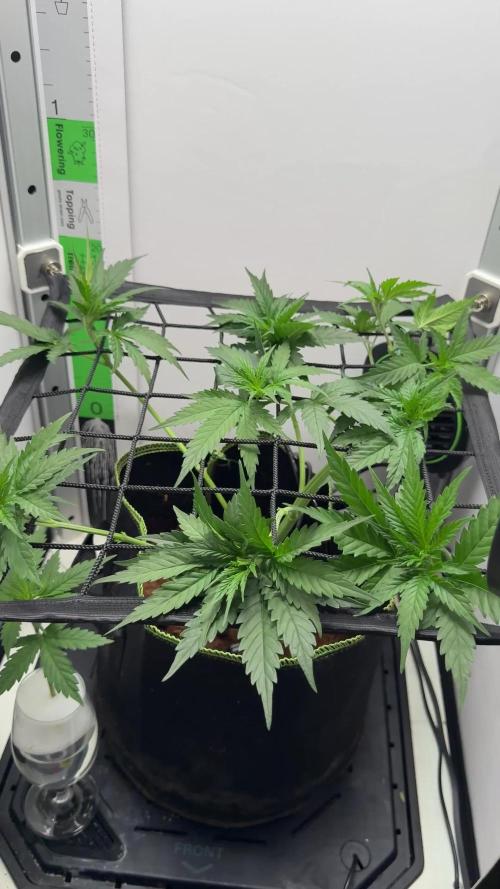
Removal to top big fan leaves and lower branch. Began some LST she’s my best auto for this run

Likes
59
Share


@Insaniac_0
Follow
Week 7 Day 43 to 49 of flower
I fed them half nute flush water this week. Feed this week was 1.25 gallons 1 time. I used 400ppm Bloom concentrate mix (recipe week 5). However, I also added .5ml/gal of CaliMagic (General Hydroponics 1-0-0) and 7ml of Roots Organics HP2 (Aurora Innovations 0-4-0). PH balance this week was 6.3. Since P2 looked mostly ready to harvest I decided to dry out after the first feed this week.
Next week is play by ear week. Currently day 48 I plan to harvest p2 tomorrow and leave p1 for another week. So I will feed p1 once more with the same half nute flush water feed that I used this week then let her dry out again.
Likes
6
Share


@The_Lonely_Farmer
Follow
Well the apricot has finally surcome too budrot and I have removed but expect it too return as it allways seems too 🙄
Such a shame as shes started really letting off her beautifull smells I hope but dint see her making it too harvest 😔 so sad too see the last outdoors auto nearing her end but we shall plod on and leave her be too see what comes of her 🌱
Great smell coming from her i must say 😍💚
Likes
35
Share


@Paulolo03
Follow
DAY 63, the grow box is now fully functional again, new extractor, new handmade softbox, back to 18/6 schedule, max temp=33°C, RH=50% (I know it's a bit high for flowering stage but I check carefully the plants and so far, nothing is wrong)
3 plants are frosty, I can see the trichomes with the microscope so I stopped the nutrients for them and flush with water pH 6,2, do you guys think I'm doing well ?
For the 7 others:
- 1 hasn't flowered, I keep her but I know shell never give nothing.
- 6 are growing and I keep giving nutrients (Biogrow, Biobloom, Topmax and Bioheaven)
Likes
24
Share


@Firepharmer
Follow
Monkey berries is finished up in 55 days flushed too 0.0 EC . The colours are so beautiful!! She’s went quite purple for me the trichomes are thick what a killer strain to go it was my first exotic mikes genetics looking forward to the next run with exotic genetics.. stated flushing the slurrican IX yesterday she be chopped by day 60 . One last update coming of the final grow in a week or so .. happy growing


Likes
69
Share


@nonick123
Follow
Día 59 (29/07) Este cultivo no es muy entretenido con solo agua, asi que...
Le hago supercropping a todas! 😁 A ver como reaccionan!
Día 60 (30/07) Las plantas se están recuperando muy bien del supercropping! 😁
Todos las puntas hacia arriba! 💥
Come onnnnnnn! A por esa floración en 2-3 semanas!
Riego 500 ml H2O pH 6,75
Día 61 (31/07) Las plantas se han recuperado genial del supercropping y están lanzando TODAS las ramas hacia arriba 😍
Un espectaculo la fuerza de estas plantas! 💥
Redistribuyo las plantas, para ver si OnionOG está más protegida del sol, ya que consume muchisima agua y voy a estar en unos días fuera...
También reubico ligeramente la malla de sombreado, debido a que en mi latitud el sol empieza a incidir lateralmente por las tardes...
Riego 500 ml H2O pH 6,55
Día 62 (01/08) Vuelvo a redistribuir las plantas en el invernadero dejando a OnionOG todavía más protegida del sol directo, para tratar de disminuir su consumo de agua estos días que no voy a estar...
Pongo una protección "visual" en el invernadero en el lado que da a los vecinos (cara norte), porque he "cazado" miradas indiscretas...
Riego 500 ml H2O pH 6,55
Día 63 (02/08) Debido a que me voy de vacaciones unos días, adelanto el riego semanal con Té y la aplicación foliar de Kelp
Riego con 1 Litro de Té Vegetativo de Lurpe Solutions. Preparación: 24 horas con bomba de aire (oxigenación) con ingredientes:
Green Sunrise 8 ml/L + Insect Frass 16 ml/L + Hummus Lombriz 8 ml/L + Melaza 1 ml/L + Kelp Hidrolizado 0,25 g/L
Aplicación foliar Kelp hidrolizado de Lurpe Solutions a 0,25 ml/l
Día 64 (03/08) Cerrado por vacaciones
Día 65 (04/08) Mi amigo viene a casa a hacer un riego con 1 Litro de H2O pH 6,5
💦Nutrients by Lurpe Solutions - www.lurpenaturalsolutions.com
🌱Substrate PRO-MIX HP BACILLUS + MYCORRHIZAE - www.pthorticulture.com/en/products/pro-mix-hp-biostimulant-plus-mycorrhizae