


@CouchLocked420
Follow
So here we are! Time flies… they had quite the stretch after flip I flipped about a week ago, and they’re continuing to stretch and fill out. Defoliated the bottom a bit where no lights is reaching.
Girls are happy so far, the OG that was straggling behind is also catching up even outgrowing the other OG. A little discolouration, however I’m not using nutes just guanakalong earth let’s see if it will be enough until end of flower… didn’t have quite enough earth so pots are full full but I hope good enough…


@Drgreenthumb627
Follow
Pineapple Express looks to be coming in on the finish line, maybe 2 weeks tops on left on it.
The ghost Train haze i the back of the tent is still throwing out all white pistils and i see bo end in sight for that one, the ghost train at the front of the tent however looks much farther along and may be ready in 2-3 weeks. they are all looking healthy, save for some fade starting to hit some of the leaves. the flowers are dense and sticky, i cannot wait to experience these plants after cure!




@Foggedaboudit
Follow
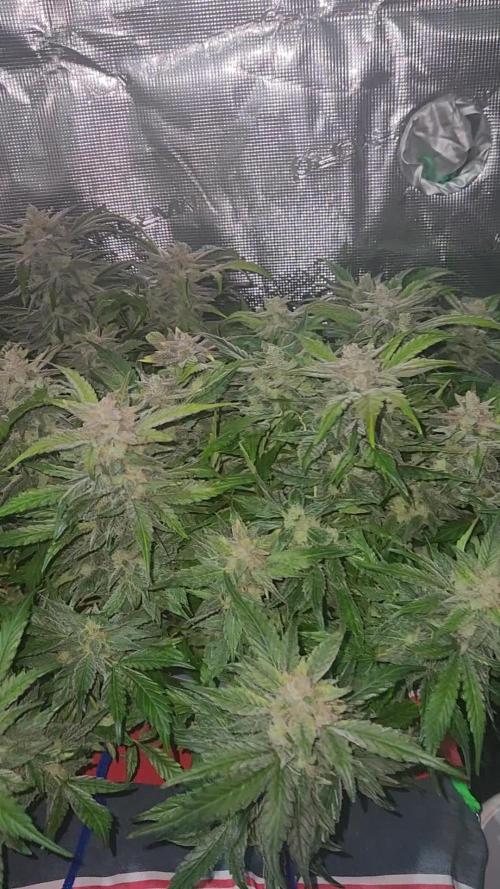
Flush is on. A week or so I reckon. 90% of trichomes are already cloudy. The smell is so complex! The colors amazing! Can’t wait!



@PicoDeGallo
Follow
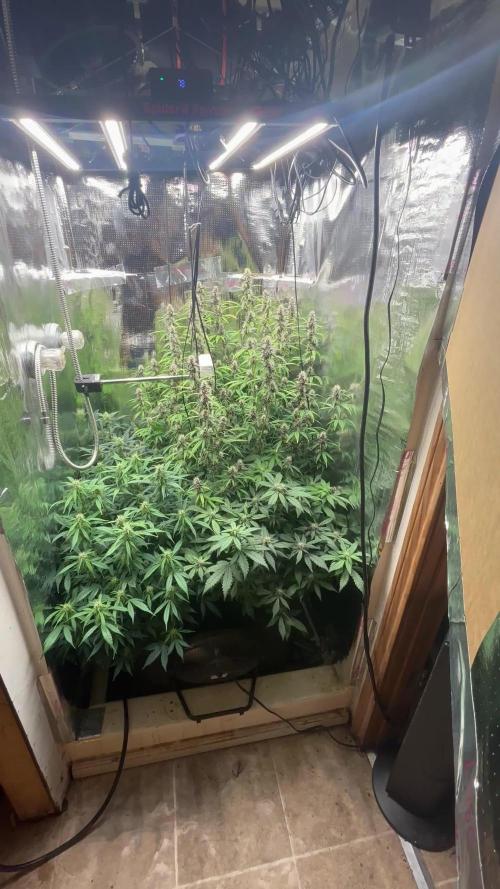
Fast Buds LSD-25 Auto
Right Rear
All I can say is WOW!
This was the smartest and slowest to start but has taken over the shower. It is full of buds that are filling in nicely.
It has been the heaviest drinker. I have been having to give it extra water after each cycle of the drip watering system.
The purple is almost black and I am looking forward to see what it turns out like, probably about 3 more weeks.


@King_Green21
Follow
Day 76 - I was on holiday all this week so not many daily photos, was able to gather the Energy the day after I come home to give them there proper defoliation at the end of week 3.
No complaints or problems as of yet with the strain very easy to grow with little maintenance

shorts_status_processing


@Eyeduno
Follow
Went abit over the top with the defoliation but first time for everything think people call it mainlining or something and looks like the cuttings have took there’s new green growth


@Mo_Powers
Follow
not much has happened this week. there is still some sun per day. however, the temperatures drop to 4-8 degrees at night. these are not exactly the best conditions. maybe this late outdoor experiment was not a good idea after all. however, they have not died yet.


@Fonzi
Follow
Die Amnesika ist was feines. 51g trocken habe ich geerntet. Sie duftet wirklich sehr lecker. Ich bin aber schlecht darin Aromen zu beschreiben. Die Wirkung mag ich auch sehr. Sie ist aufjedenfall sehr stark. Lässt sich gut rauchen. Schmeckt gut. Werde ich wieder anbauen.


shorts_status_processing


@UnkleSkunk
Follow
this week I was expecting an extension of the top that didn't happen
The plant has remained very uniform with the flowers all quite large even the lowest ones ..
the plant has remained small but I think it will have a nice yield ..
now let's talk about perfume .... last week a stronger and more pungent smell now much more delicate but always spectacular ...
The growth continues every now and then by rinsing with just water to eliminate the residual salts, otherwise the fertilization remains standard




@Naujas
Follow
89 days!!! I came back after an unplanned long vacation, and when I saw her I immediately realized that today is harvest day, it's a pity that I haven't seen her ripening for the last 12 days, I wasn't with her:D but the result really impressed me, I've never had such a beautiful strain :) the girl has been growing throughout the growth cycle, she's been growing really vigorously!!! Her smell really reminds me of cherries :) the flowers have grown very stiff and full of trichomes, I can't wait to taste her:) the update will be after the harvest has dried up:) good luck to everyone:).


@CrazyHorse
Follow
Hello my friends 😇
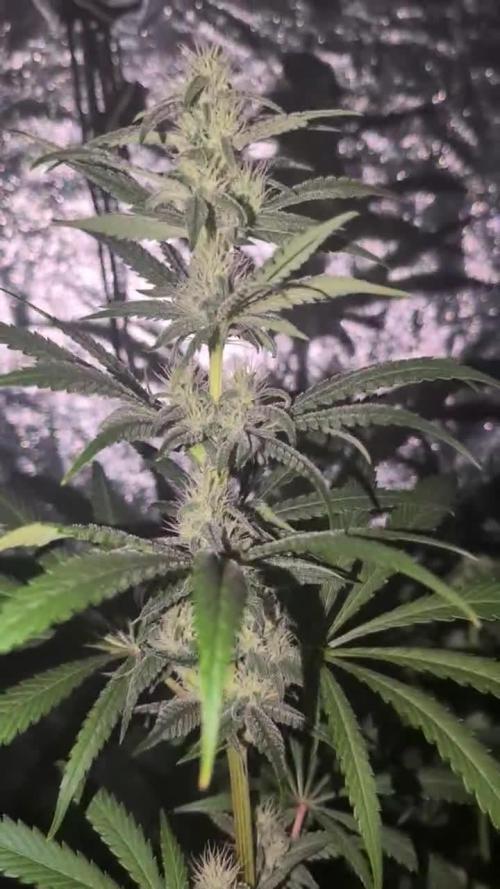
Purple Lemonade had been flush today !! She looks beautiful that purpul-dark buds are amazing. In next 3 or 4 days I will cut her 😇
Cinderella and Bruce Banner drinking less from a avg. 1.7l/day to 1.25l/day, so end of flowering for this two will be in around 2 weeks.
Cinderella looks really good, she should give a good harvest.
Update:
Day 67
Happy time !! Harvest time !! Finally Purple Lemonade get to the final point.
At this moment there is 0% of lemon scents, BUT !! There is a beautiful smell of berries, chocolate and leather in the air. I can't wait to try it
All the best, You Lovely Girls Growers 😇 💪 🙏




@fabialien071
Follow
Semana del 9 al 15 de septiembre 2024, van un poco lentas, pero se ven prometedoras ojala todo salga bien con está ya que es mi segunda vez probando Paradise.


shorts_status_processing


@Silverback_Guerilla
Follow
SATURDAY 9/21:
After having had my entire rig and all my cured produce stolen from me by my pardner in crime, I'm starting from scratch.
(That f**king asshole!)
Special thanks to the fabulous folks at Fastbuds for sending me some replacement beans!!!
I mylar'ed up a closet and got a little light to get them started with. It's 3500k with some extra 660nm and draws about 200w from the wall. I am going old-school this time around..no pre-soak and no paper towels. I bought some soluble myco + tricho + all the good beneficial bacteria and mixed a little into a liter of distilled water and wetted rapid rooter plugs. I planted all three Stardawg beans in the rapid rooter plugs and put them in a little humidome under 9w of pink light.
TUESDAY 9/24:
All three emerged with no problems, but one is still wearing a "hat"..
THURSDAY 9/26:
All three had taproots sticking out a few inches, so I planted them in their 3 gallon pots and put little mini-domes over them.
FRIDAY 9/27:
I knew better than to try to start some seedlings with no humidifier, but the asshole stole mine, so I tried it anyway..I have several seedlings that probably aren't gonna make it, but so far all 3 x Stardawgs look fine.
I wet them down and put some trays of water in the closet to try and bring up the RH.
TUESDAY 10/1:
Okay, so only one survived, and she's starting to grow.👍
My soil mix was too hot for them...rookie mistake...
I finished working on my homemade frame and mounted 6 x 120w quantum boards to it, but one of my 3 x 240w drivers failed, so I gotta get a replacement sometime in the next few weeks. I still gotta get my ventilation squared away before I can even run them.😎
FRIDAY 10/4:
She's my lone Fastbuds plants..got high hopes for her.
She'll be surrounded by a bunch of Candy Cane hybrids.



@Ultraviolet
Follow
What's in the soil? What's not in the soil would be an easier question to answer. 16-18 DLI @ the minute. +++ as she grows.
Probably not recommended, but to get to where it needs to be, I need to start now.
Vegetative @1400ppm 0.8–1.2 kPa 80–86°F (26.7–30°C) 65–75%, LST Day 10, Fim'd Day 11
CEC (Cation Exchange Capacity):
This is a measure of a soil's ability to hold and exchange positively charged nutrients, like calcium, magnesium, and potassium. Soils with high CEC (more clay and organic matter) have more negative charges that attract and hold these essential nutrients, preventing them from leaching away.
Biochar is highly efficient at increasing cation exchange capacity (CEC) compared to many other amendments. Biochar's high CEC potential stems from its negatively charged functional groups, and studies show it can increase CEC by over 90%. Amendments like compost also increase CEC but are often more prone to rapid biodegradation, which can make biochar's effect more long-lasting. biochar acts as a long-lasting Cation Exchange Capacity (CEC) enhancer because its porous, carbon-rich structure provides sites for nutrients to bind to, effectively improving nutrient retention in soil without relying on the short-term benefits of fresh organic matter like compost or manure. Biochar's stability means these benefits last much longer than those from traditional organic amendments, making it a sustainable way to improve soil fertility, water retention, and structure over time. Needs to be charged first, similar to Coco, or it will immobilize cations, but at a much higher ratio.
a high cation exchange capacity (CEC) results in a high buffer protection, meaning the soil can better resist changes in pH and nutrient availability. This is because a high CEC soil has more negatively charged sites to hold onto essential positively charged nutrients, like calcium and magnesium, and to buffer against acid ions, such as hydrogen.
EC (Electrical Conductivity):
This measures the amount of soluble salts in the soil. High EC levels indicate a high concentration of dissolved salts and can be a sign of potential salinity issues that can harm plants.
The stored cations associated with a medium's cation exchange capacity (CEC) do not directly contribute to a real-time electrical conductivity (EC) reading. A real-time EC measurement reflects only the concentration of free, dissolved salt ions in the water solution within the medium.
98% of a plants nutrients comes directly from the water solution.
2% come directly from soil particles.
CEC is a mediums storage capacity for cations. These stored cations do not contribute to a mediums EC directly.
Electrical Conductivity (EC) does not measure salt ions adsorbed (stored) onto a Cation Exchange Capacity (CEC) site, as EC measures the conductivity of ions in solution within a soil or water sample, not those held on soil particles.
A medium releases stored cations to water by ion exchange, where a new, more desirable ion from the water solution temporarily displaces the stored cation from the medium's surface, a process also seen in plants absorbing nutrients via mass flow. For example, in water softeners, sodium ions are released from resin beads to bond with the medium's surface, displacing calcium and magnesium ions which then enter the water. This same principle applies when plants take up nutrients from the soil solution: the cations are released from the soil particles into the water in response to a concentration equilibrium, and then moved to the root surface via mass flow.
An example of ion exchange within the context of Cation Exchange Capacity (CEC) is a soil particle with a negative charge attracting and holding positively charged nutrient ions, like potassium (K+) or calcium (Ca2+), and then exchanging them for other positive ions present in the soil solution. For instance, a negatively charged clay particle in soil can hold a K+ ion and later release it to a plant's roots when a different cation, such as calcium (Ca2+), is abundant and replaces the potassium. This process of holding and swapping positively charged ions is fundamental to soil fertility, as it provides plants with essential nutrients.
Negative charges on soil particles: Soil particles, particularly clay and organic matter, have negatively charged surfaces due to their chemical structure.
Attraction of cations: These negative charges attract and hold positively charged ions, or cations, such as:
Potassium (K+)
Calcium (Ca2+)
Magnesium (Mg2+)
Sodium (Na+)
Ammonium (NH4+)
Plant roots excrete hydrogen ions (H+) through the action of proton pumps embedded in the root cell membranes, which use ATP (energy) to actively transport H+ ions from inside the root cell into the surrounding soil. This process lowers the pH of the soil, which helps to make certain mineral nutrients, such as iron, more available for uptake by the plant.
Mechanism of H+ Excretion
Proton Pumps: Root cells contain specialized proteins called proton pumps (H+-ATPases) in their cell membranes.
Active Transport: These proton pumps use energy from ATP to actively move H+ ions from the cytoplasm of the root cell into the soil, against their concentration gradient.
Role in pH Regulation: This active excretion of H+ is a major way plants regulate their internal cytoplasmic pH.
Nutrient Availability: The resulting decrease in soil pH makes certain essential mineral nutrients, like iron, more soluble and available for the root cells to absorb.
Ion Exchange: The H+ ions also displace positively charged mineral cations from the soil particles, making them available for uptake.
Iron Uptake: In response to iron deficiency stress, plants enhance H+ excretion and reductant release to lower the pH and convert Fe3+ to the more available form Fe2+. The altered pH can influence the activity and composition of beneficial microbes in the soil. The H+ gradient created by the proton pumps can also be used for other vital cell functions, such as ATP synthesis and the transport of other solutes. The hydrogen ions (H+) excreted during photosynthesis come from the splitting of water molecules. This splitting, called photolysis, occurs in Photosystem II to replace the electrons used in the light-dependent reactions. The released hydrogen ions are then pumped into the thylakoid lumen, creating a proton gradient that drives ATP synthesis.
Plants release hydrogen ions (H+) from their roots into the soil, a process that occurs in conjunction with nutrient uptake and photosynthesis. These H+ ions compete with mineral cations for the negatively charged sites on soil particles, a phenomenon known as cation exchange. By displacing beneficial mineral cations, the excreted H+ ions make these nutrients available for the plant to absorb, which can also lower the soil pH and indirectly affect its Cation Exchange Capacity (CEC) by altering the pool of exchangeable cations in the soil solution.
Plants use proton (H+) exudation, driven by the H+-ATPase enzyme, to release H+ ions into the soil, creating a more acidic rhizosphere, which enhances nutrient availability and influences nutrient cycling processes. This acidification mobilizes insoluble nutrients like iron (Fe) by breaking them down, while also facilitating the activity of beneficial microbes involved in the nutrient cycle. Therefore, H+ exudation is a critical plant strategy for nutrient acquisition and management, allowing plants to improve their access to essential elements from the soil.
A lack of water splitting during photosynthesis can affect iron uptake because the resulting energy imbalance disrupts the plant's ability to produce ATP and NADPH, which are crucial for overall photosynthetic energy conversion and can trigger a deficiency in iron homeostasis pathways. While photosynthesis uses hydrogen ions produced from water splitting for the Calvin cycle, not to create a hydrogen gas deficiency, the overall process is sensitive to nutrient availability, and iron is essential for chloroplast function.
In photosynthesis, water is split to provide electrons to replace those lost in Photosystem II, which is triggered by light absorption. These electrons then travel along a transport chain to generate ATP (energy currency) and NADPH (reducing power). Carbon Fixation: The generated ATP and NADPH are then used to convert carbon dioxide into carbohydrates in the Calvin cycle. Impaired water splitting (via water in or out) breaks the chain reaction of photosynthesis. This leads to an imbalance in ATP and NADPH levels, which disrupts the Calvin cycle and overall energy production in the plant. Plants require a sufficient supply of essential mineral elements like iron for photosynthesis. Iron is vital for chlorophyll formation and plays a crucial role in electron transport within the chloroplasts. The complex relationship between nutrient status and photosynthesis is evident when iron deficiency can be reverted by depleting other micronutrients like manganese. This highlights how nutrient homeostasis influences photosynthetic function. A lack of adequate energy and reducing power from photosynthesis, which is directly linked to water splitting, can trigger complex adaptive responses in the plant's iron uptake and distribution systems.
Plants possess receptors called transceptors that can directly detect specific nutrient concentrations in the soil or within the plant's tissues. These receptors trigger signaling pathways, sometimes involving calcium influx or changes in protein complex activity, that then influence nutrient uptake by the roots. Plants use this information to make long-term adjustments, such as Increasing root biomass to explore more soil for nutrients. Modifying metabolic pathways to make better use of available resources. Adjusting the rate of nutrient transport into the roots. That's why I keep a high EC. Abundance resonates Abundance.