


Likes
Comments
Share


@Papapeyote
Follow
Traspaso a nueva carpa, por el momento misma luz, para floracion de usara un sodio en cambio de la LED

Likes
26
Share


@CannaBoy7
Follow
#myseed.ge
#soil-N1
#mysun.ge
#GROWROOM
#MYSEED-GROWROOM
The second LST and Defoliation

Likes
41
Share


@Silverback_Guerilla
Follow
1/4:
Moved a few other plants out of the closet, now they've got a little elbow room.
Both MPP's are fattening and frosting up very nicely. They are so similar that they could be mistaken for clones. Very, very stable genetic.👍
1/7:
Fed today and gave them the sniff test...delightfully sweet minty aroma!
I added a dose of endoboost in their feed today...kinda worried about the monstrous size of my plants considering that they are only in 3 gallon pots..

Likes
9
Share


@BB_UK
Follow
She’s a lovely girl just rewatched her growth sport zone and hoping in a few days she starts her pre stretch! I had to shuffle these girls around in order to suit lighting raises I’ll have to do for the purple punch! Lucky I have 3 adjustable lights ;) I think next week will be assured to be a sea of green so looking forward to training through the scrog! Thanks for stopping by buddies, feel free to hit that like button as it’s free 😉 thank you in advance.

Likes
1
Share


@Eric49
Follow
Going good not much growth comeing in to week 2 , four sets of leaves water twice a week fox farms nutrition one tsp one water cycle of a gallon

Likes
30
Share


@CanadianFillmore
Follow
Welcome growfessors to my outdoor 2021 grow! It's been 4 years since my last outdoor grow.
We've got LSD and Green Crack outside, each one in half a 55 gallon container, in pro-mix HP, with Gaia Green 4-4-4 all purpose powder nutrients.
Thanks for stopping by growfessors 👽🌳💚

Likes
5
Share


@Tony_Montana84
Follow
So die 11 Woche hat angefangen, seit ca 5 Tagen gibt es kein Dünger mehr für die Lady. Täglich gieße ich mit 1.5 Liter und das Wasser hat einen PH Wert von 6.5. Noch eine Woche und dann steht die Erste Ernte an. Bin echt gespannt wieviel Trockene Buds auf der Wage sind.

Likes
70
Share


@MrJones
Follow
Sky Walker
~~~~~INDOOR~~~~~
DAY 148 Above Dirt
💬SATURDAY 01.20.24 - The girls are starting to hum again after last week's harsh defoliation, today will be using Real Growers Recharge for their weekly Tea Feeding, will be top dressing again next week, and this may carry the girls until the end of thier grow cycle.
💬 MONDAY 01.22.24 - 6 solid weeks into flower and these ladies are starting to fatten up their buds, they are already becoming hard as rocks, I don't think they liked the heavy defoliation I put them through and may have to be content with smaller flowers, or, maybe not, we will see. The smells are amazing with a dank and earthy fragrance also some prominent citrus and fruity notes.
📝 REAL GROWERS RECHARGE -is a mix-and-pour soil microbe superpack. It works like an instant compost tea. The soil microbes in Recharge go out and grab the nutrients in your soil, help break them down, and bring them back to your plant's root zone.
~~~~~~~~~~~~~~~
🌱Sky Walker
👨🌾Sativa Jones
🌤️@Medicgrow420
📝SeedBank Seeds
📝@gaiagreenorganics
📝Bokashi Biochar
📝Real Growers Recharge
📝 ProMix-HP
~~~~~~~~~~~~~~~
📝 Skywalker OG Strain is a top-shelf Indica dominant hybrid. It is a cross of Original Amsterdam Blueberry, OG Kush, and the indica strain Mazar from Afghanistan, and is best known for its super potent effects and sky-high THC levels.
Likes
126
Share


@nonick123
Follow
Día 90 (15/04) Purple Lemonade FF empieza a teñir de morado las puntas de sus hojas, a la vez que tiene una senescencia preciosa donde sus hojas se tiñen de amarillo limón...
Día 91 (16/04) Riego 0,5 Litro H20 sin nutrientes. TDS 225 PPMs - pH 6,6
Día 92 (17/04) Estas plantas están muy sedientas en la fase final!
Riego 1 Litro H20 sin nutrientes. TDS 225 PPMs - pH 6,6
Día 93 (18/04) El olor empieza a es tan intenso que sale a través del armario a pesar de tener un potente filtro de carbono 😍😍😍
Día 94 (19/04) Mañana la cosecha! Último riego con 0,5 Litro H20 sin nutrientes. TDS 225 PPMs - pH 6,6
Día 95 (20/04) Fiesta de la cosecha! 💪 🚀 🎉 😍💥💨😁
💦Nutrients by Gen1:11 - www.genoneeleven.com
🌱Substrate PRO-MIX HP BACILLUS + MYCORRHIZAE - www.pthorticulture.com/en/products/pro-mix-hp-biostimulant-plus-mycorrhizae
-----------------------------------------------
Cosecha
Reporte de Peso húmedo & Peso Seco de Purple Lemonade FF by FastBuds
⚖️ Total peso húmedo 353 g
⚖️ Total peso seco TBD
💦Pérdida de H2O durante el proceso de secado TBD
🎨Colores
Los colores han sido preciosos, verde brillante durante toda su vida y al final ha empezado a teñir de morado las puntas de sus hojas, a la vez que tiene una senescencia preciosa donde sus hojas se tiñen de amarillo limón… 😍
👃Olores
💐Floración Fuerte aroma a limón (en momentos a “friega suelos” de limón), tierra, skunk…
🏜️ Secado TBD
🍗 Curado TBD
🍽️Sabor
A definir cuando esté bien curada en el reporte de humo
Variedad
💪Resistencia
Una planta resistente que ha soportado el peso final de los cogollos. Solo una de sus ramas que tenía un cogollo muy gordo ha necesitado soporte con cañas de bambú o similar
🏋️♂️Entrenamiento:
Se ha adaptado bien al LST realizado.
🌱Vegetativo:
Un vegetativo muy parejo, como si hubiese tenido Topping, pero no!
💐 Floración:
Un paso a floración rápido (5 días desde 12/12), un stretch del 300% pero con todas ramas a la misma altura prácticamente! ¡Impresionante!
Genética:
El resumen sería un perfil terpénico impresionante por la mezcla definida antes y unos cogollos muy gordos y densos con colores preciosos y aroma delicioso
👨⚖️Conclusión:
Una cepa muy muy recomendable! ¡A ver cuando se seque y se cure con qué sabores nos sorprende!
Likes
38
Share


@Green_Mountains
Follow
Another good week. Watered them twice. I'm not planning on feeding them again. A little defoliation. I definitely think they are in the last 2 weeks before harvest.
Still seeing some nutrient burn developing on the leaves. I don't think I watered enough through the whole grow! I'd love to hear opinions on this!
Took some videos of the buds with an iPhone 12 at 6X magnification. Decent quality!
Otherwise, still looking to successfully harvest these plants! Thinking about the next grow. Probably going to be Auto Strawberry Cheesecake and Auto Anesthesia.
Peace!
Likes
12
Share


@BrMarijuana
Follow
Plantas saudáveis, ótima qualidade, estão reagindo muito bem a alimentação, regas todos os dias e alimentação todos os dias,.cheiro doce

Likes
112
Share


@Dunk_Junk
Follow
She grew another 17cm this week! 145cm tall!!!!!!!!!
She is totally out of headroom now, her top cola is through the lights and getting close to the roof of the tent 😅
Fastbuds do say it can reach 1.4M... 😁 It's accurate, she is a MONSTER of a plant.
This week I have done a quick video showing the result of my experiment a few weeks ago where I FIMed a couple of side branches. Take a look 😃
Nothing else to the report as I'm just letting her do her own thing.
For nutrients I'm using 15g of 20-20-20 powder mixed with 10L of water. Also added 4ml/L of both Cannazym and Terpinator. This brings it to around 1600ppm including ~300ppm for my clean water.
Timelapse Sequence:
Blue Dream
Auto Jack
*** Pineapple Express ***
CBD Compassion
BLue Dream
Auto Jack
*** Pineapple Express ***
CBD Compassion
Likes
29
Share


@GTools
Follow
I've been waiting for at least some trichomes to turn amber. I prefer to harvest when there are at least a few amber. I took the PL2 3 days before the PL1. Flushed them for a week only
Likes
246
Share


@Qutro
Follow
Hello fellow growers,
As expected, the real work in the garden began this week. It started with transplanting the girls into the 25 liter bed. This will be there final residence. Apperently they didnt feel comfortable in the smaller pot. For this we used Plagron light mix with perlite that we sprinkled with a lot of Mycotrex. Mixed into the soil and put 5 grams to the planting whole as well.🍄
I didn't want to cause them any more stress even though I wanted to stop the upward growth as soon as possible. So waited 2 days after transplantation before we started with the trainings. On day 26 topped the girls and began with LST. Vertical growth really had to be stopped because they grew huge in 2 weeks.
Obviously our task now will be to teach them to invest their energies in the growth on the side branches.👨🌾🏻🌱
Watered twice this week with the above mentioned nutrients.💦
Changed the light for the Ts3000 which is on 45% intensity at the moment. This means 600 PPFD at the top of the plants. Will keep this in the whole veg period. Since I have the PAR meter, my work is much easier when it comes to set the light to the desired height. It's worth investing in a cheaper model imo.
Did not really defoliated, just took off a few big fan leaves. I just got from these CO2 tablets which you can add to the water but I don’t really know if it will work or will the plants benefit from it?
Hope everyone has a great weekend.
Take care Growmies, see you next week.🍪🍦
Likes
6
Share


@Stone1land
Follow
Пришлось повозится с капельным поливом,из-за того,что не менял предфильтр - забились капельницы,пришлось исправлять в неудобном положении тела,но всё сделал,полив снова в рабочем состоянии.
Всё так-же подвязываю проволокой шишки,начинают падать под своим весом,по листу свитч раз в 10 дней,патока+триходерма+аминокислоты раз в неделю под корень.
К слову,указал удобрения канна,на самом деле это мои удобрения из обычных солей,как кальциевая селитра,магниевая селитра и тд. замес делаю сам себе,нужно будет,покажу фото пофасованных сухих удобрений + ко всему магнитная мешалка,которой замешиваю.

Likes
Comments
Share


@OslyDabs_10
Follow
Aún las tenía metidas en casa por la noche, por qué las plante en pretemporada y no quería que se congelarán.

Likes
Comments
Share





Likes
10
Share


@Cocogrow1234
Follow
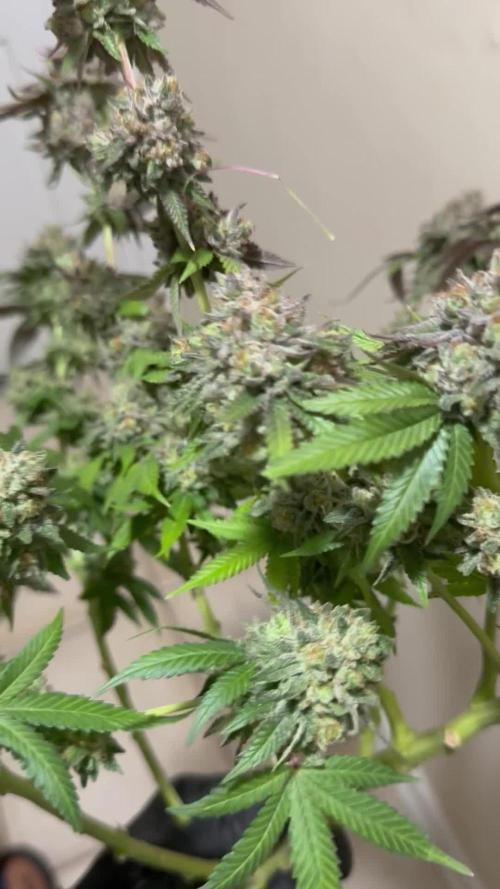
Week 4 flower : everything’s looking nice still got the lights about 7-9” from top of canopy without any issues . The humidity has gone up to 50% in day and I can’t really get it any lower I’ve already got a dehumidifier so don’t want to get another one . I would like to lower to 40-45% and lower for last 2 weeks but can’t see that happening .
I’ve started the pk from end of week 4 (day 28 )at 1ml per litre this took my ec to 2.2 I will see how it goes and maybe up it to 1.2-1.5 and I’m going to use the pk for 7-14 days then I will start the flush
I also lowered the silicone to 0.5ml per litre
3x blue cheese plants are on the left but has spread over
and 1x sunset sherbet on the right