The Grow Awards 2026 🏆
Likes
Comments
Share
Week 3 Veg - Thus far running accordingly. No signs of stress or deficiencies. Introduced a Co2 bag (Exhale 265) to run into early flowering. *End of week recap* (08/27) User error during LST for both - Gave heavy nutes to assist on the rebound - Minor chance of stunting Besides the LST error - Running smoothly - Light flower will begin in 2 weeks.
Likes
9
Share
Week 2 - I gave up on 2 that only grew a tail, didn't make it through transplant. 3 healthy plants now! I keep hurrying them deeper in their dirt. Excited to see the progress!!
Likes
12
Share
She is now in early flowering stage. So far no issues and looking forward to seeing her growing in next few weeks.
Likes
41
Share
Likes
16
Share
@Canadian
Follow
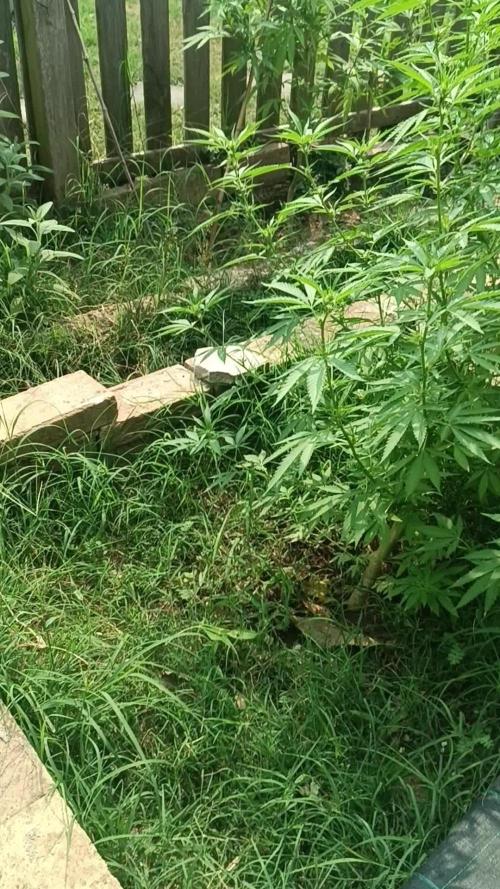
This girl flowers and branches are very heavy Despite not being sugar coated Flowers She is still in development and will become much more heavy . I think that we are looking at probably three more weeks of development to start to check on flower Maturity maybe more but despite being treated Brutally she is a survivor with so much Height she is ideal for our Canadian outside summer. Thank you for reading I continue to update have a happy grow
Likes
56
Share
What's in the soil? What's not in the soil would be an easier question to answer. 16-18 DLI @ the minute. +++ as she grows. Probably not recommended, but to get to where it needs to be, I need to start now. Vegetative @1400ppm 0.8–1.2 kPa 80–86°F (26.7–30°C) 65–75%, LST Day 10, Fim'd Day 11 CEC (Cation Exchange Capacity): This is a measure of a soil's ability to hold and exchange positively charged nutrients, like calcium, magnesium, and potassium. Soils with high CEC (more clay and organic matter) have more negative charges that attract and hold these essential nutrients, preventing them from leaching away. Biochar is highly efficient at increasing cation exchange capacity (CEC) compared to many other amendments. Biochar's high CEC potential stems from its negatively charged functional groups, and studies show it can increase CEC by over 90%. Amendments like compost also increase CEC but are often more prone to rapid biodegradation, which can make biochar's effect more long-lasting. biochar acts as a long-lasting Cation Exchange Capacity (CEC) enhancer because its porous, carbon-rich structure provides sites for nutrients to bind to, effectively improving nutrient retention in soil without relying on the short-term benefits of fresh organic matter like compost or manure. Biochar's stability means these benefits last much longer than those from traditional organic amendments, making it a sustainable way to improve soil fertility, water retention, and structure over time. Needs to be charged first, similar to Coco, or it will immobilize cations, but at a much higher ratio. a high cation exchange capacity (CEC) results in a high buffer protection, meaning the soil can better resist changes in pH and nutrient availability. This is because a high CEC soil has more negatively charged sites to hold onto essential positively charged nutrients, like calcium and magnesium, and to buffer against acid ions, such as hydrogen. EC (Electrical Conductivity): This measures the amount of soluble salts in the soil. High EC levels indicate a high concentration of dissolved salts and can be a sign of potential salinity issues that can harm plants. The stored cations associated with a medium's cation exchange capacity (CEC) do not directly contribute to a real-time electrical conductivity (EC) reading. A real-time EC measurement reflects only the concentration of free, dissolved salt ions in the water solution within the medium. 98% of a plants nutrients comes directly from the water solution. 2% come directly from soil particles. CEC is a mediums storage capacity for cations. These stored cations do not contribute to a mediums EC directly. Electrical Conductivity (EC) does not measure salt ions adsorbed (stored) onto a Cation Exchange Capacity (CEC) site, as EC measures the conductivity of ions in solution within a soil or water sample, not those held on soil particles. A medium releases stored cations to water by ion exchange, where a new, more desirable ion from the water solution temporarily displaces the stored cation from the medium's surface, a process also seen in plants absorbing nutrients via mass flow. For example, in water softeners, sodium ions are released from resin beads to bond with the medium's surface, displacing calcium and magnesium ions which then enter the water. This same principle applies when plants take up nutrients from the soil solution: the cations are released from the soil particles into the water in response to a concentration equilibrium, and then moved to the root surface via mass flow. An example of ion exchange within the context of Cation Exchange Capacity (CEC) is a soil particle with a negative charge attracting and holding positively charged nutrient ions, like potassium (K+) or calcium (Ca2+), and then exchanging them for other positive ions present in the soil solution. For instance, a negatively charged clay particle in soil can hold a K+ ion and later release it to a plant's roots when a different cation, such as calcium (Ca2+), is abundant and replaces the potassium. This process of holding and swapping positively charged ions is fundamental to soil fertility, as it provides plants with essential nutrients. Negative charges on soil particles: Soil particles, particularly clay and organic matter, have negatively charged surfaces due to their chemical structure. Attraction of cations: These negative charges attract and hold positively charged ions, or cations, such as: Potassium (K+) Calcium (Ca2+) Magnesium (Mg2+) Sodium (Na+) Ammonium (NH4+) Plant roots excrete hydrogen ions (H+) through the action of proton pumps embedded in the root cell membranes, which use ATP (energy) to actively transport H+ ions from inside the root cell into the surrounding soil. This process lowers the pH of the soil, which helps to make certain mineral nutrients, such as iron, more available for uptake by the plant. Mechanism of H+ Excretion Proton Pumps: Root cells contain specialized proteins called proton pumps (H+-ATPases) in their cell membranes. Active Transport: These proton pumps use energy from ATP to actively move H+ ions from the cytoplasm of the root cell into the soil, against their concentration gradient. Role in pH Regulation: This active excretion of H+ is a major way plants regulate their internal cytoplasmic pH. Nutrient Availability: The resulting decrease in soil pH makes certain essential mineral nutrients, like iron, more soluble and available for the root cells to absorb. Ion Exchange: The H+ ions also displace positively charged mineral cations from the soil particles, making them available for uptake. Iron Uptake: In response to iron deficiency stress, plants enhance H+ excretion and reductant release to lower the pH and convert Fe3+ to the more available form Fe2+. The altered pH can influence the activity and composition of beneficial microbes in the soil. The H+ gradient created by the proton pumps can also be used for other vital cell functions, such as ATP synthesis and the transport of other solutes. The hydrogen ions (H+) excreted during photosynthesis come from the splitting of water molecules. This splitting, called photolysis, occurs in Photosystem II to replace the electrons used in the light-dependent reactions. The released hydrogen ions are then pumped into the thylakoid lumen, creating a proton gradient that drives ATP synthesis. Plants release hydrogen ions (H+) from their roots into the soil, a process that occurs in conjunction with nutrient uptake and photosynthesis. These H+ ions compete with mineral cations for the negatively charged sites on soil particles, a phenomenon known as cation exchange. By displacing beneficial mineral cations, the excreted H+ ions make these nutrients available for the plant to absorb, which can also lower the soil pH and indirectly affect its Cation Exchange Capacity (CEC) by altering the pool of exchangeable cations in the soil solution. Plants use proton (H+) exudation, driven by the H+-ATPase enzyme, to release H+ ions into the soil, creating a more acidic rhizosphere, which enhances nutrient availability and influences nutrient cycling processes. This acidification mobilizes insoluble nutrients like iron (Fe) by breaking them down, while also facilitating the activity of beneficial microbes involved in the nutrient cycle. Therefore, H+ exudation is a critical plant strategy for nutrient acquisition and management, allowing plants to improve their access to essential elements from the soil. A lack of water splitting during photosynthesis can affect iron uptake because the resulting energy imbalance disrupts the plant's ability to produce ATP and NADPH, which are crucial for overall photosynthetic energy conversion and can trigger a deficiency in iron homeostasis pathways. While photosynthesis uses hydrogen ions produced from water splitting for the Calvin cycle, not to create a hydrogen gas deficiency, the overall process is sensitive to nutrient availability, and iron is essential for chloroplast function. In photosynthesis, water is split to provide electrons to replace those lost in Photosystem II, which is triggered by light absorption. These electrons then travel along a transport chain to generate ATP (energy currency) and NADPH (reducing power). Carbon Fixation: The generated ATP and NADPH are then used to convert carbon dioxide into carbohydrates in the Calvin cycle. Impaired water splitting (via water in or out) breaks the chain reaction of photosynthesis. This leads to an imbalance in ATP and NADPH levels, which disrupts the Calvin cycle and overall energy production in the plant. Plants require a sufficient supply of essential mineral elements like iron for photosynthesis. Iron is vital for chlorophyll formation and plays a crucial role in electron transport within the chloroplasts. The complex relationship between nutrient status and photosynthesis is evident when iron deficiency can be reverted by depleting other micronutrients like manganese. This highlights how nutrient homeostasis influences photosynthetic function. A lack of adequate energy and reducing power from photosynthesis, which is directly linked to water splitting, can trigger complex adaptive responses in the plant's iron uptake and distribution systems. Plants possess receptors called transceptors that can directly detect specific nutrient concentrations in the soil or within the plant's tissues. These receptors trigger signaling pathways, sometimes involving calcium influx or changes in protein complex activity, that then influence nutrient uptake by the roots. Plants use this information to make long-term adjustments, such as Increasing root biomass to explore more soil for nutrients. Modifying metabolic pathways to make better use of available resources. Adjusting the rate of nutrient transport into the roots. That's why I keep a high EC. Abundance resonates Abundance.
Likes
Comments
Share
Likes
2
Share
Shes stoped growing in height for the most part but the buds are just getting started and already filling the space of the nodes. Already covered in trichomes and the smell is very sweet and citrus. Going to be some perfect mid summer smoke! I cant wait.
Likes
11
Share
Just water to bring em on home. I think I’m really gonna like this lung buster. No fruit. But the MM smells all the sweet and gas
Likes
6
Share
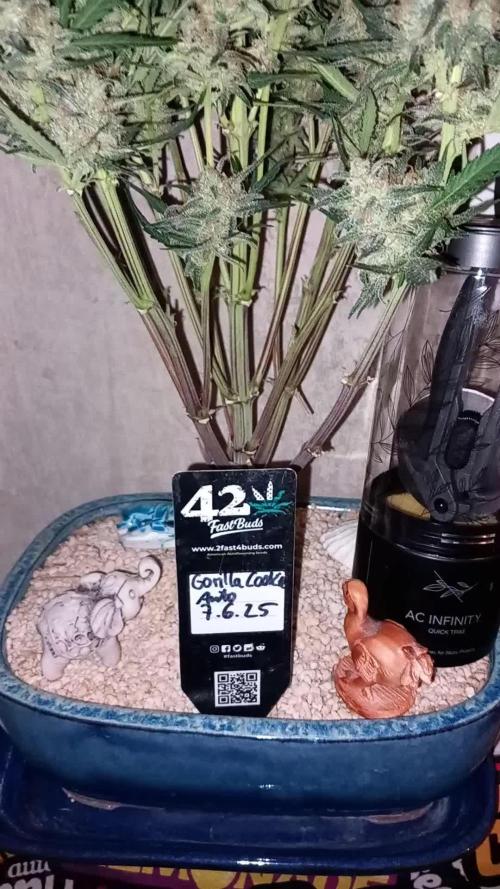
Die Gorilla cookies auto hat sich auch wieder von ihrer besten Seite gezeigt. Nach 6 wochen blüte solche wunderschöne buds zu entwickeln ist einfach ein Traum. Ich kann jedem nur fastbuds empfehlen. Egal ob outdoor oder indoor.
Likes
1
Share
Just starting vegetative stage as it looks like we made it through a week of seedling stage very nicely ! Watering about an ounce every 36 hours! In all these plants are like 10 days old. Keeping them in ac germ kit ppfd for smaller ones is 185 and other one is 200! Have added nothing just going with the original 75% promix ap with 25% worm castings! See you next week
Likes
3
Share
Phone was out of action , will try and fill up the missing weeks , 3 plants have been harvested All photos taken day 76
Likes
118
Share
@Grow3rPT
Follow
👉 ( Floração ) 👈 📅 Total de Dias 57 (F 27) - 28/09/2021 / Crescimento normal... 😀 📅 Total de Dias 58 (F 28) - 29/09/2021 / 💦 Rega apenas com agua 📅 Total de Dias 59 (F 29) - 30/09/2021 📅 Total de Dias 60 (F 30) - 01/10/2021 / 💦 Rega com nutrientes ( Grow + Micro + Bloom ) 📅 Total de Dias 61 (F 31) - 02/10/2021 📅 Total de Dias 62 (F 32) - 03/10/2021 / 💦 Rega apenas com agua. 📅 Total de Dias 63 (F 33) - 04/10/2021 👉 MARSHYDRO 👉 CODIGO PORMOCIONAL : Grow3rPT 👉 Em marshydro.eu 3% de desconto em qualquer produto
Likes
14
Share
I am so stoked about the mystery sativa that ended up being Cinderella 99 last year's favorite crop of mine. The rest of the garden is doing awesome just need to thin out a few more plants for the final stretch.. I am so looking forward to harvest this year with the varieties that I chose... I would be remiss if I did not mention the fact that red cherry berry and tangerine dream were added to the outdoor crops, they reside in the 20 gallon bucket.. I don't have the exact date when I propagated the red cherry berry and the tangerine dream from seed but it was when the other plants were already in the ground..I gave myself a challenge to see if I'd be able to do tangerine dream and red cherry berry outdoors with the other plants.. I pondered putting them in ground but I settled with the 20 gallon pot.
Likes
25
Share
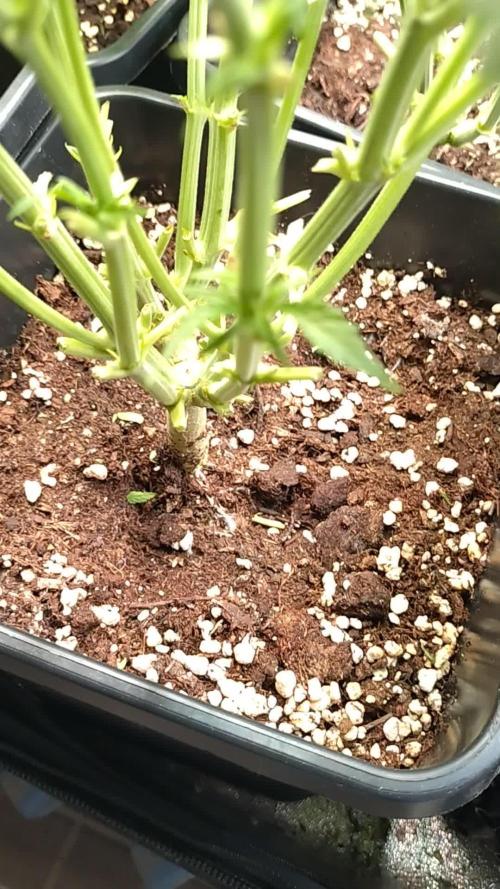
Got environment mostly dialed in thanks to an additional cool air intake fan, can get 450w mh nice and close for good penetration. Beginning the process of Lst, I’ve wrapped some plant straps around the base of each plant to anchor them, and straps at the top of their stems, giving them a slight bend. I’ll slowly increase the bend over time in order to avoid possible damage. The Gelato OG seems quite vigorous compared to the Widow so far. Starting to bump up nutes, runoff @400ppm -10/28
Likes
9
Share
Zwei Wochen in der Blütephase sind nun vergangen, und die Pflanze wurde sowohl gescrogt als auch gelollipopt. Durch das Scrogging wurde die Pflanze weiter flach und gleichmäßig verteilt, sodass das Licht auch die unteren Bereiche gut erreicht. Zusätzlich habe ich durch das Lollipopping die unteren Blätter und schwächeren Triebe entfernt, um die Energie auf die Haupttriebe und Blütenansätze zu konzentrieren. Diese Maßnahmen fördern eine bessere Luftzirkulation und Lichtverteilung, was die Entwicklung gesunder, kräftiger Blüten begünstigt. Die Pflanze sieht jetzt schon vielversprechend aus, und ich bin gespannt, wie sie sich in den kommenden Wochen weiterentwickelt.
Likes
14
Share
@m0use
Follow
*=UPDATE=* Smoke Report *=UPDATE=* Harvest Totals **Smoke Report and effects** to follow after cure, May 10th ish. This was my second ever indoor grow, and compared to my last grow I have learned a lot. My goal this time was to get about 1.5-2oz a plant, up from my previous goal of 1oz a plant from last grow. Best part is I got to my goal!!😁 Next goal will be 2oz+ a plant. This was the last time I will be using my homemade grow tent, it was compromised out of recycled Styrofoam, miss-tint paint and glue, it provided me what I needed to get the job done one a extreme budget but it is preventing me from doing more. The main problem I ran into this grow was humidity control/space. The fan broke half way through and I was too lazy to get a new one as I figured I'll wait till I get a real tent. This mind set enabled some mould to flourish and that is why I had to harvest early. I felt if I let the plants go 2 more weeks, I would have hit 2oz a plant, it was only a few grams away, however if I kept going with the mould I would have been down to 1oz after all the rot was cut out from both plants, that shit fucks up your grow fast if you don't manage your air circulation. So the main things I learned: 1) I was underfeeding my plants in there 2nd half of life, thus the buds from the previous grows and this one suffered a bit. This grow does have the most dense buds I have ever grown, but it could have been better. 2) PH is key, I still did not have a PH meter but was blindly altering the PH of my water by adding in some citric acid, not only to neutralize the chlorine but also lower the PH a bit. When I did test the soils PH using a soil testing kit, it was lower then previous grows. This helped get more nutrients into the plants and grow bigger. previous grows the PH was 7-7,5 ish 3) You can get an "ok" harvest off of blue lights, my grow was under seven 18" 6500k 18w sunblaster LEDs, and I thought they would never get over 1oz a plant because they don't have the best spectrum for cannabis in flower, among the other dumb things I do as a novice grower. but they worked out just fine, still going to upgrade in time with proper lighting in the 3500k range. 4) Once the plants get bigger and buds start to becoming more dense, the air circulation is needed, its is not longer optional for a budget grow in a shity homemade tent. 5) Defoliation works. my plants have ruffly the same amount of buds, however the plant that I fiddled around with mainlining and defoliation had bigger fatter buds vs popcorn nugs like the opposite plant. 6) Fungas gnats are annoying, fuck them, use nematodes to kill them flat in there tracks. 7) Getting better at making edibles. :) So other then that, the only real differences between this is last grow is lower PH in tap water, more lights, slightly bigger pots, bit more feed and different genetics from a different breeder. I followed everything else ruffly the same. My own hydro break down from lights alone is below. I did not notice any big difference between the two plants and there phenotypes, I was meaning to take a clone and try and grow it outdoors again but forgot and that was my last of the seeds. I was surprised that one of them was a male. not even hermi, full blown male. I'm not into breeding or I would have kept him, Yields: Plant # 1 - male, killed Plant # 2 - 42.1g bud, 13.15g trim (1 .49oz, 0.46oz) bigger fatter buds Plant # 3 - 45.1g bud, 13.15g trim (1.59oz, 0.46oz) smaller nugs, almost all popcorn. =Overall - 87.2g total bud, ave 43.6g a plant. 26.3g trim ave 13.15g a plant. Smells: plants 2-3 - both smelled the same, in the beginning they had a lovely sexy lemon sent, then in the end it just turned into something else, I think some of the moulds in the tent altered it a bit. Will wait till after cure to see what its like, I noticed some changes in just drying and having them in the jars for two days now. Now that the cure is all done and finished the two strains smell a bit different in there respective jars but there smoke is almost identical. plant #2 or pheno #1 is more of a classic OG Kush smell to me, its earthy, herbal and pungent. Hints of pine in there with lemon bit woody. plant #3 or pheno #2 is more of a bright one, It's sweet smelling with berries in it, some hints of almost floral like in it, not quite rose or lavender something else, not what I was expecting at all. I like this smell better vs the other plant. Smoke Report It took its sweet time but I finally got it in. I myself do not smoke, so I relay on my roomie for this part of the report, they are a long time smoker 10+ years. They have reported that the smoke smooth and easy going, they would say it was a bit smoother then my previous grow of OK Kush CBD and Blackberry. the only noticeable differences between the different phenos is that pheno #1 is more pungent that phoneo #2 but over all the smokes flavours and quality are the same just brighter in phone #2, I feel these are a bit off from the original seeds I grew back in the day from my first ever grow but still high quality. this was rated as a equal balance of sativa and indica feels on smoking but the smells where leaning towards sativa a bit. m0use +++++++++++++++++++++++++++++++++++++++++++++++++++++++++++++ Cost + Time Analysis Of Growing Cannabis. m0use’s Breakdown +++++++++++++++++++++++++++++++++++++++++++++++++++++++++++++ Light Schedule === growth: 18h on 6h off flower: 12h on 12hr off GROWTH: 35days 5am-11pm-on -- 11pm-5am-off --- Cost of kwh with on-peak "20.8c", mid-peak "14.4c" and off-peak "10.1c". 5am - 7am -- 2hr @10.1c/kwh off-peak 7am - 11am -- 4hr @20.8c/kwh on-peak 11am - 5pm --6hr @14.4c/kwh mid-peak 5pm - 7pm -- 2hr @20.8c/kwh on-peak 7pm - 11pm -- 4hr @10.1c/Kwh off-peak --- 6h @10.1c/kwh 6h @20.8c/kwh 6h @14.4c/kwh --- Using the previous c/kwh numbers above I can find out the daily cost of the lamps in the 3 peak periods. growth and flower 6h x 10.1c/kwh = 60.6c/kw * .126 kw = 7.64c off-peak 6h x 20.8c/kwh = 124.8c/kw * .126 kw = 15.72c on-peak 6h x 14.4c/kwh = 86.4c/kw * .126 kw = 10.89 c mid-peak The "h" hours and "kw" kilowatts cancel out and we are left with a value of "c" cents per peak period add all the peak periods up and you get your cost of running the lights in cents per day c/d --- growth : 7.64c + 15.72c + 10.89c = 34.25c/d FLOWER: 52days === 8am-8pm-on -- 8pm-8am-off --- Cost of kwh with on-peak "20.8c", mid-peak "14.4c" and off-peak "10.1c". 5am - 7am -- 0hr @10.1c/kwh off-peak 8am - 11am -- 3hr @20.8c/kwh on-peak 11am - 5pm --6hr @14.4c/kwh mid-peak 5pm - 7pm -- 2hr @20.8c/kwh on-peak 7pm - 8pm -- 1hr @10.1c/Kwh off-peak --- 1h @10.1c/kwh 5h @20.8c/kwh 6h @14.4c/kwh --- Using the previous c/kwh numbers above I can find out the daily cost of the lamps in the 3 peak periods. growth and flower 1h x 10.1c/kwh = 10.1c/kw * .126 kw = 1.27c off-peak 5h x 20.8c/kwh = 104c/kw * .126 kw = 13.10c on-peak 6h x 14.4c/kwh = 86.4c/kw * .126 kw = 7.77c mid-peak The "h" hours and "kw" kilowatts cancel out and we are left with a value of "c" cents per peak period add all the peak periods up and you get your cost of running the lights in cents per day c/d --- flower : 1.27c + 13.10c + 7.77c = 22.14c/d Lights === LED’s I use are 18w each and I have 7 lamps on an aray. 18w*7 = 126w | 126w/1000 = 0.126Kw growth: 18h/d lights on * .126kw lights hydro use = 2.27kw/d flower: 12h/d lights on *.126kw lights hydro use = 1.51kw/d G:79.45 + F:78.52 = 157.97kw for the entire grow. Cost growth : 7.64c + 15.72c + 10.89c = 34.25c/d flower : 1.27c + 13.10c + 7.77c = 22.14c/d The time my lights where on in the grow for 12 weeks and 1 day, or 85 days. growth: 35d * 34.25c/d = 1,198.75c ÷ 100 "100c in a dollar" = .99 flower: 52d * 22.14c/d = 1,152.28c ÷ 100 "100c in a dollar" = .52 the "d" days cancel out and we are left with a total cost of the lights for my 85day grow. 11.99 + 11.52 = .51 Using the regular calculation of grams harvested divided by watts used is not accurate to me, it does not account for all the time the lamps are on, the length of grow to the over all cost. The calculation that makes sense to me is this, harvested dry weight of usable cannabis buds/trim/keif/whatever in grams divided by total kw used. Could also combine it with grams per total single use costs “anything you used only for this grow and wont reuse in the next, or fractions of multi use items like fertilizers if they ½ full” and see how much you’re investing per gram. "kw" ÷ "g" = kw/g "$" ÷ "g" = $/g I have harvested 4oz or 113.5g on 157.97kw, this includes buds and trim in mycase. 157.97kw ÷ 113.5g = 1.39kw/g of usable cannabis. I’d still try and aim for under 1kw/g. .51 ÷ 113.5g = :text.20g The other ratio would have been, 113.5g to 126w = 0.9g/w just shy of the 1 mark. So in total, it cost me 20c per 1g I grew in light electricity alone. Not to bad. legend, kwh = kilowatt per hour kw = kilowatt w = watt h = hour c = cents $ = dollars d = day LED= Light Emitting Diode
Likes
13
Share
The plant is a beast. Having a lot of light burn issues and I dimmed the LED but it still continued. I’m out of vertical space in the tent. Trying to keep her happy until harvest.
Likes
45
Share
@Dingle
Follow
Just water again this week to help with the flush along with some light defoliation. The majority of the trichomes look mostly cloudy now and I’ve started to see a very small amount of them turn amber so all going well I will be turning the lights off for 48 hours some stage early next week. The buds have developed really well from the bottom up over the last couple of weeks and are stacking up nicely. The smell has also seriously increased this week. 😳