


Likes
Comments
Share


@FarmZOG
Follow
Week 7
Day 42
our VPD is getting higher day to day, we in the 1.2 - 1.4 range
hard week of defoliation this past week and its not over
Day49
we had good development but we still fighting environmental conditions all over the place
We need environment concistency and we're not getting it
💚

Likes
4
Share


@Hommero75
Follow
The Banana Purple Punch great strain with a super Sweet and Berries aroma.
I had bad issues in the beginning with the development and the grow of the plant. I amost gave up on the seed but she bounced back. She got cut today and put to dry. Give a 10 to the Banana Purple Punch

Processing
Likes
13
Share


@Cheesefarmer420
Follow
Overall this plant was great to grow, she just grew and was happy doing it the entire time, pretty good yield off a plant that was only about 12inches tall. Seemed to be a lot more resistant to deficiencies then the other two strains this grow. Definitely a great mid-day Smoke!
Likes
Comments
Share

@Budoken
Follow
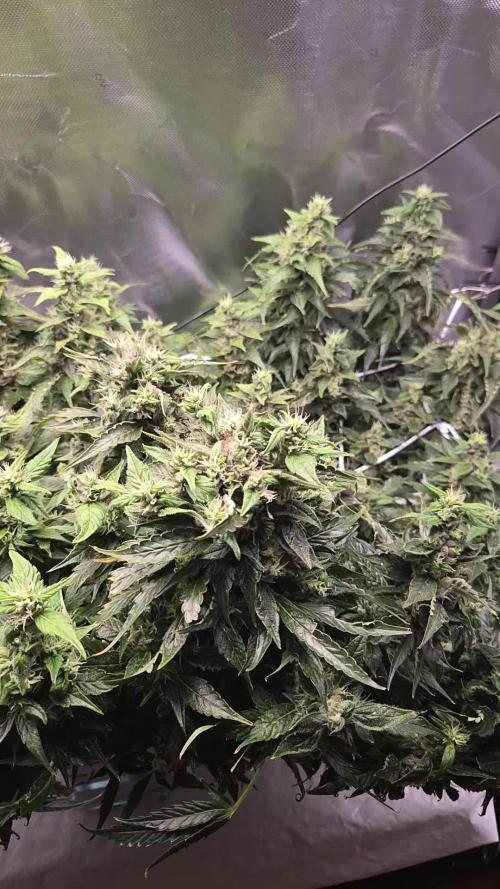
Not much to do this week. Nutrient solution was too strong, plant doesn't seem to need much anymore and ec kept rising from 1.6 to 1.8. I drained the reservoir, flushed the system twice with water, and then filled it back with the same solution but diluted it to ec 1.0.
Pistils are starting to do darken, except for the new bud growth that has emerged. Will continue to keep an eye on it during next week, harvest ia not that far away. Will flush for 2-3 days once the plant is done.
Likes
48
Share


@Focus420
Follow
Zdravím všechny pěstitele marijánky🌍🌞
Minulý týden sklizen BCN critilal xxl - tato rostlina měla od začátku problémy pak se spravila a nakonec vypadá celkem solidně.
Víc se dozvíte ve sklizni🌱🌱🙏
Nemůžu se dočkat dalšího růstu🌞🤗
Tento týden půjde pod kosu poslední automat (sleep)
Zbydou tam 3 celoroční odrůdy, ty vypadají nejlíp... ty ještě potřebují 2 až 3 týdny
Den 99. Hnojení
Celoročky - ph 6,3
ec 2,5
Den 100.🌱 holky vypadají úžasně😍
Dnes proběhla defoliace (focus)(franco lemon cheese)
Den 101.
Sekera🤟 (sleep) zbyly 3 celoroční odrůdy
2× focus , 1× franco lemon cheese
Proplach 8 - 10 dní
Den 102.
Kontrola trichomů -
focus = 10 % jantarových vrchů 🌱🤗
Franco lemon cheese = mléčné trichomy
Den 103.
Kontrola - Teplota,vlhkost,co2 v pořádku🤜
Den 104. Kontrola trichomu 15 procent jantar ( focus )👏
Den 105.proplach
Ph - 6,3
ec - 0,43


Likes
27
Share


@Dunk_Junk
Follow
Wow she's frosty!!!??!?!!
Did I mention that before? 😁 😂
Trichomes going cloudy now.
Likes
8
Share


@eldruida_lamota
Follow
Que pasa familia, vamos con la tercera semana de crecimiento de estas FBA2506 de FastBuds.
De las 5 plantas, retiré una y me quedaré con 4 , preselección.
La tierra que utilizamos que está en la publicación anterior es top crop all mix,
Por supuesto el ph se mide en cada riego y se mantiene en 6.2, regando cada 48 horas e intentando mantener la humedad un poco alta al principio.
Las próximas semanas vamos viendo cómo avanzan.
Hasta aquí todo, Buenos humos 💨💨💨
Likes
28
Share


@MrGrowthSpurt
Follow
What's up Growmies🤟🏽. I am back with another week #9 is in the books, hello Week #10.
I noticed small rust spots and yellowing on the top sugar leaves on Tropicana Cookies, White LSD #2 and Caramelicious. It isn't fungus, (it doesn't rub off and is more like its burned into the leaf rather than growing on it) so I'm guessing it is due to a lack of calcium or magnesium. As a result I have implemented calmag into the feedings. I swear it creeped up out of nowhere.
Other than that things are going very well, I am enjoying the journey.
It is crazy to me how my 2 white LSD plants while the same seed have taken on different characteristics. White LSD #2 has taken on a pinkish/red undertone which looks pretty amazing if you ask me. I wonder if I mislabeled it at the beginning of my grow and if it is actually my Tropicana Purple Cookies? I doubt it but then again I was high around the time I put these babies from their incubators into their final home.
Not much to report other than I stopped smoking new years eve, so for the first time in a long time I have clean urine🙌🏾🙌🏾. I mainly stopped to take a tolerance break and to prove to myself that I am in control. I will be tasting these suckers once they are done. I did the same thing on my last grow, took a little over 90 day hiatus, once harvested and I decided to smoke, boy was I super zooted! It was like the first time I got high, had me questioning why I smoke because I was sooo stoned😂. I'm looking forward to feeling that way again.
It won't be long now another 7 to 8 weeks (including 1 week to dry and 2 to cure) and I will be smoking again more than likely.
I still have them on a 2 waterings with nutes and 2 waterings with plain ph'd water schedule. Going forward I plan on adding calmag into the mix, which is something I didn't have to use on any of my 6 previous grows, we shall see how it goes.
Until next time my friends, Happy Growing, and may the grow goddesses bless you all with a bountiful harvest 💪🏾

Likes
3
Share


@CanarianGrow92
Follow
Another week for this SOG of Auto's from our friends fastbuds, at the moment they are doing great, i do notice that some genetics required less food than others (they all got the same amount but some showed signs of N toxicity last weeks)
At the moment we noticed the stretch and we needed to put the lamp higher, we are growing with a TS1000 at the moment and things are looking good 😊
The strawberry gorilla is getting a lot taller than the rest
Likes
10
Share


@Myrcene_Dream
Follow
-Trichomes looking ready
-Gave last watering and will harvest in the dark in a few days
-Reeking like a mix of garlic and herbs!

Processing
Likes
2
Share


@dubmusicrocks
Follow
Growing food I've been snapping the branches down a bit and they seem to love it they bounce right back...
Likes
8
Share


@Hawkbo
Follow
Soaked 7.27 for 36ishhrs, into paper towel for 12 hrs then into a solo cup with greentree garden supply pro ultra (coco/perlite). First feed was a diluted leftover feed from my other auto youngins. Basically about 1 ml/g of grow, 7ml/g humid acid, 1ml/g more roots, 1ml/g orca, cannazyme, hydroguard and a sprinkle of living organics in the nutes and on the top of the coco. Usually the ppm will be higher than I want it so I just dilute with r/o water until I'm down to 200-250. It makes it so I cant be accurate on ratios so that's why I'm tellin ya, but it's how I always do it no matter what nutes I use. This seed is also 3 years old like the pineapple Express.




Likes
3
Share


@Strangelet
Follow
Day 43. A little cleanup some old leaves and opening up budsites. No nutrients all week, pant were on the verge of getting nute burn. Water every day, back feeding next week.

Likes
70
Share

@RockoCalenberg
Follow
🌸 Blütetag 59 / 📅 Gesamttag 119
🌡️ Klima
Draußen merkt man inzwischen deutlich, dass Frühling ist.
Im Zelt läuft das Klima weiterhin ruhig und stabil und die VPD-Werte bewegen sich konstant im grünen Bereich. Insgesamt also sehr ähnliche Bedingungen wie in der letzten Woche.
🌱 Pflanzenstatus
Die Ziellinie kommt langsam in Sicht, auch wenn noch ein kleines Stück Strecke vor uns liegt.
Die beiden Pflanzen zeigen inzwischen deutlich unterschiedliche Reifestadien.
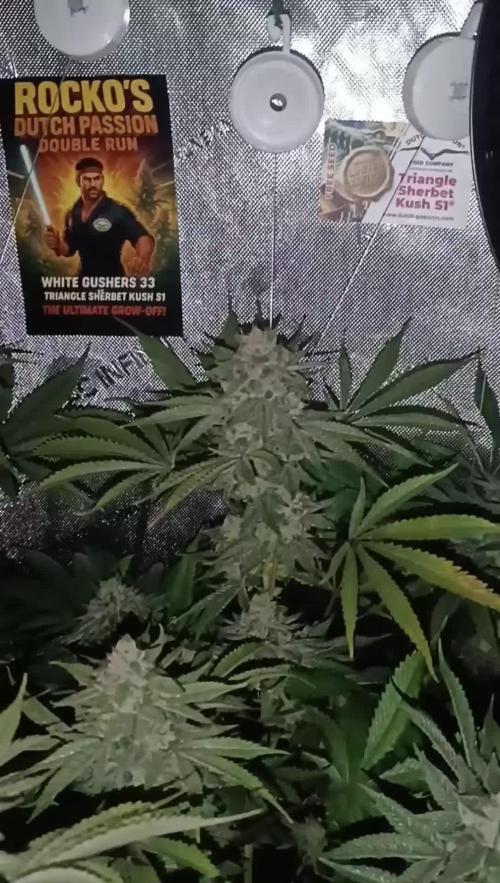
Die Triangle Sherbet Kush wirkt schon ziemlich weit: kaum noch neue weiße Härchen, stark angeschwollene Buds und insgesamt deutlich mehr Harzproduktion.
Die White Gushers 33 arbeitet dagegen weiter an neuen Blüten. Besonders an den Tops sind noch frische Pistillen zu sehen und die Buds legen weiter an Masse zu.
Interessant ist auch die Entwicklung innerhalb der Pflanze:
Die drei höchsten und kräftigsten Triebe foxtailen leicht, während einige der tieferen Seitentriebe bereits weiter wirken und teilweise deutlich weniger weiße Härchen zeigen.
🌼 Blütenentwicklung / Reife
Bei der Triangle Sherbet Kush zeigen sich inzwischen klare Reifezeichen. Unter dem Mikroskop sind bereits die ersten bernsteinfarbenen
Trichome zu erkennen 🔬.
Außerdem stehen einige Blätter bereits kanuartig nach oben, und die Pflanze beginnt sichtbar, Nährstoffe und Farbe aus den Blättern in die Blüten zu ziehen.
Die White Gushers 33 verfärbt sich ebenfalls zunehmend, wirkt aber insgesamt noch etwas später im Reifeprozess. Hier sind die Trichome überwiegend milchig, teilweise noch nicht ganz trüb.
👃 Aroma
Beim Öffnen des Zeltes entwickelt sich inzwischen eine schöne würzig-fruchtige Gesamtmelange.
Die Triangle Sherbet Kush bringt zunächst klar die würzige Kush-Komponente mit. Wenn man die Buds leicht berührt, kommt aber deutlich die bananige Note 🍌 aus der Sherbet-Abstammung durch – also ebenfalls fruchtig, aber eher cremig-bananig als süß.
Die White Gushers 33 geht aromatisch eher in eine gasigere Richtung ⛽, mit etwas Funk und Frucht darunter. Also keine Candy-Süße, sondern eher ein Mix aus Gas, leichter Frucht und einem kleinen funky Twist.
📊 Fazit
Aktuell zeigt sich immer deutlicher, wie unterschiedlich sich die beiden Genetiken in der Endphase entwickeln.
Die Triangle Sherbet Kush wirkt klar weiter und reifer, während die White Gushers 33 oben noch weiter Blüten nachschiebt, in den tieferen Bereichen aber teilweise schon erstaunlich weit ist.
🔭 Ausblick
Rein vom Eindruck her könnte die Triangle Sherbet Kush bald fallen, während die White Gushers 33 vermutlich noch etwas mehr Zeit gebrauchen kann. Da eine Teilernte hier nicht ganz unkompliziert wäre, bekommen beide vorerst noch etwas Zeit.
Mich würde aber interessieren, wie ihr das handhaben würdet:
Würdet ihr in so einer Situation schon separat die Kush ernten oder beide Pflanzen noch zusammen stehen lassen?
Und wie macht ihr das generell in der letzten Phase vor der Ernte – gebt ihr euren Pflanzen noch eine Trockenphase 🌵 oder Dunkelphase 🌑, oder lasst ihr alles einfach normal weiterlaufen?
Auch spannend: Zu welcher Tageszeit erntet ihr am liebsten? ⏰
Bis nächste Woche – bleibt sauber und gesund! 🌿
🌸 Flower Day 59 / 📅 Day 119 Overall
🌡️ Climate
Outside you can clearly feel that spring has arrived.
Inside the tent the climate remains calm and stable and the VPD values stay consistently in the optimal range. Overall the conditions are very similar to last week.
🌱 Plant Status
The finish line is slowly coming into view, even though there is still a little bit of track left.
The two plants now clearly show different stages of maturity.
The Triangle Sherbet Kush already looks quite far along: almost no new white pistils, heavily swollen buds and overall a lot more resin production.
The White Gushers 33 on the other hand is still working on producing new flowers. Especially on the tops fresh pistils are still appearing and the buds continue to gain mass.
An interesting observation inside the plant structure:
The three tallest and strongest tops are slightly foxtailing, while some of the lower side branches actually seem further along and already show far fewer white pistils.
🌼 Flower Development / Ripeness
The Triangle Sherbet Kush already shows clear signs of maturity. Under the microscope the first amber trichomes can already be spotted 🔬.
Some leaves are also starting to canoe upwards, and the plant visibly begins to pull nutrients and color from the leaves into the buds.
The White Gushers 33 is also starting to fade, but overall it still seems slightly behind in the ripening process. Here the trichomes are mostly milky, with a few still not fully cloudy yet.
👃 Aroma
When opening the tent a nice spicy–fruity blend fills the air.
The Triangle Sherbet Kush first presents a spicy kush profile, but when the buds are lightly touched a distinct banana note 🍌 from the Sherbet lineage becomes noticeable — fruity as well, but more creamy banana-like than sweet.
The White Gushers 33 goes into a different direction aromatically. It leans more toward a gassy profile ⛽, with some funk and fruit underneath. So not candy sweet, but more a mix of gas, light fruit and a slight funky twist.
📊 Summary
At this point it becomes increasingly clear how differently the two genetics behave in the final phase.
The Triangle Sherbet Kush clearly appears more mature already, while the White Gushers 33 is still pushing new flowers on the tops, even though some lower parts already look surprisingly advanced.
🔭 Outlook
From the current impression the Triangle Sherbet Kush might be ready quite soon, while the White Gushers 33 could probably use a bit more time. Since doing a partial harvest here would not be the easiest option, both plants will likely stay a little longer for now.
I’d be curious how you guys would handle this situation:
Would you already harvest the Kush separately, or leave both plants a bit longer and harvest them together?
Also interested to hear how you approach the final phase before harvest. Do you give your plants a dry period 🌵 or a dark period 🌑, or do you simply let everything run normally until harvest?
And one more thing that always comes up in discussions: what time of day do you prefer to harvest? ⏰
See you next week — stay safe and healthy! 🌿
Likes
30
Share


@Weird_Jimmy
Follow
👉 I started the week thinking I would be harvesting a branch or two a day. I planned on starting at the top with the Queen and just work my way down a little at a time every day or so. This was to allow the lower levels of branches more time to mature to get an even result from top to bottom as far as bud 'ripeness'.
👉So I did start with the Queen. The trichomes looked perfect for what I wanted, mostly cloudy. This Queen cola was not 'typical' when compared to most Auto flower plants Ive grown. It wasnt even the highest of the colas on the plant. It was about the size of a pine cone and frosty. I did a close trim in it and hung it on my drying rack to dry. After one day the cola was placed in a paper bag and hung until its weight was 25% of the original wet weight after trimming. That took two more days and last night it was placed into a jar with a hygrometer. 12 hrs later the hygrometer was at 91% so I opened the jar lid. I will leave the lid open probably all day, may even take the bud out of a while and put on the hanger. It will repeat the process till stable at 62%.
👉 What I found at trimming was that perhaps the flower could possibly pump up a little more. Also it has so many leaves it made me start to hate leaves. I that made me conflicted because leaves are why everything happens...food factories. I could see the issue before I got close to harvesting and I am happy I didn't go on a massive defoliation campaign. That wouldn't have helped the sugar leave issue. I have been taking leaves for a few weeks now even though it may be hardly noticeable. It took a long time to do the type of trim I like. I avoid snipping calyx's as much as possible and will snip as many sugar leaves as close as I can. The rest of the harvest of this plant is going to be penance for just a few of the thoughtless or stupid things Ive done in the past...a trim purgatory that is going to be close to trim hell. But if the end result is as good as the white widow Ive had in the past, it will be pain worth enduring...if its a dud that tastes like grass because of all the leaves then I will learn how to make extracts. Almost always a bright side with cannabis.
👉So I will continue lots of pre-trimming any large sugar leaves on colas around the top and work my way to the bottom. I will also continue nutrient laden fertigations and get a little more plumpness of the flowers to offset the leaves. The plant is still thirsty and I see new calyx's on all the buds. I'm going to mix my nutrients between the late bloom mix and the ripen mix, with extra Flora Bloom, and extra KoolBloom.

Likes
25
Share


@Aleks555
Follow
Chimera Cut from Anesia Seeds has grown to 44 cm and looks fantastic! The foliage is dense and bright green, and the plant has taken on a beautiful spherical shape. 🚀 We're using nutrients from @xpertnutrients for maximum results. Stay tuned for updates! 🌸 #ChimeraCut #AnesiaSeeds #GrowDiaries #XpertNutrients #IndoorGrowing #CannabisCommunity

Likes
15
Share

@Dunk_Junk
Follow
Day 21 - she got repotted into her 38 Litre airpot. She is not as close to the lights as I'd like, but saying that I wouldn't mind her to stretch a little bit.
Likes
50
Share


@Blabina
Follow
5th of november 2021 / DAY 30 👉 The new p.h. seems effectiv, uploaded x18 time laps
👉 👽Calmag 1 ml/2L + 👽 Bio-Heaven 1 ml/2L 👽Bio-Grow 1 ml/2L /// 😇2 L. p.h. 5.8 EC : 0.7 degree 24.8° 👉 Run-off for QuickGreen is : EC 0.7, ph 7.6 20.4° QuickPink is : EC 0.6 ph 7.8 20.2° QuickBlue is : EC 0.5 ph 7.6 20.2°
😥I give up, p.h is increasing. I don't know what to do, but to me they are dead. I will keep doing what I do, but I don't know how to fix this p.h issue. If I have to give them 6 litters per plant with a ph 3 to try to reach a 5.8 p.h. again.😥
6th of november 2021 / DAY 31 👉 1L per plant : Water + ph down : 3.ph. run-off : 6.0-6.1 +1L per plant : 👽Calmag 1 ml/3L + 👽 Bio-Heaven 2 ml/3L 👽Bio-Grow 3 ml/3L
/// 😇3 L. p.h. 5.8 EC : 1.0 degree 24.8° 👉 Run-off about 6.0 per plant.
7th of november 2021 / DAY 32 👉 Upload photos, checking them. I see some greens, I don't want to give up really, I will see if I will have dwarves again... They are small and sick
8th of november 2021 / DAY 33 👉 I took them down to don't see them suffer more. A bit the hart broken.
End of diary... It was an experience.
Likes
34
Share


@Wadadli_Kush
Follow
She's a very demanding plant. In addition to these listed nutrients I'm also using an organic mixture as well at full strength and she seemingly wants more lol.
Very interesting plant indeed. Her buds are becoming dense and look more advanced than what usual week 4 flower looks like so she will most likely finish in maybe 7-8 weeks I assume.
Very nice smell and resin production. Temperatures are very much different than usual here in the caribbean. Nights stay cool and day temps have soared for the month.
Damn global warming!!!!!!!!!!
On a positive note she's still doing well with no signs of heat stress and by next week I expect even more rapid production as she approaches the end of mid bloom.
Stay with me, she's gonna be nice and until next week................
#HappyGrowing
