


Likes
Comments
Share


@Pokan187
Follow
The trichomes on the Runtz are all milky and I'm getting some amber on the sugar leaves, I think the end is near 😁
The G13 is looking great and smelling wonderful, the buds are getting heavier and same for the GDP

Likes
3
Share

@Zengrower
Follow
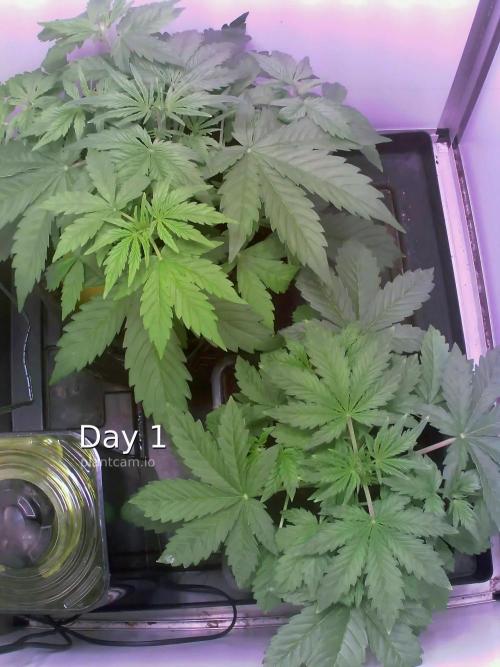
Week four marks the true beginning of the flowering phase.
Both Pink Rosay ladies have shifted gears and are now growing explosively. The first pistils are clearly visible across both phenotypes, and they look fresh, vibrant, and full of energy. It’s always a beautiful moment when that transition becomes undeniable.
The difference between the two phenos is becoming more pronounced. The left plant is stretching much more vigorously, while her sister on the right remains more compact and reserved in her growth. Running two different expressions in the same space always comes with a bit of uncertainty — especially without clones — but that’s part of the adventure. Let’s see how it plays out.
For now, I’m deliberately avoiding any defoliation. I don’t want to encourage additional stretch, as they’re already growing fast enough as it is. Sometimes doing less is the better strategy, especially in a limited vertical space like this.
At this stage, everything looks healthy and well-balanced. The structure is forming, the flowering sites are multiplying, and the energy in the tent is clearly shifting.
The real show is about to begin 🌸
Processing
Likes
6
Share


@ProfDoty
Follow
This week flew by. Work had away from the plants kinda didn’t realize the plant were drinking hella water way faster than before so I fell behind a lil with the watering but nothing to major as you can see. The black cream is jus amazing right now , never smelled anything like it it literally smells like candy. There’s also hells buds all around the plant it’s just shining right now definitely running this strain until the seeds are gone.
The Green Poison Auto is coming along nicely even though she took hella long to flower from veg but I’m hoping that means she jus going to keep taking her time and beast up . Her trichomes already flooding the plant which is a bright side I’m also I’m patient to so that’s not helping. For the most part I’m pretty sure I’m going to be running the same medium and nutrient line a couple more times Before I venture out And my AC is finally fixed so no more hot days for the ladies. I’m predict the black cream to go another 2-3weeks and the green poison at least another 4 from what I’m seeing my ladies are taking their time with this one . Can’t wait to see the growth this coming week

Processing
Likes
10
Share


@TrimQueen
Follow
So, guys.. This is her first month blooming. 4 complete weeks has passed. Here we are for 2 more. Gave Her a super powerful egg shell fert (all powdered - Phosforium Whelthy.)
07/10/20 - We are in the middle of week 5. Thats the way they look like. For me a good number of buds and they are as dense as I thought they would be by this time. I think everything is under control despite some foxtails cuz the heat. Loving the experience.
Processing
Likes
11
Share


@TickTockCroc
Follow
Hey everyone! Hope you're all doing amazing!
TickTockCroc is back for another grow! ┏(^0^)┛
Last time, I did a Fastbuds Girl Scout Cookies grow in my closet using a small pot. Yielded 22g dry weight (lol). Didn't do any ph monitoring or temperature control until later.
This time... I'm determined to do it better!
For this grow I will be doing:
2 x Fastbuds Girl Scout Cookies
2 x Fastbuds Gelato
I AM DOING A SEPARATE DIARY FOR EACH STRAIN. THIS DIARY WILL ONLY BE UPDATING PROGRESS WITH THE GIRL SCOUT COOKIES!
For this set-up, I decided to get a 1.2m x 1.2m x 2.0m tent and a carbon filter with fan. Also using fabric pots instead of plastic. For lights I'm using my old 600W Viper LED. I love this set-up!!
This diary is starting on Day 7 from seed for the GSC. They just got moved to the tent yesterday (had to wait for it in the mail, got excited and germinated seeds too soon lol) and so they were in the closet until then. There has been no fan to circulate air or remove heat, and I think that's why the first set of leaves are curling a bit. Annoyingly, I have to wait for distilled water to arrive in the mail so I can calibrate my PH meter, so have not been able to ph adjust water. It has had one watering of evian water so far, so hopefully thats OK.
I am using BioBizz Light Mix soil and using BioBizz nutrients. I will update which specific nutrients when I can.
Take care for now, folks!
*EDIT*
DAY 10 UPDATE:
I've uploaded a day 10 video update!
So today is day 10 and I fed them their first feed yesterday. I've added the nutrient details to the diary. They seem to be LOVING it. I also noticed some pale spots on some leaves - perhaps exterior nute burn as I splashed the leaves by accident. We'll see.

Likes
14
Share


@Dunk_Junk
Follow
Wow... She's really entered flowering this week!
I've had to bend over her main cola so is could receive light as opposed to growing above it 😂 😕
Also she's been stretching like crazy. I have backbuilt quite a few bud sites. We will see in the coming weeks how effective this has been.

Likes
16
Share


@ChewiesGrow420
Follow
Today on day 17 from date of birth Iam preparing a worm casting tea. In a cheese cloth bag ,Made up of 2 cups of worm castings 2 tablespoons of unsulfured molasses,2 tablespoons of mineralized phosphate (bat shit) ,2 tablespoons of soluble seaweed extract . 2 tablespoons of alfalfa meal 2 tablespoons of all purpose 4-4-4 all Gia green products other than. I also sprinkled in some great white premium mycorrhizae inton2 gallons of water. Tea will brew for 24 hours before applying.
Likes
27
Share


@Smokepurple137
Follow
All plants are starting to flower and doing great. Starting bloom feed 20/12/20. I'll update 3 or 4 times this week.


Likes
20
Share

@DogDoctorOfficial
Follow
Week 13 from Seed | Ghost Train Haze (12/12 From Seed)
The Queen of the Room
Week 13 from seed marks a special point in this run, and for this update the spotlight belongs to one plant in particular — the undeniable queen of the room.
This Ghost Train Haze has been the outlier from the beginning. Same treatment, same schedule, same root space, same 12/12-from-seed approach as the rest of the room — but she chose her own direction early and never looked back. No veg, no special treatment, no extra time. Just pure expression.
And she expressed big.
At nearly 1.8 meters tall, she became the tallest plant in the room by a comfortable margin, stretching far beyond her sisters and building into a true vertical queen. Her main cola is massive, dominant, and impossible to ignore, but what makes her impressive is that the rest of the plant actually kept pace. This isn’t just one oversized top and a weak frame underneath — the entire structure followed through beautifully, with strong secondary flower sites and consistent development all the way down.
She’s tall.
She’s heavy.
And she earned every yo-yo holding her up.
At this point, support is no longer optional. The main cola carries serious weight, but so do the side branches, and by now most of the plant is being assisted to keep everything upright and stable. Late flower is no longer about shaping — it’s about holding the frame together long enough to finish properly.
And she’s finishing beautifully.
The flower set is now fully mature, with long, dense spears stacking hard and resin production spreading well beyond the tops. Frost coverage is exceptional this week, and the plant has clearly shifted out of “building” and into “ripening.” Calyxes are swelling, resin heads are multiplying, and the entire plant is beginning to wear that late-flower look that tells you the end is close.
Not finished.
But clearly approaching it.
One of the clearest signs is in the fade.
The yellow and orange tones now starting to move through the fan leaves are exactly what we want to see at this stage. With nutrients pulled back and only enzymes remaining in the water, the plant is now doing what late flower plants are supposed to do: consuming what remains, mobilizing stored energy, and redirecting everything toward the flowers.
This is not deficiency.
This is senescence.
A controlled, expected end-of-cycle fade.
The enzymes are helping break down residual material in the substrate, keeping the root zone active and clean while the plant finishes using what it already has available. The color shift in the leaves is the visual confirmation of that transition — less energy going into maintaining foliage, more energy going into finishing flower.
And she’s responding exactly as hoped.
This week also carried a fitting bit of atmosphere: the Red Moon.
A small visual moment, but a very appropriate one. The timing lined up perfectly with where the room is now — because the room itself has begun to turn red too.
At this stage, spectrum is being pushed more heavily toward red than white. The room is no longer being driven for broad vegetative energy or aggressive structural development. Now the goal is simpler: guide the final stage, support ripening, and let the plants finish under a warmer, more flower-forward spectrum.
That shift is visible immediately in the room.
The red dominance is stronger now, the whites are less prominent, and the overall environment has taken on that unmistakable late-cycle tone. Alongside that, the end-of-day far-red treatment remains in place — roughly 15 minutes after lights-off — used here as part of the final flowering approach to gently support the plant through the transition into night and help reinforce that end-of-cycle signal.
Nothing extreme.
Just small spectral nudges in the right direction.
And the room is responding fast.
She is still drinking well, though intake has begun to slow slightly — which is expected now. Uptake remains strong enough to show she is still active, still moving, still finishing with intent, but the pace is beginning to taper as she shifts closer to the line.
That makes this week less about intervention and more about observation.
Right now, trichomes are the real clock.
This is the stage where structure, density, and visual appeal matter less than resin maturity. Frost levels are already excellent, but the harvest window will be decided by the heads, not the shine.
For this run, the target remains the same:
mostly cloudy trichomes,
a light touch of amber,
and still a few clear heads remaining.
That balance still isn’t fully here yet.
She is moving fast, but not finished fast.
The room is alive, the room is accelerating, and she is clearly entering the final phase — but the resin still needs a little more time to land exactly where we want it.
Elsewhere in the room, this week also brought the arrival of the Bubbleator — a welcome addition, and one that will soon have its role to play. Not for this queen, but for one (or maybe two) of her sisters headed toward ice water and a different kind of finish. That part comes next, and it’ll be shared properly when the time comes.
For now, all eyes stay here.
What to expect next week:
more swelling,
more fade,
heavier terp expression,
slightly slower drinking,
and trichomes becoming the only metric that really matters.
What not to expect:
major changes,
last-minute corrections,
or unnecessary interference.
At this stage, the work is mostly done.
Now it’s about patience, timing, and letting the plant complete what she already started.
As always — love to everyone following along.
The longtime growers, the new eyes, the curious, the skeptics, the quiet supporters, the quick stoppers, the day-ones, the lurkers, the lovers, and even the haters.
And love as well to the genetics, the nutrients, the tools, the gear, and the people behind them.
If you’ve spent even a moment of your energy here, thank you for sharing it.
See you next week.
📲 Don’t forget to Subscribe and follow me on Instagram and YouTube @DogDoctorOfficial for exclusive content, real-time updates, and behind-the-scenes magic. We’ve got so much more coming, including transplanting and all the amazing techniques that go along with it. You won’t want to miss it.
GrowDiaries Journal: https://growdiaries.com/grower/dogdoctorofficial
Instagram: https://www.instagram.com/dogdoctorofficial/
YouTube: https://www.youtube.com/@dogdoctorofficial Deleted by Youtube - https://www.youtube.com/@TheDogDoctorOfficial NEW
Vimeo : https://vimeo.com/dogdoctorofficial Under construction stay tuned ⸻
Explore the Gear that Powers My Grow
If you’re curious about the tech I’m using, check out these links:
🔆 Lighting & Environmental Control
• Future of Grow — Advanced LED lighting technology
https://www.futureofgrow.com/
DISCOUNT CODE: DOG20
• Lumiflora — Under-canopy LED lighting
https://lumiflorade.com/
• TrollMaster — Environmental controllers and automation gear (past collaboration)
⸻
Genetics
• Zamnesia Seeds — Genetics used in this project
https://www.zamnesia.com/
⸻
🌱 Soil, Substrates, Boosters & Root Support
• Plagron — Substrates, bio mixes, and supportive products
https://plagron.com/en/
⸻
🎒 Storage, Curing & Preservation
• Grove Bags — Curing and storage solutions
https://grovebags.com/
⸻
📸 Photography Equipment & Tools
(Not sponsors, but part of my creative toolkit)
• Sony A6700
• Sony full-frame macro lens + few more
• Stacking photography workflow - learning
• iPhone (for behind-the-scenes shots)
We’ve got much more coming as we move through the grow cycles. Trust me, you won’t want to miss the next steps, let’s push the boundaries of indoor horticulture together!
As always, this is shared for educational purposes, aiming to spread understanding and appreciation for this plant. Let’s celebrate it responsibly and continue to learn and grow together.
With true love comes happiness. Always believe in yourself, and always do things expecting nothing and with an open heart. Be a giver, and the universe will give back in ways you could never imagine.
💚 Growers love to all 💚
📸 P.S. – The Eye Behind the Lens
All photos in this diary (for now — except for the ones showing the camera, which I took with an iPhone) are taken with a Sony A6700 paired with a Sony full-frame macro lens and a few more.
Photography is part of the story — it’s how we share the fine textures, the glow, and the quiet details that words can’t always capture.
I’ve also started experimenting with photo stacking — a technique where multiple images, each taken at a slightly different focus point, are layered together to create one perfectly sharp image from front to back.
It’s not digital enhancement or AI; it’s pure photography — a way to reveal the plant’s beauty in microscopic depth, from trichome to petal.
You’ll even see a few shots of "ghost me" capturing the shots — camera, lens, setup — because every grow deserves not just to be cultivated, but documented like art.
FOR DISCOUNT CODES AND MORE JUST FOLLOW THE LINK https://website.beacons.ai/dogdoctorofficial
NEW DISCORD - Official Server Invite Link : https://discord.gg/ksjAkA5T74

Likes
14
Share


@ao_grows1978
Follow
Another week of training down. Leaves are starting to smell skunky now and no signs of deficiencies or struggle. Environment has been steady and the Kush has been loving it. Starting the transition to flower (flip is in 2 weeks) so she's been fed a bloom mix and some all purpose to get her ready. Figure it'll be about a week before the slow release is available for the plant and in her system by flip. Fingers crossed, but I'm hoping for explosive growth soon. She's relatively modest in size right now, but getting nice and wide.

Likes
11
Share


@Sejnik
Follow
Nové větve hezky vyrostly. Dám jim ještě 2 týdny a potom bych rád přepnul světlo na 12/12
Na rostlinách se objevují lehké náznaky popálení živinami. Některé listy mají hnědé konečky ale opravdu jen v malé míře
D51 Pondělí:
Použil jsme LST abych udržel rostliny v jedné výšce.
Během LST mi z 50% praskla 2 větve u HazeBerry 2 ve spoji po posledním zastřižení . Jedna větev je v pořádku. Druhá po 3 dnech vypadá že přežije i když vypadala velmi špatně.
Holky dostaly 1L vody s 0,5ml/1l RQS Booster Bigger Flowers.
D54 Čtvrtek:
Poslední velké LST a Defoliace, kdy jsem z každé rostliny odstranil celkem 16 spodních listů
D55 Pátek:
Dostaly 1,5L vody s vypsanými živinami
Holky jsem postříkal výluhem z hmyzího trusu, který má repelentní účinky téměř na vše.

Likes
10
Share


@Mr_Ewell
Follow
9 weeks from sprout. Week 3 in flower.
Everything's going smooth.. i think. Had degrees up mid 90s for a couple days and plugged in the ac. My bedroom is cold as fuck now which has my closet ranging from 77 at night to 81 during the day. I really don't want any colder than that. They are starting to smell jus a little more these past three days. At first i didn't smell them unless i touched em for the most part.
Ppms staying between 2000 and 2300...
Playing the damn waiting game.
I got some free time tomorrow. Maybe ill take some of them close up glam-style shots of some buds starting to form.


Likes
11
Share


@YeniHarman
Follow
Saksı değişimi yapıldı. (7 - 26L), 80*80 kabinden 60*60 kabine alındı.




Likes
10
Share


@MG2009
Follow
09/26/2021
Starting week #7 of flower still picking caterpillar, and eggs of leaves, not to serious as we are on top of it.
Starting the week with banana peel tea drench 2 gallons per girl, which is all she will get besides water till harvest.
Still small flushes of pistils coming out I believe she (Hulk) is in final stage of flower (4) lots of orange hairs (pistils) but fresh one coming out daily albeit slower. Hopefully she fatting up in coming weeks.
09/28/2021
Week7
Day #3
Definitely seeing more calyx swelling.
#1 is chunking up nicely
#2 looks good little bud rot were caused from cattipillar poop!
#3 coming from behind Will be last to harvest for sure.
Likes
11
Share


@GREENPHOENIX6262
Follow
Week 5 - 08/27
Seedsman - Critical + 2.0
Blimburn - Apple Fritter
All running smoothly, Introduced the exhale C02 bag last week thus far no issues or signs of deficiencies.
Light defo - Heavy feed to start the week (Nutes)
*Mid-Week Update* Week 1 -Early Flower* 08/30
Both have grown significantly since last update, Flowering has begun.
Introduced Raw NPK (Potash/Phosphorus)
*End of week recap* 09/02
39-40 inches in height
Week 1 of flower went smoothly
Introduced Raw NPK Phosphorus and Potassium

Likes
Comments
Share


@Yiyis_Grow
Follow
Buen aumento en el volumen de las flores.
Una planta no está tomando agua, revisé y no es botritis, la regaré con agua solamente cuando esté seca .
La planta con manchas en la hojas sigue igual , ya ella no se recuperará, no tiene tiempo.
Semana con nutriente de floración al 100% y potenciadores.
Se cambió de lámpara por otra del doble de potencia 2000W. BESTVA
- Luz: Bestva Pro 2000W / 18 h/d
-FloraNova Bloom G.Hydroponics: 0.7ml/l
- Bio Bud G. Hydroponics 2.5ml/l
- Armour SI G. Hydroponics 0.4ml/l
- C4 Mills 1ml/l
- Everest: 0.5 ml/l
Control biológico:
-Solution (bioinsecticida generalista: Beauveria, Metarhizium, Lecanicillium y
Cladosporium + esencia de ajo y chile).
-Acaridox (bioacaricida: Metarhizium e Hirsutella + esencia de canela)
- Scamin (control escama y cochinilla) Cladosporium Herbarum
-Bioprotection BD Plus (microorganismos bioestimulantes y bioprotectores: Trichoderma + actinomicetos + Lactobacillus)
- Bioprotection TR + BSLIN
(biofungicida generalista: Bacillus subtilis + Trichoderma y metabolitos).

Likes
75
Share


@Jef79
Follow
Hello and welcome to u all.. Hope ur all well and had a good day.. 😁👍
Last wks entry before i harvest my 2 "Royal Gorilla" clones from RQS.. Both are still pushing out lots of new white pistils but glands are swollen all over the place and she's completely covered in cloudy trichs with few ambers 3-5%..will b harvesting her mid to late wk and will write final harvest report when she's ready to cure.. My carbon filter is struggling to completely take away all the smell and you get a faint odour when i enter room were the tent is.. Beautiful strain and very pleased I've grown her.. 😁👍
Huge amount of thanks to you all for your support, comments, follows and likes.. Stay safe and best wishes for all your grows.. 😁👍🍀