


Likes
Comments
Share


@Northern_Ent
Follow
Oct 12: super warm still so the season is still going. In previous years we’ve had a -10 C sort of hard frost by now.
Anyway, Bruce here is taking advantage of the warm weather. Sunlight is weak so not producing as many trichomes as she could under stronger light, but she is still putting on weight and the buds are decently firm. Most fan leaves turned purple at which point they’re no good for photosynthesis so I figured it’s better to remove them here in the home stretch.
Might harvest in a few days, or might not…
Oct 13: first round of 940 g wet buds, mostly as fresh frozen, with 80 g of that hanging. Buds are less dense than the Gorilla Cookies so despite Bruce being the bigger plant, it looks like the final yields will be similar. Left biggest cola on plant to see how much further it can ripen.
Oct 14: watered with 26 C water with some potassium sulphate. My TDS meter has been broken all season so was estimating.
Oct 15: nice weather continues.
Oct 16: +4.2 C temperature anomaly over last 30 days, and this is “extremely hot”. Yay.
Oct 18: sun is so low now that I lose direct sun by late afternoon. Weather turns soon and there are just four more days to go. Bruce will be harvested this weekend.

Likes
4
Share

@lebrongrows
Follow
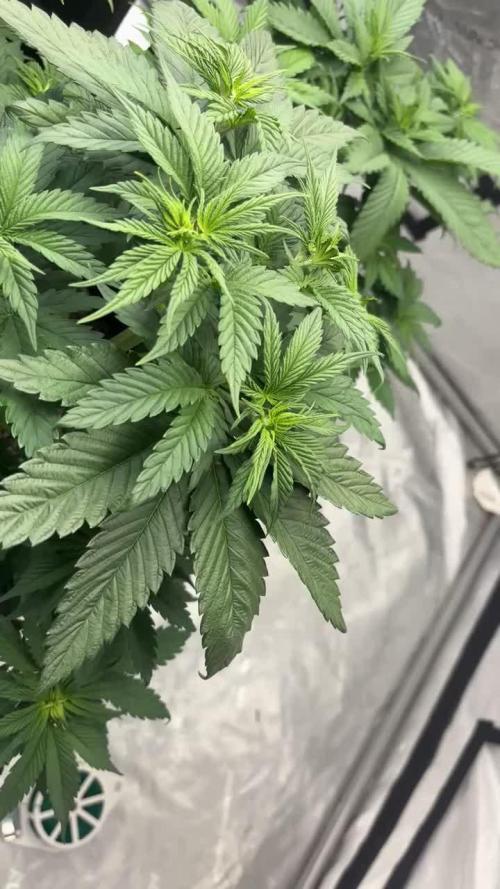
2/18: 4 weeks since we planted them. Some of the new nodes since topping are starting to come in. Also finally got to doing some lst. First time, so I didn't rlly know what I was doing all that much, but my main goal was to pull branches outward and have more light reaching all the nodes. I should definitely have topped and done LST earlier, but oh well, now I know for next time. I also removed some of the new fan leaves that were covering the new nodes. My roommate wanted to experiment with the smallest one so removed some of its big fan leaves. I don't really think that was the right call, but whatever we'll see what happens. Would also have loved to try mainlining but its also pretty late for that. It would have slowed down veg quite a bit too, and since we have to go home from college in early may, they have to be harvested by then. Gonna water later this afternoon as well.
2/19: Watered them last night. 0.75 gallons each. 4 tsp grow big, 6 tsp big bloom, 1.5 tsp calimagic per 2 gallons. I'm not sure why I didn't realize earlier I can just partially tuck the higher fan leaves under the lower nodes coming in. It makes the plant look droopy since big leaves are tucked, but I feel like it helps the lower nodes receive light and catch up, while being able to keep the fan leaves without cutting them. The small plant has 10 main nodes, and the rest have between 12-14, with many smaller additional nodes coming in under. I'm not sure how much I should try to grow these smaller nodes on the lower branches, or if I should just snip them off. Main focus right now is to get the nodes at similar hight and horizontal grow.
2/23: Watered this morning. Should have watered last night but my roommates were asleep and I was a bit too lazy to do it myself (took me an hour last time to do it all myself). I think I'm gonna start filling up a 5 gallon bucket instead of the 2 gallon one I was using, since I won't have to spend as much time refilling the water, nutrients, and get correct ph. Nutes doseage was 3 tsp grow big, 6 tsp big bloom, 2 tsp calimagic per 2 gallons. Roughly 0.8 gallons each plant. Ran out of big bloom for a few of the plants, but I don't think that should cause any big issues. Me and my roommate were debating if we should feed them nutes this water, or do straight water and calmag. Ended up feeding them since I didn't think we already have much salt buildup, but I think we will do a straight water and calmag flush next time. I also remembered we have a TDS meter, so I used it for the first time. Water in was about 750 or so ppm, and runoff was about 1350. I think thats kinda high for runoff, but like I said we will flush next time, and plants look healthy for the most part. Will definitely look more into that starting now. Also, the ph meter I had previously bought is complete garbage, so I had only been setting ph to around 6.2-6.5 with one of those visual mixing solution kit. I'd been doing this before mixing nutrients, and hoping that they don't throw the ph values off too much. I know this is pretty reckless and stupid, but it seems to somehow be working for now. I think it's probably a better idea we get a working ph meter so we can make sure levels are good after mixing in nutrients, but I'm feeling a bit lazy and frugal to buy a meter, so we'll see. Overall, plants look fairly healthy. They were a bit droopy today because I think I waited a bit too long before watering them, but oh well. One of the two plants that is a leggier and less bushy phenotype is turning pretty yellow however. I'm assuming it's a nitrogen deficiency but I'm not certain. Seems to have gotten a bit worse the last few days, but I'm hoping things will sort themselves out. Might also just up the doseage for grow big, which contains more nitrogen than big bloom. On a few of the other plants, the older and lower fan leaves also seemed to have some spotting resulting from calcium deficiency. Newer leaves all seem fine, and with the recentish addition of calmagic, I'm hoping this won't be an issue going forward. Have also been snipping very small nodes that are coming in on the lower branches. Not snipping them all, just trying to predict which ones have a chance at reaching quality light and developing into good colas. Anything I think will turn into larf im just snipping.
Looking back on the last few weeks, there are a lot of things I have learned that I hope to carry over to our next grow next year. I should have started lst and topping sooner, I understand how much and often to water them much better now, and there are a plethora of other small things that I have learned. I wish I didn't cut corners on some small things and overall was a bit more attentive to details, but for how well it seems to be going, I really can't complain. I'm incredibly stoked about how this is going, and I still can't believe I'm growing these plants with my roommates in our garage as a college student.

Likes
31
Share


@The_Doctor_Green
Follow
Esta semana han aparecido los malditos trips en las hojas, estoy tratando este problema con aceite de neem .
Con el tema de fertilizantes he regado con melaza únicamente, a las macetas con 3 litros de agua cada 3 días.
Likes
20
Share


@Diariesweed
Follow
week 11 whole tuesday i am advancing the total cycle of this purple plant in a few days i will try to cut the 22nd day to close 90 days 2 and a half weeks after the rinse. is counting the day when the other plant was placed in the water to germinate. the other plant will update it until the end of the week. I'm still feeding 🍁🔥😎
Likes
13
Share


@WeR1plzBlve
Follow
Pre-flower time... Top dress feeding for the first time for this lady added with some worm casting. Switching lights to 12/12 in a few days, Monday but until then each day I'll decrease the lights. Other than that things have been super easy, once again she's strong. She's thick she's healthy she's happy. If I can count correctly I may have about 16 tops, so things will be clear later on In flower. We'll see the true tops. Plus she is putting off a really leafy greeny smell, if that makes any sense. Other than that looking good

Likes
7
Share


@Ganjo
Follow
Very satisfied with this genetics. From bud to harvest in only 60 days. Once dried and trimmed I got 89 grams of beautiful buds, with a very intense aroma. This plant never gave me any problems, it grew very fast and healthy despite very hot, dry days and the presence of aphids

Likes
7
Share


@Damonkey
Follow
It’s spreading out really nicely and quite slowly as hoped. Defoliation and bending continues until flowering hopefully I should manage with space 😱😱😱😂
Likes
170
Share


@Tropicannibis_Todd
Follow
👉Alrighty Then👈
56 days in flipped at 28 days
It's been a great week all plants are killing it ......... 👉we are now in full flowering 👈
There all gonna get a slight defolation over the next few days to let air and light get in there which seems like I'm doing just about every feeding 👈
👉So I topped all but Babba Kush and Slurricane they didn't require it ... 👌 Got some nice level tops 👌
I've now started there full flowering nutrients program , so we are set to go ......
Persian Pie from Greenhouseseeds
Full Gas from Greenhouseseeds
Babba Kush from Greenhouseseeds
Rainbow Melon from Fastbuds
Papaya Sherbet from Fastbuds
Weddingcheesecake FF From Fastbuds
Purple Oreoz F1 From Seedsman
Slurricane From Premium Cultivars
Soil by Promix
Nutrients by Cronks
Well this should be fun 🙃
Thanks to all my growmies out there for stopping by its much appreciated 👈
👉Happy Growing👈


Processing
Likes
4
Share


@Skillgrower
Follow
Inicio da 4° semana vamos no dia 20 com muita força, adicionei agora ao plano de alimentação rinho skin e sensizym para limpar as raizes para pernanecerem brancas e engrossar os ramos strain vigorosa 100% indica estou a gostar
Como da pra ver no video houve um pequeno acidente a fazer lst, uni onde rasgou e pus papel vegetal a volta a segurar bem, vamos ver se ela cura.. continua com boa cor e nao se foi abaixo nem uma vez! Esperar uns dias, se nao curar vou cortar e fica um top acidental kkk
Ja curou o pequeno corte que tinha no ramo principal, decidi exprimentar fazer um supercrop, é a primeira vez espero que tudo de certo..
Em geral esta ser uma boa semana nada a apontar nestas meninas, a ir muito bem! 😏😁

Likes
5
Share


@Mr_nugs_lover_David
Follow
She's looking very healthy and ready to give all of her, looks beautiful,let's see how she performs the rest of the way! 💚🌱💎🔝

Likes
49
Share


@Roberts
Follow
Green Cure CBD is growing good for a solo cup grow. She got her first lst and defoliation today. She grew 2 inches over the course of the week. I figure in about 2 weeks she will be root bound. Everything is looking good. Thank you Medic Grow, and Zamnesia seeds. 🤜🏻🤛🏻🌱🌱🌱
Thank you grow diaries community for the 👇likes👇, follows, comments, and subscriptions on my YouTube channel👇.
❄️🌱🍻 Happy Growing 🌱🌱🌱
https://youtube.com/channel/UCAhN7yRzWLpcaRHhMIQ7X4g

Likes
57
Share


@BudBoutique
Follow
Welcome to Bud Boutique Grow Diary - really appreciate all your love and support :)
Dont forget to check out my other current grows!
🗓️ This Week:
- Day 52: the end is near
- Day 53: Trichomes check from #1 and #2 - looking super good almost all cloudy, a few amber and clear. perfect point to chop
- Day 54: this one is finished, let's chop them both #1 & #2 !! ✂️✂️✂️
- both phenos got still super purple beautiful leaves
- now its time to dry inside the tent at about 60%rh and less than 20°C/68°F trying to get it even lower for the next 10-14 days
Thank you for still staying with me 💚
___________________________________________
--- 🌱 Strain (Sponsor) 🌱 ---
🏷️ PEACH GIRL by Art Genetix
https://www.artgenetix.world/product-page/peach-girl
--- 🥗 Nutrients and Feeding (Sponsor) - (APTUS Ambassador) ---
🍸 APTUS: full nutrient schedule extreme
-- Regulator, N-Boost, P-Boost, CaMg-Boost, K-Boost, Allin1 Liquid, Startbooster, Topbooster, Enzym+ every feeding
-- Fulvic-Blast, NutriSpray as Foliar each once a week
🔗 https://aptus-holland.com/
--- ♻️ Grow Control (Sponsor) ---
TROLMASTER: TENT-X + LM14 Light Adapter to dim/sunrise/sunset lights + Temp & rH Sensor all remote on App
🔗 https://www.trolmaster.eu/
--- 🚿 PetraGrow (Sponsor) ---
CannaFogger Foliar Spray
🔗 https://www.petratools.com/product/petragrow-cannafogger-atomizer-new-mini-fogger
--- 🏭 Grow Setup ---
💡LUMATEK Zeus Pro 600
* 🏠🌿 Indoor: Homebox 120x120x200cm (4x4)
* 📐🌀 PrimaKlima exhausting Fan 1180m3/h (running on 60-80%)
* 🌀 Can Light Filter 800m3/h & 1x Fanbox 1x Dyson fan for Air circulation
🔗 https://lumatek-lighting.com/zeus-600w-pro-29/
🔗 https://primaklima.com/de/shop/ventilatoren-de/ec-ventilatoren/pk160ec-tc/
🔗 https://canfilters.com/products/filters/
All Likes and comments are highly appreciated!!!
👨🌾 don't forget to check out my Instagram for daily educational content: budboutiquee
- Bud Boutique

Likes
22
Share


@Naujas
Follow
a new air pot has been replaced, and a new "Girl", I have very limited space, so I don't even know how I will do:) an interesting trip awaits, I will soon start making a timelapse video :).
Likes
2
Share


Likes
20
Share

@Qerss
Follow
the plant is doing well. I think it will be ready next week. Unfortunately, the website slightly spoils the quality of the videos.



Likes
127
Share


@PapaNugs
Follow
Overall great product. Easy growing. Good looking. Smells great. Nothing but the best from Humboldt!



Likes
53
Share

@valiotoro
Follow
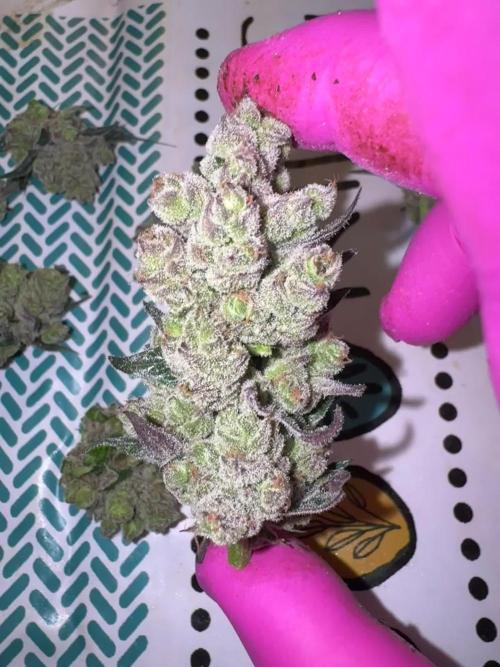
The buds were easy to trim, except they were super sticky but that’s always a good thing! I got two phenos: the first one with that garage-like aroma, and the second one, 100% Blue Cheese!

