





@Rusty_Shackleford
Follow
Drowned a few seeds, lesson learned. Super thankful for these beautiful girls. 4 WW, 3 BK, 3 JH, 1 Lemon haze. All feminized autoflowers . Actual week 1 from germination.


@Satax
Follow
Everything is still going well overall. I’ve always had an issue with a Cal/Mag deficiency that I had to monitor for some of the plants. Otherwise, they’re swelling nicely — the Green Poison is starting to look really good and is showing signs of maturity, earlier than the others. I’m starting the flush on all the plants since I’ve fed them well during the grow, and I think they still have enough nutrients left in their systems.
The smell is very strong, and the buds are dense and resinous — it’s looking promising..
I’m going to start applying my stress technique on the plants by inserting screws into the stems and using a small scalpel to remove some bark along the trunks, in order to push the resin production even further.




@GERGrowDesigns
Follow
Dear Growers ,
Welcome to Week 10 or Flower week 7 // Harvest Day from Kannabia Baby Boom Auto
Whether you're a beginner or an expert, you are warmly invited to join, ask questions, and share your own experiences along the way!
Project Setup & Conditions:
• Brand/Manufacturer: Kannabia Seeds
• Tent: 222cmx150cmx150cm
• Light: 2x 720 Watt Full Spectrum
• Humidity: 50%
• Soil: Narcos Organix Mix
• Nutrients: Narcos Products
• pH Value: 6
The Pictures Showing genetic 1 and 2 of Lemeon Haze Auto
If you want Germinitation results like mine , check out Kannabia Seeds with my link [https://www.kannabia.com/de?ref=61966] and grab the germination device or the strains I used . Trust me – it’s worth it for sure !
Get another 20% Discount at all products using the code [GGD] at the Checkout .
Stay curious and keep up Growing —we look forward to welcoming you back for the next Projects soon!




@Ultraviolet_
Follow
Not all minds think the same, its a hard concept to grasp from one who has only ego. When someone operates solely from the ego, they tend to view their own perspective as the objective truth. To them, if someone else thinks differently, it is seen as a flaw, a lack of intelligence, or a personal affront, rather than simply a different, valid experience.
The ego assumes that others are just extensions of itself. It cannot easily differentiate between "I think this" and "This is the universal truth". This is called the Mirror Fallacy. True understanding of another mind requires stepping out of oneself. The ego, by definition, is obsessed with self-preservation and being "right," which blocks empathy. Different perspectives are interpreted as attacks on the ego's stability. Instead of curiosity, it feels defensive. Acknowledging that others have entirely different internal worlds—with unique motivations, fears, and histories—requires dismantling the illusion that the world revolves around one’s own viewpoint. It’s a shift from "Why are they wrong?" to "How did they get to that perspective?"
Gospel of Thomas #17 "I shall give you what no eye has seen, what no ear has heard, and no hand has touched, and what has not come into the human heart." precedes saying #18, which questions the "beginning" and "end".
First, you need The Eyes to See, The Ears to Hear & The Mind of the Heart.
"Alpha to omega" refers to the first (Α/α) and last (Ω/ω) letters of the Greek alphabet, symbolizing "the beginning and the end". It represents totality, eternity, or the entirety of something.
Revelation 22:13, "I am the Alpha and the Omega, the First and the Last, the Beginning and the End" (NKJV, NIV).
Alpha & Atom: Both originate from Greek. Alpha (Α/α) is the first letter of the Greek alphabet (representing the beginning). Atom comes from atomos, meaning "indivisible," often seen as the foundational "first" particle of matter.
Adam & Atom: In some esoteric and linguistic theories, the biblical name "Adam" (Hebrew for man/earth) is connected to "atom" because both represent the original, foundational unit (the first man vs. the first particle).
Alpha Particles are particles emitted during radioactive decay, named "alpha" because they were the first type of nuclear radiation discovered. They are atomic nuclei consisting of two protons and two neutrons.
The study of the atom often deals with the "beginning" (alpha) of chemical reactions and fundamental building blocks.
The terms are linked primarily as symbols for "the beginning" (Alpha), the "fundamental unit" (Atom), and the "original man" (Adam).
The uppercase symbol Omega (Ω/ω) is primarily used in electronics and physics to measure electrical resistance in ohms, representing how materials resist electron flow. It is also used in various fields to represent the density parameter in cosmology, solid angles in physics, and special constants or asymptotic growth rates in mathematics.
In quantum mechanics, "Omega" (Ω/ω) can refer to several concepts related to measuring or representing quantum coherence, generally categorized into dynamical, mathematical, or physical parameters:
Dynamical Coherence Measures
Omega Pattern (Superconducting Circuits)
Coupling Strength
Angular Frequency
Quantum Coherence Framework (Omega v24.0)
Electron flow is not the same as electrical conductivity, but they are intimately related. Electron flow is the physical motion of electrons, while electrical conductivity is the material property that determines how easily that flow can happen.
Electron Flow (The "What"): The physical movement of negatively charged electrons through a conductor (usually from negative to positive). It is the act of carrying charge.
Electrical Conductivity (The "How Well"): An intrinsic material property that measures how easily a material allows electrons (or other charge carriers) to move through it.
Electron Flow (The Action): The actual physical movement of electrons from one molecule (donor) to another (acceptor) in a pathway, such as the photosynthetic electron transport chain or cellular respiration. The current itself (dynamic electricity).
Electrical Conductivity (The Property): An intrinsic property of a material (like copper vs. glass) that measures how easily it allows electric current (electron flow) to pass through it. A measure of ease. A high-conductivity material has low resistance and lets electrons move freely.
Electron transport rate (ETR), the rate at which electrons travel through the chain.
You can have Electron Flow occurring (electrons moving through the chain), but a very low Electron Transport Rate if the plant is in the shade. If light increases, the Electron Flow still follows the same path, but the Electron Transport Rate increases because more electrons are moving per second. In summary, ETR is a quantitative measure of electron flow.
The Electron Transport Rate (ETR) is not exactly the same as Electron Flow, although they are intimately related. Think of "Electron Flow" as the movement itself, and "Electron Transport Rate" as the speed or quantity of that movement.
Photosystem II (PSII) is a critical multi-subunit protein complex in thylakoid membranes that initiates photosynthetic light reactions by splitting water and transferring electrons.
"Et lux in tenebris lucet, et tenebrae eam non comprehenderunt,"



@Dr_Green_Thumb87
Follow
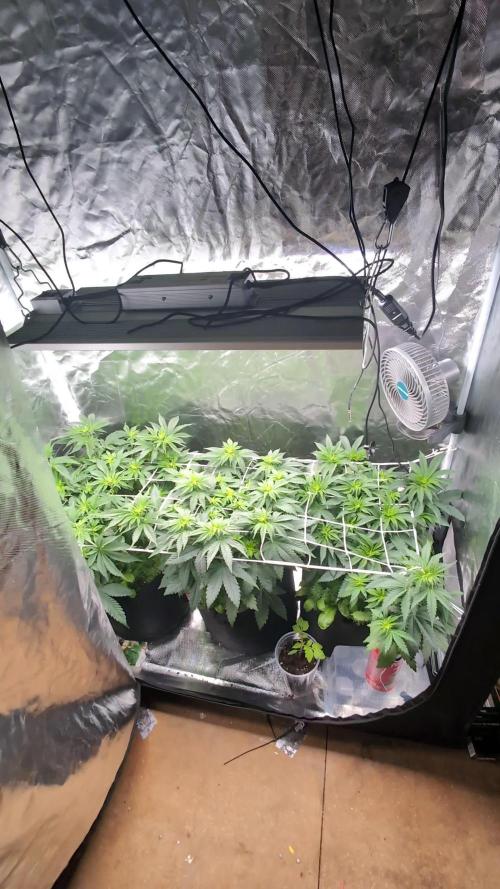
5/21 start week 2 flower all of them are in good shape humidity still a bit high 🌀 60%
Doing some more LST until end of this week 🏻


@UK420hydrogrow
Follow
Ok had a lot going on this week with various issues affecting plants in flower tent but managed to take few pics and keep u guys updated on this grow feel free to comment or give me any advise I'm a newby out of his debth




@Ultraviolet
Follow
What's in the soil? What's not in the soil would be an easier question to answer. 16-18 DLI @ the minute. +++ as she grows.
Probably not recommended, but to get to where it needs to be, I need to start now.
Vegetative @1400ppm 0.8–1.2 kPa 80–86°F (26.7–30°C) 65–75%, LST Day 10, Fim'd Day 11
CEC (Cation Exchange Capacity):
This is a measure of a soil's ability to hold and exchange positively charged nutrients, like calcium, magnesium, and potassium. Soils with high CEC (more clay and organic matter) have more negative charges that attract and hold these essential nutrients, preventing them from leaching away.
Biochar is highly efficient at increasing cation exchange capacity (CEC) compared to many other amendments. Biochar's high CEC potential stems from its negatively charged functional groups, and studies show it can increase CEC by over 90%. Amendments like compost also increase CEC but are often more prone to rapid biodegradation, which can make biochar's effect more long-lasting. biochar acts as a long-lasting Cation Exchange Capacity (CEC) enhancer because its porous, carbon-rich structure provides sites for nutrients to bind to, effectively improving nutrient retention in soil without relying on the short-term benefits of fresh organic matter like compost or manure. Biochar's stability means these benefits last much longer than those from traditional organic amendments, making it a sustainable way to improve soil fertility, water retention, and structure over time. Needs to be charged first, similar to Coco, or it will immobilize cations, but at a much higher ratio.
a high cation exchange capacity (CEC) results in a high buffer protection, meaning the soil can better resist changes in pH and nutrient availability. This is because a high CEC soil has more negatively charged sites to hold onto essential positively charged nutrients, like calcium and magnesium, and to buffer against acid ions, such as hydrogen.
EC (Electrical Conductivity):
This measures the amount of soluble salts in the soil. High EC levels indicate a high concentration of dissolved salts and can be a sign of potential salinity issues that can harm plants.
The stored cations associated with a medium's cation exchange capacity (CEC) do not directly contribute to a real-time electrical conductivity (EC) reading. A real-time EC measurement reflects only the concentration of free, dissolved salt ions in the water solution within the medium.
98% of a plants nutrients comes directly from the water solution.
2% come directly from soil particles.
CEC is a mediums storage capacity for cations. These stored cations do not contribute to a mediums EC directly.
Electrical Conductivity (EC) does not measure salt ions adsorbed (stored) onto a Cation Exchange Capacity (CEC) site, as EC measures the conductivity of ions in solution within a soil or water sample, not those held on soil particles.
A medium releases stored cations to water by ion exchange, where a new, more desirable ion from the water solution temporarily displaces the stored cation from the medium's surface, a process also seen in plants absorbing nutrients via mass flow. For example, in water softeners, sodium ions are released from resin beads to bond with the medium's surface, displacing calcium and magnesium ions which then enter the water. This same principle applies when plants take up nutrients from the soil solution: the cations are released from the soil particles into the water in response to a concentration equilibrium, and then moved to the root surface via mass flow.
An example of ion exchange within the context of Cation Exchange Capacity (CEC) is a soil particle with a negative charge attracting and holding positively charged nutrient ions, like potassium (K+) or calcium (Ca2+), and then exchanging them for other positive ions present in the soil solution. For instance, a negatively charged clay particle in soil can hold a K+ ion and later release it to a plant's roots when a different cation, such as calcium (Ca2+), is abundant and replaces the potassium. This process of holding and swapping positively charged ions is fundamental to soil fertility, as it provides plants with essential nutrients.
Negative charges on soil particles: Soil particles, particularly clay and organic matter, have negatively charged surfaces due to their chemical structure.
Attraction of cations: These negative charges attract and hold positively charged ions, or cations, such as:
Potassium (K+)
Calcium (Ca2+)
Magnesium (Mg2+)
Sodium (Na+)
Ammonium (NH4+)
Plant roots excrete hydrogen ions (H+) through the action of proton pumps embedded in the root cell membranes, which use ATP (energy) to actively transport H+ ions from inside the root cell into the surrounding soil. This process lowers the pH of the soil, which helps to make certain mineral nutrients, such as iron, more available for uptake by the plant.
Mechanism of H+ Excretion
Proton Pumps: Root cells contain specialized proteins called proton pumps (H+-ATPases) in their cell membranes.
Active Transport: These proton pumps use energy from ATP to actively move H+ ions from the cytoplasm of the root cell into the soil, against their concentration gradient.
Role in pH Regulation: This active excretion of H+ is a major way plants regulate their internal cytoplasmic pH.
Nutrient Availability: The resulting decrease in soil pH makes certain essential mineral nutrients, like iron, more soluble and available for the root cells to absorb.
Ion Exchange: The H+ ions also displace positively charged mineral cations from the soil particles, making them available for uptake.
Iron Uptake: In response to iron deficiency stress, plants enhance H+ excretion and reductant release to lower the pH and convert Fe3+ to the more available form Fe2+. The altered pH can influence the activity and composition of beneficial microbes in the soil. The H+ gradient created by the proton pumps can also be used for other vital cell functions, such as ATP synthesis and the transport of other solutes. The hydrogen ions (H+) excreted during photosynthesis come from the splitting of water molecules. This splitting, called photolysis, occurs in Photosystem II to replace the electrons used in the light-dependent reactions. The released hydrogen ions are then pumped into the thylakoid lumen, creating a proton gradient that drives ATP synthesis.
Plants release hydrogen ions (H+) from their roots into the soil, a process that occurs in conjunction with nutrient uptake and photosynthesis. These H+ ions compete with mineral cations for the negatively charged sites on soil particles, a phenomenon known as cation exchange. By displacing beneficial mineral cations, the excreted H+ ions make these nutrients available for the plant to absorb, which can also lower the soil pH and indirectly affect its Cation Exchange Capacity (CEC) by altering the pool of exchangeable cations in the soil solution.
Plants use proton (H+) exudation, driven by the H+-ATPase enzyme, to release H+ ions into the soil, creating a more acidic rhizosphere, which enhances nutrient availability and influences nutrient cycling processes. This acidification mobilizes insoluble nutrients like iron (Fe) by breaking them down, while also facilitating the activity of beneficial microbes involved in the nutrient cycle. Therefore, H+ exudation is a critical plant strategy for nutrient acquisition and management, allowing plants to improve their access to essential elements from the soil.
A lack of water splitting during photosynthesis can affect iron uptake because the resulting energy imbalance disrupts the plant's ability to produce ATP and NADPH, which are crucial for overall photosynthetic energy conversion and can trigger a deficiency in iron homeostasis pathways. While photosynthesis uses hydrogen ions produced from water splitting for the Calvin cycle, not to create a hydrogen gas deficiency, the overall process is sensitive to nutrient availability, and iron is essential for chloroplast function.
In photosynthesis, water is split to provide electrons to replace those lost in Photosystem II, which is triggered by light absorption. These electrons then travel along a transport chain to generate ATP (energy currency) and NADPH (reducing power). Carbon Fixation: The generated ATP and NADPH are then used to convert carbon dioxide into carbohydrates in the Calvin cycle. Impaired water splitting (via water in or out) breaks the chain reaction of photosynthesis. This leads to an imbalance in ATP and NADPH levels, which disrupts the Calvin cycle and overall energy production in the plant. Plants require a sufficient supply of essential mineral elements like iron for photosynthesis. Iron is vital for chlorophyll formation and plays a crucial role in electron transport within the chloroplasts. The complex relationship between nutrient status and photosynthesis is evident when iron deficiency can be reverted by depleting other micronutrients like manganese. This highlights how nutrient homeostasis influences photosynthetic function. A lack of adequate energy and reducing power from photosynthesis, which is directly linked to water splitting, can trigger complex adaptive responses in the plant's iron uptake and distribution systems.
Plants possess receptors called transceptors that can directly detect specific nutrient concentrations in the soil or within the plant's tissues. These receptors trigger signaling pathways, sometimes involving calcium influx or changes in protein complex activity, that then influence nutrient uptake by the roots. Plants use this information to make long-term adjustments, such as Increasing root biomass to explore more soil for nutrients. Modifying metabolic pathways to make better use of available resources. Adjusting the rate of nutrient transport into the roots. That's why I keep a high EC. Abundance resonates Abundance.


@Squaregrouper
Follow
This week was very hot week you were in a heatwave temperatures reached upwords 100 degrees while the heat index was around 120 degrees Fahrenheit.. the triple cheese has probably due to genetics did not grow is much as the others in the garden..I would say maybe it is the blueberry but I have grown blueberry outdoors and the trees reach-around 13 ft which isleading me to believe that this unknown plant in the garden could be leftover blueberry from last year.. I have started to review last Summer's grows to try to identify the plant if indeed the plant was in fact in the garden last Summer (took clones last year like I do every year)


@valiotoro
Follow
Hello everyone 👨🌾🏻
she grew fast and with a beautiful green colour on the leaves!
Preflower has started and its a girl
Wish you all a good day and happy growing


@NCgrower252
Follow
The plants are growing nicely! They were all flushed with plain pH balanced water on Friday and will be fed nutrients listed above on: 5/31


@Naujas
Follow
the girl is growing a little bit, it's getting better, but the weather is not in her favor so far... the weather forecast doesn't show anything good either... but she's growing a little bit, and she looks healthy:).


@Sauce_XL
Follow
2.17.2024: Start of week 5, day 29 from seed, day 25 from sprout. Plant is healthy from what i can tell. Top of the plant's leaves all have slight white tips from what i'm assuming is light stress? Light is 16 inches from top of plant at 112 watts. I've let it pretty much do its thing so far. Branches are rather short making any sort of LST hard. Pistils are clearly visible so i'm assuming we're entering the flowering stage. Wouldn't be surprised to see the first signs of bud growth by the end of the week. Still no nutrients given. The fan leaves are large and blocking bud sites so perhaps i'll clip soon? Will upload pics today.
2.18.2024: Plant is responding well to the increase in light intensity. Still can't bring myself to take the large fan leaves off.
2.19.2024: Day 31 from seed. Plant is drinking more. Gave 64oz at 6.4ph. Run off ppm was 1450 at 6.6ph. Essentially 4 full weeks from seed before i need to start feeding. Next watering will contain nutrients.
2.20.2024: Humming along. Now firmly in the preflower/early flower stage. Growing 1/2 to 1 inch a day. If anyone is reading this, please tell me its ok to chop the big fan leaves blocking bud sites!
2.21.2024: Day 33 from seed, 29 from sprout. Picked up the pot this morning and it was very lite so i gave it another 64oz at 6.3ph. No run off this time which tells me they are starting to need more water or i need to up the frequency. Still no nutes in 33 days!
2.22.2024: Besides white tips on top growth, steady as she goes. I'll post a pic of the white tips. No idea how to solve. Plant is totally in flower but since we're almost at the end of week 5 from seed, i'll keep the diary in "flower." 14.5 inches from soil to top. Would love to see these get to 24 inches by the end.
2.23.2024: Upped water to 96oz at 6.4ph. About 2 cups of run off at 6.6ph and 1130ppm. Original soil still has nutes to offer at day 35 from seed.


@Satica_G
Follow
One seedling streched a bit, but thats not a problem. Besides that, everything went great! 3/3 Germination rate
I am very excited to see the ladys grow. We couldnt order our grow equipment, so we started the plants on the Windowstill.



@Elixire
Follow
• Just get the seeds already soaked them up on water waiting them to crack open 😝.
• 48h after 2 of them pop out the fast honey cream and also the critical.
• They finally all pop out and looking nice and healthy after a complete 72h
18/05/2020
• I lower the light yesterday the 🌱 did not react . They didn’t stretch at all they look green and healthy Day 2.
• everything seems ok hot days on my place fighting the heat 30c inside the tent today
• after 6 days little bit of red stem due to light level, i raise up the light until the stem turn back to green. No deficiency for know they look healthy and 😃


@Reyden
Follow
È arrivato il momento di pulire i boccioli delle ragazze di @anesiaseeds che sono fenomenali con dei fiori gelidi, pieni di resina, un ottimo profumo che ancora dovrà migliorare nel tempo…cercando di fare una buona concia che è sempre importantissima nel processo di guarigione per avere un fumo delicato e non pesante per la gola, questo fumo è già ottimo! Ottimo lavoro Anesia Seeds


@mk420
Follow
49 days from planting seed.
All 4 plants are now flowering
The runt has grown a little this week and is now flowering, I am starting to think that it could be a different strain? look at the difference in appearance compared to the others. It is now 17 inch. looks more like an indica strain?
The other three are looking good, 2 measure at 30 inch and the third is slightly behind at just under 26 inch. All three look healthy. lots of flowers appearing.
No changes to my setup this week other than moving my light up a few inches, starting to run out of head room in my short tent, will have to consider moving the fan and filter outside my tent if they get any taller.
No rhizotonic in my reservoir now but I have increased my A & B to 3ml per litre.


@Aircoholic
Follow
When I got into the room one day before I scheduled the harvest, her branch collapsed under the weight of the buds. Not surprising, the buds were massive and dense! This is one of the best problems to appear during a grow, could never be mad at a plant for lack of strength to support the massive buds. I decided to view it as a sign from the plant, that it's done, it had enough, so the harvest happened a day early.
Her buds were too tall for my DIY Cooler and since the buds were so dense, it wasn't easy to get to the stem to cut it and since the buds were covered in trichomes, the gloves were super sticky.
The genetics were pretty amazing to grow, super happy plant with amazing growth - thank you, @Exotic_Seed for the seeds! 🙏
