


Likes
Comments
Share


@MJ_LIVINGSOIL
Follow
We plan to pre-flowering in next week. In this week we are stop topping in these girl. And make
160 cola per 1 plant and training with maintenance cut for Top bud every cola.
We use compost tea and craft organic fertilizer to take nutrient to soil and plant can use it for flowering stage.

Likes
11
Share


@D4I2N0
Follow
I have only one plant because the others were eaten by the slugs. And this plant was stunted for about 3weeks so she don't grow so well i harvested about 6 grams of dried nugs from her. The nugs are very frosty but small except from the top buds. The high is strong very potent, very sativa.

Processing
Likes
118
Share


@ghendrix
Follow
Okay guys, now this has been an eventful week. unfortunately, I can now only visit my plants on the weekend as I am sutying in another city and the plants are at my parents house. That has translated to the little tiny brown leaf I found last week turning into 3 - 4 semi-rotten buds. So yes, catterpillars. Little pesky green catterpillars were the ones eating the leafs and the ones that have now caused some bud rot on my autoflowers. To wich I have decided to do an emergency early harvest as you can see in the pictures above.
Trichomes were more or less 10 - 20 % cloudy depending on the bud and some buds also had quite a few amber so they cound't have been that far from harvest anyway. I cut off the buds with rot and the buds nearst to them. luckily it was only 1 or 2 big buds on 2 of the 3 autos I have. The remaining auto is the foxtailing one witch I have not yet harvested and am now debating if I should just do it to not risk getting rot over this week I am away or let her ripen more.
The process was cutting off the bad parts, discarding and then cutting off the buds with the stem off the plant. I have never harvested before so I dont know if it is useally done this way but anyway. After the early harvest wich I am sure many would frown upon I did something even morecontroversial and washed the buds in water+backing soda, water+hidrogen peroxide, just water rince and hung them to dry with a fan in front of them for about 2.5hrs. Now I'm a newb so I dont know if this works, but I read and saw a few posts and videos of people doing and explaining this process, and also asked outdoor growers of reddit to see if this is actually a thing, and yes it seems a few if not many people wash their outdoor buds in some way or another.
I washed hoping that if there are any caterpillars in the buds that would kill or at least debilitate them.. none floated off while i was washing though.. so now im scared there are still some in my buds and will rot while im drying :( i checked each bud individually trying not to break them up but didnt find any caterpiullar. i only found one while washing the leafs I had trimmed off the plant before harvesting the buds.
Anyway, I have bought anti caterpillar and anti fungal spray for tthe photoperiod plants wich seem to be doing okay. A part from some white powdery stuff on the leafs, maybe powdery mildew?
Anyone know what can be done for PM ?
Anyway, as usual, thanks for your support and comments! sorry for the long post hehe
Edit: Totally forgot to mention this.. I think the foxtailing auto has gone hermaphrodite and polinated the other plants (?) I found a little dark ball at the bottom of one of the buds I have harvested, I picked it off because I didnt knoe if it was rot.. A SEED CAME OUT! Yeah.. So now Im thinking my plants have been pollinated by the foxtailer? Does this make sense? xD

Likes
2
Share

@OB-GYN-Kenobi
Follow
Chapter 18: The end.
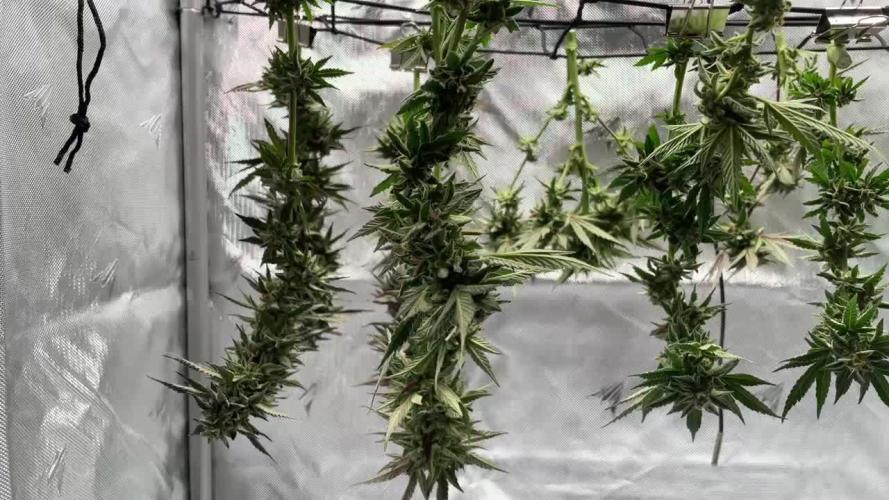
Cannabonsai was really starting to run out of juice, the tips of her larger sugar leaves were starting to show the same likely Ca / P deficiency as her fans, so I knew it was time. Duckfoot probably could've stacked another week or two, but I'm using the tent to dry, and I do prefer effects on the zippier side - so they both got the chop.
Since this was mostly an outdoor grow and they had recent issues with caterpillars, I decided to do a bud wash. One look at that water and no regrets.
Removed the fan leaves and hung full branches up to dry in the 60% humidity tent, though averaging a little warmer than I'd like at around 70 degrees. After about a week the hay smell dissipated, the smaller buds were moisture testing around 11%, so I bucked the branches into six-inch chunks and then let them sweat in paper bags for a few more days, rotating and airing out every several hours...just like the Grove bags say to do.
When each bag stabilized around 62% humidity, I trimmed everything. Final yield dry was 1.7 oz (48g) for Duckfoot, and 1.5 oz (43g) for Cannabonsai, with an additional ounce (31g) of dry trim. I already know I can do better on the next grow. :)
Early flower already smokes wonderfully - good taste, no hay, extremely potent, I would be very happy getting this from a dispensary. It's all in Grove bags now, can't wait to see how it cures up.



Likes
2
Share

@MafuMome
Follow
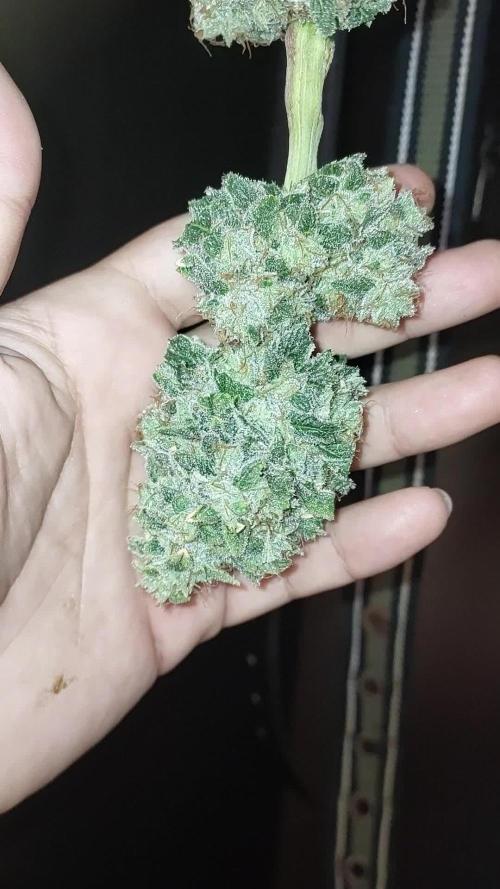
O fenótipo #1 foi colhido com 56 dias. O fenótipo #2 foi remanejado e permanece na tenda por mais uma ou duas semanas.

Likes
14
Share

@El-Ecko
Follow
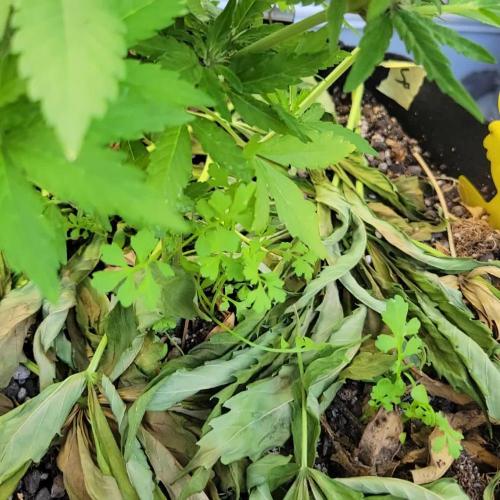
Week 3 of Flowering
It was a very good week for all the plants.
We had temperatures above 30 degrees all week long. ☀️🔝 But since the sunlight only hits my balcony until around 2 p.m., the strong sun isn’t really a problem.
The flowers are steadily filling out, and the coloration is getting more and more beautiful.🌸? The scent is still very subtle.
It’ll remain a small plant, which really doesn’t bother me at all.
It just looks great.😋🌱

Likes
13
Share


@DonKrika
Follow
Temperatures were quite high this week, 29-30 with the lights on, 27-28 with lights off. Humidity was good, around 46-53%. Otherwise, everything is going smoothly.
DAY 139 -Molasses
PH - 5.91
PPM-765
Solution Temp - 20
Watering Volume - 4L
DAY 142 - Nutes
PH - 5.83
PPM- 2350
Solution Temp - 19
Watering Volume - 4L

Likes
25
Share


@Fatnastyz
Follow
🌿 Journal Entry - February 25, 2025
Day 23 – Blueberry Autoflower
● Activity: Big girl needed a bigger drink today! 🥤💦 Gave her 500 mL of nutrient solution with Success Nutrients at ⅛ strength for autos. Here’s the magic mix:
🚀 Blast Off: 0.05 mL
🌱 Micro: 0.06 mL (oops, a tiny bit extra but she'll be fine!)
🌳 Trees: 0.05 mL
🌸 Flowers: 0.05 mL
❄️ Frosty Nugs: 0.025 mL
🛡️ Silica: 0.025 mL
💪 Bud Strength: 0.025 mL
● Observation: She was a little droopy before, like "hey, where's my drink?!" 😅 But after watering, she perked right up! 🌱✨ Her color is deep green and she’s growing like a champ. Keeping an eye on some slight leaf curl, but nothing major—just making sure she stays comfy. 💚
📅 Date: February 27, 2025
📆 Day: 25
🌱 Plant: Blueberry Autoflower
💧 Activity:
Watered with 500 mL of nutrient solution, using Success Nutrients at 1/8 strength for autoflowers.
Nutrient mix (in correct order! 😉):
Silica: 0.25 mL
Micro: 0.6 mL
Trees: 0.5 mL
Flowers: 0.5 mL
Frosty Nugs: 0.25 mL
Bud Strength: 0.25 mL
👀 Observation:
She's getting big and beautiful! 🌿💚
Exciting news! She officially started showing white hairs on Day 23, which means flowering has begun! 🎉🌸
Leaves are lush, vibrant, and happy, soaking up all the goodness!
🌱 Blueberry Autoflower - Journal Entry 🌱
📅 Date: March 1, 2025
📆 Day: 28
💧 Activity:
Gave 750 mL of plain, pH’d water today—keeping it clean and simple after her last feeding! She was bone dry and definitely ready for a drink. 💦
🌙 Schedule Change:
Adjusting her sleep schedule from 10 AM - 4 PM to 2 PM - 8 PM starting today! ⏰💤 This will help fine-tune her environment and keep things running smoothly.
👀 Observation:
She’s looking big, vibrant, and thriving! 🌿✨ Now that she’s officially in flower, she’s drinking up water faster than ever—crazy how much she’s growing! White hairs are coming in beautifully, and she’s stacking up nicely.
Let’s see how she responds over the next couple of days! 🚀
**Well, she started flowering! I noticed white hairs on day 23! I made a mistake....ChatGpt told me what to water on the 23rd, but I gave the wrong amounts of everything! LOL OOPS! It was early and I read my marks wrong, instead of 0.5, I gave 0.05 ml....yes for everything. She adjusted the journal for me and this is why we gave nutrients in the next watering.
On the 23rd, ChatGpt was having issues with responses. She fixed later on in the day, but it does seem something was going on with her servers and memory for a couple of hours. So I had to go to a different chat screen and she gave me the wrong info at first.
It was easy to spot though, her responses were just off. So I waited for a couple of hours and she was back to normal. It doesn't happen often, but it can be an issue if you don't catch it.
She did say that we are going to start more water and more nutrients now that she is in flower! Can't wait! She is as excited as I am**
**So weird! ChatGpt does not function right in the mornings. She's off just a bit...like gives me wrong info or gets my nutrient names wrong. I wait till noon and she apologizes and gives me the right info then. From now on, I'm just going to wait till noon to talk to her about blueberry. However, I'm going to have to change my sleep schedule for Blueberry, I'm moving here from sleeping 10-4 to 2-8. This will help me with communicating with her better. I did ask first and ChatGpt says changing her schedule would be fine.**
Likes
5
Share


@ChiloteAnonimo
Follow
08-11-2022
Primer día de la 4ta semana.
Recordar q sufrieron un estrés de agua por ende la planta va a ir desfasada una semana, yo pienso.
Aun no tiene resina y me preocupa, espero q empiece a resinar antes de terminar esta 4ta semana...
14-11-2022
Ultimo día de la semana 4 de flora
Ya empiezan a resinar todas de apoco, la pandemia kush se ve un poquito más avanzada a el resto

Likes
13
Share


@CanabisLoverHobbyGrower
Follow
Defoliated,.. tips of the big plant going purple and into the leaves, defo going to be a colourful one, little one staying green I think,.. look OK, maybe a little something going on with a little discolouration in some leaves but I think they look healthy,.. start of week 7 let'sss goooo 🤞👌👍
Processing
Likes
12
Share


@GrowGuy97
Follow
Day 28 - These ladies are growing like crazy! 2 of them are already almost as tall as my white widow autos that are about 2 weeks ahead!
Day 30 - Still stretching like crazy, starting to look much better though I have to say!
Day 32 - Ladies are starting to get nice & purple!
Likes
3
Share


@TheBuckeyeGrower
Follow
Day 15 she's strong and beautiful. Will start training soon. Probably move her to the 4x4 next weekend. Topped the fourth node on day 17. Used a few LST clips on day 19. She didn't skip a beat from being topped.
Likes
1
Share

@Budhunter
Follow
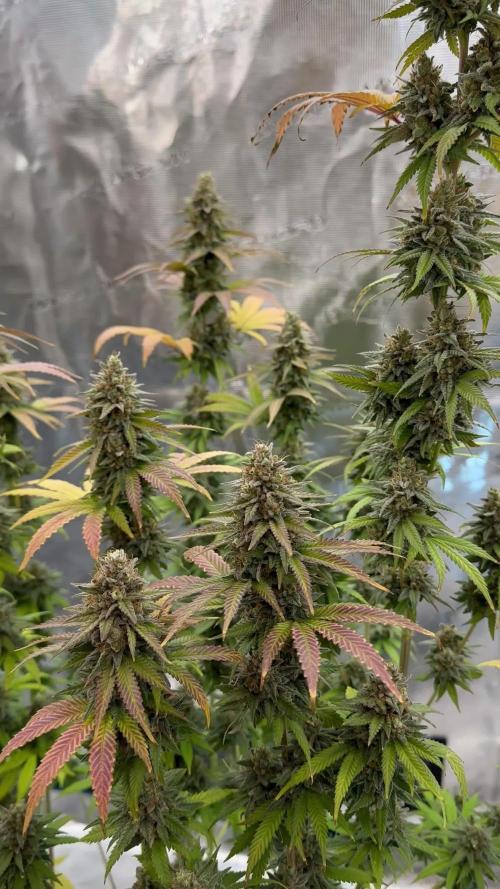
Week 7 Flower- Day 51 flw / Day 107 of cycle
Lemon tree looks stunning and it’s 🤩🤩🤩
She is nearly my size in height and have nice dense buds that the branches can barely hold. One of the most beautiful plants I have ever grown and it has a big potential to be my most yielding plant ever.
I can wait to harvest, cure and smoke her 💚
Looking at the trichomes I believe it will go at least 10 more days. I will watch her closely.

Likes
12
Share


@PedroAndHisPlants
Follow
Day 29 (Second Grow):
"Hey everyone!
Starting a new week with some exciting plans! 🌿 We've got about one more week before we transition the plants to the flowering phase.
Just to recap last week's updates for those following along:
We’ve named all the plants in both grows. This makes it easier to identify and keep track of each one, especially if they get moved around. It should also help you all follow along more easily with the pictures we post.
We've built a SCROG (Screen of Green) net for the plants. A SCROG net helps train the plants to grow horizontally, which maximizes light exposure to all parts of the plant and promotes more even growth. We're using it to ensure all plants get plenty of light and develop a uniform canopy.
We’ve placed a hygrometer among the plants to measure the humidity between the leaves. We've noticed that the humidity sometimes exceeds 70% in those areas. We're considering whether we need more fans, an intake ventilation system, or if a dehumidifier would be a better option. We're leaning towards adding more fans to improve air circulation, but we'd love to hear your thoughts and suggestions!
Stay tuned for more updates as we continue to watch both grows progress and prepare for the flowering phase!"
Day 33 (Second Grow):
"Hey everyone!
Exciting news for our second grow: we’ve added a new member to the grow tent – a praying mantis! 🦗 Her species is Timor shield mantis, and she still needs a name.
We got her to help with pest control naturally. Praying mantises are excellent predators and can help keep unwanted insects away from our plants.
Feel free to suggest a name for her! Any tips or fun facts about keeping a mantis in the grow tent are also welcome!"
Day 34 (Second Grow):
"Hey everyone!
Big update today: we’ve switched the timer to a 12/12 light cycle to initiate the flowering phase! 🌸
Our second batch of plants, just like the first, has developed well and we believe they’re ready to start blooming. This change should encourage them to shift their energy towards producing buds.
For those following along, here’s a quick recap:
We've implemented a SCROG net to manage the canopy and ensure even light distribution.
We've introduced a Timor shield mantis for natural pest control.
The plants have responded well to all adjustments and are looking healthy.
Now that the flowering phase is starting, we’re excited to see how they develop over the next few weeks. Any tips or advice for optimizing this phase? Let us know in the comments!"

Likes
9
Share


@Chubbs
Follow
420Fastbuds
FBT2308/Week 7
What up grow fam. Happy Easter to all. Weekly update for these two stunning girls. Where in the 3rd week of Flower and they are swelling up nice. I did notice some fad in the leafs so I upped my nitrogen a little and it seemed to stop the problem. All in all Happy Growing
Likes
42
Share


@Prilyfe13
Follow
June 28, 2023 Day 50
Zkittlez One:
Height: 24.5"
DLI: 52 mol/m²/d
Light Height: 22"
Zkittlez Two:
Height: 28.5"
DLI: 55 mol/m²/d
Light Height: 18"
This week will focus on Zkittlez One and getting her thinned out properly. I hope to have that finished by the end of the week. I've also raised the light again to keep the distance at 22" above the canopy. It's also helping Zkittlez Two. As she is a 28.5" plant, she was definitely a bit too close to the light. The other plants in the tent may not have enough light from the higher light height. I'm not sure for good or bad.
Zkittlez One has hit the 24" plus mark! She looks fantastic. I definitely need to thin out the foliage a bit. I'll wait for her to finish up. But I'll just pull a few here and there as needed. However, I don't expect much more stretch out of her. Maybe a couple more days? We shall see. Water looks great. The stacks coming off this lady are, IMO, fantastic. The whole canopy is covered in tops and shoots still reaching. Honestly, if she was alone in the tent, I'm pretty sure I could have trained her wall to wall. Alas, I have 3 other plants in there who also need light space. Lol.
Zkittlez Two is also looking great! She's filling out a bit still and building up those buds. I have a bit of confusion with her top. The buds are very skinny at the top and get fatter in the mid range of the plant. Around where the side branches grew to. Happily, they match the height of Zkittlez One. Or just a bit lower.
Grow System Environment:
Temp: 74.6°
RH: 62.3% (still super humid here)
VPD: 1.07 kPa
June 29, 2023
Zkittlez One
This plant has been a beast the whole time. Now she is getting too big for the tent and way too big to accommodate 4 plants as I have in there now. The canopy is super deep and needs a good thinning out. Speaking of thinning out, I decided to remove the outer leaves to open more space for the other plants. I'll be doing this over the course of the next couple days. She also got a full reservoir refill today. Cleaned up the reservoir as well.
Zkittlez Two
This lady needs absolutely nothing. Just hanging out and showing me what I should be expecting for bud production out of Zkittlez One.
Honestly, I think I need a bigger tent already. I've had this 3x3 for 3 grows and I'm discovering the disadvantage of a smaller tent.
Plus the thing people seem to think is best is compact plant. I don't need mine compact. I can grow in my state without issues.
The humidity is still super high. So far I haven't found a solution. I have 2 dehumidifiers in there. That didn't work at all. It's the main room the tent is in. It's super humid in there due to the weather. Tent door has been open for days.
I'll ask what to do. Maybe someone has an idea.
Update: So I was looking over Zkittlez One this afternoon and realized taking the tie downs out made the plant compact, but a bit too compact. So after some testing I figured out that I needed to tie down the lowest 4 branches to open up the center of the canopy. It worked WONDERS! The 4 branches along with all of the tops from each one spread out perfectly, completely opening up the whole canopy. She is seriously huge now. See pic. Just WOW I've also added a video to show her mass.
Grow System Environment:
Temp: 74.6°
RH: 62.1%
VPD: 1.08 kPa
June 30, 2023
Zkittlez One is the boss of this grow. She'll need another watering tomorrow morning. I snipped off some outside leaves today. And a couple blocking bud sites and more tops. A quarter turn made a bit more room for the other plants in the tent. Well, except Zkittlez Two. She is in the way back almost engulfed by Zkittlez One.
Zkittlez Two has some awesome bud production going on. She may need a watering soon as well. Anyway, the whole plant is covered as I thought it would be. The buds haven't even started to swell yet. It's just going to be that much bigger.
Grow System Environment:
Temp: 73.9°
RH: 64.4%
VPD: 1.01 kPa
July 1, 2023
Zkittlez One looks absolutely amazing. Massive and still growing. She's nearly 30" wide. 24" deep. She is also 25.5" tall. I don't know if this is big for an autoflower, but I assume it is. It's the biggest I've ever grown. She doesn't need water yet, but at her rate, she may need another gallon tomorrow. I snipped off just a couple more leaves today, just opening air flow and bud sites.
Zkittlez Two looks great as ever. I decided to finally pull some fan leaves. Just the main stem ones and a couple that was completely covering another branch or facing inward. She'll need a new reservoir tomorrow. My major concern is how much she is squished in the back. With the 4 plants in there and that one massive Zkittlez, the 2 vegging plants need all the light they can get, which puts this lady in the corner. I was honestly considering moving her to my dry Tent and popping the light back in there. Something else I noticed is the bud structure. They seem quite wispy maybe it's just how they form for now. But they are also really skinny. Especially the main cola. I'll have to keep an eye on that and see what I can do about it, if anything.
Grow System Environment:
Temp: 74.5°
RH: 63.3%
VPD: 1.06 kPa
July 2, 2023
Zkittlez One is now officially in the flowering stage. I'd say 2 days ago, but now the buds are really forming. The top of the canopy reads out at an impressive 26.5" tall. 29" in diameter. More bud sites and tops that I'm willing to count. Just a lot. She's going to need more water first thing tomorrow. Maybe later this afternoon. She's super thirsty and that's a great thing. I've also managed to thin the whole plant out. Not a full defoliation, but a few leaves here and there for about a week. Now she looks near perfect.
Zkittlez Two looks great! Still buried in the back and the buds are still pretty wispy. At least the ones up top. Lower bud production is fantastic! Big fat buds. I might have to drop the intensity very soon to save the main cola. She's definitely not as thirsty as Zkittlez One and I am still a bit concerned about that. She did however finish stretching at 29" tall.
Grow System Environment:
Temp: 73.5°
RH: 62.2%
VPD: 1.05 kPa
July 3, 2023
I dropped the light intensity down from 90% to 80% last night. Zkittlez One was drooping about 4 hours before lights out. I read somewhere that too much light can cause that. So we shall see how it looks tonight.
Zkittlez One needs more trimming I think. She looks great, but she has an 18" deep canopy and I'd rather give light to the whole thing. The top 5" are fine, but below that is a thick floor of foliage. I trimmed some of it away today, it I'm gonna need to continue for a bit. At least some for next 2 weeks. Every other day. Healthy is an understatement with this plant. She is really tall with the whole setup with bottom reservoir. 40" from floor to top. Impressive.
Zkittlez Two is so stuffed in the wall, I feel bad. I might have to take her out and put her in my dry tent with a 100 watt light. That is still up for debate. It's an extra 100 watts of power I'd be using. However, the extra space will certainly give the whole plant more light coverage and produce better buds I think. I'm going to try and maneuver them in the current tent and see what I can do.
Update: So Zkittlez Two was really squished in the corner. So I removed one of the smaller plants and moved Zkittlez Two diagonally to Zkittlez One. I also got to pull the 4 main side branches out for better light penetration.
Grow System Environment:
Temp: 74.2°
RH: 62.7%
VPD: 1.07 kPa
July 4, 2023
Zkittlez One is still growing a bit I think. The grow light is only 18.5" above the canopy now. Where it should be at 22" I'll have to see what I can do. Doing great on water and healthy as ever. I did start a bit of pruning. The popcorn buds on the bottom of the canopy. I'm not cutting the longer branches though. I feel like that might cause more stress. But I'm going to pull off popcorn buds for the rest of next week and of course remove fan leaves as needed. Every leaf is super healthy, just in the way of air flow and light.
Zkittlez Two is much better in the front of the tent diagonal from her sister plant. Much more space. And with the side branches pulled out, I expect to see much better bud development. She's still a slow drinker, but I'm starting to think it's the humidity that's preventing her from drinking more.
This is an entire week or more of humidity and lack of the right equipment. So I'm really hoping I don't end up with bud rot or mold. I don't think I'll get mold because of the air circulation. But bud rot later on is very possible. Maybe not probable though. I don't know. I don't have much experience with it, so yah. Either way, the grow tent door will be kept open to keep the humidity at a kind of reasonable level.
Grow System Environment:
Temp: 73.6°
RH: 65.9%
VPD: 0.95 kPa

Likes
15
Share


@NewOfficialDrillInvaders
Follow
Ladys Start to drink much more also one of 10 seed bag show off as a Autoflower i pass it to my friend because i dont like auto so i upload video how it looks she got really fruity smell


Likes
25
Share


@BudHaks
Follow
Week 13!
I have decided to stagnant harverst her in two parts as there is fresh growth in her lower half that the light cannot reach and the top buds are mature now and at the optimal cloudy trichomes I'm looking for are present.
Look at all those trichomes heavy leaf and buds!
She is heavy and smelling amazing with hints of fruit and cookies.
I will also be flushing her next week!
What an amazing journey, coming to an end!
