


Likes
Comments
Share


@Roberts
Follow
Purple Ryder is growing great under the Medic Grow Mini Sun-2. She loves the Agrogardens nutrition as well. She has been eating and drinking a lot. She is due for a solution change very soon. Everything is looking really good at the moment. Just waiting on the bulking to begin. Thank you Doctors Choice, Medic Grow, and Agrogardens. 🤜🏻🤛🏻🌱💪🏼🌱
Thank you grow diaries community for the 👇likes👇, follows, comments, and subscriptions on my YouTube channel👇. ❄️🌱🍻
Happy Growing 🌱🌱🌱
https://youtube.com/channel/UCAhN7yRzWLpcaRHhMIQ7X4g


Likes
88
Share


@wolfvb
Follow
🌿 RS11 "C" - The 186cm Balcony Monster! 🏙️🌲
Let's go! This RS11 "C" is going completely crazy out on the balcony and just does not know when to stop stretching. She is turning into an absolute giant!
📈 The Details / Progress Report:
Towering Height: She has officially hit 186cm tall! 🤯 The vertical stretch on this girl is unreal, and she is building a super thick, sturdy main stalk to support all that height against the outdoor elements. 🦒
Still Vegging: Just to clear things up no, she is not in flower yet! She is a true photoperiod plant, and since we are growing outdoors in Berlin right now, we are still getting about 16 hours of daylight. She is strictly in her vegetative phase and taking full advantage of the long summer days to build this massive frame. ☀️
Lush Canopy: If you look at the close-ups, her foliage is absolutely flawless. The fan leaves are massive, praying hard to the sun, and rocking a deep, healthy green. Zero signs of pest damage or nutrient issues. She is completely thriving in her balcony environment! 🍃
Pre-flower Tease: While she isn't flowering, those top nodes are getting super tight, and you can see some strong stipules and early pre-flower action. She is perfectly prepping her structure so she's ready to explode when the light schedule finally flips.
💧 Next Steps:
With her standing at 186cm, wind support is the number one priority right now. The main goal is to make sure she is securely tied down and supported against any strong balcony gusts. Besides that, I am just keeping her well-fed to support this massive vegetative growth and waiting patiently for the Berlin days to get shorter so the real flower show can begin!
She is looking like a total beast! Let's keep it growing! 🌱💨


Likes
52
Share


@Ultraviolet
Follow
Lacewings seemed to have mostly killed themselves by flying into hot light fixtures. I may have left the UV on which was smart of me :) Done very little to combat if anything but make a sea of carcasses, on the bright side its good nutrition for the soil.
Made a concoction of ethanol 70%, equal parts water, and cayenne pepper with a couple of squirts of dish soap.
Took around an hour of good scrubbing the entire canopy.
Worked a lot more effectively and way cheaper.
Scorched earth right now, but it seems to have wiped them out almost entirely very pleased.
Attempted a "Fudge I Missed" for the topping. So just time to wait and see how it goes.
Question?
If I attached a plant to two separate pots but it was connected by rootzone, one has a pH of 7.5 ish the other has 4.5. Would the Intelligence of the plant able to dictate each pot separately to uptake the nutrients best suited to pH or would it still try to draw nitrogen from a pot with a pH where nitrogen struggles to uptake?
Food for stoner thought experiments!
Another was on my mind.
What happens when a plant gets too much light?
Well, it burns and curls up leaves.
That's the heat radiation, let's remove excess heat, now what?
I've always read it's just bad, or not good, but when I look for an explanation on a deeper level it's just bad and you shouldn't do it.
So I did.
How much can a cannabis plant absorb, 40 moles in a day, ok I'll give it 60 moles. 80 nothing bad ever happened.
The answer, finally. Oh great........more questions........
Reactive oxygen species (ROS) are molecules capable of independent existence, containing at least one oxygen atom and one or more unpaired electrons.
"Sunlight is the essential source of energy for most photosynthetic organisms, yet sunlight in excess of the organism’s photosynthetic capacity can generate reactive oxygen species (ROS) that lead to cellular damage. To avoid damage, plants respond to high light (HL) by activating photophysical pathways that safely convert excess energy to heat, which is known as nonphotochemical quenching (NPQ) (Rochaix, 2014). While NPQ allows for healthy growth, it also limits the overall photosynthetic efficiency under many conditions. If NPQ were optimized for biomass, yields would improve dramatically, potentially by up to 30% (Kromdijk et al., 2016; Zhu et al., 2010). However, critical information to guide optimization is still lacking, including the molecular origin of NPQ and the mechanism of regulation."
What I found most interesting was research pointing out that pH is linked to this defense mechanism. The organism can better facilitate "quenching" when oversaturated with light in a low pH. Now I Know during photosynthesis plants naturally produce exudates (chemicals that are secreted through their roots). Do they have the ability to alter pH themselves using these excretions? Or is that done by the beneficial bacteria?
If I can prevent reactive oxygen species from causing damage by "too much light".
The extra water needed to keep this level of burn cooled though, I must learn to crawl before I can run.
Reactive oxygen species (ROS) are key signaling molecules that enable cells to rapidly respond to different stimuli. In plants, ROS plays a crucial role in abiotic and biotic stress sensing, integration of different environmental signals, and activation of stress-response networks, thus contributing to the establishment of defense mechanisms and plant resilience. Recent advances in the study of ROS signaling in plants include the identification of ROS receptors and key regulatory hubs that connect ROS signaling with other important stress-response signal transduction pathways and hormones, as well as new roles for ROS in organelle-to-organelle and cell-to-cell signaling. Our understanding of how ROS are regulated in cells by balancing production, scavenging, and transport has also increased. In this Review, we discuss these promising developments and how they might be used to increase plant resilience to environmental stress.
Temperature stress is one of the major abiotic stresses that adversely affect agricultural productivity worldwide. Temperatures beyond a plant's physiological optimum can trigger significant physiological and biochemical perturbations, reducing plant growth and tolerance to stress. Improving a plant's tolerance to these temperature fluctuations requires a deep understanding of its responses to environmental change. To adapt to temperature fluctuations, plants tailor their acclimatory signal transduction events, specifically, cellular redox state, that are governed by plant hormones, reactive oxygen species (ROS) regulatory systems, and other molecular components. The role of ROS in plants as important signaling molecules during stress acclimation has recently been established. Here, hormone-triggered ROS produced by NADPH oxidases, feedback regulation, and integrated signaling events during temperature stress activate stress-response pathways and induce acclimation or defense mechanisms. At the other extreme, excess ROS accumulation, following temperature-induced oxidative stress, can have negative consequences on plant growth and stress acclimation. The excessive ROS is regulated by the ROS scavenging system, which subsequently promotes plant tolerance. All these signaling events, including crosstalk between hormones and ROS, modify the plant's transcriptomic, metabolomic, and biochemical states and promote plant acclimation, tolerance, and survival. Here, we provide a comprehensive review of the ROS, hormones, and their joint role in shaping a plant's responses to high and low temperatures, and we conclude by outlining hormone/ROS-regulated plant-responsive strategies for developing stress-tolerant crops to combat temperature changes.
Onward upward for now.
Next!
Adenosine triphosphate
(ATP) is an energy-carrying molecule known as "the energy currency of life" or "the fuel of life," because it's the universal energy source for all living cells.1
Every living organism consists of cells that rely on ATP for their energy needs. ATP is made by converting the food we eat into energy. It's an essential building block for all life forms. Without ATP, cells wouldn't have the fuel or power to perform functions necessary to stay alive, and they would eventually die. All forms of life rely on ATP to do the things they must do to survive.2
ATP is made of a nitrogen base (adenine) and a sugar molecule (ribose), which create adenosine, plus three phosphate molecules. If adenosine only has one phosphate molecule, it’s called adenosine monophosphate (AMP). If it has two phosphates, it’s called adenosine diphosphate (ADP).
Although adenosine is a fundamental part of ATP, when it comes to providing energy to a cell and fueling cellular processes, the phosphate molecules are what really matter. The most energy-loaded composition for adenosine is ATP, which has three phosphates.3
ATP was first discovered in the 1920s. In 1929, Karl Lohmann—a German chemist studying muscle contractions—isolated what we now call adenosine triphosphate in a laboratory. At the time, Lohmann called ATP by a different name. It wasn't until a decade later, in 1939, that Nobel Prize–-winner Fritz Lipmann established that ATP is the universal carrier of energy in all living cells and coined the term "energy-rich phosphate bonds."45
Lipmann focused on phosphate bonds as the key to ATP being the universal energy source for all living cells, because adenosine triphosphate releases energy when one of its three phosphate bonds breaks off to form ADP. ATP is a high-energy molecule with three phosphate bonds; ADP is low-energy with only two phosphate bonds.
The Twos and Threes of ATP and ADP
Adenosine triphosphate (ATP) becomes adenosine diphosphate (ADP) when one of its three phosphate molecules breaks free and releases energy (“tri” means “three,” while “di” means “two”). Conversely, ADP becomes ATP when a phosphate molecule is added. As part of an ongoing energy cycle, ADP is constantly recycled back into ATP.3
Much like a rechargeable battery with a fluctuating state of charge, ATP represents a fully charged battery, and ADP represents a "low-power mode." Every time a fully charged ATP molecule loses a phosphate bond, it becomes ADP; energy is released via the process of ATP becoming ADP.
On the flip side, when a phosphate bond is added, ADP becomes ATP. When ADP becomes ATP, what was previously a low-charged energy adenosine molecule (ADP) becomes fully charged ATP. This energy-creation and energy-depletion cycle happens time and time again, much like your smartphone battery can be recharged countless times during its lifespan.
The human body uses molecules held in the fats, proteins, and carbohydrates we eat or drink as sources of energy to make ATP. This happens through a process called hydrolysis
.
After food is digested, it's synthesized into glucose, which is a form of sugar. Glucose is the main source of fuel that our cells' mitochondria
use to convert caloric energy from food into ATP, which is an energy form that can be used by cells.
ATP is made via a process called cellular respiration that occurs in the mitochondria of a cell. Mitochondria are tiny subunits within a cell that specialize in extracting energy from the foods we eat and converting it into ATP.
Mitochondria can convert glucose into ATP via two different types of cellular respiration:
Aerobic (with oxygen)
Anaerobic (without oxygen)
Aerobic cellular respiration transforms glucose into ATP in a three-step process, as follows:
Step 1: Glycolysis
Step 2: The Krebs cycle (also called the citric acid cycle)
Step 3: Electron transport chain
During glycolysis, glucose (i.e., sugar) from food sources is broken down into pyruvate
molecules. This is followed by the Krebs cycle, which is an aerobic process that uses oxygen to finish breaking down sugar and harnesses energy into electron carriers that fuel the synthesis of ATP. Lastly, the electron transport chain (ETC) pumps positively charged protons that drive ATP production throughout the mitochondria’s inner membrane.2
ATP can also be produced without oxygen (i.e., anaerobic), which is something plants, algae, and some bacteria do by converting the energy held in sunlight into energy that can be used by a cell via photosynthesis.
Anaerobic exercise means that your body is working out "without oxygen." Anaerobic glycolysis occurs in human cells when there isn't enough oxygen available during an anaerobic workout. If no oxygen is present during cellular respiration, pyruvate can't enter the Krebs cycle and is oxidized into lactic acid. In the absence of oxygen, lactic acid fermentation makes ATP anaerobically.
The burning sensation you feel in your muscles when you're huffing and puffing during anaerobic high-intensity interval training (HIIT) that maxes out your aerobic capacity or during a strenuous weight-lifting workout is lactic acid, which is used to make ATP via anaerobic glycolysis.
During aerobic exercise, mitochondria have enough oxygen to make ATP aerobically. However, when you're out of breath and your cells don’t have enough oxygen to perform cellular respiration aerobically, the process can still happen anaerobically, but it creates a temporary burning sensation in your skeletal muscles.
Why ATP Is So Important?
ATP is essential for life and makes it possible for us to do the things we do. Without ATP, cells wouldn't be able to use the energy held in food to fuel cellular processes, and an organism couldn't stay alive.
As a real-world example, when a car runs out of gas and is parked on the side of the road, the only thing that will make the car drivable again is putting some gasoline back in the tank. For all living cells, ATP is like the gas in a car's fuel tank. Without ATP, cells wouldn't have a source of usable energy, and the organism would die.
Eating a well-balanced diet and staying hydrated should give your body all the resources it needs to produce plenty of ATP. Although some athletes may slightly improve their performance by taking supplements or ergonomic aids designed to increase ATP production, it's debatable that oral adenosine triphosphate supplementation actually increases energy.
An average cell in the human body uses about 10 million ATP molecules per second and can recycle all of its ATP in less than a minute. Over 24 hours, the human body turns over its weight in ATP.
You can last weeks without food.
You can last days without water.
You can last minutes without oxygen.
You can last 16 seconds at most without ATP.
Food amounts to one-third of ATP production within the human body.

Processing
Likes
30
Share


@CBD_Sweden
Follow
2018-04-03 Week 14 Day 1
Not much to say, there isn't much drama going on in growroom 2, the only things I do is giving them water and nutes 2 - 3 times/week and making sure that the lamp don't burn the girls.
I gave them 4 liters today, and since they live in smartpots I can see when the pot gets wet when watering the girls, but you could hardly notice that. They are getting thirsty 😛
The flowers are developing very good, they look really healthy and their colors are fine.
Crazy Cookies nr 1 is 66 cm
Crazy Cookies nr2 is 52 cm
2018-04-04
Raised the lamp to it’s highest level and turned all girls 1/4 turn, it’s really hard to get in to the ladies in the back, I need to push the girls up against the walls on each side and crawl on the floor to be able to turn them and give them water/nutes.
Damn these plants, why do they have to grow and become so BIG?! 😆💪
Added a new video, enjoy my SoG 😄
-----------------------------------------------------------------------------------------------------------------------------------
Strain information:
The word synergy is a business term first quoted in the early eighties to describe mutual enhancement through interaction or cooperation, where the end result gained is greater than the sum of the parts used. What do synergy and the Crazy Cookies cannabis strain have to do with each other you may well ask?
The parents of the forthrightly indica Crazy Cookies are marijuana royalty. OG Kush and Girl Scout Cookies. These strains of contemporary legend have been combined to cerebrum shattering effect. The cured flowers deliver a mouth-watering and couchlocking 24% THC. The initial delectable spacey upbeat onrush compliments of the Durban Poison coursing through the genes of the Cookies soon becomes a lush and rich, inescapably delicious body flux.
There should be a picture of a Crazy Cookie nugget in the dictionary next to the word synergy. Crossing the OG back into the Cookies has amplified the psychoactive effects of the notorious lineage of both parents. This is an indica with a capital I.
As a breeder it would be fair to assume that injecting more OG into the Cookies would result in an OG-dominant Cookie, or even close to a pure OG, but something else has happened. Some long dormant genetic switch has been flipped and a standalone indica has emerged whose spicy notes and earthy tones, hints of grape and horny pheromone are an absolute pleasure.
Paying this breed some careful attention as it grows will reward you substantially, indoors or out. Typical hybrid vigour is shown throughout each grow phase. Stout plants to 80cm can be expected indoors and muscular examples with fluted stalks growing to two metres can be easily achieved outdoors. Good bracing is necessary as the flowers mature. With more than 500g at harvest per robust plant, colas can easily snap and twist branches.
--------------------------------------------------------------------------------------------------------------

Likes
33
Share


@Ieiogrow94
Follow
Eccoci qui...
Questa è una bestia!!!
Con le fredde temperature che ha sostenuto, si vede chiaramente il foxtails... Ho ridato i nutrienti per far ripartire i nuovi germogli e continuare l'allungamento.
Ha un odore davvero molto intenso non vedo l'ora di assaggiare i frutti del cultivo, e mi sento grato per aver tentato quest'avventura così presto!!
Mancano 1/2 settimane e poi si raccoglie!!
Grazie a @KannabiaSeeds e a @Xpertnutrients per la collab e a tutti per il supporto🔥🌲❤️

Likes
39
Share


@flako
Follow
All good she look healthy again, she reminds me to Lowryder#1, :D w/e we are good rigth now.
i hope a big central Cola , like a bottle :D
day 42 irrigation

Likes
15
Share

@IberianRootcraft
Follow
Continuing the journey with the HiHolyHigh selection in this 8th cycle Living Soil bed. The canopy is looking mostly uniform, though a few cultivars (RS11, Colorado Nightshifter, and Runtz HHH) are taking a bit longer to fully acclimatize to the environment.
Key Technical Details:
• IPM: Fully up to date and strictly maintained.
• Soil Moisture: Keeping levels constant within the optimal range to ensure the soil microbiology remains active.
• Biological Activity: Applied avocado tech today to congregate and stimulate the worm population on the top layer, prepping them for the upcoming pre-flower re-amendment.
Nutritional Notes:
The space is almost completely filled, but I’m noticing a slight Magnesium deficiency in the Animal Tsunami and the RS11 is currently recovering from a minor Nitrogen lockout. I’ll be spending this week dialing in these corrections to ensure they are 100% healthy before flipping to the flowering cycle.





Likes
Comments
Share


@WalachianGrowinDiary
Follow
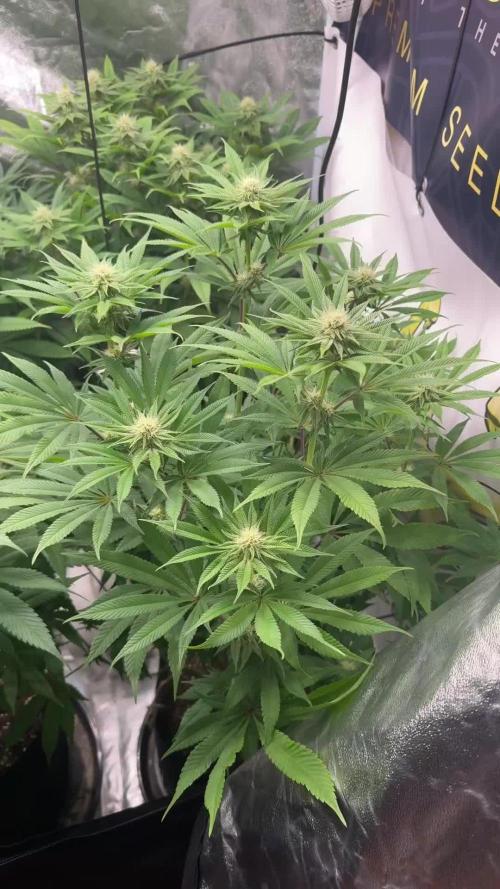
I'm little bit overwhelmed with all my projects that i my forgetting about others So i forget to film 4 weeks of growth straight of this strain 😂😂😂
Here Is what ive done by that time
Topdressed with GHF bio grow 3grams/liter of soil plus wormhumus and watered with growth compost tea recipe .
All i was doin was bending,training with lst and watering top dress with compost Tea for week then ONLY dechlorined water from autopot tray 2 grow


Likes
12
Share


@valiotoro
Follow
One with a topping the other one just LST both huge yield!🦖
For the smell its cookie dough,lemon & diesel🍪🍋⛽️
Super sticky buds 🤩


Likes
19
Share


@420DeepGrow
Follow
Gracias al equipo de Royal Queen Seeds, Marshydro, XpertNutrients y Trolmaster, sin ellos esto no seria posible.
💐🍁 Gelato #44:
Los criadores de Tyson 2.0 criaron Gelato 44 a partir de cepas finas. Al cruzar la Sunset Sherbet y la Thin Mint Girl Scout Cookies, crearon un híbrido de dominancia índica que asesta fuertes golpes en el cuerpo y la cabeza.
Su contenido de THC del 22% crea sinergia con terpenos colocantes para ablandar los músculos
Mantenla hidratada y con una dieta constante y pasará por la fase de floración en unas ocho semanas. Las plantas de interior alcanzan una altura máxima de 120 cm y producen 400-450 g/m², mientras que sus homólogas de exterior alcanzan los 180 cm y producen hasta 600 g por planta.
🚀 Consigue aqui tus semillas:
https://www.royalqueenseeds.es/rqs-semillas-cannabis-tyson/664-dynamite-diesel.html
💡TS-3000 + TS-1000: se usaran dos de las lámparas de la serie TS de Marshydro, para cubrir todas las necesidades de las plantas durante el ciclo de cultivo, uso las dos lámparas en floracion para llegar a toda la carpa de 1.50 x 1.50 x 1.80.
https://marshydro.eu/products/mars-hydro-ts-3000-led-grow-light/
🏠 : Marshydro 1.50 x 1.50 x 1.80, carpa 100% estanca con ventanas laterales para llegar a todos los lugares durante el grow
https://marshydro.eu/products/diy-150x150x200cm-grow-tent-kit
🌬️💨 Marshydro 6inch + filtro carbon para evitar olores indeseables.
https://marshydro.eu/products/ifresh-smart-6inch-filter-kits/
💻 Trolmaster Tent-X TCS-1 como controlador de luz, optimiza tu cultivo con la última tecnología del mercado, desde donde puedes controlar todos los parametros.
https://www.trolmaster.com/Products/Details/TCS-1
🍣🍦🌴 Xpert Nutrients es una empresa especializada en la producción y comercialización de fertilizantes líquidos y tierras, que garantizan excelentes cosechas y un crecimiento activo para sus plantas durante todas las fases de cultivo.
Consigue aqui tus Nutrientes:
https://xpertnutrients.com/es/shop/
📆 Semana 9:
No ha sido una gran semana respecto al tiempo pero el incremento de nutrientes le ha venido muy bien
Continuo con la dosis recomendada por el fabricante.

Likes
20
Share


@Mrs_Larimar
Follow
2024-09-07
Girls showing up,
now they will need time to establish, before going to grow vigour
"BE a Breeder", is one of Doctor´s Choices Motto.
Regular Seeds Seeds germinate- A backcross from Chronic Ryder_
BREEDER INFO
LEGEND We’re so proud of our latest drop - Chronic Ryder regular - as it results from a hardworking breeding process. We used an original Chronic male plant from Serious Seeds and backcrossed it with our Chronic Ryder from Sasha The Joint Doctor’s private collection to receive the Chronic Fast F1 BX Regular. By crossing 2 Chronic Ryder F3 lines, L1 and L2 from the same parents, we have created a new hybrid line. Well, it seems like it should be an F4 hybrid, but it's incorrect to name so. This process is called interline breeding, which means the cross of 2 lines. This cross allowed us, over several generations, to get a fully automatic Chronic Ryder that predominates its parents by 25% in key characteristics. Chronic Ryder is also available in feminized variety. GROWING Chronic Ryder regular shows the best performance of parents’ heritage. It grows into a uniform and compact plant that rarely exceeds 1m in height. Thanks to its compact size it is better grown in small spaces, terraces, and balconies and is quite suitable for stealth growing. The plant forms a single huge central bud cola with few side branches. Fatty and frosty buds will be ready to harvest in 70-75 days from germination. You’ll be truly surprised how big and dense buds are - the nice and fruity smell adds extra pleasure. The short growing period and strong resistance are other strong points of the strain. Chronic Ryder regular would be a great choice for growing outdoors with short summers - you’ll get your guaranteed high-quality yield in any case. Be ready to harvest up to 500 g/m2 indoors and 50-100 g per plant outdoors. TASTE and EFFECT Chronic Ryder regular has a nice taste - fruity and citrus tones complement one another, giving an unforgettable aftertaste. The effect is mild and doesn’t hit you like a hammer - the perfect choice for novice smokers. It brings balanced high and stone effects. Thanks to it, Chronic Ryder is a good smoke that calms your body, giving a strong body relaxation for a long time. CHARACTERISTICS Autoflowering: Yes Type: Regular | Autoflowering Room: Indoor | Outdoor | Greenhouse Genotype: Hybrid Genetics: (Serious Seeds) Chronic BX Chronic Ryder Finish time: 70-75 days from seed Indoor: Productivity: 500 g/m2 Height: 60 - 80 cm Outdoor: Productivity: 50-100 g/plant Height: 60 - 80 cm THC: High Flavour: Citrus | fruity | apricot Effect: Balanced high and stone | daytime | giggly
Likes
Comments
Share


@SirNoodlesGrow
Follow
Chop Down. The Plants looked healthy and the Trichomes mostly were milky and some amber.
Next time i go with less plants. Cause 6 Plants on 1m2 is really too much i seen. Cause if all Lemon Cheese would have gotten as big as the biggest one... i would have filled a 1,20x1.20 or even bigger.
She is well made for Scrogging and its pretty stress resistant. She kicks back nearly immediatly after Defoliation or Topping.
I will go for another run for it later. But for now i really like the strain and for future projects i will keep it in mind.

Likes
4
Share


@Dankgrowz786
Follow
Growing OG AUTO in a small 6X4 tent in my spare room, I did a little defoliation on the plant a few weeks ago and im thinking I overdid it? what are you opinions? also, ill attach some pictures but the pistels on the side are taking ages to open and expand.. is this normal? It’s been couple weeks and they are looking unchanged?
Thanks All


Likes
5
Share


@Ninjabuds
Follow
These pound cake auto seeds are 100 off rip.
I put the seeds in some paper towels on nov29, then put them in the pro-mix potting soil on dec2. Now it's dec4. Only 5 whole days sense. I put the seeds in paper towels, and they have already been born into this world. Thanks, fastbuds, for the seeds. Ever since I saw the seed drop with the pound cake auto, I have had my eye on this strain. I have really wanted to grow a plant with giant giant huge nugs, and I have yet to do so. I have high hope for these guy. I'm only allowed 12 plant and have 10 plants in other other tent. So I will be tossing one of them later 2day. I plan on only bringing one if them to flower. This is my 1st real auto grow so I'm testing the waters in a spare 2x2 tent with my spider farmer 100 board light the newer one with the evo leds.
Thanks for reading
Likes
10
Share


@FlavoursUk
Follow
Day 30 for this girl, shes doing pretty well. Very nice structure due to plant training early in veg, a little bit of HST to keep the height down. Shes smelling quiet a bit now but has undergone a lot of stress although she is not showing it. Growing daily and cant wait to see what this girl has to give me. Very happy with her overall growth. I'll be back with an update soon. Stay tuned for now. FlavoursUK
If you're not already following my Instagram and youtube give me a follow and SUBSCRIBE. Loads of content to come. Thanks again.