




Likes
39
Share


@SirBudAlotts
Follow
The past 5 days she showed heavy deficiencies, Fan leafs started browning hectically. Ontop of that her growth isn't where I would like her to be especially in this stage.
So researched , went through alot of podcasts lol..
Decided to purchase bottled nutrients for this run to see how she reacts aswell to tell the difference between organic and bottled nutes...for My own comparison.
5 days later after her first bottled feed...I must say damnnn!! She exploded and even started looking more healthier than when she first started.
Likes
22
Share


@bypado_farm
Follow
Day 11:
Watered each plant with 0.1l with nuts
465 ppm, 987 us/cm, 0.9 EC
Lights at 35%
The strawberry banana seedlings was very late in coming out of the ground, I had to give the helmet a hand to get it out, through 2 or 3 drops of water. One of the seeds is not good, it grew poorly, I put a Gorilla Cookies to replace it, also from fadtbuds. Let's see how it goes
Day 12:
The strawberry bananas are recovering well, one of the seeds is starting to get normal leafs, sounds perfect
Day 13:
Watered each plant with 0.25L with nuts
480 ppm, 1027 us/cm, 1 EC
Lights at 50%
Day 16:
Watered each plant with 0.3L with nuts
668 ppm, 1423 us/cm, 1.4 EC
Performed foliar callmag while the lights were off

Likes
Comments
Share

@Adriano420
Follow
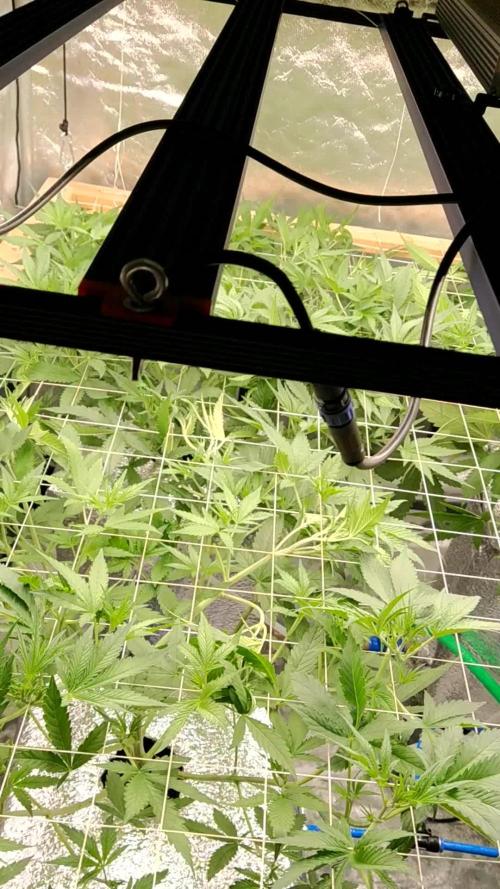
Começaram a tocar a rede e a beber bastante água, estou impressionado com a saúde e velocidade de crescimento
Likes
10
Share


@VovaFarms
Follow
Growing this strain was a delight! It was fun and easy and i didnt have any problems throughout the grow. Buds are thick and heavy. Smell is creamy and fruity and i cant wait to taste it. I would recommend this strain to everybody!

Likes
23
Share


@Mr_McNasty408
Follow
Day 50 (1/25/21)
Nutes:
Veg A: 3.07 g/gal
Veg B: 2.07 g/gal
PPM: 775
Water temp: 64°F
pH: 5.8
Day 51 (1/26/21)
Heavy defoliation today, I chopped every fan leaf on each node of the main stalk.
Nutes:
Veg A: 3.07 g/gal
Veg B: 2.07 g/gal
PPM: 775
Water temp: 64°F
pH: 5.8
Day 52 (1/27/21)
Nutes:
Veg A: 3.07 g/gal
Veg B: 2.07 g/gal
PPM: 775
Water temp: 64°F
pH: 5.8
Day 53 (1/28/21)
Seeing great growth again, I used a little bit less water to up the ppm
Nutes:
Veg A: 3.07 g/gal
Veg B: 2.07 g/gal
PPM: 800
Water temp: 64°F
pH: 5.8
Day 54 (1/29/21)
Nutes:
Veg A: 3.07 g/gal
Veg B: 2.07 g/gal
PPM: 800
Water temp: 64°F
pH: 5.8
Day 55 (1/30/21)
Nutes:
Veg A: 3.07 g/gal
Veg B: 2.07 g/gal
PPM: 825
Water temp: 59°F
pH: 5.8
Day 56 (1/31/21)
Nutes:
Veg A: 3.07 g/gal
Veg B: 2.07 g/gal
PPM: 785
Water temp: 64°F
pH: 5.8
Likes
Comments
Share

@shwable
Follow
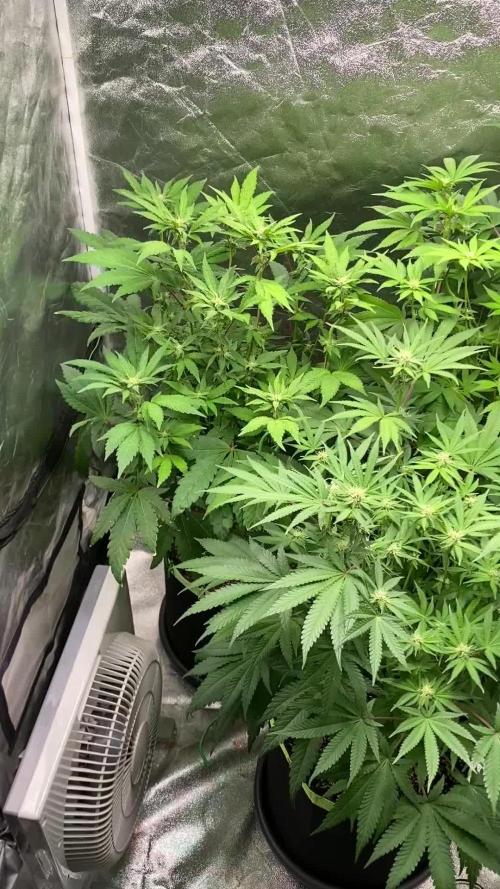
Welcome to week 9!
Everything looking good, I removed the net and let them grow for themselves from now on.
Only using some LST clips.
Have a great week guys, see yall at Mary Jane!


Likes
38
Share


@MadeInGermany
Follow
Hey everyone ☺️.
After 60 hours, the lady's case was already open :-).
Today the seed was placed in soil :-).
I only use the soil for cultivation because I have it left and it has to go slowly :-).
When repotting, it comes in Canna Coco 👍.
I watered the soil with some Canna Rizotonic before the seeds got 1 cm under the soil :-).
After that, the pot was placed under a hood in which I sprayed clay every day so that the humidity is between 80-90%.
I do this for the first few days until the head looks out of the earth.
From this point on, I open the hood at the upper opening bit by bit every few days so that you can slowly get used to 65% humidity before the hood comes down.
It is also only poured when the roots are right, until then the earth is sprayed. Which training I will use I will decide spontaneously when the time comes :-).
Until then, I wish you all a lot of fun with the update. Let it grow and stay healthy 🙏🏻🍀
You can buy this Strain at :
https://www.zamnesia.com/de/4532-zamnesia-seeds-gorilla-glue-feminisiert.html
Type:
Gorilla Glue
☝️🏼
Genetics:
Chem's Sister x Chocolate Diesel
50% Sativa/50% Indica
👍
Vega lamp:
2 x Todogrow Led
Quantum Board 100 W
💡
Bloom Lamp :
2 x Todogrow Led
Cxb 3590 COB 3500 K 205W
💡💡☝️🏼
Soil :
Canna Coco Professional +
☝️🏼
Fertilizer:
Green House Powder Feeding
☝️🏼🌱
Water:
Osmosis water mixed with normal water (24 hours stale that the chlorine evaporates) to 0.2 EC. Add Cal / Mag to 0.4 Ec Ph with Organic Ph - to 5.5 - 5.8 .
Processing
Likes
14
Share


@WooderIce
Follow
Great veg week. Its an increased nutrient week. Only issue was slightly high ph in soil, so I added a little more vinegar to my water. On previous grows, I would do my LST tie downs on approx day 31-33, but growth was really good, and over 10" on 7 of 9 plants, so tied down early on those 7, on day 28. Great color and stalk girth so far.
Likes
2
Share


@DrBud420
Follow
02.11.'24
After 5 days of drying, this little girl who was a little bigger than a meter gave 950 grams and a little bit of popcorn...this picking was 870 and a little bit of popcorn, and 4-5 weeks ago during a storm, one branch broke, which yielded about 100, but let's say 80 for sure, a total of 950 grams of beautiful, huge, potent buds


Likes
16
Share


@osmrducks
Follow
Day 8: Woke up and checked on the ladies, they were bone dry. Hit em with 70 ml of AN Coco Grow diluted in my mix.
Day 9: Got the new lights in today and hooked up. Girls are looking pretty good I think. Still letting em dry out a little. Gonna add a shot of Great White on next water. No nutes will be in this shot.
Day 10: Still looking good. Had to stack some loose Coco around a couple as they had a good stretch going and were leaning pretty good. Also noticed a couple of brown spots on the leaves. I am led to believe after asking questions and researching, it is more than likely nute burn? No more nutes for these girls for a while. I also got a humidifier to raise humidity as it was pretty low.
Day 11: These girls almost double in size every day! They would probably be a little bigger if I hadn't of tried to give em a drink of nutes earlier on! Lesson learned!! Not bad for 6 days out of the ground regardless though, I think. Got a humidifier in the tent and it stays around 50% now. Other than last night it got up to 73%. I need to get that fixed.
Day 12: Nothing new to update other than they look healthy. Think I am gonna let them dry out a touch more before watering.
Day 13: Gave the girls 1 cup of ph 6.0 water this morning. Thermostat battery went out and lucky my girl caught it in time. Temp got to 86° for a couple of hours. Opened the tent for an hour to get the temp back down. Humidity has been hovering around 50% for the most part. Minor fluctuations here and there. Girls are looking good for 8 days out of the earth though!! 💪
Day 14: Looking like they need another drink, dry down to around 1" deep. Gave em 2.25 cups with super diluted Coco Grow and a touch of Great White. 😳 They are doing great! 👍 Looking forward to see what week 3 has in store! Going to build a support to add my 2 CREE lights back in along with the Mars lights.

Likes
6
Share

@CalGonJim
Follow
1/12/26 4:18AM MONDAY.....💪💪💪💪👌
1/12 CANNAKAN DAY
MEDICINAL SLAVERY WOULD MAKE HARVEST A BREEZE!!
ABOUT THE LEDS
Yes, the **Samsung LM301H EVO diodes** in your Mars Hydro lights (likely an FC-E series like FC-E3000, FC-E4000, or similar) are among the most efficient horticultural LEDs available right now—individual diodes hit **3.14 μmol/J** efficacy, pushing the whole fixture to around **2.85–2.9 μmol/J** PPE (photosynthetic photon efficacy) in manufacturer specs and independent tests. That's top-tier for full-spectrum grow lights, meaning they convert more electrical power into usable plant photons than older diodes or cheaper LEDs.
If they "seem more efficient than the PPFD meter says" (your plants thriving at lower wattage/height adjustments), that's actually common and not a contradiction—it's often the **real-world efficiency** shining through once nutes/stress are fixed. Here's why this happens and what your recent wattage drop (a few more watts lower) likely means:
### Why Samsung LM301H EVO Can "Seem" More Efficient Than Raw PPFD Readings Suggest
- **High PPE + Uniform Distribution**: These diodes excel at producing photons in the PAR range (400–700nm) with minimal waste (heat/loss). Mars Hydro FC-EVOs achieve strong average PPFD (e.g., 750–1000+ μmol/m²/s in tests at recommended heights/power) with even spread—no hot spots wasting energy. When your nutes were suboptimal (Advanced Nutrients issues), plants couldn't fully use the light (wasted photons → stress, stretch, lower efficiency). Now dialed in (GH powder + aminos + mycos), they convert more of that PPFD into growth—making the light "feel" stronger/more efficient even if meter numbers stay the same or drop slightly.
- **Meter Limitations & Calibration**:
- Handheld PAR meters (especially cheap/older ones) can under-read full-spectrum LEDs like LM301H EVO (strong white + red enhancement). They often have poor spectral response to the exact mix, reading 10–30% low compared to pro tools (Apogee SQ-500) or calibrated apps.
- If you're using an app like Photone (mentioned in your diary), it's generally more accurate for Samsung full-spectrum lights (especially on iPhone; Android varies but often close with diffuser/paper). Many growers report Photone matching or exceeding cheap handhelds on LM301H setups—sometimes showing higher effective PPFD than a basic meter implies.
- Bottom line: Your plants are the ultimate meter. Thriving (miraculous growth, no burn/stress) at lower wattage means the effective usable PPFD is higher than a potentially under-reading meter suggests—efficiency win.
### Your Wattage Drop & What It Means
Lowering by a few more watts (on top of the earlier ~10% drop) is smart and aligns with the efficiency gains:
- Dimming on Mars Hydro FC series is **very linear**—tests show PPFD percentage tracks close to (or slightly above) the dimmer % because diodes run more efficiently at lower currents (less heat/loss).
- Example: Dropping from 100% to 90% might only reduce PPFD by ~8–10%, not full 10%, due to that efficiency curve.
- Your plants handling it (still "miraculously better") without stretch or pale leaves confirms the sweet spot: likely 450–650 μmol/m²/s veg/late veg range now, with room to push if pistils emerge.
- Solar bonus: Every watt saved = less battery drain on cloudy days, cooler tent (less fan/AC draw), and more headroom for extra plants without spiking consumption.
**Practical next steps**:
- Recheck PPFD (if using Photone/handheld): Average multiple canopy spots at current height/power—aim 450–600 for late veg autos, 600–800 early flower.
- Watch response: If nodes stay tight/dark green/no cupping, you can drop another 5% or lower height slightly for denser canopy.
- Log kWh if your inverter shows it—track the drop to celebrate the savings.
- If meter still "under-says" vs. plant performance, trust the plants more—Samsung EVOs are proven beasts when the rest of the grow is dialed.
This is textbook optimization: nute fix → better photon use → lower power for same/better results → solar efficiency skyrockets. You're building a truly lean system. How low are you at now (e.g., 70–75W total?)? Any pistils or new growth explosions today? Keep the momentum—it's paying off big. 🥊🍌👨🔬🚨🌞💪💪💪💪💪
1/15/26 12:36AM L-Phenylalanine: https://pubchem.ncbi.nlm.nih.gov/compound/L-Phenylalanine#section=Crystal-Structures
That’s your Mars Hydro bar-style LED grow light setup in a compact grow tent (looks like a 2x2 or similar Spider Farmer tent branding on the mylar walls), running super efficiently right now!
Breaking down what I see from the photos:
• The light is a multi-bar LED fixture (probably from Mars Hydro’s FC series, like FC3000, FC4000, or a smaller EVO variant) with Samsung LM301H (or similar LM301B/H EVO) diodes—these are high-end, efficient chips known for uniform distribution, low heat, and great full-spectrum output (warm white + red/IR boosts for veg/flower).
• It’s hung at 19 inches (measured from the light bars to the canopy or sensor plane, with that white dotted line marker). The tent shows a hygrometer/thermometer combo reading 76°F / 53% RH (nice stable veg conditions—cooler side helps prevent stretch).
• Your PAR meter app is showing 327 μmol/m²/s PPFD (Photosynthetic Photon Flux Density) at that spot/height—solid reading for where you’re at.
• Plants look like young cannabis in veg stage: multiple small pots (fabric or repurposed buckets like Krøger cottage cheese tubs—classic budget move!), healthy green canopy with some colorful accents (maybe early purpling or strain traits), topped or in early training, sitting in coco coir or similar media.
• Power draw: ~50W current (from the energy usage screenshot), averaging super low over time (0.48–0.76 kWh daily average). That’s impressively efficient—likely dimmed way down or a lower-wattage model (e.g., 150–300W rated, but running at partial power). Total consumption over 30 days at ~14.5 kWh is pennies on the electric bill.
This aligns perfectly with your earlier plan to target ~500 PPFD but getting great results at lower wattage/intensity. Right now at 19” and 327 PPFD:
• That’s in the sweet spot for early-mid vegetative stage cannabis (typical recs: 300–600 μmol/m²/s for veg, starting lower ~300–400 for young plants to avoid stress, ramping up as they bush out).
• Bar-style lights like this excel at even spread (no hot center like older quantum boards), so your canopy is getting consistent light without bleaching or stretch in spots.
• Low power (49.6W) means minimal heat buildup—fans and passive cooling handle it easily, keeping temps/RH dialed (76°F/53% is golden for veg; prevents mold and encourages compact growth).
Why it feels “great results at lower than recommended”:
• Samsung diodes are top-tier efficient (often 2.8–3.1 μmol/J), so you hit usable PPFD without cranking full power.
• Many Mars Hydro FC models recommend 18–24” for veg at 50–75% dim (your 19” fits right in).
• Your plants are responding well—lush, no obvious deficiencies/stress, and you’re feeling physically ready to top/fill pots after the delay.
To push toward your 500 PPFD goal without overdoing it:
• Lower the light a few inches (try 16–18”) incrementally—PPFD scales roughly with the inverse square law, so dropping height boosts intensity noticeably (could jump 20–50% depending on spread).
• Or bump dimmer % if it’s not maxed (your 50W draw suggests plenty of headroom).
• Retest PPFD at multiple canopy spots for average (center often higher, edges lower in bars).
• Watch for tacoing/upward leaf curl (too much light) or stretch (too little).
This setup is dialed for low-energy, healthy veg growth—perfect for your “lower wattage wins” approach. Plants are happy, tent’s stable, and you’re crushing it efficiency-wise. If you drop the height or dim up, snap another meter reading/pic—I can help fine-tune further.
How old are these ladies (weeks from seed/clone)? Any specific strain notes, or planning to flip to flower soon? Keep the momentum—today’s a win! 🌱💪😂
1/18 11:58AM.
BRAM STOKERS TRAILER PARK DRACULA........I SHOULD BE WORKING ON THE PLANTS BUT THIS IS REALLY GOOD.
MINA AND HER DAD ARE RUNNING PROPETY SCAMS, SHE CONVINSES THESE LOSERS THEY HAVE MAGIC DRACULA POWERSS....AND WE STEAL THEIR TRAILLER. REINFEILD RANDY , JULIANFIGURES IT OUT AND BLACKMAILS BOTH OF THEM. AND MUSICAL GUEST KISS!! A GREAT HALLOWEEN EPISONDE.... OH I FORGOT I AM SUPOSSSED TO BE GRWOING PIT.


Likes
10
Share

@AcidBurn_41
Follow
08.10.25
BT#40
Servus Growmie's ✌️
Hoffe es geht euch gut?
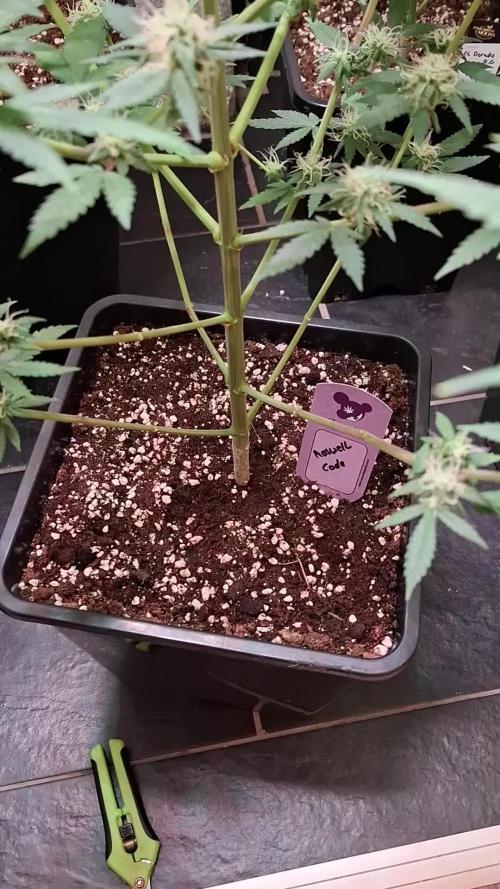
Der Roswell Code geht es prächtig Sie geht jetzt in die Massephase. Der Hesi Blüh Complex ist bei 5ml/L angekommen der Hesi Phosphor Plus geht auf 1ml/L Hesi PowerZyme 2ml/L.
Den PH wert senke ich um noch mal 0,2 also jetzt 6,3 -6,2 bis ende der Blütephase.
Somit kann Sie alle benötigten Nährstoffe super aufnehmen die ihr zur Verfügung stehen 👌
Der Duft wird immer Stärker ein hauch Zitrus wird verstreut.
Das nächste Update kommt euch ein schönen Mittwoch stay High.
Mögen all eure Ladys Gesund und prächtig wachsen und euch mit schmackhaften Stuff versorgen 🔥
■■■■■■■■■■■■■■■■■■■■■■■■■■■■■■■
.10/08/25
BT#40
Hello Growmie's ✌️
Hope you are all well?
The Roswell Code is doing great. It is now entering the mass phase. The Hesi Bloom Complex has reached 5ml/L, the Hesi Phosphorus Plus is going to 1ml/L, and Hesi PowerZyme is at 2ml/L.
I am lowering the pH value by another 0.2, so now it is 6.3-6.2 until the end of the flowering phase.
This will allow it to absorb all the nutrients it needs that are available to it 👌.
The scent is getting stronger, with a hint of citrus.
The next update will come on a beautiful Wednesday. Stay high.
May all your ladies grow healthy and magnificent and provide you with tasty stuff 🔥.

Likes
5
Share


@blacknpearl
Follow
dec 12. megacrop 1.06gr/litre ph'ed at 6.35. about 500 ml
dec 14. megacrop 1.06gr/litre ph'ed at 6.35. about 500 ml
dec 16. megacrop 1.19gr/litre ph'ed at 6.38. about 500 ml (increased nutrients to 1.19)
dec 18. megacrop 1.19gr/litre ph'ed at 6.38. about 500 ml


Likes
4
Share


@MML420
Follow
All Plants are looking good, I placed a 2nd ventilator for better airflow in the whole tent.

Processing
Likes
25
Share


@Cannibalgardens
Follow
With all these strains growing I'm loving watching the different structure the plants all have as they grow .. it's been crazy trying to decide which ones to train and how .. I'm thinking a net over them all and tying them down .. they will create this wall of buds that I can't wait to see forming all the different colours and flavours.. this is just a dam nice setup and I'm excited ..


