


Likes
Comments
Share


@valiotoro
Follow
Hello everyone, all good for this week 😎
They grow fast and with a beautiful green colour on the leaves!
In this grow i will be testing out Plagron Nutrients and Mars Hydro FC-E6500
Mint Jelly from Humboldt Seed ❄️🍀

Likes
8
Share


@KUNST
Follow
Week F3: 11/04/2025 – 17/04/2025
12/04 & 14/04 – 2L nutes. Minor branch LST.
17/04 – Major defoliation. 2L nutes. Risk taken but plant strong.
I was hesitant about this late defoliation, I should of gone harder prior to flowering, my mistake and easily avoidable with experience. All that in mind, there is ample room for airflow. Currently cool air is being brought in through the bottom of the tent, circulated via the internal fan, then pulled up and out through the exhaust fan system, air is then easily vent out of the external rom to manage humidity (also done by using an extractor fan - can you guess where it is yet?). I think the stretching is coming to a close, finally, almost ran out of headroom...
Likes
176
Share


@DevilsBud
Follow
Week 9 of flowering Cookies Gelato
Day 56
Dank dence and frosty that's what i can say aboet the cookies gelato . It's a waiting game now 💪🏻
Day 57
Cookies Gelato will get 1 week nutrition and then i am flushing these baby's so they will have almost 70+days of flowering 😎
Day 58
Cookies Gelato colas where hanging scary low when i came home so i hoist them up not a day to late tho . Gave them 1.5L water pH 6.5 with advanced Nutrients overdrive and biobizz calmag
Day 59
Not a lot to do today just looking around to see everything oké 👌🏻
I am so glad there standing in my marshydro 100X100X180cm 👍🏻👍🏻👍🏻 i could have never finished them of in that growmaster tent 👎🏻 .
Day 60
Gave them both 1.5 water with overdrive and calmag that's it🤘🏻
And now i know that i have bin lazy checking with EC meter so luckily i can be aware with my cookies Gelato
Day 61
Sunday rest day nothing going on 🤘🏻
Come look at my other diaries! I appreciate it a lot 🤘🏻
Also want to thank everybody for the comments likes etc you know who you all are 👍🏻😍👍🏻
visit www.marshydro.eu
for your best gear and use the PROMO CODE: DEVILSBUD
Fully marshydro supported Setup:
Marshydro GT100X100X180
Marshydro Ts 1000 LED lamp
soil :Plagron batmix
Nutrients :Advanced Nutrients
Advanced Nutrients pH Perfect Bloom
Advanced Nutrients pH Perfect grow
Advanced Nutrients pH Perfect micro
Advanced Nutrients B-52
Advanced Nutrients Voodoo Juice
Advanced Nutrients Rhino Skin
Advanced Nutrients Big bud
Advanced Nutrients Bud candy
Advanced Nutrients Overdrive
Advanced Nutrients flawless finish
Advanced Nutrients Sensizym
BioBizz - Calmag
Some handy info about the
marshydro TS-1000
Increase Yield&Crop Quality in Led Grow
Newest SMD Led technology provides the highest Par/Lumen output, makes you get 30% higher yield compare old led lights, can get up to 2.5g/watt yied.
High Efficiency Energy Saving Plant Light
Only 150 watts true output with so you don't have to check your light bill every month 😎 342 pcs LEDs, more scientifically and energy-efficient! Perfect for 3'x3' (100x100cm) veg stage and 2'x2' (60x60cm) bloom stage, higher intensity in a Mars Hydro grow tent.
Sunlike Full Spectrum Led Indoor Growing
Infinite close to natural sunlight, suit for all plants whole satge indoor growing, rapid plant response from seed to flower, achieve maximum quality and quantity, much better than traditional HPS grow systems.
High Reflective&Noise Free Fanless Led Grow System
Quickly heat dispersing material aluminum reducing light lost to aisles and walls, increase the light intensity up to 20%, allowing your plants to receive more energy and without burning your plants for maximum headroom.

Likes
8
Share


@ManilaGrowOp
Follow
She’s starting to look like “real” cannabis lol
Buds are much nicer and fragrant. Some tops smells like candy, some of them smells like pastry and coffee. Weird but good!
Likes
27
Share


@Dunk_Junk
Follow
I note this strain is super frosty!!!!!!!!!!!!!!!!!!
Still weeks to go!


Likes
21
Share


@420DeepGrow
Follow
Gracias al equipo de Kannabia Marshydro XpertNutrients y Trolmaster sin ellos esto no sería posible.
💐🍁 Amnesi K - Lemon:
La Amnesi-K Lemon es una semilla formada a partir de un trío de reyes, la Amnesia, la Lemon Skunk y la Jack Herer. Este matrimonio de tres dio lugar a una gran sativa que, con tonos dulces, terrosos y muy cítricos
🌻🚀 Consigue aqui tus semillas:
https://www.kannabia.com/es/semillas-marihuana-feminizadas/amnesi-k-lemon
💡TS-3000 + TS-1000: se usaran dos de las lámparas de la serie TS de Marshydro, para cubrir todas las necesidades de las plantas durante el ciclo de cultivo, uso las dos lámparas en floracion para llegar a toda la carpa de 1.50 x 1.50 x 1.80.
https://marshydro.eu/products/mars-hydro-ts-3000-led-grow-light/
🏠 : Marshydro 1.50 x 1.50 x 1.80, carpa 100% estanca con ventanas laterales para llegar a todos los lugares durante el grow
https://marshydro.eu/products/diy-150x150x200cm-grow-tent-kit
🌬️💨 Marshydro 6inch + filtro carbon para evitar olores indeseables.
https://marshydro.eu/products/ifresh-smart-6inch-filter-kits/
💻 Trolmaster Tent-X TCS-1 como controlador de luz, optimiza tu cultivo con la última tecnología del mercado, desde donde puedes controlar todos los parametros.
https://www.trolmaster.com/Products/Details/TCS-1
🍣🍦🌴 Xpert Nutrients es una empresa especializada en la producción y comercialización de fertilizantes líquidos y tierras, que garantizan excelentes cosechas y un crecimiento activo para sus plantas durante todas las fases de cultivo.
Consigue aqui tus Nutrientes:
https://xpertnutrients.com/es/productos/
📆 Semana 5:
Comienzan a formarse los cogollos, las hojas se llenan de resina cada dia y el olor es bastante fuerte. Parece que ha terminado de estirar. Practico una defoliación intensa para airear los futuros cogollos y dejar mas espacio en el cuarto de cultivo.
Agrupo de nuevo las macetas en su lugar optimo para asi rellenar por completo la carpa @marshydro.
Me quedé algo corto de nutrientes pero estoy muy contento con los resultados, cada vez le voy encontrando mas su punto optimo. Siempre es mejor quedarse corto que pasarse.


Likes
Comments
Share


@Phenophilgrow
Follow
After Week 1 in the eazyplug, i've transplanted the Permanent Marker into a bigger Pot

Likes
15
Share


@SouthernOnions
Follow
Chopped all plants down on October 18th. Will report back soon with final harvest pics and dry weight for each plant. I have multiple grows coming down around the same time and I'm still backed up with the outdoor harvest but will update with final numbers asap!

Likes
65
Share


@MadeInGermany
Follow
After more than 100 days she was hung up to harvest 👍
Hey Guys :-)
It was hung upside down in the drying tent for 10-14 days at a temperature of 18-19 degrees and 55-58% humidity before it was trimmed clean by hand and put into the glass with Boveda 62%.
The glass was opened every day for 15 minutes to air and the buds were taken out individually for the first few days.
Now after another week the pictures were taken then put back in the jar where they now stay complete for 4-6 days.
After another 2 weeks, the Boveda 58% comes into the glass and it's perfect 💚😊.
Report :
As always, Dr Grinspoon from Barneys farm is top notch.
The smell, the look is everything :-) .
She has grown extremely tall as always but due to heavy LST she ended up at 70cm with a very good yield.
The rest follows in Smoke report

Likes
49
Share


@AsNoriu
Follow
Day 88. Last of Zamnesia girls is down.
Thank You Zamnesia Seeds one more time for lovely strains to try out. I think I found one diamond even ;)
If you wanna try out Zamnesia seeds, here is 10% off from your buy :
Use code - GROWITGD
Happy Growing !

Likes
6
Share


@WeedM8
Follow
So beautiful looks its going vey well apart of thats its too hot the heat from the lights if there is no air circulation it gtes very humid and i have to leave the tent open

Likes
48
Share


@Rangaku
Follow
GSC looking like a really nice yielder with plenty of bud arms starting to fatten up , flushed again this week , otherwise same same .
Likes
20
Share

@Hempcules
Follow
WEEK 9
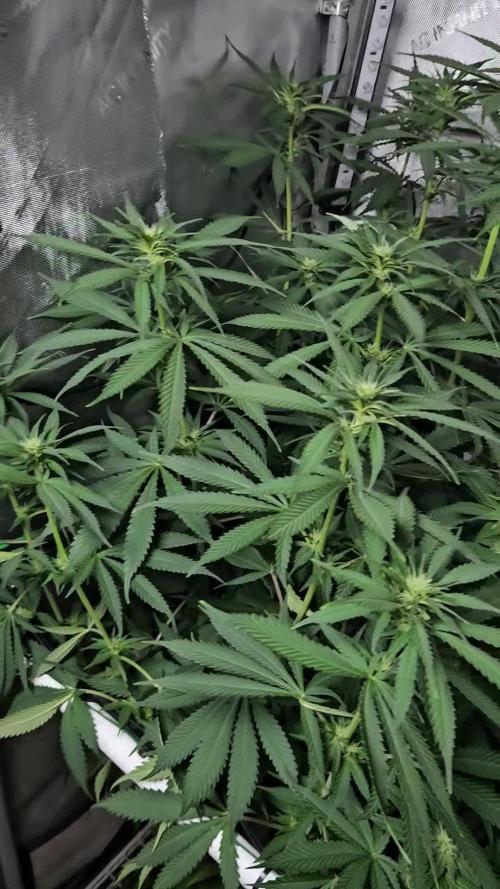
The first week of flowering went very well for my plant. So far, it has stretched strong and is slowly beginning to add fullness to the buds.
I’m quite happy with the plant’s overall shape — it has developed a fairly even canopy with many strong shoots. The leaves have a rich, deep green, and overall the plant appears to be very healthy. All in all, another truly great week.
PPFD: 800µmol/m²/s
Water: 2x water, 2x nutrient solution
With this code, you will receive a 20% discount on your next Zamnesia order:
ZAMMIGROW2024
Likes
2
Share

@CheeRz
Follow
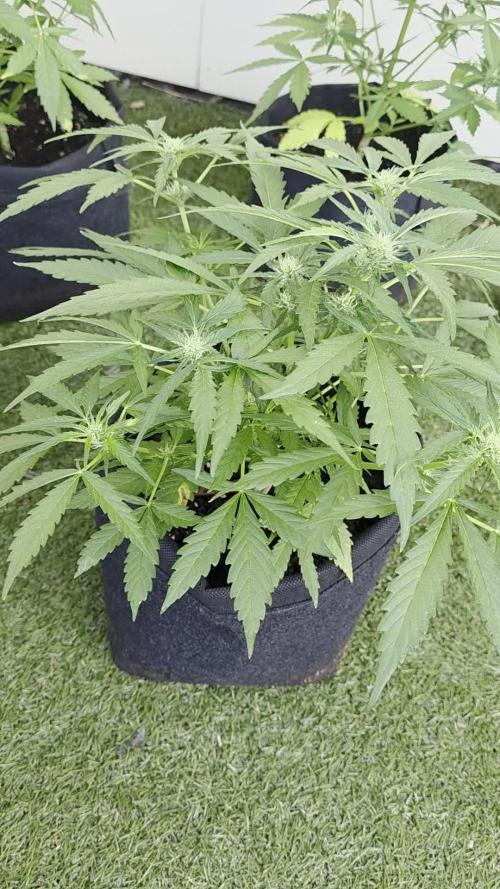
The outdoor ladies are enjoying the nice weather and doing very well. Divine Rapier is also beginning to bloom. Unfortunately, it's supposed to rain a lot next week. We're hoping for the best!

Likes
8
Share


@Bryankush
Follow
Giorno 1 tra 4 giorni effettuerò il taglio della parte superiore. annaffiata con 2L di acqua
Giorno 5 taglio parte superiore della pianta

Likes
Comments
Share

@DogDoctorOfficial
Follow
🌿 Frosted Guava Auto by Zamnesia | Pheno A | Week 5 (Early Flower)
🌱 The Stretch Is Over, the Show Is Beginning
Every week inside the 8×8 Adventure feels like another chapter unfolding, and Frosted Guava Pheno A has officially entered one of the most exciting stages of her life.
From the moment she germinated under our 12/12 From Seed experiment, her goal has been to prove that autoflowers can still build impressive structure and healthy development under a flowering light schedule from day one. Now, after weeks of careful Low Stress Training, patient leaf tucking, and allowing her natural architecture to develop, she has fully transitioned into flowering.
This week isn’t about explosive vegetative growth anymore.
It’s about transformation.
The first real flowers are forming, the canopy is alive with brilliant white pistils, and every branch is beginning to reveal the framework that will eventually become her harvest.
⸻
🌸 Week 5 – Frosted Guava Finds Her Rhythm
The flowering transition couldn’t have gone much smoother.
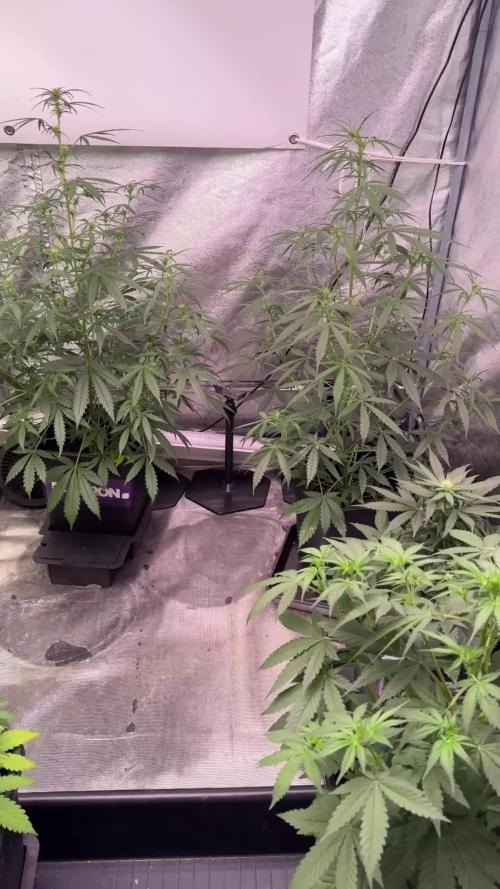
Standing at approximately 99 cm, Frosted Guava has developed into a beautifully balanced medium-sized plant that fills her space naturally without becoming overwhelming. The stretch is slowing down, allowing more energy to shift toward flower production rather than vertical growth.
One of the things I enjoy most about this phenotype is her internodal spacing.
Every branch has enough room to breathe while remaining close enough together to promise excellent bud stacking in the weeks ahead. Nothing feels crowded, nothing feels sparse—it simply looks naturally well built.
Looking from above, the canopy is incredibly satisfying.
Looking from the side, her structure tells exactly the same story.
Healthy.
Balanced.
Ready.
⸻
🌿 Training & Canopy Development
Throughout vegetative growth the focus has remained on keeping the canopy open instead of forcing the plant into an artificial shape.
Regular Low Stress Training combined with gentle leaf repositioning has allowed every developing branch to receive strong light without creating unnecessary stress.
Those small adjustments are beginning to pay off now.
Multiple flowering sites are receiving excellent exposure, air movement through the canopy remains unrestricted, and each branch has space to develop independently.
Sometimes the simplest training methods produce the most natural-looking plants.
Frosted Guava is becoming a perfect example of exactly that.
⸻
? The First Flowers
One of my favorite moments in every grow is watching those first clusters of bright white pistils appear.
This week they’re everywhere.
Each tiny white hair is another confirmation that flowering is fully underway, marking the locations where future buds will continue building over the coming weeks.
The tops are already beginning to gather themselves into small floral clusters, while every node along the branches is joining the party with fresh pistils reaching toward the light.
There’s something incredibly satisfying about this stage.
Everything still looks delicate…
Yet you already know what’s coming.
⸻
🍃 Plant Health
Color remains outstanding across the entire canopy.
The foliage carries a beautiful healthy green tone from top to bottom, with fresh new growth emerging vibrant and full of life.
Leaf posture remains excellent, stems continue thickening nicely, and the plant simply gives the impression of being comfortable in her environment.
There are no distractions.
She’s focused entirely on growing flowers now.
⸻
💧 Nutrition & Irrigation
With flowering now established, Frosted Guava is receiving the complete transition feeding program alongside the rest of the room.
Current feeding:
• Terra Grow — 1.8 ml/L
• Terra Bloom — 1.9 ml/L
• Pure Zym — 1 ml/L
• Sugar Royal — 1 ml/L
• Power Roots — 1 ml/L
• Power Buds — 1 ml/L
Maintaining:
* EC: 1.88 mS/cm
* pH: 6.05
The AutoPot system continues delivering consistent irrigation, allowing the root zone to remain stable while supporting the increasing nutritional demands that come with early flower.
Everything is progressing exactly as planned.
⸻
🌡️ Environment
The entire room continues operating as one stable ecosystem, giving every phenotype the same opportunity to express its unique characteristics.
Current conditions:
* Day temperature: 31.1°C
* Night temperature: 25°C
* Relative humidity: 72%
* Solution temperature: 21.6°C
* Root zone temperature: 21°C
* CO₂: approximately 639 ppm
Despite the warm summer conditions, the plants continue responding exceptionally well thanks to stable irrigation, healthy roots, strong airflow, and carefully maintained environmental consistency.
The room continues doing the heavy lifting.
The plants simply reward it.
⸻
👀 Looking Ahead
Now the fun really begins.
Over the next couple of weeks, I expect the vertical stretch to gradually come to an end as Frosted Guava redirects nearly all of her energy toward building flowers.
Those tiny white pistils will soon develop into recognizable bud sites, resin production will begin increasing, and the beautiful open structure she’s built throughout vegetative growth should translate into excellent light penetration and strong flower development across the entire canopy.
She’s entering the stage every grower waits for.
And she’s entering it beautifully.
⸻
🙏 Final Thoughts
Frosted Guava Pheno A is exactly where I hoped she would be at this point in the grow.
Healthy.
Balanced.
Beautifully structured.
She’s a reminder that successful flowering starts long before the first pistils appear. Every careful adjustment during vegetative growth—from LST to leaf tucking—has helped create the strong framework she’s now using to build what promises to be an impressive canopy of flowers.
Watching each phenotype develop its own personality inside this shared environment continues to be one of the most rewarding parts of this entire 8×8 Adventure.
A huge thank you to Zamnesia for making this project possible, Plagron for providing outstanding nutrition, Future of Grow for powering the room with exceptional lighting, AutoPot for keeping the root zone thriving, TrolMaster for maintaining environmental precision, and to everyone following this journey here on GrowDiaries.
Your support, advice, and encouragement continue to make this adventure even more rewarding.
Until next week…
Growers Love and happy growing! 🌱💚
Likes
15
Share


@Herbz_Unkraut
Follow
awesome strain, fat resinous buds with an awesome scent and great yield! both plants grew very evenly and almost looked the same, would grow again any time!
Likes
1
Share

@Northern_Ent
Follow
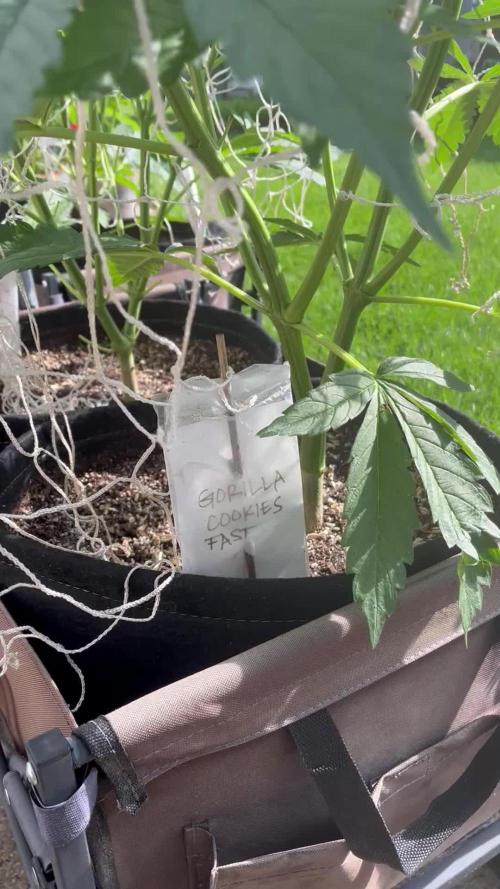
July 4: Gorilla Cookies is looking great and I did the final round of topping to get 16 growth tips.
July 10: looking really good and growing fast. Did a foliar spray of Epsom salts (for the Mg) and potassium silicate.
Likes
61
Share


@UnorthadoxDude
Follow
Hello present and future growmies! Welcome to the start of week 9 for Queen Citronella.
First things first, please go and check week 8, I update daily and the week is now complete.
Day 57: Her majesty is parched and so overgrown in her space that I've decided to give her a haircut. It will hopefully make her easier to move about too. I've fertigated 10l today and performed LST adjustments and significant defoliation. Made a little collage to show the training I did.
Day 58: Tried to colour correct photos. Any good?
Day 60: Disaster! SOMETHING has gone horribly wrong! The Queen is unwell and now I shall try to figure out why. It seems like heat stress but I don't get how.
Alright I think it is heat stress but I am not sure how, the temp hasn't gone above 26 degrees to my knowledge. Two things have changed this week first my house has been about 3 degrees warmer, and second I switched the main tent to 20 hours. I wonder if the additional time and the extra heat in the house has caused it to get too high. I have opened a flap at the side of her tent, and I am going to drop the light in the main tent down to 19h. As well as this I am now leaving a window open when the lights are on. Hopefully I can stop it getting worse but it is all over the plant. :(
Okay soI think I have caused nute tox/shock - specifically I think what happened was an accidental big overdose of CalMag raising the EC too high. These symptoms came on way too fast to be a simple deficiency or lock out, and the PH wasn't so far off as to cause these issues. I've treble checked and the temp hasn't exceeded 26 degrees, nor dropped below 17. I flushed her through with PH water today approx 40 litres - until runoff was clear and correct PH. I am not going to nute her for a day or two.
Day 62: I have ordered the queen a new tent. 75 x 75 x 200. She's still asleep at the moment but I'll photo her later. She's really taken a hammering from, what I now believe is, nutrient toxicity.
Day 62: Her majesty is looking much revived compared with the last few days. I THINK she will be ok. I've made a video assessing the damage. Ouch. Sorry your majesty, please not off with my head!
Day 63: Alright I have a new tent for her majesty arriving next week and I've new airflow for the main tent. She seems to have recovered from the burn and is stretching again.
End of week summary: First big mistake and first serious issues for Citronella. Sorry about that. However she has now recovered and is growing again. I cannot undo the damage but I think I have halted any further damage. Let's see what happens next week.
