Likes
51
Share
@MisterZ
Follow
Bonjour les amis, Les températures commencent à baisser et c'est tant mieux. J'ai repris l’engraissage pour quelques jours, il me semble qu'avec la chaleur le développement ralenti. Les fleurs peinent à prendre du volume. C'est une question de patience. A bientôt, bonnes vacances à tous, M.
Likes
21
Share
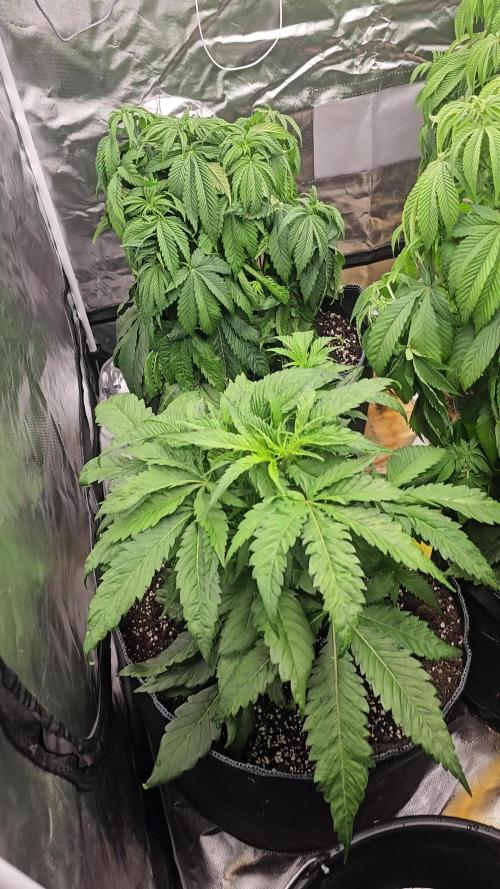
Welcome back to growfessor theatre! Week 4F begins in the 4x4. Heavy defoliation performed on the Mandarin dreams and Do-si-dos, Green Crack and LSD got a light defoliation. LSD had the most yellowing, she seems to be the hungriest for nutrients. Not much else to report, the ladies are happy, healthy and bud is developing nicely! Thanks for stopping by growfessors 👽🌳💚 stay tuned for another episode, later this week.
Likes
Comments
Share
@MumboJump
Follow
Reducing water to 5l every 3-4 days. Glookies just builds leaves and little bud but alot of trichomes...
Likes
3
Share
She got to big for the 2x2x4 so I had to move it to a bigger 2x4x5 that has a new never before used 320w kingbright so this whole grow is evolving as it goes I had no clue that hydro and 200w in veg would make the plant this big. Temps are much easier to control now in the bigger setup. the 7 gallon res. is loseing about 1 gal a day I top it off and check PH/EC once a day it almost never needs adjusting so that is really nice.
Likes
3
Share
Likes
18
Share
Best week of my life🙏 Last week started with gagarin that overall yeiled about 20 dried g soon will scale exactly. And this week started with gelato #2 that suprise me with a lots of big fat buds at leats 60g dried, but i could tell in about a week or more. Tomorrow i would harvest the gg. Update: Harvest gg on day 85. Smell fruity and glue Overall about 20 dry g but soon to tell. On day 86 gelato #1 show amber trichomes and fully clouded. Seems that #1 yeiled a bit more than #2 And also treated the same and no stress during the cycle. So there still 3 gelato's and one amazing ww.
Likes
48
Share
Gran genética cultivada de manera totalmente orgánica. Sin grandes necesidades ni complicaciones en el cultivo, pero a tener en cuenta la poca tolerancia al exceso de nutrientes. Buen desarrollo en crecimiento, gran ramificación con distancia internodal media. Impresionante el cambio a color morado fuerte en las últimas semana de floración y gran cantidad de tricomas en las flores. Fuerte aroma afutado y sabor dulce, con una buena pegada. Totalmente recomendable.
Likes
18
Share
@cannasaxx
Follow
Sie haben das Umtopfen ganz gut überstanden. Eine von den dreien macht ganz gut los. Die anderen beiden haben wohl noch etwas Stress durch das Umtopfen. Alle 3 sind Samen der selben Genetik aber selbstverständlich auch verschiedene Phenotypen, sie werden auf jeden Fall unterschiedlich wachsen und aussehen. Ich finde aber No-till besser als Stecklinge und je besser der Züchter um so weniger Phenos 😉 Wir werden sehen... 😎
Likes
17
Share
@Kirsten
Follow
7.5.25: I retied down the branches on RQS Northern Lights auto. I had to clean the tent, so the opportunity had to be taken, I hope not to have to move them again. I ended up snapping a small branch off another plant 😖 She is looking so big out of the tent, and even bigger than I thought! Now, having readjustmed, the fabric ties, and she is looking even larger still. This really is an absolute giant of a plant! 😱 I really am struggling to get them all in, I think the 8 gallon pots were a definite factor in that. They certainly are great for getting big plants, but be prepared if you have a small space. She's still stretching and not really focusing on her bud development in these mid flowering weeks. I think we will be in for a long haul with this lady. I hope she doesn't get too much bigger. I watered some bloom nutes after I top dressed, with Mega Crop Part A by Greenleaf Nutrients. I watered 3.2 litres PPM:745 PH:6.0. This time, I'm going to keep the top dressing moist. So as not to kill all the beneficial microbes. Other than that, I will wait until the pots are light again. Overall, she is doing great, I wish she had stretched a little more evenly to catch up in height. I just can't even out the canopy anymore. I'll leave it and hope she'll sort herself out 😅 I'm very excited to see what happens next! This is going to be crazy whatever happens! 😍😋 8.4.25: Northern lights had dried out significantly, so I watered with 2 litres of dechlorinated water PH'd to 6.4. Containing per litre: ♡ 1/4 tsp of Greenleaf nutrients Sea K(elp). PPM: 800 PH: 6.4 I don't want the top dress to dry out too much, and the plants are starting to drink much more. 9.5.25: It's a necessity to keep the soil moist. That means I need to water more often now. Today I watered with 1.5 litres of dechlorinated water PH'd to 6.4 which contained: ♡ 1/5 tsp of Sea K(elp). By Greenleaf nutrients ♡ 1/4 tsp Ecothrive Biosys. PPM: 564 PH: 6.4 12.5.25: Northern Lights has been srayed with the foliar spray and all symptoms have resolved. Due to having a few leaves burnt with that, I've decided to use the Ecothrive Trace in the water instead. It left some orange spots of damaged leaves. Thanks for checking out my diary and hanging out 😊💚🙌🍃✌️
Likes
49
Share
@Roberts
Follow
I thought I had major issues, and stunned this plant during growth. Apparently this plant is a very short strain. I didn't mess it up as bad as I thought. I did have issue with the grow. Bud smells very intriguing, and looks potent. I don't have much else to report, but am curious to how it smokes. Thank you Fast Buds, Athena, and Medic Grow. 🤜🏻🤛🏻🌱🌱🌱 Thank you grow diaries community for the 👇likes👇, follows, comments, and subscriptions on my YouTube channel👇. ❄️🌱🍻 Happy Growing 🌱🌱🌱 https://youtube.com/channel/UCAhN7yRzWLpcaRHhMIQ7X4g If anyone needs to purchase fastbuds here is a link for my affiliate program https://myfastbuds.com/?a_aid=60910eaff2419
Processing
Likes
17
Share
@Ashbash
Follow
Massive fattening this week from the Lemon AK, shes a big one. Another 2-3 weeks and she might be ready! Zkittles is maturing, but slower than i had hoped :( another week at least i think. but thats about what everyone else gets. Both of these plants are very true to their names and smell spot on. Lower nute intake seems to be working somewhat so im gonna keep it this way till the end.
Likes
2
Share
Ill update this more as I continue to cut down, dry, trim, and finally squish!
Likes
2
Share
Α,α (alpha) and Ω,ω(omega) Here we grow again. LAST GROW. 344g+280g+445g+255g=1324g dry bud. Yielding 1,324 grams of dry cannabis using a 600W light in a 4x4 tent is exceptionally efficient. This breaks down to roughly 2.21 grams per watt, far exceeding the standard indoor benchmark of 1.0 g/W and outperforming elite professional targets (1.5–2.0 g/W). For carbon and energy efficiency, this output drastically lowers the carbon cost per gram compared to typical indoor grows. Achieving 1,324 grams (47.2 ounces) of dry cannabis from a 600W light in a 4x4 tent is exceptional, yielding roughly 2.21 grams per watt. This is an elite-tier result that reflects world-class photosynthetic conversion, highly optimized canopy light distribution, dialled-in CO2 supplementation, and precise environmental control. Growing 1.3kg of dry in a 2x2 with 1 plant is just being silly and not understanding how carbon and energy conversion works towards mass. Took 6 years and 10,000+ Hours to break the 2 grams-per-watt barrier not exactly 600W, in honesty, though—even with modern, high-efficiency LEDs—is an incredible feat that requires hitting the absolute genetic ceiling of the cultivar and maintaining flawless environmental parameters for the space. Photosynthesis is the literal conversion of light energy (photons) into chemical energy (carbohydrates). Leaf temperature, driven by radiation from fixtures and mitigated by latent heat of vaporization (transpiration), dictates metabolic rates. If your room's thermal dynamics are off, enzyme activity inside the plant stalls, grinding growth to a halt. Anyone else pretending to have done so with nothing but Plagron nutrients at 75F is telling porkie pies *cough*, otherwise known as a liar, liar with a bum that's on fire, but it seems that's the new norm these days on GD. *cough cough*. Using copper and zinc plates in the plant medium to form a natural earth battery to assist with Electrochemical Reactance. The moist soil acts as an electrolyte, while zinc serves as the anode and copper as the cathode. Zinc is a highly reactive metal and oxidizes, losing electrons into the soil. These electrons travel through an external wire to the copper plate. The moisture and dissolved salts in your plant medium allow charged ions to move freely between the plates, completing the circuit and generating a small direct current (usually between 0.8 and 1.1 volts). This micro-current subtly alters/the Electrical Conductivity (EC), allowing more effective breaking apart of chemical bonds in the soil (electrolysis), making soil nutrients like phosphorus, calcium, and potassium more accessible to roots. Buried the zinc plates around the sides of the plant pot's root zone and the copper plate in the middle. Ran an insulated copper wire above ground to connect the zinc plate to the copper plate, creating a closed loop. Making sure the soil remains perfectly moist and contains everything it needs; entirely distilled water or bone-dry medium will prevent ion exchange and block the current. Leave that up to the rhizosphere. Currently testing new parameters for a couple of weeks. Seeing what she can do with a new and upgraded ducting closed loop and double the water capacity. Also added 6kg of inoculated biochar along with a slew of small improvements. Keeping an eye on. Zinc toxicity vs. consumption, given how sacrificial zinc is. Want to make sure the biochar stabilizes first. A Synganic closed-loop bioengineering-logic grow room merges synthetic inputs (precision minerals/chelated nutrients) with an organic living soil matrix (microbial life/bio-stimulants), managed via automated, data-driven automation. Master Operating Procedure (MOP): The system balances a sterile environment with a thriving, dynamic rhizosphere, merging the biological resilience of living organic soil with the high-precision chemical control of modern Controlled Environment Agriculture (CEA). Synganic blends a biologically active living soil or microbe-rich substrate with targeted, low-dose mineral or synthetic fertigation to optimize both metabolic yield and secondary metabolite expression (terpenes/flavonoids). What else is alive! Eisenia fetida (Red Wigglers) will continuously process organic matter into plant-available nutrients and aerate the media. Stratiolaelaps scimitus (Hypoaspis mites) provides excellent biological control against fungus gnats and pupating thrips. Armadillidium vulgare (Pillbugs) excel at breaking down tough, woody organic matter and toxic heavy metals. New "Closed-Loop Sealing" Isolates the internal microclimate from external weather, vectors, and pests. Air is scrubbed 264nm UV-C, recirculated, and enriched rather than openly exhausted. Operational Parameters (MOP Framework). Microbes act as biological buffers for the mineral inputs, preventing salt toxicity and ensuring continuous nutrient availability. Precise management of Vapour Pressure Deficit (VPD) day and night to force optimal stomatal conductance without stressing the biological media. Strict clean-room protocols prevent pathogen intrusion while maintaining non-sterile, highly active beneficial bacteria and fungi populations in the root zone. Looking at a grow room as a closed-loop system changes everything. You aren't "growing a plant"; you are managing a mass and energy balance equation where the plant is a biological transducer. Every watt of light introduces sensible heat. Every drop of water turns into latent heat via transpiration. When a deficiency appears, a grower flushes or adds a bottle of "magic" additive. A master looks at the HVAC duty cycle, realizes the dew point spiked, the stomata closed, and calcium transport stalled due to lack of transpiration, not lack of nutrients. Protocol-driven logic can be automated, replicated, and optimized. Legacy growing and anecdotal habits fail the moment the room moisture volume changes. ADD CALMAG! Comprehensive Substrate Composition: Because why not. 1. Substrate Base & Aeration Media Expanded Clay Aggregates (Hydroton Pebbles) Coir Chunks & Horticultural Coco Coir Sphagnum Peat Moss Horticultural Perlite Horticultural Vermiculite Horticultural Pumice Volcanic Basalt Rock 2. Mineral Amendments & Soil Conditioners Agricultural Gypsum (Calcium Sulfate) Wollastonite (Calcium Silicate) Dolomitic Limestone (Calcium Magnesium Carbonate) Basalt Rock Dust (Trace Mineralizer) Azomite (Micronutrient-Rich Volcanic Ash) Glauconite (Greensand) Crushed Seashells (Calcium Carbonate Source) Pyrolyzed Carbon Feedstocks (Biochar & Horticultural Charcoal) Shungite (Carbonaceous Mineraloid) 3. Organic Nutrient Amendments Steamed Bone Meal (High Phosphorus) Dehydrated Blood Meal (High Nitrogen) Fish Bone Meal (Phosphorus & Trace Calcium) Cold-Processed Kelp Meal (Ascophyllum nodosum) Dehydrated Moringa Oleifera Powder (Botanical Nutrient) Spirulina Powder (Arthrospira platensis / Cyanobacteria Nutrient) Marine Crustacean Biomass (Shrimp & Crab Chitin) 4. Biological Inoculants & Organic Acids Mycorrhizal Fungi Inoculant (Endomycorrhizae / Ectomycorrhizae) Vermicompost (Premium Worm Castings) Humic & Fulvic Acids (Concentrated Humates) Soil-Plant-Atmosphere Continuum (SPAC): An ecological concept referring to the pathway of water moving from the soil, through the plant, and into the atmosphere. Humidity of the air dictates the moisture in the medium, which dictates the rate of pull from the terracotta stakes 15 in total. Terracotta (unglazed, low-fired clay) is highly porous, acting as a breathable, permeable membrane that transports water based on the moisture gradient between the potting medium (soil) and the surrounding air. White terracotta and brown terracotta often have different pore sizes and overall porosity, primarily driven by differences in clay composition, impurities, and firing temperatures. While both are considered porous, brown terracotta often has higher iron content and impurities that behave as fluxes, affecting how the pores form during firing, while white terracotta is generally derived from more refined clays, with smaller pores making it more suited to pure water. This mechanism is driven by capillary action and evaporation. When the surrounding soil is dry, the terracotta acts as a wick, pulling water out of the pot and into the soil. If the soil is very saturated, the terracotta absorbs water from the soil and allows it to evaporate from its outer surface, increasing the drying rate of the soil. Terracotta tends to keep the potting mix at an optimal saturation point, wicking up more water when the outside surface evaporates water into the air. The greater the difference in moisture between the soil and the outside air, the faster the water transfers through the ceramic. In low humidity and hot weather, the evaporation rate from the terracotta surface is high, creating a rapid drying effect. Newer terracotta pots often have a denser, lighter-toned structure that is less porous than traditional, red-orange terracotta, slowing down the moisture transfer rate. Over time, dissolved salts from fertilizer or tap water build up and block the pores, reducing the permeability of the clay. Water is all that is used or needed, thanks to the biochar and the massive storage bank of nutrients. Just waiting until something creeps up. Clay pot irrigation (Ollas), an ancient farming practice, utilizes this property by burying unglazed jars in the soil, allowing water to slowly seep into the surrounding soil only when the soil dries out. Remember to clean terracotta stakes in mild acid after each grow. Submerge the stakes in a solution of 1 part distilled white vinegar to 3 or 4 parts water. Let the stakes soak for 20 to 30 minutes. You will hear a fizzing sound as the acid reacts with and dissolves the mineral salts. Use a stiff-bristled brush or an old toothbrush to scrub away the loosened residue. Rinse the stake thoroughly in clean water to wash away any leftover vinegar. BOOM good for next grow! Indigenous Amazonians created, or at least significantly enhanced, the fertile, dark soil known as Terra Preta de Índio (Portuguese for "Indian Black Earth") by incorporating biochar and other organic materials into the soil. This anthropogenic (human-made) soil technique, which dates back roughly 2,500 to 8,000 years, allowed ancient civilizations to flourish in regions with naturally poor, acidic, and nutrient-poor tropical soils. Electrical Conductivity refers to how easily a material or solution allows electrons or ions to flow continuously when an electrical potential is applied. Electrochemical Reactance is the opposition to alternating current (AC) caused specifically by the temporary storage of energy in electric or magnetic fields, rather than energy being lost as heat. Reactance does not directly alter a material's intrinsic electrical conductivity. Instead, it dictates how the system stores and releases energy over time, which creates a temporary barrier to current flow in AC circuits. Together with resistance, reactance makes up total impedance. Electrical impedance (the combination of resistance and reactance) in the rhizosphere dictates how easily ions and water move into plant roots, directly impacting the Electron Transport Rate (ETR). High impedance restricts ion mobility, leading to nutrient deficiencies that decrease ETR and stunt overall plant growth. Electrolysis in the rhizosphere can reduce the direct ATP energy cost for a plant by electrochemically altering soil chemistry, changing pH gradients, and splitting or reducing compounds so that nutrients become easier to absorb or break down. Electrolysis uses an external electrical voltage to drive chemical reactions (like splitting water or reducing ions). This external electricity performs thermodynamic work on the soil solution. Rather than directly fueling plant enzymatic machinery or lowering biological ATP synthesis costs inside root cells, electrochemical reactions alter surrounding nutrient forms (e.g., changing pH, altering redox states, or breaking tight mineral bonds). By electrochemically making mineral ions more mobile or bioavailable, the plant may spend less root exudate carbon or membrane-transport ATP trying to scavenge locked nutrients, though the plant's baseline respiration and ATP costs for active uptake still apply. Laws of math are conceptual, laws of math are universal, the laws of math are invariant, and the laws of math are exceptionless. The laws of mathematics are the foundational rules that govern structure, quantity, space, and change. Unlike the laws of physics, which describe how our specific universe behaves, mathematical laws are absolute truths independent of physical reality. Think of electricity like highway traffic to easily understand the difference between the movement, the road, and the speed. •Electron Flow is the traffic (the cars moving). •Electrical Conductivity is the highway (how wide and smooth the road is). •Electron Transport Rate (ETR) is the speedometer (how many cars pass by per second). ETR stands for Electron Transport Rate. It measures the speed at which electrons are moved through the thylakoid membranes in a plant's chloroplasts during the light-dependent reactions of photosynthesis. Mass is effectively "congealed" energy. Energy is just numbers. Energy isn't a physical "substance" you can hold or touch. It is essentially an abstract, calculated number that we assign to a system to predict how it will change, interact, or move. A numerical label we attach to matter to track how it behaves. ATP (adenosine triphosphate) is the primary energy carrier in cells, including plant cells. It powers various cellular activities like nutrient uptake, protein synthesis, and cell division. Without ATP, the plant's metabolic machinery would grind to a halt, regardless of the presence of nutrients, oxygen, or carbon. Nutrients, like nitrogen, phosphorus, and potassium, are essential for building plant tissues and various molecules. They are incorporated into proteins, nucleic acids, and other vital compounds. While crucial, their uptake and utilization rely on ATP-driven processes. Oxygen is vital for cellular respiration, a process that generates ATP. While plants can produce ATP through photosynthesis, oxygen is essential for maximizing ATP production in mitochondria through oxidative phosphorylation. Carbon is the backbone of all organic molecules, including carbohydrates synthesized during photosynthesis. It's the fundamental building block of plant structures and fuels. However, its incorporation into organic molecules is also ATP-dependent. We don't grow we facilitate energy conversion. Everything is energy. Energy is represented by numbers. Numbers are frozen music. Music is moving sacred geometry of the Uni-verse.
Likes
12
Share
@ciansta
Follow
I’m going to leave the seedlings in the small brown pots until their 1st node and then I’ll transfer them into bigger plastic 3.5gal pots with 80/20 soil to perlite potting mix. One Dosidos is looking a bit behind and the one with the weird leaves ended up catching up to the Northern Lights, maybe even growing faster than it. All Dosidos’ ended up dying but one and I’m sure it’s on the way out. Northern Lights has had no issues and growing perfect.
Likes
4
Share
@Adam22
Follow
Smell is amazing like fizzy pineapples it overpowers the cookie dawg smell but the combo of the strains is also amazing the slight cookie and chem smell inside the tent. Will re pot these all and hope they all females due to the seeds being regular and not feminised. All looks good will keep eye on pistils to appear or not. I am always using the same feed: Coco A Coco B Canna Rhizotonic Cannazym Canna cal mag Canna boost Ph up
Likes
5
Share
Hallo Ihr lieben 💚 Woche 2. hat bekommen, die Damen wurden in Ihre 20l Töpfe umgezogen und haben inzwischen wieder Fuß gefasst. Bald werden die kleinen getoppt und dann wird es auch endlich wieder etwas spannender. Ich finde die ersten Wochen vergehen immer sehr langsam. Genießt das tolle Wetter und habt einen guten Start ins Wochenende. ☀️
Likes
371
Share
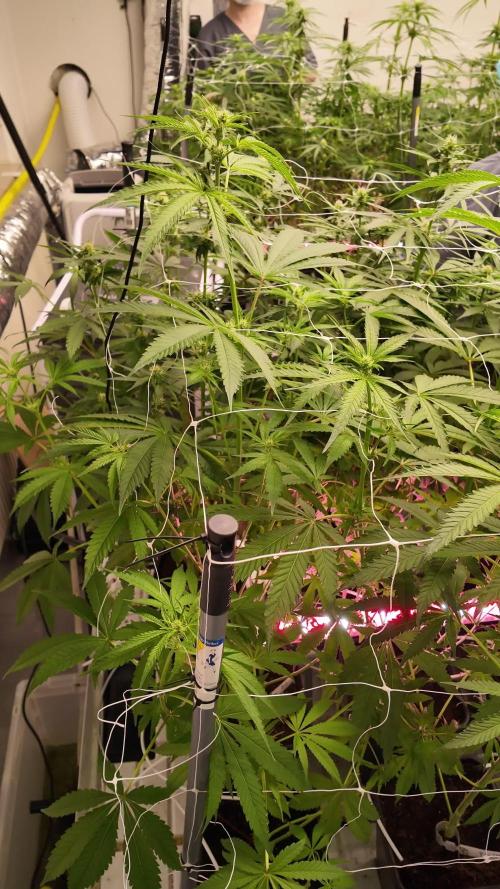
D71. Week five of flower and the girls are simply doing their thing. I scouted the plants today and found thrips on the second girl. I was hoping the lacewings would have gotten them all by now, but no such luck. I'll give them a week before ordering another batch. For some reason, the thrips avoid the first girl. Visually, there's also a clear difference between the two girls, with the first girl being darker and having more buds. ------------------------------ D73. I brewed a short (6 hours) compost tea today consisting of worm castings, kelp meal, neem meal, humic and fulvic acid, rock dust, biochar, and molasses. After the brew, I added homemade Bokashi juice, which lowered the pH of the tea to 6.6. Each girl got 2.5 liters of tea (5% of pot volume.) I also did another light round of defoliation, down low on the plants. ------------------------------ D75. Each girl got 2.5 liters of water @ pH 6.5, with 5 ml of FFJ. The plants stretched SO MUCH after flipping them into flower that it's challenging for the light to penetrate the canopy, and it's pretty dark further down. I bought some LED grow light strips and installed them in the tent to provide additional side lighting. It's only 36 W of extra lighting, but I hope it will help to develop the numerous buds down low. I put the lights on the left side of the tent, around the first girl, since she has a lot more buds, but now that it looks like the concept works, I might get another set of lights for the right side of the tent. ------------------------------ D77. We've reached the end of the fifth week of flower, and all is well in the tent. Ahem, almost all since I still have the thrips to contend with, BUT I just put a bunch of Cucumeris predatory mites in the tent, so the war rages on. A friend suggested adding white cloth below the plants to reflect more light toward the lower buds. Sounds plausible, but I didn't have any fabric, so I went all ghetto by simply putting strips of kitchen paper on top of the scrog net. Not the most fantastic reflector material ever, but it's what I had at hand. Plus, it's easy to work with and costs next to nothing. I doubt it will make a big difference, but even a slight increase is still an increase, and I could see a visible difference in the amount of light hitting the lower canopy. Finally, each plant got 2.5 liters of water @ pH 6.3, with FFJ and Bokashi Juice. ------------------------------
Likes
146
Share
@Haoss
Follow
Shes Excellency the Future #1®️ The buds are normal density, has the smell and aroma of grapes, is very sugary and sticky After drying I will add pictures and comment on the effect This breed of Anesia is a true masterpiece💚
Likes
12
Share
@TappedN
Follow
Sorry For The Delay but I was kinda busy ......Anywho on 3/19 I Changed The light Schedule form 18/6 to 12/12 To Begin My Pre-Flower Stage I Also Bent The Last Few Uneven Tops To Have A Table Top like Canopy (LST) Also Cut Off all Little Branches (Lollipopping) To Prevent Getting Any Little Pop Corn NUGs. Then ON 3/20 I Increased My Light Intensity From 25% to 50% And began giving These Girls There Flower Nutrients Listed Above . AN Updated Video Of the Week POSTED ABOVE Video Taken About 3 Days After Making These Changes And yes The are All Showing to Be Females