


Likes
Comments
Share


@CampaCavallo
Follow
E si parte con la seconda settimana vegetativa💚
Aspettiamo un attimo che si riprenda la piccola per poi iniziare a darle un po di Plagron👍🏻
30.10.23 trapianto => 6,5 litri ✅
.. Sul fondo del vaso, questa volta, ho provato a mettere lapillo vulcanico al posto della classica argilla espansa👍🏻
Ad un giorno dal travaso possiamo già vedere che la piccola è in netta ripresa💪🏻👹🍬
2.11.23 Fertilizzanti ⚗️

Likes
67
Share


@AsNoriu
Follow
Day 22. Last 3 girls got final house. 20 liters pots for those late runners. They look sad, but maybe big house and other girls will encourage them to kick in.
I took last NL away and now humidity and lightning are a lot better. Will drop lights down in few days, but not a lot ... 16 girls again in one room ;))))
I changed names of diaries, because I will try to finish them indoors ...
Happy Growing !!!

Likes
5
Share

@Permanentmarker88
Follow
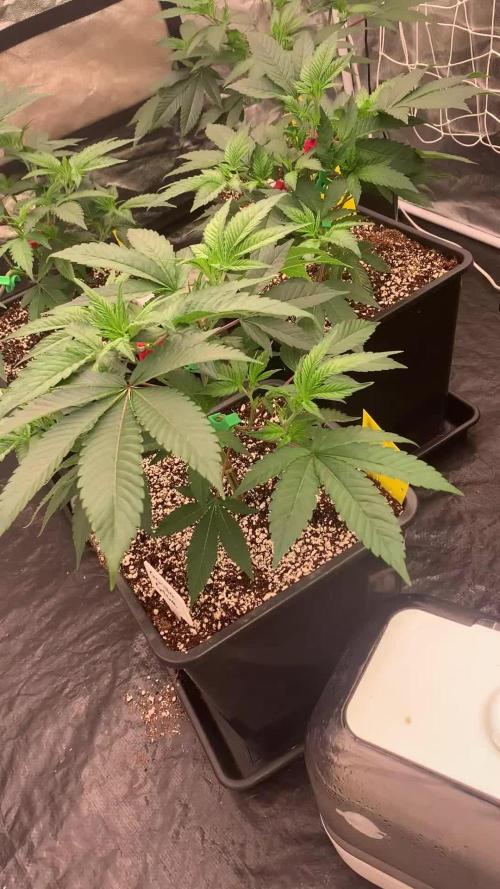
Vegetation Day 18
Die Steckies gedeihen prächtig mit den Athena Blended line Nähestoffen auf Coco/perlite70/30.
Sie sind alle kerngesund und die Triebe sprießen aus allen Richtungen nach dem Toppen.
Heute wurden unnötige Fächerblätter entfernt ,welche die unteren Triebe bedeckt haben (Defoliert).
In den nächsten 3-4 Tagen werden die Pflanzen in die Netze geflechtet und dann kommen wir der Blütenzeit immer näher.
Gegossen würd weiterhin nach dem Athena Blended Schema EC :2,1
PH: 5,8
Hinterlasst gerne ein Kommentar:))
Viele Grüne Grüße🏻🏻🏻


Processing
Likes
46
Share


@PureMedicin
Follow
Nice growth and bud developtment. Hps still doing its thing while im sitting back and relaxing. Got to keep an hawk eye on watering. I feed full strenght going over to full canna so they were transplanted into soil. Clones doing good but the Lemon skunk clone dont feel to good. Lets see what the week will bring.

Likes
5
Share


@Ziocannabis
Follow
Alla fine sono uscite 4 su 5 piante
Una Future Auto#1 non c'è là fatta
Continuo a farle crescere senza stressarle, visto che al momento sto usando una 300 watt Lumatek, anziché la mia Marsh Idro 480 watt "Evo".. tutta un altra storia per 4 piante, anche se la Lumatek è un ottima luce...ma con 180 watt di meno!
Metto se riesco degli aggiornamenti con foto giornaliere o 3/4 volte a settimana, così da vedere gli sviluppi in tempo reale 🙏


Likes
154
Share


@Tropicannibis_Todd
Follow
Well growmies ive been looking forward to the FastBud Tester 2311 , the more she went into flower the more the frost would build up , and that's when the terps came out 👉 Sweet , fruity 👈 Buds are tight and full of frost 👈 Couldn't of asked for better Genetics 😉
The smell coming from this girl during the entire grow was just dreamy 👈. Of course I have no clue to what she is but I like it......
Amazing Job FASTBUDS 👏 I would definitely recommend once they release this one 👍
👉 Big thanks to all my Growmies out there in GD land 👈 Much appreciated 🙏
Thanks To MarsHydro for the TS1000
👉I used NutriNPK for nutrients for my grows and welcome anyone to give them a try .👈
👉 www.nutrinpk.com 👈
NutriNPK Cal MAG 14-0-14👉 All Weeks
NutriNPK Grow 28-14-14👉 Weeks 2 & 3
NutriNPK Bloom 8-20-30👉 Weeks 4 to 8
NutriNPK Bloom Booster 0-52-34👉 Weeks 4 & 9 👌👌


Likes
15
Share


@MrGrowMan
Follow
Week 12-13
1 nutrient water
1 non nutrient water
LsT and Scrog
Diesel and Mimosa (front 2) auto
day 62 start 12/12 light period
2 break up cake day 67 start flowering

Likes
2
Share

@Ultraviolet_
Follow
Sequence: A sequence is an ordered list of numbers. For example, 1, 2, 3, 4 is a sequence.
Series: A series is the sum of the terms of a sequence. For example, 1 + 2 + 3 + 4 is a series.
Summation: The addition, and also the resulting value, are called the "sum" or the "summation".
Use summation:
207,360=9
103,680=9
51840=9
25920=9
12960=9
6480=9
3240 =9
1620=9
00=0
09=9
18=9
27=9
36=9
45=9
54=9
63=9
72=9
81=9
90=9
180=9
360=9
720=9
1440=9
2880=9
5760=9
The number 25,920 is relevant in the context of astronomical phenomena, specifically the Earth's axial precession, a cycle that takes about 25,920 years to complete as the Earth's axis "wobbles," causing the Earth to shift its orientation relative to the stars.
144x180 = 25,920
Axial Precession (Great Year): A slow wobble of Earth's axis, completing a cycle approximately every 25,920 years, causing the apparent shift of constellations over long periods.
72 Years per Degree: The 25,920-year precession cycle is divided by 360 degrees, resulting in roughly 72 years per degree (25920 / 360 = 72).
The number 72 is connected to the golden ratio in pentagonal geometry. The angles of a golden triangle, an isosceles triangle where the ratio of the longer side to the shorter side is 1.618, are 36°,72° 72°. The central angle of a regular pentagon is also 72(360°/5=72°).
Trigonometry: The golden ratio can be expressed using trigonometric functions of angles related to 72°, such as in the formula for the cosine of 36° or the sine of 54°
The Sacred Cubit (or Royal Egyptian Cubit) is an ancient unit of measure, typically 20.6 to 25.26 inches, derived from the length of the forearm from the elbow to the tip of the middle finger. It was used to design sacred structures like the Giza Pyramids. Discovered and popularized by Slim Spurling in the 1990s, this technology involves measuring a specific length of wire—typically 20.6 inches (52.4 cm) based on measurements from the King’s Chamber of the Great Pyramid of Giza—and twisting/looping it into a "tensor ring". Within the context of Tensor Technology and sacred geometry, the Sacred Cubit is considered to create or resonate at a frequency of 144 MHz (megahertz).
Proponents, such as Bruce Cathie and Jain 108, define the speed of light (c) as a "harmonic" value of 144,000 minutes of arc per grid second within a hypothetical universal grid system, rather than the standard physical constant of approximately 3x10^8m/s.
•The Tetrahedron totals 720°, (7+2=9)
•The Octahedron totals 1440°, (1+4+4=9)
•The Cube totals 2160°, (2+1+6=9)
•The Icosahedron totals 3600°, (3+6=9)
•Dodecahedron totals 6480°. 6+4+8= 18 1+8=9
6480+3600+2160+1440+720=144,000
Unlike the standard tuning of 440 Hz, which is used in most music today, 432 Hz is said to be mathematically consistent with the patterns of the universe. It is often referred to as the “frequency of the universe” or the “miracle tone.”
•The Cube (Hexahedron - earth) is 2160 degrees, 216 x 2 is 432
Everything is energy. Energy is represented by numbers. Numbers are frozen music. Music is moving sacred geometry of the Uni-verse. Here the tension comes from the interaction between spins causing them to magnetically resonate. For these interactions, we found a series (scale) of resonant notes: The first two notes show a perfect relationship with each other. Their frequencies (pitch) are in the ratio of 1.618…, which is the golden ratio famous from art and architecture. It reflects a beautiful property of the quantum system — a hidden symmetry. Actually, quite a special one called E8 by mathematicians.
•The E8 structure itself has relationships to Phi (1.618).
The golden ratio is the limit of the ratio of consecutive numbers in the Fibonacci sequence. The number 144, which is the 12th Fibonacci number, appears in calculations related to the 25,920-year cycle in some esoteric contexts 144°x180°=25,920° total degrees in a 64-tetrahedra structure's surface). The outer surface of a structure made from 64 tetrahedrons, often referred to as the 64 Tetrahedron Matrix or the Isotropic Vector Matrix (IVM), is composed of 144 equilateral triangles. This complex geometry is significant in sacred geometry and some unified field theories. The 64 Tetrahedron Matrix is a three-dimensional representation that is related to the two-dimensional "Flower of Life" symbol, where the arrangement of spheres around each tetrahedron creates the dense sphere-packing lattice of the Isotropic Vector Matrix.
The golden ratio has been reported to appear in the overtones of magnetic resonance at the quantum scale. Some theories propose a mathematical framework where the golden ratio is central to the absorption and emission of light photons (electromagnetic energy) by electrons. This dynamic process is linked to the fine structure constant, a fundamental physical constant relating the electron's charge, Planck's constant, and the speed of light. The ratio of certain color frequencies in the visible light spectrum (e.g., infrared to green and green to ultraviolet) has been posited by some researchers to approximate the golden ratio, suggesting an underlying harmonic principle.
Philosophical and theoretical frameworks suggest that the golden ratio acts as a "universal resonance constraint" for frequency in a unified mathematical model of reality and consciousness. Electromagnetic vibrations, such as those from electrons and photons, are thought by some to travel along biological structures like proteins and DNA, where the golden ratio is found in geometric patterns, suggesting a link to biological electromagnetism. The golden ratio emerges in discussions regarding quantum gravity, black hole physics, and even the potential shape of the universe (a dodecahedron based on 1.618) The geometry is considered fractal, meaning it can be scaled infinitely while maintaining its fundamental properties and structure.
Likes
57
Share


@Ultraviolet
Follow
Views expressed are my own. All opinions are my own. The opinions expressed here belong solely to me and do not reflect the views of Growdiaries or Grandcru Genetics.
The cannabis strain Grape Guava can be a purple strain, depending on its specific phenotype and genetic makeup. While not all phenotypes of Grape Guava are purple, some variations, such as the Zatix Grape Guava, are noted for their striking purple appearance due to the genetic expression of anthocyanin pigments.
Grand Cru Genetics is a cannabis seed bank that emerged in 2018 from a group of breeders in Madrid to provide a satisfactory experience to all cannabis users.
"If we do things, we do them well. Due to our experience in the sector and our taste for excellence, we know high quality and we seek it in everything we propose and do."
"We have a “cultivate without giving up” philosophy that we apply to everything we do. We do not give up, we are friends of change, and we adapt as necessary in a still restricted sector."
"We speak relaxed because we know how to relax. We are not intense or preachy; we accept everyone as they are, and we understand that farming is not for everyone. But for those who do, we are here to accompany you. We like to do it and tell it. We are experts in the field because we are the first to do it. We speak from experience and connect with others because we share the passion for cultivation."
"Cannabis has the ability to show us a world of possibilities. When you cultivate and live its growth process, you enjoy a path full of emotions and not just the final destination. At Grand Cru we find beauty in small things. We are attentive, observant, detail-oriented and aware of everyday things, and we savor them without rushing."
In a garden of green, Grape Guava gleams,
With its fruity aroma, enchanting dreams.
Clusters of grapes, guava's sweetness ignite,
A strain so divine, in purple and white.
Euphoria whispers, a lush fruity haze,
Grape Guava's embrace, a tranquil daze.
Off and away.@1400ppm. The increased CO2 allows plants to thrive at higher temperatures, which in turn necessitates higher humidity to maintain the ideal VPD for healthy growth and transpiration. 80F -5F = 75F LST with 70% RH = 0.72 kPa. Higher temperatures and humidity promote rapid growth, nutrient uptake, and photosynthesis while maintaining a lower stress level. Temperature influences the rate of enzymatic reactions involved in aerobic respiration. Enzymes, such as those involved in glycolysis, the Krebs cycle, and the electron transport chain, work most efficiently at an optimal temperature range. In low temperatures, enzymatic activity will slow down, thus reducing the rate of aerobic respiration. In high temperatures, enzymes can become denatured, thus impairing their function and stopping the process of aerobic respiration. Glucose is the primary fuel for aerobic respiration. The rate of aerobic respiration increases with the availability of glucose, as it is the starting point for glycolysis. If glucose levels are low, cells may rely on alternative energy sources such as fatty acids or amino acids , but these processes may yield less ATP or be less efficient. To determine this effect, carbon dioxide volume was measured (as carbon dioxide is an output of aerobic respiration)
18/6 with the 6 being IR. The near infrared (IR-a) borders around 700nm up to 1400nm @ photon par flux density of 1.8 instead of darkness, keeping temps overnight a neat 77F-80F.
I think of my tent as a lung. What goes in must come out. When the rate of air going out exceeds the amount of air coming in, it creates a negative pressure. Tent concaves (bends in). If set up correctly, the RH will begin to drop slowly to the desired level I set, and the extraction turns off when it reaches the desired RH. The plant, as it performs cellular respiration, will always release more water into the air; therefore, the RH% of the tent overnight will increase, as long as oxidative phosphorylation is occurring. As soon as the RH% creeps back up to 55%, the extraction turns back on, over and over. This creates a strong pressure differential, which will work wonders with mass flow. Replicating high and low-pressure fronts in nature. Critical for oxygen diffusion at the critical time of peak cellular respiratory function..
Moisture will not transfer from a saturated atmosphere to another if that air is already at or above its saturation point, meaning the air can't hold any more water vapor. Once I understood that water is produced as a by product during cellular respiration, specifically at the very end of the electron transport chain (ETC) where electrons are finally transferred to molecular oxygen, the higher the RH of the air, the more resistance there is for more moisture to be added to that environment, and effects the ease with which it does so. But none of that water comes from the pot; it's pulled from the air. If you run high daytime RH, your medium/pot is 100% reliant on transpirational root pull to move water. ZERO evaporation happens across the atmosphere if the tent air has high RH%, the medium cannot release its water through evaporation. Once a canopy develops, light no longer slowly wicks and evaporates from the topsoil. The Soil-Plant-Atmosphere Continuum (SPAC) describes the continuous pathway and process of water movement, driven by a gradient in water potential, from the soil, through the plant's roots, stem, and leaves, and finally evaporating into the atmosphere through transpiration. There is evaporation, there is transpiration, and then there is evapotranspiration; Evapotranspiration (ET) is the combined total of two processes: evaporation (water lost directly from soil and surface water into the atmosphere) and transpiration (water released from plants to the atmosphere through their leaves). Evapotranspiration represents the total amount of water that moves from the medium into the air. There is no such thing as a medium with too much water, only a medium that retains too much for too long.
The water must always flow efficiently from one atmosphere(Medium) to another(Air) in a timely manner. Moisture is a critical factor for bacterial growth and decay. Dictating how long it's allowed to sit in any one location for any given period is a key preferred control. To ensure a net reduction in a bacterial population, the rate of removal (ET) must exceed the rate of bacterial growth (decay rate), which is often modeled as a growth rate for the specific bacterium under the given conditions. By optimizing daytime VPD, we also optimize conditions for bacterial growth to explode exponentially above 77°F.. If water is allowed to sit in a medium without an escape within a timeframe, nothing good will happen. IF High RH is maintained overnight as well as during the day, placing 100% of water movement at the behest of daytime transpiration, roots can only pull where they can reach, and if soil is compressed above a certain point, moisture will become trapped in a medium with no way of moving day or night. This will begin the countdown for decay to take hold. When water stagnates in a medium, it loses oxygen, creating anaerobic conditions that foster the growth of harmful microorganisms like bacteria and fungi, which can produce toxins and disease vectors.
Thigmomorphogenesis, the process by which plants respond to mechanical stimuli like touch by altering their growth and development, results in significant morphological changes to improve survival against mechanical perturbations. This complex response involves sensing touch and initiating physiological and genetic responses, leading to changes in form and structure over days or weeks. The process is triggered by physical forces such as wind, rain, or touch. Plants adapt to these stimuli by changing their shape and structure, which may include slower growth, thickened stems, or altered leaf development. Plants possess sophisticated mechanisms to detect even subtle mechanical stimuli and initiate responses. A variety of molecules, including calcium ions, jasmonates, ethylene, and nitric oxide, are involved in signaling these mechanical inputs. Touch can induce the expression of genes that encode proteins for calcium sensing, cell wall modification, and defense mechanisms. A plant exposed to constant wind may become shorter and sturdier. A plant that is touched frequently might grow more slowly to conserve energy and develop thicker cell walls. These changes increase a plant's resilience and ability to survive in harsh environments.
Let's get Thiggy with it.
Likes
29
Share


@gnome
Follow
Almost week 10
This grow went by soo fast. I watered with molasses and the kelp4less extreme blend ph to 5.6 range. digital meter says 6.1 but my fluid tester is orange with slight tint of yellow. ppm going in are low and is pulling out about 700ppm of salts. highest its ever been for this stage . but from what it started out as I got it to normal ranges with out plant freaking out. added a video and a few pics of the veg side. I got new tsw2000 light in as a backup the new design is soooo much better then ones i bought. I also got my order in from seedsman og kush , peyote wifi cbd , strawberry grape banana , and white widow regular. Can hardly wait to start the breeding! So far the mite sighting looks to be a one off fluke as no others have been spotted.

Likes
109
Share


@Green_Man_420
Follow
Hello everyone. Welcome to another week of Medusa love!! Finally entered week 9 these ladies are really packing on some weight now. Maybe 2 weeks left at most. The smell is very intense and interesting. These ladies will be on plain water now until harvest.
Once again thank you to all my fellow growers for the love and support received I really do appreciate each and every one of you 🙏🏻
A link to Medusa F1 below I believe everyone should have a go at this one. And a massive thanks to James @ RQS for giving me the opportunity to grow out the F1 strains. ✌️👊🏻
⭐️⭐️⭐️https://www.royalqueenseeds.com/uk/f1-hybrid-cannabis-seeds/621-medusa-f1.html⭐️⭐️⭐️
Likes
2
Share

@DogDoctorOfficial
Follow
🍮 8×8 Adventure – Week 11
Chem Brûlée – Pheno B
Hungry, Frosty & Still Asking for More 🌸❄️💡
Hello everyone, and welcome back to another chapter of the 8×8 Adventure! 🌱💚
And here we go again...
Chem Brûlée Pheno B.
If you've been following her diary, you already know this girl has never really been shy about expressing herself.
She's tall.
She's vigorous.
She's hungry.
She's beautifully structured.
And she's definitely not the quiet girl in the room. 😂
But this week, something interesting happened.
The plant itself didn't need much from me.
The room changed.
The lighting system received a serious upgrade.
The nutrition moved forward slightly.
And then...
we stepped back.
Because at this stage of flowering, sometimes the most important thing we can do is provide what the plant needs and let her get on with the job.
And Chem Brûlée Pheno B?
She's doing exactly that.
She's still shining.
She's still hungry.
She's still building.
And she's still very much herself.
🍮🌸❄️💡
────────────────────────
🌸 Week 11 – Let Her Keep Building
Chem Brûlée Pheno B remains around 130 cm, maintaining that taller, more open architecture that has separated her from her sister throughout this journey.
And honestly...
I'm really enjoying watching what she's doing with that structure.
The height isn't the story anymore.
The flowers are.
The plant has already established her architecture.
The branches are positioned.
The flowering sites are developing.
And now we're watching that framework slowly become something much more substantial.
This is the stage where I don't feel the need to constantly interfere.
She's healthy.
She's green.
She's flowering.
She's developing resin.
She's using the environment.
So...
let her work.
────────────────────────
🍽️ Yes... She's Still Hungry
If there's one thing Chem Brûlée Pheno B has made extremely clear throughout this grow, it's that she has an appetite.
😂🍽️🌿
She seems to look at the environment we've created and say:
"Okay... what else have you got?"
And while we obviously don't make nutritional decisions based purely on appearance, her vigorous growth and continued flower development make her a very interesting phenotype to observe.
She's using resources.
She's producing new floral development.
She's maintaining her foliage.
She's processing all that available light.
And she's continuing to build.
So yes...
our hungry girl is still hungry.
And we're listening.
We're not throwing everything at her.
We're not changing things dramatically.
We're simply making measured adjustments and watching the response.
That's the approach.
────────────────────────
❄️ The Frost Is Becoming Part of Her Personality
One of the things becoming increasingly difficult to ignore is the resin.
The frost is developing beautifully.
When you look at the plant from a distance, you see her overall architecture.
Move closer...
and suddenly the story changes.
Pistils.
Sugar leaves.
Trichomes.
Flower structure.
Texture.
Tiny details everywhere.
That's one of the reasons I love documenting these plants individually.
The wide photograph tells you where the plant is.
The macro photograph starts telling you what she's becoming.
And Chem Brûlée Pheno B is becoming increasingly interesting.
She's not finished.
Not even close.
But the direction?
I really like it.
────────────────────────
🌸 The Flowers Are Taking Shape
The developing flowers continue becoming more defined.
Those long white pistils are still reaching outward from the developing structures, giving the flowers that almost explosive appearance we've been watching.
But underneath those hairs, something more substantial is happening.
The buds are gaining structure.
The individual flowering sites are becoming easier to distinguish.
And the plant is slowly moving away from:
"I have flowering sites."
toward:
"I'm building flowers."
That's the transition we're watching now.
And because Pheno B has such a distinctive structure, it's particularly satisfying to see those flowers developing throughout her branches.
The architecture is becoming the foundation.
The flowers are becoming the story.
────────────────────────
💡 The 8×8 Just Got A Serious Photon Upgrade
Now let's talk about the biggest change this week.
The plants themselves didn't need much intervention.
But the lighting environment received a major upgrade.
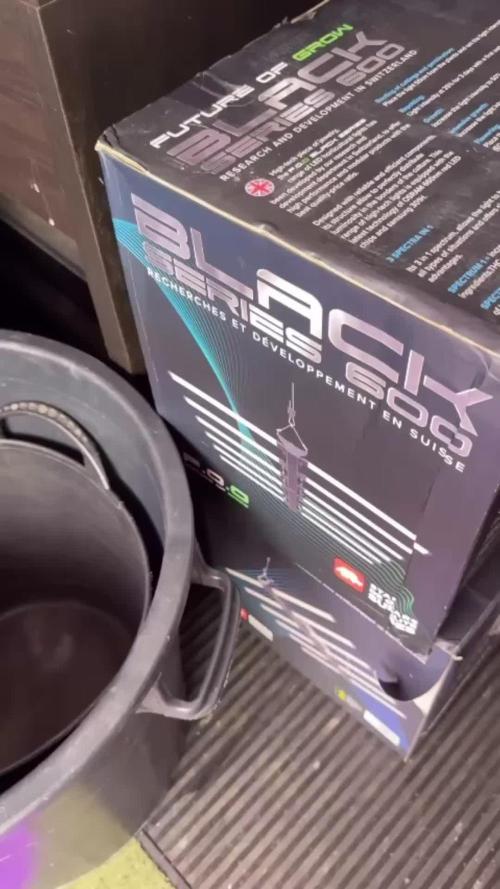
We've added two additional Future of Grow Black Series 600W fixtures to the 8×8.
And...
yes.
We definitely noticed. 😂💡
The available light increased more than I wanted initially.
So rather than simply running everything harder, we reduced the output.
We're currently running at approximately:
🔌 59% power from the plug.
And we're seeing approximately:
☀️ 1,500 PPFD across the upper canopy.
That's a serious amount of available light.
And I much prefer having that capacity available while controlling how much of it we're actually using.
We're not chasing the biggest number possible.
We're looking for the level that makes sense for the plants and the room.
And right now...
I'm very happy with where we've landed.
────────────────────────
☀️ More Light Doesn't Mean We Need More Power
This is something I particularly like about the new setup.
We now have considerably more lighting capability.
But we're not obligated to use all of it.
We added the two additional fixtures.
We measured the result.
The PPFD went higher than I wanted.
So we turned them down.
Now we're around 59% power from the plug.
Approximately 1,500 PPFD across the upper canopy.
And we're also saving electricity compared with simply running all the fixtures at maximum output.
That's a win for me.
We're testing the fixtures properly.
We're learning what they can do.
We're finding a practical operating point.
And we're not wasting power just because we have it available.
That's exactly what I wanted from this lighting upgrade.
────────────────────────
💚 Future Of Grow – A Big Thank You
A special shout-out this week to Future of Grow.
They provided the two additional Black Series 600W fixtures for us to test here in the 8×8 Adventure.
And now we're putting them to work.
Real room.
Real flowering plants.
Real measurements.
Real adjustments.
The additional fixtures gave us more lighting capability than we initially wanted, so we reduced the output to approximately 59%.
We're now seeing around 1,500 PPFD across the upper canopy.
And I'm genuinely happy with the balance.
Strong lighting.
More control.
Lower power consumption than running everything flat out.
And twelve different plants showing us how they respond.
Thank you, Future of Grow, for giving us the opportunity to test these additional fixtures and see what they can do in a real grow environment.
────────────────────────
☀️ Chem Brûlée Under The New Artificial Sun
And here's where things get fascinating.
The lighting environment has changed.
But Chem Brûlée Pheno B hasn't suddenly become another plant.
She's still tall.
Still vigorous.
Still hungry.
Still beautifully structured.
Still developing those flowers.
Still frosting up.
That's the beauty of genetics.
We can provide the environment.
We can provide the photons.
But the plant decides what to do with them.
The same light can fall on two phenotypes and produce two completely different stories.
And Pheno B is continuing to write hers.
She's taking that available energy and putting it toward what she does best:
growing.
Building.
Flowering.
────────────────────────
☀️ Around 1,500 PPFD Across The Upper Canopy
The approximately 1,500 PPFD we're currently seeing is across the upper canopy.
And with Pheno B, that distinction is particularly important.
She's a tall plant.
Her flowers and leaves occupy different levels.
The top of the plant sees stronger direct illumination.
The middle receives a different intensity.
The inner areas receive less direct exposure.
And lower parts of the structure naturally receive something different again.
That's completely normal.
A plant isn't a flat surface.
It's a three-dimensional solar field.
😂🌿☀️
Our goal isn't to make every single flower receive identical light.
It's to create a strong, useful lighting environment while allowing the plant to use the available photons effectively.
And that's why the ability to control the output is so valuable.
We can provide a very powerful artificial sun without necessarily running it at maximum intensity.
────────────────────────
💡 Photons Are Only One Part Of The Equation
I've talked about photons throughout this project because they're fundamental to what we're doing.
But they're never the entire story.
Light interacts with temperature.
Temperature interacts with transpiration.
Water availability affects nutrient movement.
Root-zone conditions influence uptake.
Nutrition supports development.
CO₂ influences photosynthetic potential.
Plant structure determines how photons move through the canopy.
Everything is connected.
That's why I don't want to simply keep increasing light because we can.
The objective is balance.
Give the plant strong usable light.
Keep the environment appropriate.
Maintain irrigation.
Support nutrition.
Observe.
And adjust when the plant actually tells us something needs changing.
Right now?
Chem Brûlée Pheno B is telling us she's happy.
────────────────────────
⚗️ Nutrition – A Small Step Forward
We've also made a small adjustment to the flowering nutrition this week.
Nothing dramatic.
We're simply moving Terra Bloom from 2.2 ml/L to:
🌱 Terra Bloom — 2.3 ml/L
The rest of the recipe remains:
🌱 Green Sensation — 1 ml/L
🌱 Power Buds — 1 ml/L
🌱 Sugar Royal — 1 ml/L
🌱 pH adjustment as required
That small increase brought the EC up slightly.
We're now around:
⚡ EC — 2.14 mS/cm
Again...
small adjustment.
Small movement.
Measured response.
We're not trying to reinvent the feeding programme.
The plants are developing beautifully.
So we're simply giving the flowering nutrition a small progression and watching how they respond.
And our hungry girl?
She's certainly giving us plenty to watch.
😂🍽️🌸
────────────────────────
💧 Irrigation – Let The System Keep Doing Its Job
The irrigation system remains consistent.
We're currently around:
💧 1.45 L per plant / 24 hours
with approximately:
🌡️ Solution temperature — 25°C
🥥 Substrate temperature — 25°C
At this stage, consistency becomes increasingly important.
The plant doesn't need us constantly changing things.
She needs a reliable root environment.
She needs water.
She needs nutrition.
She needs oxygen around the roots.
And then...
she needs time.
So that's what we're giving her.
The system continues doing its job in the background while we concentrate on observation.
────────────────────────
🌡️ Week 11 – Current Environment
The room is currently running approximately:
• 🌡️ Day Temperature: 26.5°C
• 🌙 Night Temperature: 26°C
• 💧 Relative Humidity: 61%
• 🥥 Substrate Temperature: 25°C
• 💦 Nutrient Solution Temperature: 25°C
• ⚗️ pH: 6.02
• ⚡ EC: 2.14 mS/cm
• 💨 CO₂: approximately 693 ppm
• 💡 Light Schedule: 12/12
• 💧 Irrigation: approximately 1.45 L/plant/24h
• ? Pot Size: 15 L
• 📏 Plant Height: approximately 130 cm
The environment remains broadly stable.
Summer still likes to remind us that absolute precision isn't always possible. 😂☀️
So the objective isn't chasing one perfect number.
It's maintaining a stable overall environment.
Avoiding unnecessary swings.
Watching the plants.
And responding when something actually needs attention.
Right now...
Pheno B looks very comfortable.
────────────────────────
🌿 No Need To Manufacture Work
This is probably one of the biggest themes of this week's report.
We're not doing much to the plants.
And that's intentional.
Earlier in the grow, we had plenty of work.
Training.
Structure.
Canopy management.
Defoliation.
Positioning.
Adjustments.
But now?
The plant has done most of the building.
She's created the architecture.
She's established the flowering sites.
She's developed the canopy.
She's now putting her energy into the flowers.
So I'm not going to manufacture work simply because I feel like I should be doing something.
Healthy leaves are working.
Flowers are developing.
The plant is healthy.
Air is moving.
Light is available.
Nutrition is consistent.
Water is being delivered.
Sometimes...
the best thing a grower can do is leave a healthy plant alone.
And our hungry girl seems perfectly happy with that arrangement.
────────────────────────
🌸 She's Putting Those Photons Somewhere
This is what I really enjoy about looking at Pheno B now.
We can actually see the result of all that invisible energy.
The photons are arriving.
The leaves are capturing light.
The plant is processing that energy.
And the visible result is right there:
More flower structure.
More definition.
More resin.
More development.
The plant itself becomes the record of what's happening.
And Pheno B is giving us a pretty impressive record.
She's not sitting still.
She's working.
Hard.
😂🌿
────────────────────────
📸 The Camera Is Still Loving Her
And once again...
this girl is fun to photograph.
😂📸
The full-plant shots show that tall, open architecture.
The middle-distance photographs show how the flowers are distributed through the branches.
And then you get closer...
and suddenly the frame becomes pistils, resin and flower structure.
That's the beauty of photographing the same plant every week.
You stop relying on memory.
You can actually compare.
Week after week.
Flower after flower.
Change after change.
And when you look back at the early photographs?
The difference is remarkable.
Chem Brûlée Pheno B has travelled a long way.
And she's not finished yet.
────────────────────────
Same Environment. Completely Her Own Answer.
This is still the heart of the 8×8 Adventure.
Twelve plants.
One room.
Shared environmental conditions.
Shared general lighting philosophy.
Shared irrigation.
Shared nutrition.
And yet...
twelve individual stories.
Pheno B is another perfect example.
She isn't Pheno A.
She isn't one of the compact girls.
She isn't one of the quieter phenotypes.
She's tall.
She's vigorous.
She's hungry.
She's frosty.
And she's developing her flowers in her own particular way.
The environment gives her the opportunity.
The genetics decide how she uses it.
And honestly?
I really like her answer.
────────────────────────
🍮 The Hungry Girl Is Still Hungry
If I had to choose one sentence for this week's report, it would probably be:
"She's still asking for more."
😂🍽️🌿
More photons.
More time.
More room to build.
More opportunity to develop.
And we're giving her those things in a controlled way.
Not blindly.
Not excessively.
But consistently.
The new lighting gives us additional capacity.
The small nutritional increase gives the flowering programme a little more room.
The irrigation keeps the root environment supplied.
The environment remains stable.
And then...
we watch.
That's the relationship between grower and plant at this stage.
We provide.
She responds.
We observe.
And when necessary...
we adjust.
────────────────────────
🔬 The Lighting Experiment Continues
The two additional Future of Grow Black Series 600W fixtures have added another fascinating layer to this project.
We now have substantially more lighting capability than before.
But the interesting result isn't simply the maximum output.
It's finding the useful operating point.
The PPFD initially went higher than I wanted.
So we reduced the fixtures to approximately 59% power from the plug.
We're now seeing around 1,500 PPFD across the upper canopy.
And we're doing it while using less electricity than running the fixtures at maximum output.
That's exactly the kind of practical information I wanted from this experiment.
The hardware gives us the capability.
The measurements tell us what is actually happening.
And the plants tell us whether they like it.
Chem Brûlée Pheno B?
So far...
she's looking pretty happy.
────────────────────────
🔮 Looking Ahead
From here, the plan remains beautifully simple.
Keep watching.
Keep photographing.
Keep the environment stable.
Keep irrigation consistent.
Keep nutrition appropriate.
Keep monitoring the lighting.
And let Pheno B continue doing what she's been doing.
Over the coming weeks, I'll be watching:
🌸 Continued flower development
❄️ Increasing resin coverage
🌿 Healthy foliage
💡 Response to the stronger lighting environment
💧 Water demand
🌡️ Environmental stability
🌬️ Air movement through the canopy
📈 Increasing flower density and definition
No need to force the next chapter.
She's already writing it.
We'll simply be here to document it.
────────────────────────
💭 Final Thoughts – Let This Hungry Girl Shine
Chem Brûlée Pheno B continues to be exactly what she has shown us throughout this journey.
Tall.
Vigorous.
Hungry.
Beautiful.
Distinctive.
And increasingly frosty.
This week, we didn't need to do much to her.
And that's a good thing.
We added two additional Future of Grow Black Series 600W fixtures.
We measured the increased light.
The PPFD went higher than I wanted.
So we reduced the output to approximately 59%.
We're now sitting around 1,500 PPFD across the upper canopy.
We increased Terra Bloom slightly from 2.2 to 2.3 ml/L.
The EC moved a little higher to approximately 2.14 mS/cm.
And then...
we stepped back.
Because she's doing her job.
She's taking the photons.
She's using the water.
She's using the nutrition.
She's building flowers.
She's producing resin.
She's becoming more and more herself.
And honestly?
That's exactly what I want to see.
The goal isn't to make her behave like another phenotype.
It's to give her the opportunity to show us what she can become.
And Chem Brûlée Pheno B is definitely taking that opportunity.
🍮🌸❄️💡🔥
So keep shining, hungry girl.
Keep building.
Keep frosting up.
Keep showing us what your particular expression of Chem Brûlée can become.
We're watching.
We're photographing.
We're learning.
And we're enjoying every minute of it.
────────────────────────
🙏 Thank You
A huge thank you to everyone following the 8×8 Adventure and taking the time to follow these individual stories.
Thank you to GrowDiaries for giving us the platform to document the journey and share what we're learning along the way.
Thank you to Zamnesia for the Chem Brûlée genetics and for giving us the opportunity to explore different phenotypes side by side.
Thank you to Plagron for supporting the garden with the nutrition and growing programme throughout this adventure.
And a massive thank you to Future of Grow for providing the Black Series lighting and, especially this week, for providing the two additional 600W fixtures for us to test in the 8×8.
Being able to increase the lighting capability, measure the response, reduce the output and find a practical operating point has been a fantastic part of this experiment.
We're currently running around 59% power and seeing approximately 1,500 PPFD across the upper canopy while also keeping electricity consumption lower than simply running everything at full power.
That's real-world testing.
That's what I like.
Thank you as well to Lumiflora for helping illuminate the deeper parts of the canopy and giving us another perspective on three-dimensional lighting.
And thank you to TrolMaster for helping us monitor and manage the environment behind the scenes.
And finally...
thank you to everyone following along.
Every comment.
Every question.
Every message.
Every person stopping by to see what these girls are doing.
You're all part of the adventure.
Twelve plants.
One room.
One shared environment.
And twelve completely different stories.
Chem Brûlée Pheno B is writing hers with an appetite.
😂🍽️🌸
She's hungry.
She's frosty.
She's beautiful.
She's developing some gorgeous flowers.
And she's still asking for more.
So let's give her the spotlight.
Let's keep those photons flying.
Let's keep watching those flowers develop.
And let's see just how far this hungry girl wants to take us.
🍮❄️🌸💡🔥
Until next week...
Growers Love, my friends, and happy growing! 🌱💚
See you next week in the 8×8 jungle. 🌿📸🍮

Likes
19
Share

@AsNoriu
Follow
Day 22. Work forced me to open tent 20 min earlier and i had to do shortest watering ever, like in 5 min ...
Its hard to implement growing into 12 hours shift, especially during flowering...
But girls look nice, drink quick, should be good result, unless .... ;)))))))))
Day 23. Girls still run up and i have only 20 cm left max ...
Supercroped most streching Middle Clone top, one side is shooting strong, will have to repeat action with it as well in couple days ...
So all is good !!!
Day 24. All got full feed. Supercroped branch is ok , all leaves are up !!!
Got my last delivery, now lady bugs and theirs larvae has new support. When was working with plants yesterday i haven't seen any thrips, but order was made, so i rather use them ...
Day 26. Had to clean predators balast from flowers,so i touched them ....
Oh boy !!! Wanna chop them now ;))) i think thats one of tastes i was chasing, now waiting is pure PAIN !!! ;))
It looks like i pushed them a bit too far with double feed attempt ... so now , water, water + silica, water + calmag, water + molasses , and only then new feed again.
Happy Growing !!!

Likes
12
Share


@AtomicOrgy
Follow
Was that a nute burn or a newbie burn hahaha?
I flushed it but I'm afraid it's gonna delay her growth. No cuarentine candy for me...
Likes
4
Share


@fezzollas
Follow
That was the most difficult week. It was very cold and rainy, the humidity of the air reached 90% at most, but without sequels, thank God. On day 63, I defoliated and she is strong, fat and definitely smells like cheese.


Likes
92
Share


@Roberts
Follow
Apple Fritter is doing good. Just switched light to 12/12. Increased nutrition on last solution change. I cut a clipping I am attempting to clone. If all good I will start a diary next week for it. She is growing in a New Level Hydro bucket, under a Spider Farmer SE5000 light. Thank you New Level Hydro, Spider Farmer, and Amsterdam Marijuana Seeds. They been producing quality seeds for 25 years, and counting. 🌱🤜🤛🌱
Http://amsterdammarijuanaseeds.com
Thank you grow diaries community for the 👇likes👇, follows, comments, and subscriptions on my YouTube channel👇. ❄️🌱🍻 Happy Growing 🌱🌱🌱
https://youtube.com/channel/UCAhN7yRzWLpcaRHhMIQ7X4g
SE5000
https://amzn.to/3qFpAML
Spider Farmer Official Website Links:
US&Worldwide: https://www.spider-farmer.com
UK: https://spiderfarmer.co.uk
CA: https://spiderfarmer.ca
EU: https://spiderfarmer.eu
AU: https://spiderfarmer.com.au
Coupon Code: saveurcash
Www.newlevelhydro.com
Www.hygrozyme.com

Likes
8
Share


@Kindbudz
Follow
Flowers started to form. Gonna be absent for a little while. Just got a new job. Will definitely give an end result.

Likes
15
Share

@masterofsmeagol
Follow
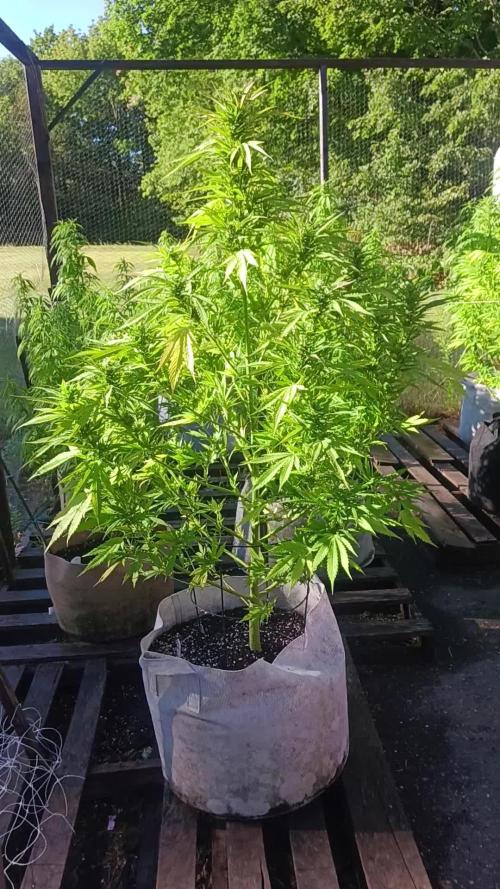
8/17 Watered everything but the 50. Found two leaves with sep markings on the pink kish in the 50. Definitely not using old soil again. I'm pretty sure THIS plant contracted it from the soil and not the way the others did with the lawn mower and birdseed hijinx. It's supposed to rain for the first time basically all summer. It's am 80% chance so I HELD OFF ON PLANT DOCTOR AND DID NOT APPLY as I'm supposed to have a clear day after. I'll apply the plant doctor in the morning. I'm hoping this rain will knock down a bunch of those thrips. They seem to be on a small branch on a plant or two. One or two leaves show damage and I'll pick them off. I figure I'll get them after I apply plant doctor. I'll use either citric acid or just my regular bt-k pillar treatment with Castille or liquid soap. That will kill them as well. I'm on really worried about it. I also might just buy a bunch of lady bugs and unleash them once things get further along.
EDIT: TOOK A QUICK VIDEO AND A COUPLE PICS. HOPEFULLY WE GET THIS RAIN. IF NOT IM GOING TO TREAT THE THRIPS THAT ARE ON TWO PLANTS NOW. I THINK IM GOING TO GO WITH BT-K FOR NY PILLARS AND HOPE THAT THE DISH SOAP IN THE MIX KILLS THE THRIPS. I HAVE LOTS OF DIFFERENT OPTIONS SO ILL FIGURE SOMETHING OUT. BUDS SEEM TO BE EXPLODING IN GROWTH. OH AND THANKS TO THE OUTDOOR GROWER THAT MESSAGED OFFERING TO HELP. I APPRECIATE THAT. THANKS.
8/18 We got the rain we were expecting. It was sheet rain for a few hourscand rained during the night. Everything was drenched and it was cold (50°F). I shook off the special kush that's way further in flower. I decided to use the leafblowrr despite the risk of spreading anything. I did it so that it wasn't ever blowing TOWARDS another plant but still. I was hoping it might blast off some thrips that might have survived that torrential rain. We've never had a dry summer like this. I'll moniter things. My water day is tomorrow so I assume that's when the girls will get their plant doctor dose. It's a great time of year for cannabis growers. We get to watch all the hard work we've put in literally pay off. It's very peaceful in the garden.


