


Likes
Comments
Share


@GMSgrows
Follow
The Cheese is the Cheese! Mm the smell. Shut my extraction fan off for some vids the other night and when we awoke in the morning., oh my lord. I can't even describe the odor in my home, but the wife sure wasn't happy. I forgot to turn the fan back on. I have done this before but never has it smelled the way it did the other morning. Oh well, all good now. The Cheese trees are happy, as am I. Couple more week and hope they ripen up quickly. These are some beauty plants. Looking forward to trying the cheese, then some crackers lol.

Likes
49
Share


@M0S3S
Follow
D108: After the stress we experienced, we managed to recover with a yield of 60-70%. We will start monitoring trichomes in the 8th week. Continuing with two waterings, one with fertilizer and one with calcium, we proceed.

Likes
4
Share

@Alvareas
Follow
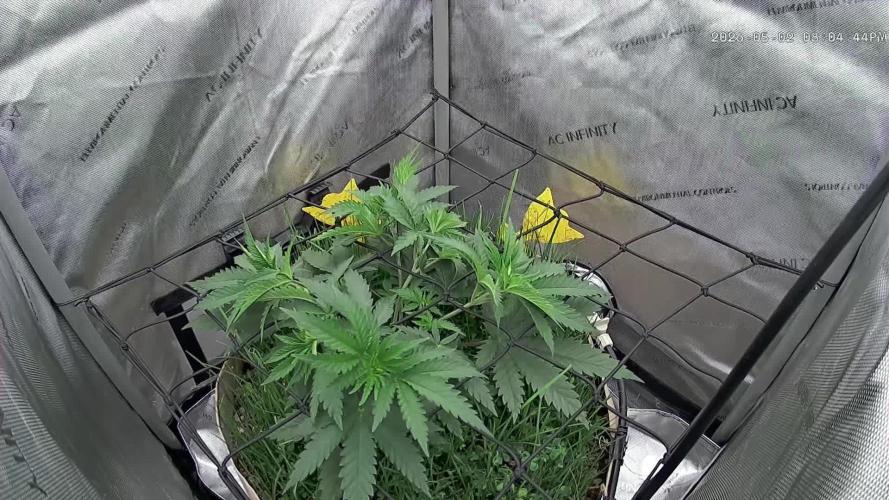
Zu Beginn der Woche habe ich das Scrog-Netz installiert.
Die Pflanze ist zwar noch nicht besonders hoch, wird aber vermutlich auch nicht mehr viel an Höhe gewinnen.
Der Wuchs ist eher kompakt.
Das stört mich jedoch nicht: Das Scrog-Netz soll zunächst die Triebe auf gleicher Höhe halten und es mir ermöglichen, sie auseinanderzuziehen, um Nebentriebe zu fördern.
Im Verlauf der Woche ziehe ich die Pflanze nach und nach weiter auseinander.
Vereinzelt habe ich an den Haupttrieben nach innen wachsende Blätter entfernt, wenn sie Nebentriebe verdeckten.
Die entfernten Blätter habe ich kleingeschnitten und auf die Erde gelegt.
Die Würmer dürfte das freuen.
Nach dieser Woche hänge ich noch eine weitere Vegi-Woche an und stelle danach auf Blüte um.
In dieser Woche wurde einmal mit Komposttee gegossen.
Den Tee setze ich jedoch nicht mit Melasse und Sprudelstein bei erhöhter Temperatur an.
Stattdessen lasse ich den Kompost 24 Stunden ohne Melasse und Sprudelstein in Wasser ziehen.
Anschließend gieße ich das Wasser unverdünnt.
Die Parameter in Woche 5:
Controller Einstellung Tag: Advanced AI VPD 1,0 – 1,2
Controller Einstellung Nacht: Advanced AI VPD 0,9 – 1,1
Durchschnittliche Tagestemperatur: 27,9 Grad
Durchschnittliche Nachttemperatur: 25,7 Grad
Durchschnittliche Luftfeuchtigkeit Tag: 58,4%
Durchschnittliche Luftfeuchtigkeit Nacht: 59,3%
Durchschnittlicher VPD Tag: 1,1
Durchschnittlicher VPD Nacht: 1
Durchschnittliche Bodenfeuchtigkeit in Mbar: 115
LED Leistung: 20% = 90 Watt
Beleuchtungsdauer: 18 Stunden
Umluft: Stufe 1 oszillierend

Likes
39
Share


@GrowWiththeBro
Follow
Start of week 3.
Feeding a little more consistently. 1gal of the above every 3 days.


Likes
12
Share


@russrahl
Follow
Plants continued to stretch last week, I had to weave a couple branches through the top screen as well to keep them level with the canopy. Overall it’s going good, I did a defoliation again a few days ago to try and open up as many budding sites as possible to the light. I noticed some nutrient burn on my leaf tips at the end of last week so I diluted the reservoir water with 3 gal of fresh water. My HPS light is still turned down to 750w as the light output at the top of the canopy exceeds 75 000 lux directly under the light even turned down. I have a light mover moving my light though so it’s not always in one spot. This is only my second crop using this light mover though so I’m still adjusting its speed and pause time and doing some experimenting with it...lol smell is normal still, not strong but it’s noticeable when you open up the tent. I will be updating more pictures and videos throughout the week as well. Cheers 💨

Likes
9
Share


@Krautbauern
Follow
The ladies are doing very well. They will soon start to bulk. We are very happy to be able to test the resinator from the rock nutrients, plus elan by crazyhillsnutrients and some calmag. we did a little bit of defoliation as well

Likes
6
Share


Likes
8
Share

@Xplod
Follow
Welcome back to week 9
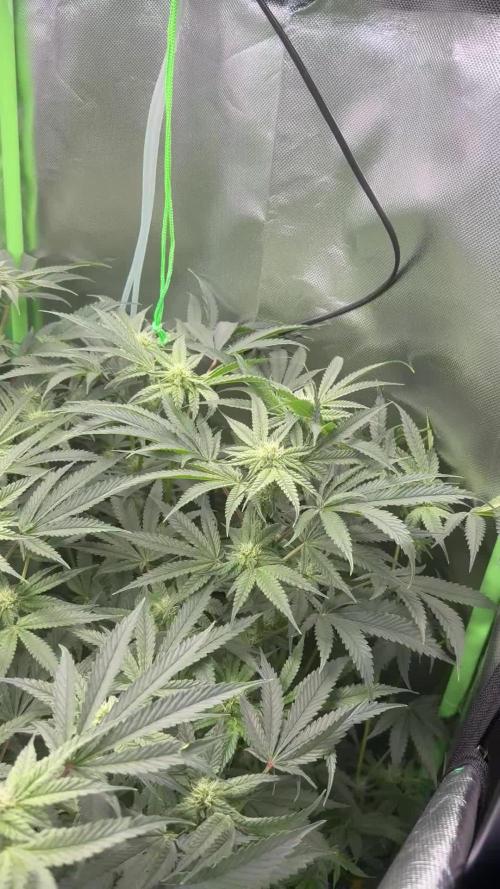
This week will be mostly playing the waiting game and some post stretch defoliation on the Photos
As all plants are done stretching, the feeding of PK was increased to support the bulking phase.
The auto tent is getting more frosty every day with temps between 25-20 degrees
Not much to do there, just ensuring reservoir is filled and airflow is good
The photos are also done stretching….mostly….i hope 😬
The BBM now reached same height than the others and some side branches also
If they stay like that for the next days I will do a final clean up defoliation on all 3 to get a bit more airflow and light penetration through all plants
Feeding will reach its peak this and next week with 2.0-2.1 EC and 5.9PH and decreased slowly after that
As an addition to my “why are photos stretching so crazy this time?” Question, I think I found the answer…. I started the PK a bit too early, as phosphorus in stretch makes plants grow more in between the branches… which is exactly what happened to all 3… they some times have 5-10cm spacing between the branches…
Lesson learned: don’t start pk before stretch is REALLY done! 😅👍
Update: the BBM and BKH are both still growing 😬 while I first thought the CW would be the big stretcher…it now shows I was completely wrong…
The CW is now the smallest in height and due to my LST the most dense
I have all a heavy defoliation (not completely lollipoped but still a lot foliage removed)
When I shut down the UCL it was complete darkness at the tray 😱 never had anything that dense and bushy
I just hope I can keep the RH under control in late flower…
And as a remark: I need new vents…both top fans get issues with the oscillation
Those need to be replaced before late flower starts!



Likes
11
Share


@adam_pawloski87
Follow
Let’s go day 9 of flower!! This week went real well , all these lil babies just doin there thang , got a nice bit of stretch goin on an staying super healthy for week 2 of flower 🌺! Either sometime this week or next week we will do some Defoliation, clean up them legs lil bit lol! Hope you all enjoy an have an amazing productive Week! Peace love an positive vibes to all y’all Cheers 😶🌫️💨💨💨💨🤙🏻

Likes
79
Share


@Salokin
Follow
Hello Growmies,
As we conclude week 9 with our Epic Buzz trio, our spirits are high and our grow space is thriving. The introduction of an intake fan has been a remarkable success, significantly enhancing our control over the grow room's climate. Though not manipulated by Tent X's advanced automation, this new system has integrated seamlessly, working wonders for humidity regulation and fresh air circulation. The positive impact on the VPD is clearly reflected in the graph, showcasing a stable environment conducive to plant health and vigor.
The plants themselves are a testament to this success; they've stretched up nicely, with the canopy becoming denser by the day, promising an abundant harvest. Each Epic Buzz, from #1 to #3, stands lush and robust, with a vivacity that indicates they're on the right track. It seems they're set to make us proud, not just as individual specimens but as a harmonious collection within our carefully curated tent.
The precision in our approach continues to be our guiding principle, as evidenced by the meticulous adjustments to our environmental controls, shown in the steady data from our VPD readings. Our hands-on efforts complement the automated systems, creating an ideal balance that our Epic Buzzes are clearly loving.
Looking forward, the prospect of the flowering phase fills us with anticipation. With the canopy now in optimal condition, thanks to our strategic planning and the supportive role of the intake fan, we're poised for the next stage of growth. The thriving Epic Buzz plants, along with our proactive measures like the fly trapping, signify that we're not just growing plants—we're cultivating excellence.
Stay lifted,
Salokin

Likes
26
Share


@1Right_Angle
Follow
Starting week 7 of Flower finds me planning the next 6, including scheduling a Flush and Tapering the Nutrients off in the next month.
- ReStaked a few branches for even spacing & At the End of last week I top-dressed both pots with fresh Soil n Sand.
-fresh material at play and the plants are using a lot of water.
-able to feel when the big pots are drier and ready for water, by lifting one-end regularly. Just to gauge weight... it’s working.
This grow has me trying to establish a much bigger root-ball; re 15 gal pots / 16 litre feeds ... I’ve laughed at some of the previous ones.
Feb 2nd, Buds are touching, conditions are being changed slowly mid-flower & hoping they get real chubby in the coming weeks.
With the constant reminders that quality grows take longer to mature in Flower than the literature usually states; my plan is to Flush sometime during week 10 (month end)
- Three weeks to make it count. Trichomes to dictate
Feb 4,
- getting my head around htf I’m going to flush this pair in 3+ weeks. Low ceiling+tall sink+tall plant.
Feb6
- slight reduction in Calimag and the next feed will see rapidstart reduced as well. Small moves but in the right direction.
- tonight is a scheduled feed. Volumes have been big over the last 3 weeks and I am deciding to give the plants an extra couple days without Water, to make sure it is on the dry side as we enter the 2nd half of flower.
Feb 7th
- the UV-B light just might be having an impact on the buds of the R plant. There are a number of buds that are becoming obviously covered in Resin Glands.
- used a moisture meter, the bottom of both pots is a bit wet. Patience wins...
This is the plant that physically is still ~ 10 days behind the L plant. just an observation...
As this week wraps-up, my plans for next week are to reduce the light cycle by 30 min to 11.5 hrs lite per day. And to drop the humidity another 2%. But that’s for next week.
All is going strong at this point, Buds are filling out, smell at the door of the tent is obvious; earthy & dank. Up close from touching a bud it explodes of a Citrus smell. That’s the best description so far
Feb 9th, almost a week since last water/nutes, tonight is a green light. Actually felt the pot lighter. Moisture Meter agreed. 17L later ...
- balanced the branches / supports and found a good fit between the two pots under the one light.
-adding more fresh air to the tent also helped drop the RH a bit.
Ready for this transition.
- A dry week in reality, cannot wait to see the changes next week after this last, big Max nutrient feed.
** bottom leaves had just began to droop as I watering the plant. Did manage to take it close to the edge mid-way through flower, now it’s Hungry at a critical time. Come on week 8

Likes
37
Share


@Vegetoo420
Follow
Hey hey ! I left my girls during 4 days without watering due a hospitalization !
I discovered this girl like this when I opened the room and she exploded !!
Day 3 : floweeeers comin !
Day 6: little defoliation and 🍭 lollipop on this girl : she’s clean now !


Likes
52
Share


@HazeyBobby
Follow
The week starts Monday, Dec-9 in vegetative stage.
Started lowering the distance from the light to 45cm (18") over the coming week.
The extraction fan on its lowest setting is too strong for the current growth environment so the humidity levels have been rather low (35% -> 50%). An attempt to stop/start the fan with 30min intervals caused both temp and humidity levels to swing wildly. The environment inside the tent is now stable, albeit low temp and humidity levels since the fan has been left to run continuously.
Added a large tray of water with an aquarium heater warming it to raise the humidity level inside the grow tent. And added a large hanging wet towel. Both methods helped.
The plant is recovering very well and stretching in its growth. The side branches are reaching out to the light.
Starting to increase the frequency of fertigation to daily as the plant seems to be sucking up water/nutrients well. Run-off was measured at EC 0.94 and pH 6.2.
Topping at 5th node - start of LBH’s Famous ScrOG Tutorial.
Cut the stem above the 4th node. The topping should probably have been done a few days ago but I wanted to see the plant recover first.

Likes
6
Share

@PapaTerps
Follow
Lemonessence - Doja
Week 6 Bloom
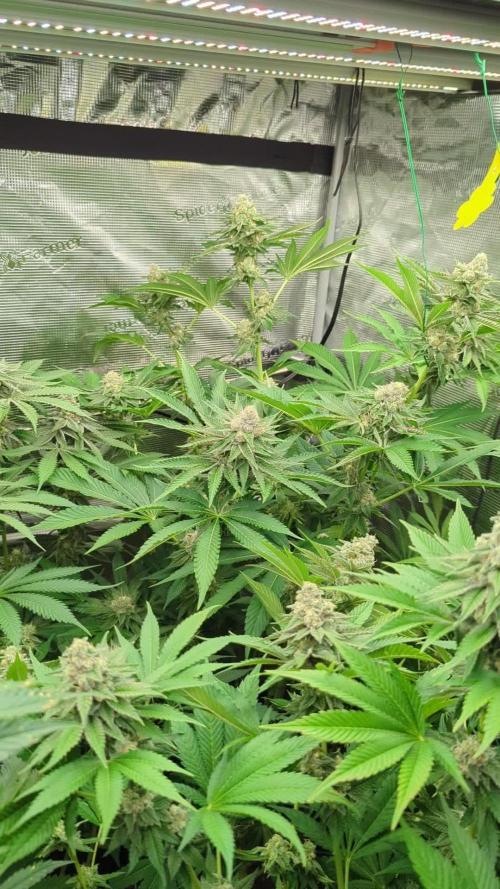
🌸 She has finished her bulk and is working on maturity her flower - she has beautiful grape sized bracts in tightly formed colas, lime green with purpling tips and a sugar coating of trichomes. Her structure has the scent to back it, with deep lemons fragrance backed with a creamy finish, very delicious 👌🏻 External temperatures have started to drop this week, which is perfect timing for these girls as they all have about 3-4 weeks of scheduled bloom left.
✂️ I've removed her lowest most side stems, because they were just too far behind the canopy. But other than that, she's in good health - no herming or disease 👌🏻
💧 Watered every three days with 5L of RO water, nutrients were mixed individually, in order and then finally pH'd to 6.3. I've altered her nutrients to meet her needs for this late phase of bloom.
💡 PPFD: ~900
♒ VPD: 1.46kPa
🌱 Days from seed: 102
🌸 Days in Bloom: 41

Likes
15
Share


@PiusWaxis
Follow
Here we are at the end of my plant's wonderful eleventh week of flowering, another week full of exciting developments and new discoveries.
The constant and unstoppable growth of the plant has come to an end, showing a beauty and vitality that are a true spectacle for the eyes. 😎
The abundant layer of resin that has formed is a clear sign of the health and well-being of the plant, once again confirming the benefits of the premium nutrients used throughout the entire growth cycle.
TrollMaster's "TENT-X" environmental control system continues to prove its worth, precisely maintaining optimal temperature and humidity levels to promote vigorous plant growth.
The combination of advanced and precision technologies ensures that plants can thrive in a controlled and conducive environment😎
I am thrilled to share with you the latest video showing the temperature, humidity and VPD trends of this last week of flowering, providing further demonstration of the extraordinary performance of the TrollMaster control system and its synergy with the other elements of the grow room.
With each week that passes, the anticipation for the new discoveries and challenges that await us continues to grow.
With the constant support of Plagron nutrients, trust in the TrollMaster control system and the excellence of MEDIC GROW LED lighting, I am sure that I am always ready to face any challenge!
Thank you again for being by my side in this extraordinary adventure, dedicated to exploring the wonders of plant cultivation. Together we continue to look to the future with confidence and enthusiastically anticipate the successes that each new week holds for us. 💪👽🌱✨
REVIEW TENT-X:
I was pleasantly surprised by the effectiveness and functionality of the TROL MASTER!
This device is simply amazing, as it has allowed me to monitor the environments I use it in accurately and efficiently.
One of the most impressive features of this device is its ability to operate LED lights easily and intuitively. Thanks to its user-friendly interface, I could easily customize the lighting of my rooms according to my tastes and different situations. I particularly appreciated the possibility of programming the sunrise/sunset simulation, thus creating a more natural situation.
But that's not all: the device goes further and manages to keep me constantly informed about the humidity and temperature of the surrounding environment. This feature has proven to be very useful, especially in times when I am not present.
I was able to set humidity limits, so that the device would immediately alert me if the levels exceeded the desired threshold. This allowed me to intervene promptly and avoid excessive oscillations.
The accuracy of the temperature measurements was another welcome surprise. The device is equipped with a high precision sensor that allows me to constantly monitor the temperature of the rooms. Here too I was able to set temperature limits, allowing me to be notified immediately if they were exceeded.
Overall, I was really satisfied.
The TENT-X exceeded all my expectations. Its ease of use, precision of measurements and possibility of customization make it an indispensable tool for those seeking to monitor and optimize environmental conditions.

Likes
10
Share


@Dunk_Junk
Follow
11cm vertical growth this week.
Loads of new growth coming out!!!!!
Thinking she will enter flowering during the coming week..
Likes
6
Share


@MadeInGermany
Follow
Flowering day 22
since time change
to 12/12 h.
Hey guys :-)
Another great week that is over.
They all develop exactly as it should be 💚.
Since the last leaf and substrate application against tripse, I finally haven't seen any of the little biters 👍.
Watering was done twice this week with 1.3 l each time (see table above for nutrients).
The lowest shoots were removed so that the energy is not wasted in the lower part :-) .
Otherwise, as always, everything was cleaned and checked.
Fresh osmosis water was filled with stale tap water in a 100 L tank for the coming week 👍.
Have fun and stay healthy 💚🙏🏻
👇🏼👇🏼👇🏼👇🏼👇🏼👇🏼👇🏼👇🏼👇🏼👇🏼👇🏼👇🏼
You can buy this Nutrients at :
https://greenbuzzliquids.com/en/shop/
With the discount code: Made_in_Germany you get a discount of 15% on all products from an order value of 100 euros.
👇🏼👇🏼👇🏼👇🏼👇🏼👇🏼👇🏼👇🏼👇🏼👇🏼👇🏼👇🏼
You can buy this strain at :
Clearwater Seeds
Water 💧 💧💧
Osmosis water mixed with normal water (24 hours stale that the chlorine evaporates) to 0.2 EC. Add Cal / Mag to 0.4 Ec Ph with Organic Ph - to 5.8 - 6.5
MadeInGermany


Likes
176
Share


@DevilsBud
Follow
NEW WEEK 7 OF FLOWERING
COOKIES GELATO BY RQS
Woohoo soooooo excited 💪🏻🤯🤘🏻
I am normally not so excited with certain things but these grows have definitely made me get excited every new week . It also calms me down a little bit with stress and helps calm my nerves somewhat. Also I am normally not very talkative to others but with the nice community of growers we have here it makes you want to start conversations and it helps knowing you won't get trolled etc .
Tomorrow First day update
Day 42 cookies gelato
Hallo guys/girl's not a lot to say it's a waiting game now. i can take 100 of the same photographs but it gets a bit boring so I will update every day but maybe not ram it full with photos . The cookies gelato are doing good getting frosty but has a way to go for sure and they are drinking a lot and i spilled a lot sometimes getting to back plants but luckily Tray Keep Clean a removable waterproof floor tray to hold soil and fallen leaves. The tray can be taken out easily to wash. Removable and water-proof cleaning easy.👌🏻
! I made Video again so enjoy 🤘🏻🤘🏻.
Come look at my other diaries! I appreciate it a lot 🤘🏻
Day 43 flowering Cookies Gelato
This morning with lights out i gave a nice batch of advanced Nutrients It's overdrive time . So far so good humidity good temp good plants looking good. What those grower want more 😎 . The marshydro TS-1000 is doing a great job nothing to complain about top notch . Quickly heat dispersing material aluminum reducing light lost to aisles and walls, it don't get any hotter maybe 2 degrees that's it 👌🏻and increase the light intensity up to 20%, allowing your plants to receive more energy and without burning your plants for maximum headroom.
Come look at my other diaries! I appreciate it a lot 🤘🏻
day 44 flowering cookies gelato
Nothing really to say other then it's going good . made little photo collage today come have look
Come look at my other diaries! I appreciate it a lot 🤘🏻
Day 45 flowering Cookies Gelato
Bulking up pretty good hopefully a bit more in the next 2 weeks gave this morning the nutrients they need .today i got package delivered and i was stunned what was in it 🤯🤯🤯🤯🤯🤯🤯🤯 i will reveal later on but holy hell that made my day and probably week 😂😂 only thing i can say is 8X5
Day 46 flowering Cookies Gelato
Damn they like to drink the pots where feeling light so i add almost 1.5L ph6.6 water per plant Other then that 👌🏻👌🏻after this 1 more week ore so with nutrition and then going to flush with flawless finish from advanced Nutrients
Day 47 flowering Cookies Gelato
Going good not a lot to say plants are loving there environment i. Getting them nice and frosty with TS-1000 i saw some light burn going on the leafs so dim the light a little bit 👌🏻 .
Day 48 end of week 7 flowering
This week went perfect for the cookies gelato i have noticed that the cookies gelato need at least longer then critical but that's no problem .
See you in the next week Growmies
Also want to thank everybody for the comments likes etc you know who you all are 👍🏻😍👍🏻
visit www.marshydro.eu
for your best gear and use the PROMO CODE: DEVILSBUD

Likes
9
Share


@garchol
Follow
Everything’s fine so far. The plant is looking great and takes up the space it gets. Stretch is just perfect and very manageable.