The Grow Awards 2026 🏆
Likes
Comments
Share
@Growin_it
Follow
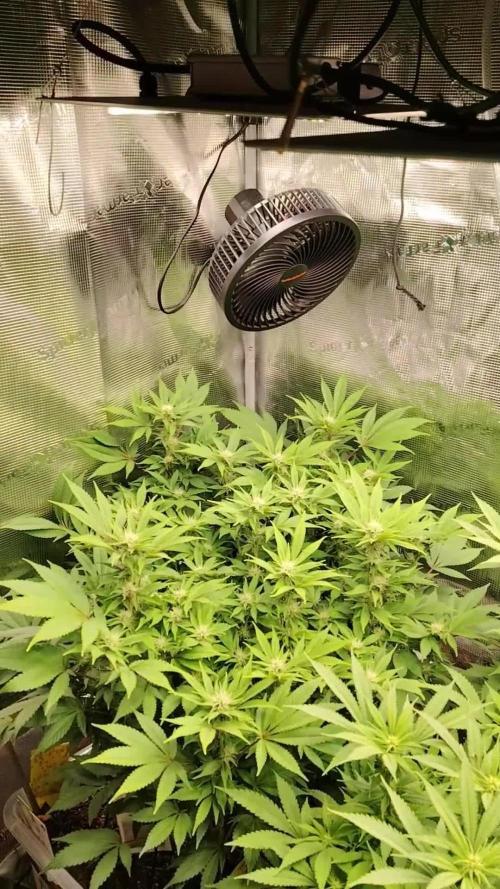
Back to low maintenance. Getting closer to harvest! Giving it a little longer to fatten those buds up.
Likes
93
Share
Welcome to the Zamnesia Spring Cup 🏆 Hello everyone :-) A lot has happened this week 🤗. It has developed very nicely and its roots have exploded properly 😍. It is also slowly becoming lighter, since it has obviously been slowly consuming its nutrients from the soil :-) That is why it was repotted today, mixing 3 layers with a total of 60-75 g Monster Bud Mix between the soil. Then everything was mixed and distributed well, and the plant used. Unfortunately I noticed too late that I didn't take any pictures of the root ball while repotting 🤦‍♂️🏻. I look forward to seeing how it evolves this week. Above all, I am excited to see how she is doing with the Monster Bud Mix, as I have been used to mixing everything for each wash separately 😊. During the course of this week I will also spontaneously decide whether I will give her an LST, topping fimming, etc., since I have to see how I am in the vegi phase, because the Spring Cup has a limited time 😁. I wish you all a lot of fun watching, have a nice week, stay healthy 🙏🏻 and let it grow ☘️👍 . Zamnesia Spring Cup 🏆 Type: Runtz ☝️🏼 ☝️🏼 Genetics: Zkittlez x Gelato 👍 😍 Vega lamp: 2 x Todogrow Led Quantum Board 100 W 💡 Bloom Lamp : 2 x Todogrow Led Cxb 3590 COB 3500 K 220 W 💡💡☝️🏼 Soil : Canna Bio ☝️🏼 Nutrients : Monster Bud Mix ☝️🏼🌱💪🏻 Water: Osmosis water mixed with normal water (24 hours stale that the chlorine evaporates) to 0.2 EC. Add Cal / Mag to 0.4 Ec Ph with Organic Ph - to 6.0 - 6.3 💦💧
Likes
56
Share
@Prof_Weed
Follow
Okay vor 5 Tagen Blüte eingeleitet,ist ja 137 cm hoch und 140 cm breit.. Wird ne ordentliche Hydroponic Pflanze die Purple Lemonade von Fast Buds!!
Likes
2
Share
Likes
15
Share
Her perfume is so unique this skunky girl already gave me two seeds that germinated today and her smells are amazing
Likes
19
Share
@Comfrey
Follow
Tropicana had to go back indoor because the temperature outside is the opposite of tropical. I took off two leafs and gave her time to relax after. Everything is fine and I can already smell something when I‘m near to her. 🤭☺️ Where is the sun? Preparing for sun storm!
Likes
47
Share
What's in the soil? What's not in the soil would be an easier question to answer. 16-18 DLI @ the minute. +++ as she grows. Probably not recommended, but to get to where it needs to be, I need to start now. Vegetative @1400ppm 0.8–1.2 kPa 80–86°F (26.7–30°C) 65–75%, LST Day 10, Fim'd Day 11 CEC (Cation Exchange Capacity): This is a measure of a soil's ability to hold and exchange positively charged nutrients, like calcium, magnesium, and potassium. Soils with high CEC (more clay and organic matter) have more negative charges that attract and hold these essential nutrients, preventing them from leaching away. Biochar is highly efficient at increasing cation exchange capacity (CEC) compared to many other amendments. Biochar's high CEC potential stems from its negatively charged functional groups, and studies show it can increase CEC by over 90%. Amendments like compost also increase CEC but are often more prone to rapid biodegradation, which can make biochar's effect more long-lasting. biochar acts as a long-lasting Cation Exchange Capacity (CEC) enhancer because its porous, carbon-rich structure provides sites for nutrients to bind to, effectively improving nutrient retention in soil without relying on the short-term benefits of fresh organic matter like compost or manure. Biochar's stability means these benefits last much longer than those from traditional organic amendments, making it a sustainable way to improve soil fertility, water retention, and structure over time. Needs to be charged first, similar to Coco, or it will immobilize cations, but at a much higher ratio. a high cation exchange capacity (CEC) results in a high buffer protection, meaning the soil can better resist changes in pH and nutrient availability. This is because a high CEC soil has more negatively charged sites to hold onto essential positively charged nutrients, like calcium and magnesium, and to buffer against acid ions, such as hydrogen. EC (Electrical Conductivity): This measures the amount of soluble salts in the soil. High EC levels indicate a high concentration of dissolved salts and can be a sign of potential salinity issues that can harm plants. The stored cations associated with a medium's cation exchange capacity (CEC) do not directly contribute to a real-time electrical conductivity (EC) reading. A real-time EC measurement reflects only the concentration of free, dissolved salt ions in the water solution within the medium. 98% of a plants nutrients comes directly from the water solution. 2% come directly from soil particles. CEC is a mediums storage capacity for cations. These stored cations do not contribute to a mediums EC directly. Electrical Conductivity (EC) does not measure salt ions adsorbed (stored) onto a Cation Exchange Capacity (CEC) site, as EC measures the conductivity of ions in solution within a soil or water sample, not those held on soil particles. A medium releases stored cations to water by ion exchange, where a new, more desirable ion from the water solution temporarily displaces the stored cation from the medium's surface, a process also seen in plants absorbing nutrients via mass flow. For example, in water softeners, sodium ions are released from resin beads to bond with the medium's surface, displacing calcium and magnesium ions which then enter the water. This same principle applies when plants take up nutrients from the soil solution: the cations are released from the soil particles into the water in response to a concentration equilibrium, and then moved to the root surface via mass flow. An example of ion exchange within the context of Cation Exchange Capacity (CEC) is a soil particle with a negative charge attracting and holding positively charged nutrient ions, like potassium (K+) or calcium (Ca2+), and then exchanging them for other positive ions present in the soil solution. For instance, a negatively charged clay particle in soil can hold a K+ ion and later release it to a plant's roots when a different cation, such as calcium (Ca2+), is abundant and replaces the potassium. This process of holding and swapping positively charged ions is fundamental to soil fertility, as it provides plants with essential nutrients. Negative charges on soil particles: Soil particles, particularly clay and organic matter, have negatively charged surfaces due to their chemical structure. Attraction of cations: These negative charges attract and hold positively charged ions, or cations, such as: Potassium (K+) Calcium (Ca2+) Magnesium (Mg2+) Sodium (Na+) Ammonium (NH4+) Plant roots excrete hydrogen ions (H+) through the action of proton pumps embedded in the root cell membranes, which use ATP (energy) to actively transport H+ ions from inside the root cell into the surrounding soil. This process lowers the pH of the soil, which helps to make certain mineral nutrients, such as iron, more available for uptake by the plant. Mechanism of H+ Excretion Proton Pumps: Root cells contain specialized proteins called proton pumps (H+-ATPases) in their cell membranes. Active Transport: These proton pumps use energy from ATP to actively move H+ ions from the cytoplasm of the root cell into the soil, against their concentration gradient. Role in pH Regulation: This active excretion of H+ is a major way plants regulate their internal cytoplasmic pH. Nutrient Availability: The resulting decrease in soil pH makes certain essential mineral nutrients, like iron, more soluble and available for the root cells to absorb. Ion Exchange: The H+ ions also displace positively charged mineral cations from the soil particles, making them available for uptake. Iron Uptake: In response to iron deficiency stress, plants enhance H+ excretion and reductant release to lower the pH and convert Fe3+ to the more available form Fe2+. The altered pH can influence the activity and composition of beneficial microbes in the soil. The H+ gradient created by the proton pumps can also be used for other vital cell functions, such as ATP synthesis and the transport of other solutes. The hydrogen ions (H+) excreted during photosynthesis come from the splitting of water molecules. This splitting, called photolysis, occurs in Photosystem II to replace the electrons used in the light-dependent reactions. The released hydrogen ions are then pumped into the thylakoid lumen, creating a proton gradient that drives ATP synthesis. Plants release hydrogen ions (H+) from their roots into the soil, a process that occurs in conjunction with nutrient uptake and photosynthesis. These H+ ions compete with mineral cations for the negatively charged sites on soil particles, a phenomenon known as cation exchange. By displacing beneficial mineral cations, the excreted H+ ions make these nutrients available for the plant to absorb, which can also lower the soil pH and indirectly affect its Cation Exchange Capacity (CEC) by altering the pool of exchangeable cations in the soil solution. Plants use proton (H+) exudation, driven by the H+-ATPase enzyme, to release H+ ions into the soil, creating a more acidic rhizosphere, which enhances nutrient availability and influences nutrient cycling processes. This acidification mobilizes insoluble nutrients like iron (Fe) by breaking them down, while also facilitating the activity of beneficial microbes involved in the nutrient cycle. Therefore, H+ exudation is a critical plant strategy for nutrient acquisition and management, allowing plants to improve their access to essential elements from the soil. A lack of water splitting during photosynthesis can affect iron uptake because the resulting energy imbalance disrupts the plant's ability to produce ATP and NADPH, which are crucial for overall photosynthetic energy conversion and can trigger a deficiency in iron homeostasis pathways. While photosynthesis uses hydrogen ions produced from water splitting for the Calvin cycle, not to create a hydrogen gas deficiency, the overall process is sensitive to nutrient availability, and iron is essential for chloroplast function. In photosynthesis, water is split to provide electrons to replace those lost in Photosystem II, which is triggered by light absorption. These electrons then travel along a transport chain to generate ATP (energy currency) and NADPH (reducing power). Carbon Fixation: The generated ATP and NADPH are then used to convert carbon dioxide into carbohydrates in the Calvin cycle. Impaired water splitting (via water in or out) breaks the chain reaction of photosynthesis. This leads to an imbalance in ATP and NADPH levels, which disrupts the Calvin cycle and overall energy production in the plant. Plants require a sufficient supply of essential mineral elements like iron for photosynthesis. Iron is vital for chlorophyll formation and plays a crucial role in electron transport within the chloroplasts. The complex relationship between nutrient status and photosynthesis is evident when iron deficiency can be reverted by depleting other micronutrients like manganese. This highlights how nutrient homeostasis influences photosynthetic function. A lack of adequate energy and reducing power from photosynthesis, which is directly linked to water splitting, can trigger complex adaptive responses in the plant's iron uptake and distribution systems. Plants possess receptors called transceptors that can directly detect specific nutrient concentrations in the soil or within the plant's tissues. These receptors trigger signaling pathways, sometimes involving calcium influx or changes in protein complex activity, that then influence nutrient uptake by the roots. Plants use this information to make long-term adjustments, such as Increasing root biomass to explore more soil for nutrients. Modifying metabolic pathways to make better use of available resources. Adjusting the rate of nutrient transport into the roots. That's why I keep a high EC. Abundance resonates Abundance.
Likes
14
Share
6/29 the past 3 days were 112, 115, and then 118 degree days. The plants held up fine but this one had some heat damaged leaves because of it. Also top dressed with a cup of one shot 7/3 watered with slf-100 and recharge
Likes
31
Share
Questa gorilla cookie cresce ben forte..spero arrivi al termine senza nessun intoppo.... Siamo arrivati alla fine della3 settimana. Tt procedere alla grande
Processing
Likes
16
Share
@osmrducks
Follow
Day 8: Woke up and checked on the ladies, they were bone dry. Hit em with 70 ml of AN Coco Grow diluted in my mix. Day 9: Got the new lights in today and hooked up. Girls are looking pretty good I think. Still letting em dry out a little. Gonna add a shot of Great White on next water. No nutes will be in this shot. Day 10: Still looking good. Had to stack some loose Coco around a couple as they had a good stretch going and were leaning pretty good. Also noticed a couple of brown spots on the leaves. I am led to believe after asking questions and researching, it is more than likely nute burn? No more nutes for these girls for a while. I also got a humidifier to raise humidity as it was pretty low. Day 11: These girls almost double in size every day! They would probably be a little bigger if I hadn't of tried to give em a drink of nutes earlier on! Lesson learned!! Not bad for 6 days out of the ground regardless though, I think. Got a humidifier in the tent and it stays around 50% now. Other than last night it got up to 73%. I need to get that fixed. Day 12: Nothing new to update other than they look healthy. Think I am gonna let them dry out a touch more before watering. Day 13: Gave the girls 1 cup of ph 6.0 water this morning. Thermostat battery went out and lucky my girl caught it in time. Temp got to 86° for a couple of hours. Opened the tent for an hour to get the temp back down. Humidity has been hovering around 50% for the most part. Minor fluctuations here and there. Girls are looking good for 8 days out of the earth though!! 💪 Day 14: Looking like they need another drink, dry down to around 1" deep. Gave em 2.25 cups with super diluted Coco Grow and a touch of Great White. 😳 They are doing great! 👍 Looking forward to see what week 3 has in store! Going to build a support to add my 2 CREE lights back in along with the Mars lights.
Likes
5
Share
shes looking great loads of frost all over responded well to a vigerous topping when she was young but came through a trooper beautiful cant wait hehe 💪💯
Likes
35
Share
Unfortunately, I had to find out that my account is being used for fake social media sites. I am only active on growdiaries here. I'm not on Facebook Instagram Twitter etc. All accounts except this one are fake. Have fun with the update. Hey everyone 😀. The plant develops as it should 😍. It grows very well and very beautifully. She also coped with the topping very well, so I will top it a few more times before it finally goes to the flower tent 😃. Until then, I wish eucb a lot of fun until the next update. Stay healthy and let it grow 🙏🏻 You can buy this Strain at : https://www.zamnesia.com/de/3271-zamnesia-seeds-blue-dream-feminisiert.html Type: Blue Dream ☝️🏼 Genetics: Blueberry x Haze 20% Indica / 80% Sativa 👍 Vega lamp: 2 x Todogrow Led Quantum Board 100 W 💡 Bloom Lamp : 2 x Todogrow Led Cxb 3590 COB 3500 K 205W 💡💡☝️🏼 Soil : Canna Coco Professional + ☝️🏼 Fertilizer: Green House Powder Feeding ☝️🏼🌱 Water: Osmosis water mixed with normal water (24 hours stale that the chlorine evaporates) to 0.2 EC. Add Cal / Mag to 0.4 Ec Ph with Organic Ph - to 5.5 - 5.8 .
Likes
Comments
Share
Likes
10
Share
@Rangaku
Follow
lil Zstraw is filling out nicely and flying right along , same same next week . I’m so happy I held on to her
Likes
8
Share
@Zark002
Follow
Segue engordando bem, sem muitas novidades, estou regando apenas com água há 7 dias e vai assim até o final
Likes
2
Share
Lovely start and lovely end to week 1