


Likes
Comments
Share




Likes
18
Share


@DreamIT
Follow
Sponsored by:
🌴SPLIFF SEEDS🌴-💡VIPARSPECTRA💡-💐GREEN BUZZ LIQUIDS💐-🛠️WEDRYER🛠️
28/7 almost ready to go into bloom. They perform well and grow even better. we will see how they behave at the switch
2/8 it took a few days of absence to discolor the leaves and dry out the soil. Today I will be watering properly with Green buzz nutrients fertilizers before sending them into bloom
__________________________________________
Personal advertising (contains affiliate links)
__________________________________________
🦄 Are you new to the world of cultivation and don't know where to safely buy your seeds?
Fast and anonymous shipping. Check out their hilarious graphics. (no affiliate links)
✅https: //bit.ly/spliffseeds_
__________________________________________
Did you know that Green Buzz Liquids fertilizers are 100% vegan? A complete line of products ready to give the best to each of your plants! Visit the site and see my journals to see how they work 🦄
🤯 And with the code "dreamit" you will immediately receive a 15% discount on your purchases
✅https: //bit.ly/GreenBuzzLiquidsPro
__________________________________________
👀 Are you looking for a good lamp to start with? 👀
🌞Viparspectra has something more than the others, take a look at their site.
⏩ Use "GDVIP" for an extra discount or "DREAMIT3" for an extra 5 %% discount
👀 Search for it on Amazon
✅Amazon USA: https://amzn.to/30xSTVq
✅Amazon Canada: https://amzn.to/38udUVe
✅Viparspectra UE: bit.ly/ViparspectraUE
✅Viparspectra USA: bit.ly/ViparspectraUS
______________________________________________
🌈 Tired of blowing on your weed hoping it dries quickly? Check out the Wedryer website! You will find a well-made accessory that will help your weed dry in just 8-10 days without the annoying risk of finding mold or other annoyances! (no affiliate links)
✅https: //bit.ly/Wedryer_
______________________________________________
📷🥇Follow the best photos on Instagram 🥇📷
https://www.instagram.com/dreamit420/
Backup
https://www.instagram.com/dreamit4200/
🔻🔻Leave a comment with your opinion if you pass by here🔻🔻
🤟🦄💚 Thank you and good growth 💚🦄🤟

Likes
174
Share

@Schnabeldino
Follow
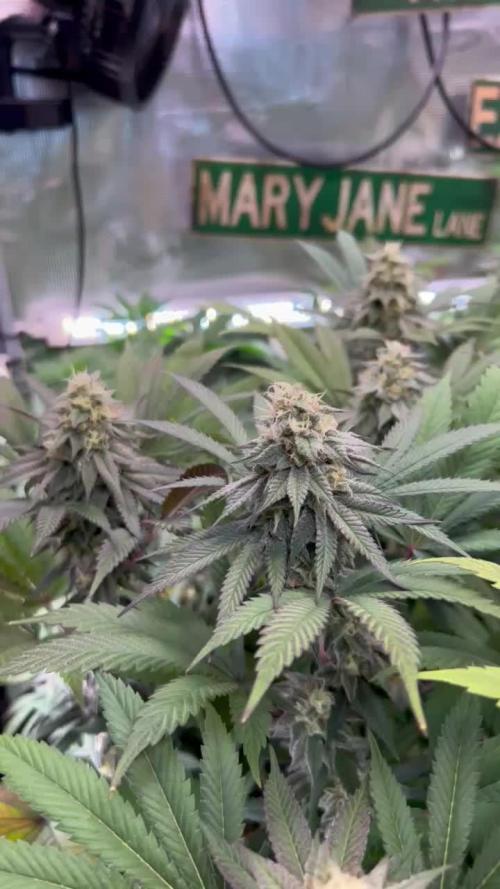
📅 Week 12 | 🗓️ Day 78–84
Day 84 – 4-5 week of flower 🌸 Lemon Cherry Runtz 🍋🍒
🔸Nothing much happened this week. I spent a few days in London with friends and watching the NFL London Game between the Denver Broncos and New York Jets, my mother took great care of the ladies, hehe. 😇
🔸Conditions are stable over the entire period. I am very excited.
📈 Current Conditions (Day 77)
🌡️ Day = 26 °C
🌡️ Night = 19 °C
💨 Humidity = 55%
🌬️ VPD = 1.4 – 1.6 kPa
🔦 PPFD = ~1000 µmol (12/12)
🛠️ Setup (unchanged)
💡 2 x SANlight Evo 4-120 @100%
⛺ 120 x 120 x 180 Spiderfarmer tent
🍯 Pots: 18L fabric pots
🌱 Soil: Bio-Bizz Light Mix
💊 Nutrients: BIO Tabs
🌱 “Easy, organic, only-water method. Save 15% with GDBT420. biotabs.nl/en/shop/”

Likes
11
Share


@TechDCo
Follow
12/02/2024
13/02/2024
MS is growing funny 😁
TF has exactly the same feed mls.
Shes looked forever hungry
14/02/2024
Lite Defoll.
Midday.
TF has never looked the healthiest with the first time using HydroSol + H202 water soluble feed.
I think i have the ratio/some sroted to where I've seen improvements.
First improvements i have seen are:
1. NO Nutritional burn or Lockout!
(non-salt based). P.s ignore the over salas 12% HP at the start (no idea what i was thinking).
Sometimes being ahead; means i am a being with a head that makes human errors. Oh, the joys of plant-discovery. Sorry side tracked lol
2. Quicker Absorbing witb water soluble food. As long as she's hydrated she's eating!
3. No idea yet
Have a ball!!
Listening to this relaxing and i started thibking about Spirituality and how its included in all faiths. But if say "Jesus Christ is a façade and all religions are based on astrological events painted with fictional characters to repent the Christological doctrine to "date" the past.
21 Ways Archaeologists Date Ancient Artifacts are mostly flawed because they only have the "present" to date decay from. They miss the mark and the professionals deliberately push the religious artifacts to match up to the hollyword.
So who's to say what "Date & Time" we are currently living in!
In reality; we can only measure and date time from the the last natural apocalypses or near misses, dor we are the surviours from such events..
Look round at real history! What mordern day academics just brushed under the rug with some made up theories of what they like us to believe happened. Even they are in a Dilemmas (government's) have the knowledge of these such events.
SpaceX and Nasa are all doomsday preppers! As for India going to the moon 🌙 seriously 😐 who's buying this stuff?
I've let go so much that the whole world is my own intention and floods my brain with endorphins of being the observer. The reason we are all "consciousnesses" and in sudden alert of awareness of this world and being alive is because we are in the end time again! We have all woken up to everything because the omens of the apocalypse alerts and kicks in certain parts of the DNA to force memories to the soul like "hey you need to remember this and get somewhere safe"
17/02/2025
Vast improvements
18/02/2025
Defolled to make way for fast growth

Likes
Comments
Share


@Chronickarl
Follow
Finally moved into their forever home and final pots all seems generally good,it's abit tricky with multiple strains as they all react differently so trying to balance and learn what each strain likes is abit harder,net is in place and already using it to spread the canopy out for more top nodes and coverage

Likes
37
Share


@Ruediger
Follow
Tag 34 - Die kleinen gedeihen prächtig 😁
Bin mir allerdings nicht sicher wie lange ich sie noch in der Wachstumsphase lassen sollen, habe die Befürchtung dass das Zelt bald voll ist 😅
Habe heute die Triebe wieder zurechtgerückt um alles möglichst gleich hoch wachsen.
Und hab heute ca. 1,5l gegossen.
Tag 35 - ich Kapp denen jetzt jeden Tag 2 Stunden Licht um sie langsam auf die Blüte vorbereiten, also ab heute bekommen sie 16/8

Likes
6
Share


@daybreaksky
Follow
Started LST not planning on topping. The plant looks a couple of days away from starting to flower

Likes
4
Share

@GREENPHOENIX6262
Follow
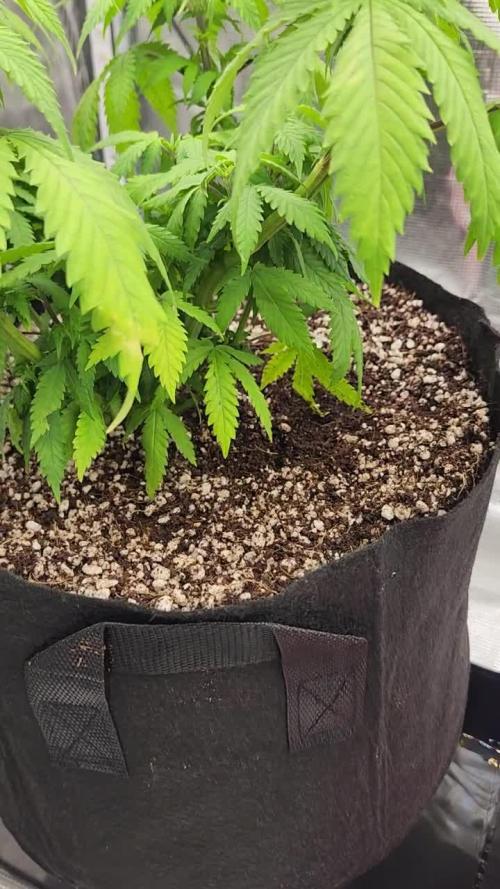
03/1 - Applied LST last week - thus far no issues - Gave her a top dressing of warm castings - increased nutrient formula by .5 on all nutrients. She will be transferred out of the nursery tent within this coming week and moved into the 4x4 to run alone and prep for clone picking.
03/04 - Transplanted into a 5 gallon pot & transferred into the 3x3 to run alone for clone prep - topped 8 more additional sites - She is running under the 3x3 Sunraise QB3000.
03/08 - Closing out the week on a hiccup - Got careless with the EC/PPM and PH and she went kind of neon on me and leaves began to dip - Since then I gave her a clean water feed to drop levels with PH down - She is bouncing back


Likes
23
Share


@NSCanna
Follow
Buds are fattening up pretty well and I've had to use more rubber garden wire and clips to keep the branches from bending over. Smell is increasing on the Northern Light but still a mild skunk on the Black Devil. Also gave the very last feeding on the plants this week so they will get nothing but water until the chop.
I'm very happy with the microbe populations so I stopped feeding the sugars (molasses/agave) as the plants themselves don't get much out of them; that stuff is just for feeding the soil beasties. I had added some predatory mites several weeks ago to deal with some springtails, and the mites annihilated the population. I did find a developing larva though so there are still some around. Posted lots of microscope videos today.


Likes
14
Share


@inhale_exhale
Follow
This week was no less stressful, but the previous week prepared us.
More and more snow turns white. The microscope is ready.
Nutrient solution at the maximum recommended parameters. But there is a problem with the tips of the leaves, they turn yellow first and then dry up and turn brown. I think this is the consequence of the maximum ppm. direct sunlight, a running giant fan at a distance of 20 cm, and an unstable ph lvl.
There were significant changes in temperature from 16 at night to 31 during the day. The funnest is when it rains after a hot day. and they turn off the electricity at night.
A humid environment of 65-70% without a fan is my nightmare in reality. So a piece of cardboard and energetic hand movements created the wind and the impression that I crazy
But there are often good times, when the temperature is 26-27 degrees and the humidity is 45% without a humidifier.
The girls smell amazing 😎
Likes
22
Share


@Top_Banana
Follow
Almost harvest time.. She's filled out some more this past week. Most fan leafs have fell off the plant so it wont be much longer for sure.. most sugar leafs are full amber now just waiting for the buds..
Likes
35
Share


@g_slim
Follow
The plants are comming along nicely. They got some horsetail extract in the past 2 weeks, nothing else. I will top dress with a handful guano the comming days.
The sativa pheno seems to be the furthest aong in terms of trichromes. We will see, when we start looking at the trichromes with a microscope soon.
Numbers 1 and 7, the indica phenos, are similar. Only number 1 is lagging behind 7-10 days.
All plants started to receede from their bigger lower fan leaves. I keep picking them of as they turn yellow.
Happy growing everyone!


Likes
22
Share


@MELs_Garden
Follow
Del 5 al 12 de julio
Buenas a todos otra semana más.
La cosa avanza bien y Esta va a ser la última semana que actualizamos únicamente una vez por semana, volveremos a las actualizaciónes diarias.
Continuamos con nuestro LST diariamente.
8 y 9 de julio
Usamos el quemador de azufre alrededor de unas 5-6h como preventivo ante posibles plagas.
10 de julio
Hoy a tocado poda (bastante severa) podamos algunas hojas y seguimos doblando las ramas. Las dpblamps entre si, por debajo, por arriba... Por todos lados, es una salvaje.
Las temperaturas están siendo muy buenas en comparación a lo que me llegan en cuanto a los indoors de mi alrededor y de otros compañeros.
Tenemos unos 25 - 26°C en On cpn Max de 27.8°C y mínimas en pdf de 23°C.
Preparados porque viene lo bueno.
11 de julio
Regamos vía foliar 1 ml aceite de nem + 10ml spruzit + 1 ml de un producto que nos dieron para probar como preventivo e insecticida. De este mismo liquido inundamos la bandeja unos centímetros para realizar un riego vía absorción.
¿ Por qué ?
Pues porque los trips se alimentan en la superficie pero viven en la tierra, y muchos de estos están en la parte inferior de la maceta por lo que no tendran salida estos bichillos. Mi guerra con ellos ya viene de tiempo atrás y quiero mantenerlos a raya.
Likes
3
Share


@Weeder_am_Start
Follow
Los geht es mit dem Testgrow der Medic Grow Mini-Sun 2 mit 500W!
Auf 100x100cm, in einem gedämmten Growroom, baue ich 2x Sensi Skunk an und versuche den Raum mit diversen Techniken so weit es geht auszufüllen.
In dieser Woche habe ich aber erst mal das selbst gebaute DWC System einsatzfertig gemacht und den Sämling eingesetzt.
Das DWC System besteht aus einem 30L Eimer, einer Aquaforte Luftpumpe mit 30L Luft pro Minute und 2x Aquaforte Ausströmer mit 20cm Durchmesser.
Zum Ende der Vegi Woche 1 hat sich schon so einiges getan, aber schaut euch die Bilder an!
Link zur Lampe (Medic Grow Mini-Sun2 500W)
http://medicgrow.growtackle.de/
Gutscheincode für MedicGrow (5% Rabatt): DocGreen

Likes
126
Share


@nonick123
Follow
Día 69 (25/03) Su hermana Gorilla Cookies FF muestra una ligera necrosis... me preocupa...
Día 70 (26/03) Necrosis en Gorilla Cookies muy avanzada en solo 2 días. Hablo con el gran @dogdoctorofficial y me hace ver que estoy regando mal...
He dejado que se seque demasiado el sustrato! (como en la fase vegetativa) Y la Gorilla Cookies FF al ser la planta más grande y que más agua pide, está demasiado sedienta...
Voy a modificar los patrones de riego para que el problema no persista en Gorilla Cookies FF ni aparezca en las otras plantas!
Riego 0,5 Litro H20 sin nutrientes. TDS 225 PPMs - pH 6,6
Día 71 (27/03) Riego 1,25 Litro H20 + Wholly Base 3 ml/l + Solid Green 1,75 ml/l + Early Flower 0,75 ml/l + Big Bloom 1,5 ml/l de Gen1:11
TDS 1150 PPMs - pH 6,2
Día 72 (28/03) La necrosis en Gorilla Cookies FF se ha detenido 😁 y las flores siguen creciendo
Observa alguna mancha de necrosis también en Wedding Cheesecake FF y decido a subir un poco la lámpara
Ahora el PPFD en apical es de unos 830 PPFD
Día 73 (29/03) Riego 0,5 Litro H20 sin nutrientes. TDS 225 PPMs - pH 6,6
Día 74 (30/03) Riego 1,25 Litro H20 + Wholly Base 3 ml/l + Solid Green 1,75 ml/l + Early Flower 0,75 ml/l + Big Bloom 1,5 ml/l de Gen1:11
TDS 1150 PPMs - pH 6,2
Día 75 (31/03) Detecto una ligera necrosis en Purple Lemonade FF y en Wedding Cheesecake FF.
Voy a aumentar un poco la distancia de la lámpara para tener un DLI de 37, por si fuese estrés por luz.
💦Nutrients by Gen1:11 - www.genoneeleven.com
🌱Substrate PRO-MIX HP BACILLUS + MYCORRHIZAE - www.pthorticulture.com/en/products/pro-mix-hp-biostimulant-plus-mycorrhizae
Likes
12
Share
@ThatsmyGrow
Follow
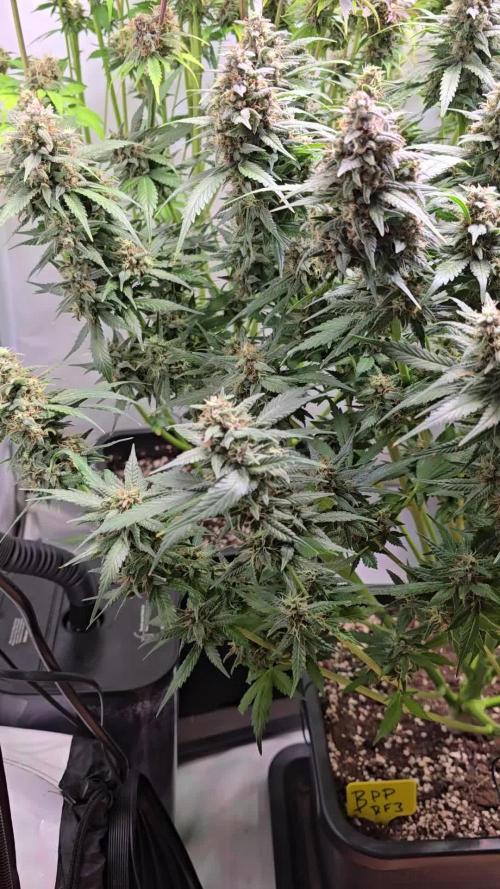
Its the last week befor we Flash. I love the buds, they are fat like a cola can. They smell like lemon, its a crazy pheno
Likes
2
Share


Likes
29
Share


@GrownwithLED
Follow
The one plant of STRAWBERRY SOUR DIESEL harvested 49,3 gram of EXCELLENT dried bud. That makes her the second lowest yielder of my tent. The buds are GLISTENING with trichomes and the smell is sooooooo sweet snd soooooo delicious, she is mouthwatering! My plant grew tall with long internode distances, so I had to super-crop her in order to control her height. She grew healthy all thru the cycle and had developed very nicely.


Likes
114
Share


@Coco4CocoPuffs
Follow
Well we are now at DAY 70 from seed and 42 Days of Flowering 🍉 🍉 🍉
So shes been doing reall well ☺️
I have moved the feeding to accommodate the next step in flower 😀
So there now full steam ahead 😋 yet again
🍉 🍉 🍉 🍉 🍉 🍉 🍉 🍉 🍉 🍉 🍉 🍉 🍉 🍉 🍉 🍉 🍉 🍉 🍉 🍉
Thanks 😊 my friends for the support 🙏👊
Likes
7
Share


@Ms_Herbalist
Follow
Full of resin 😍 smells amazing
Curr it properly and you can smell the papaya and gassy tones
