Likes
Comments
Share


@illegal_brain
Follow
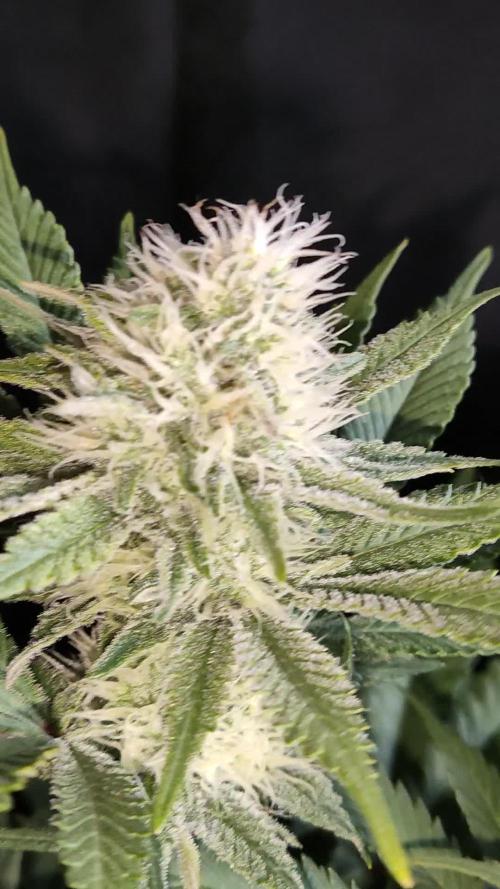
Wonderful harvest! Plants were very dense and frosty and smell was super strong. I made sure to wear gloves so my hands weren't sticky the rest of the day.
Very happy with this strain, it seemed to produce quite a bit of dense frosty bud. Nice deep purple leaves at the end. Will update with a smoke report after a 6 day dry, 30 day cure in my Cannatrol.


Likes
13
Share


@FlavoursUk
Follow
Week 2 of flower, RO water change with an EC of 1.3. Will adjust from here and observe the next day or two.
Although you watched as I did a major defoliation, as you can see, they have bounced back pretty quickly. As of now, I will be defoliating every few days just to keep the light penetrating the canopy so we have some nice buds come harvest time.
Will be back to update in a few days to update where they are at and if they need more nutrients. pH is set and stable.
Stay tuned until the next update and follow my YouTube and Instagram (Link on growdiaries profile)

Processing
Likes
10
Share


@BodyByVio
Follow
After 21 days in turbo cloner I transplanted 4 Sweet seeds Green Poison into 1 gallon plastic pots filled with Cana coco. Few days later I transplanted another 4 clones into DWC!
Stay tuned!
Coco feed at 700ppm
Dwc feed at 480ppm



Likes
Comments
Share


@Yiyis_Grow
Follow
Se usó pk1314 de Canna esta semana.
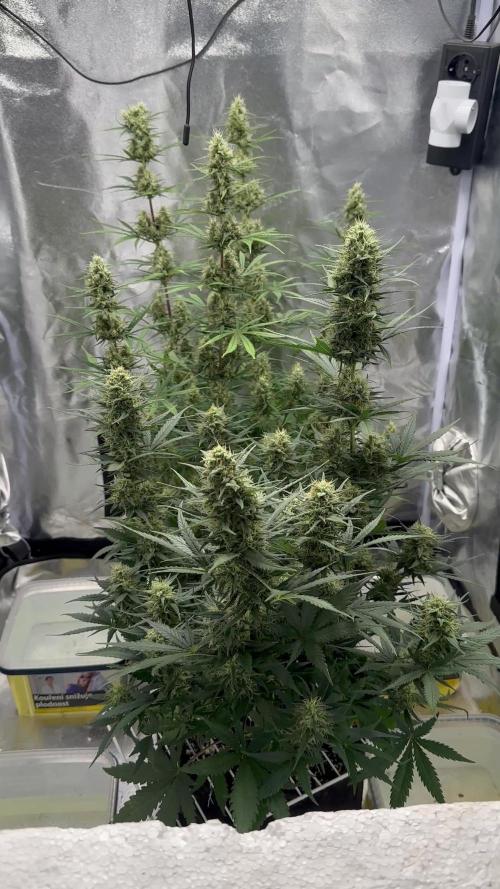
Las plantas tienen muy buen aroma y están pegajosas.
En cuanto al tamaño, si han aumentado de tamaño, pero no lo que esperaba. Hay dos que van un poco más retrasadas y espero que en semana 10 aumenten más de volumen.
La planta que no estaba tomando agua ahora está bien, volvió a la normalidad.
La planta con manchas en la hojas se quemó con el pk1314, no estaba lista. Nunca lo estuvo, no debí echarle.
Semana con nutriente de floración al 100% y potenciadores.
- Luz: Bestva Pro 2000W / 18 h/d
-FloraNova Bloom G.Hydroponics: 0.7ml/l
- Bio Bud G. Hydroponics 2.5ml/l
- Armour SI G. Hydroponics 0.4ml/l
- C4 Mills 1ml/l
- Everest: 0.5 ml/l

Likes
35
Share


@MadeInGermany
Follow
Info:
Unfortunately, I had to find out that my account is used for fake pages in social media.
I am only active here on growdiaries.
I am not on facebook instagram twitter etc All accounts except this one are fake.
Bloom day 70
since time change
to 12/12 h.
Hi everyone :-)
We have slowly reached the end 👍.
Tomorrow the lady will be rinsed a little so that she can be harvested in the next 5-10 days :-).
Before that, she comes to the darkroom for 48 hours.
Have fun and stay healthy 🙏🏻
You can buy this Strain at :
https://www.zamnesia.com/de/3271-zamnesia-seeds-blue-dream-feminisiert.html
Type:
Blue Dream
☝️🏼
Genetics:
Blueberry x Haze
20% Indica / 80% Sativa
👍
Vega lamp:
2 x Todogrow Led
Quantum Board 100 W
💡
Bloom Lamp :
2 x Todogrow Led
Cxb 3590 COB 3500 K 205W
💡💡☝️🏼
Soil :
Canna Coco Professional +
☝️🏼
Fertilizer:
Green House Powder Feeding
☝️🏼🌱
Water:
Osmosis water mixed with normal water (24 hours stale that the chlorine evaporates) to 0.2 EC. Add Cal / Mag to 0.4 Ec Ph with Organic Ph - to 5.5 - 5.8 .

Likes
6
Share

@Paying_Customer
Follow
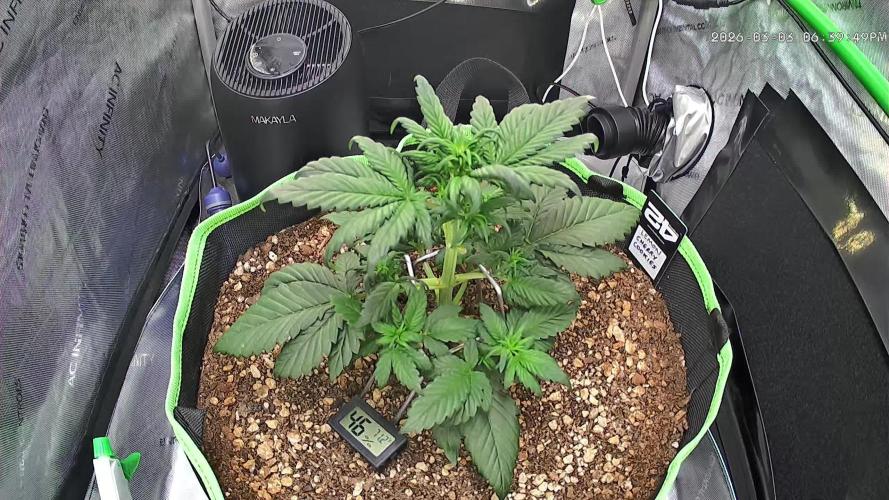
Started flowing after about 25 days in Veg. She stayed very compact but all the sudden she’s growing rapidly bumped up the lighting to 600 ppfd and have side lights on full getting about 550 ppfd under the canopy which is better than 150 ppfd without the side lights. The leaves have a curl on the ends I think maybe it had too much Nitrogen in early veg leaves were extremely dark green. I'm still learning this is only my 3rd grow hopefully I keep learning from my mistakes. Accidentally broke one branch that had multiple bud sites I think it snapped while plant kept getting taller and the pressure made it break and me not knowing this broke it the rest of the way when resetting the metal stakes. Hopefully it doesn't affect it too much, I know I should've just left it alone.
Likes
Comments
Share

@DogDoctorOfficial
Follow
🍮 Chem Brûlée – Pheno B
Week 10 | She's Hungry for More… and She's Still Shining 🌸❄️🔥
Welcome back to another week of the 8×8 Adventure! 💚🌱
And I have to admit...
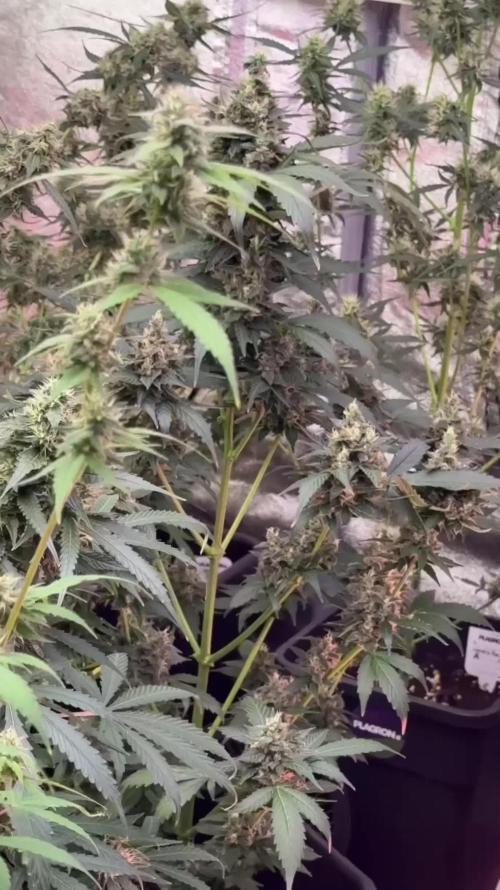
Chem Brûlée Pheno B is looking beautiful.
Really beautiful.
She's got that unmistakable personality we've been watching develop week after week, and the further we move into flower, the more clearly she's showing us exactly who she is.
She's demanding.
She's hungry.
She's definitely not the quiet girl in the room. 😂
But she's also growing amazingly.
The flower formation is getting better and better.
The structure is becoming more impressive.
And those developing flowers are giving us plenty of reasons to stop, grab the camera, and take another look.
So this week...
we're putting the spotlight right back where it belongs.
On this beautiful, demanding girl.
🍮🌿🌸
🌱 Week 10 – She's Still Doing Her Thing
Chem Brûlée Pheno B has never really been interested in following anybody else's schedule.
And honestly?
I wouldn't have it any other way.
She's continued moving forward in her own rhythm, building on the structure she created earlier in the run.
She's around 130 cm, and that taller, more open architecture remains one of the characteristics that immediately separates her from her sister.
But now the structure is becoming secondary to what it's carrying.
The flowers.
And they're looking fantastic.
This week, when I look at her, I don't see a plant that's simply flowering anymore.
I see a plant that's building flowers with purpose.
And that's a very exciting transition.
🌸 The Flower Formation Is Beautiful
This is probably the first thing I want to highlight this week.
Her flower formation.
It's getting seriously beautiful.
The developing buds are becoming much more defined, and the individual flowering sites are starting to show much more character.
Those long white pistils are still reaching out everywhere, creating that almost explosive appearance around the flowers.
And underneath them, the actual bud structure is becoming increasingly substantial.
You can see the plant putting everything together.
Layer by layer.
Week by week.
Flower by flower.
It's still not the finished product, obviously.
There's plenty of development ahead.
But we're getting to that point where the imagination starts doing some of the work.
You look at a flower today...
and start wondering what it's going to look like several weeks from now.
And with this girl?
I genuinely don't know.
😂
That's what makes it fun.
🌿 That Beautiful Green Is Coming Through
And there's another thing I really appreciate when I look at her now.
She's looking beautifully alive.
The foliage has a strong, healthy presence, and the whole plant has that feeling of being actively engaged in flowering.
She's not sitting there quietly.
She's working.
And working hard.
This phenotype has always had a different character from Pheno A, but now that we're deeper into flower, those differences are becoming even easier to appreciate.
She's got her own architecture.
Her own flower formation.
Her own rhythm.
And definitely...
her own appetite.
🍽️ She's Definitely a Hungry Girl
I have to admit it:
this one is demanding.
Looking at her progression, I get the feeling that she could happily sit down at the dinner table and ask:
"Is that all?" 😂🍽️🌿
She seems to be using everything the environment is giving her incredibly enthusiastically.
And while I'm not going to pretend that one visual observation tells us exactly what a plant needs, this girl certainly gives the impression that she has a strong appetite.
She's growing.
She's flowering.
She's developing.
She's capturing light.
And she's putting that energy somewhere.
The interesting thing is that she's doing all of this while still showing us that distinctive phenotype expression we've been following since the beginning.
So rather than trying to force her into someone else's idea of what she should look like, I'm simply continuing to watch her closely.
Because she's clearly got something to say.
And apparently she's saying it with an appetite. 😂
💡 She's Catching Every Photon She Can
And that brings us to one of my favourite subjects in these weekly reports:
photons.
Because when I look at this girl, I genuinely think about how much invisible energy is passing through her canopy every day.
The Black Series LEDs are sending photons into the room.
Those photons encounter leaves.
The leaves capture what they can.
And the plant uses that captured light energy to power its biological processes.
We don't see the photons.
We see the result.
The green leaves.
The developing flowers.
The increasing structure.
The growth.
The resin.
The plant itself becomes the visible record of all that invisible energy moving through the system.
And Chem Brûlée Pheno B?
She's clearly trying to catch every photon she can.
💡🌿
☀️ The Canopy Is Her Solar Field
I really like thinking about the canopy this way.
Every leaf represents another opportunity to intercept light.
Every angle matters.
Every layer of the plant creates a slightly different relationship with the light above it.
And this girl's architecture gives us a particularly interesting example.
She's taller.
She's more open.
Her branches occupy different heights.
Her flowers aren't all sitting in exactly the same place.
So the photons entering the canopy aren't interacting with one flat surface.
They're moving through a three-dimensional plant.
And that's why the additional lighting within the room is so interesting to me.
We're not simply thinking about the top of the plant.
We're thinking about how useful light reaches different parts of the entire structure.
The plant has built the architecture.
The lighting provides the photons.
And together...
we get to watch what happens.
💡 Same Photons. Different Stories.
And this is where the 8×8 Adventure gets really interesting.
The photons don't know which phenotype they're hitting.
The same general lighting environment is shared by the room.
But look at the results.
Pheno A tells one story.
Pheno B tells another.
Different height.
Different structure.
Different flower arrangement.
Different foliage expression.
Different appetite.
Different personality.
That's the beauty of having these plants growing side by side.
The environment gives us a common foundation.
The genetics write the individual story.
And Chem Brûlée Pheno B is writing hers in a very interesting way.
🌸 She's Putting That Energy Into Flowers
And when I look at the photographs this week, that's probably the most satisfying part.
She's not just producing foliage.
She's building flowers.
The developing buds have more definition.
The pistils are becoming increasingly prominent.
The flower structures are becoming more substantial.
And the whole plant has a sense of progression.
It's one of those moments where the photographs from previous weeks become extremely valuable.
Because when you see a plant every day, change can be difficult to appreciate.
But put Week 5 beside Week 8...
then Week 9...
then Week 10...
and suddenly you realize:
Wow.
She's really moving.
📸🌸
❄️ And the Frost Is Joining the Party
The developing resin is another part of the story that's becoming increasingly enjoyable.
Those close-up photographs reveal little details that disappear completely when you're standing across the room.
The sugar leaves.
The pistils.
The developing trichomes.
The texture of the flowers.
The little structures forming around the buds.
It's almost like looking at an entirely different plant.
And that's why macro photography has become such a big part of this adventure for me.
The wide photograph tells you:
where she is.
The macro photograph tells you:
what she's becoming.
And Chem Brûlée Pheno B is becoming increasingly interesting.
🌿 Her Architecture Is Working
One thing I really appreciate about this phenotype is that the architecture she created earlier in the grow is now becoming useful.
She's tall.
She's open.
She's got flowers distributed throughout her branches.
And as those flowers develop, the structure becomes easier to understand.
We're not trying to make her into Pheno A.
We're not trying to compress her.
We're not trying to make her follow another plant's blueprint.
This is her blueprint.
And it's working for her.
That's one of the biggest lessons this whole project continues giving me.
Sometimes the best thing you can do is create a good environment...
and then get out of the plant's way.
💨 Air, Space & Balance
As the flowers continue developing, I'm still keeping an eye on the overall canopy.
The goal remains balance.
Enough foliage to support the plant.
Enough space for air movement.
Enough light reaching productive areas.
And enough observation to notice when something actually needs attention.
We're not trying to strip the plant.
We're not trying to create an artificial shape.
We're simply watching how the canopy develops and responding when appropriate.
She's already built a beautiful structure.
Now we let that structure carry her forward.
⚗️ The Environment Keeps Providing the Foundation
The room remains broadly consistent:
🌡️ Day temperature: ~29.9°C
🌙 Night temperature: ~25°C
💧 Relative humidity: ~60%
🥥 Substrate temperature: ~26°C
💦 Solution temperature: ~25°C
⚗️ pH: ~6.0
⚡ EC: ~2.0 mS/cm
💨 CO₂: ~639 ppm
💡 Light schedule: 12/12
? Pot size: 15 L
💧 Watering: ~1.3 L/plant/24h
📏 Height: ~130 cm
And once again, the interesting thing isn't simply the numbers.
It's how the plant responds to the whole environment.
Chem Brûlée Pheno B is showing us that she's capable of putting a lot of that available energy toward continued flowering.
She's certainly not wasting the opportunity.
⚗️ Feeding – This Girl Has an Appetite
The nutrition strategy remains part of the shared-room approach:
🌱 Plagron Terra Bloom – 2.2 ml/L
🌱 Plagron Green Sensation – 1 ml/L
🌱 Plagron Power Buds – 1 ml/L
🌱 Plagron Sugar Royal – 1 ml/L
With pH adjustment as required.
Current solution:
pH ~6.0
EC ~2.0 mS/cm
And this is where I want to continue paying particular attention to her.
Because visually, she gives me the impression of a plant with a healthy appetite.
She's eating.
She's growing.
She's flowering.
She's using the resources available to her.
That doesn't automatically mean that changing anything is necessary, but it does make her an especially interesting phenotype to watch.
She's clearly telling us:
"I'm hungry." 😂
And I'm listening.
📸 Behind the Lens – She Deserves the Spotlight
The camera loves this girl.
Seriously.
😂📸
There's something about the combination of her longer structure and developing flowers that makes her incredibly fun to photograph.
You can photograph the entire plant...
and appreciate the architecture.
Then move closer...
and suddenly you're looking at those beautiful individual flowers.
Move closer again...
and the entire frame becomes pistils, resin and tiny details.
And that's when I really appreciate how unique she is.
She's not simply another Chem Brûlée.
She's this Chem Brûlée.
Pheno B.
Her own expression.
Her own story.
Her own little universe inside the 8×8.
🌿 Twelve Plants, Twelve Personalities
This is still one of my favourite parts of the project.
Twelve plants can share the same room...
and still feel like twelve completely different characters.
Some are quiet.
Some are demanding.
Some are tall.
Some are compact.
Some seem to drink like they're preparing for a marathon.
Others take things a little more slowly.
And then there's this girl.
She's basically standing there with an empty plate saying:
"More, please." 😂🍽️
But underneath the joke is something genuinely interesting.
The genetics influence how each plant uses the same environment.
And that's exactly what we're trying to document.
We're not creating twelve completely different worlds.
We're creating one environment...
and observing twelve different responses.
🔮 Where Are You Going, Pheno B?
And now I'm genuinely curious.
Because she's giving me a feeling that there could be something very interesting waiting further down the road.
The flowers are developing.
The structure is established.
The plant is active.
She's capturing photons.
She's consuming resources.
She's continuing to build.
So where does she go from here?
I honestly don't know.
And I'm not going to pretend I do.
That's the fun.
We'll keep watching.
We'll keep photographing.
We'll keep documenting.
And we'll let Chem Brûlée Pheno B reveal herself.
💭 Final Thoughts – Let the Hungry Girl Shine
If I had to summarize this week in a few words:
Beautiful. Hungry. Unique.
Chem Brûlée Pheno B is looking fantastic.
Her flower formation is getting better every week.
Her pistils are beautiful.
Her structure is impressive.
She's clearly making good use of the environment we've created.
And yes...
she's demanding.
😂🌿
I get the feeling she could happily take everything on the table and then ask what we're having for dessert.
But that's part of her personality.
And I like it.
She's not trying to be Pheno A.
She's not trying to be the greenest plant.
She's not trying to follow anyone else's story.
She's simply doing what she does.
And right now, what she does is grow beautifully.
The photons keep flying.
The canopy keeps capturing them.
The plant keeps converting that available light energy into biological work.
And those flowers keep getting more interesting.
So let's not rush her.
Let's not try to predict the ending.
Let's simply give her the spotlight...
and see where she takes us.
🍮🌸❄️💡🔥
She's got an appetite.
She's got personality.
She's got beautiful flowers.
And she's definitely got somewhere she's going.
I just can't wait to see where.
🙏 Thank You
As always, thank you so much to everyone following the 8×8 Adventure. 💚🌱
Thank you to GrowDiaries for giving us the space to document these individual journeys and share them with the growing community.
Thank you to Zamnesia for the Chem Brûlée genetics and for giving us the opportunity to discover these different phenotypes side by side.
Thank you to Plagron for the growing media and nutrition supporting the garden throughout this adventure.
Thank you to Future of Grow LED for providing the Black Series lighting and keeping those photons flying through our little jungle. 💡☀️🌿
Thank you to LumiFlora for helping bring additional light into the inner and lower areas of the canopy.
Thank you to TrolMaster for helping us keep track of the environment behind the scenes.
And thank you to everyone following along.
Every comment.
Every question.
Every message.
Every person who stops by to see how the girls are doing.
It genuinely means a lot.
And this week...
the spotlight belongs to Chem Brûlée Pheno B.
She's beautiful.
She's demanding.
She's hungry.
She's capturing every photon she can.
She's building some gorgeous flowers.
And she's still writing her own story.
So let's keep watching.
Let's keep learning.
Let's keep photographing.
Let's keep those photons flying.
And most importantly...
let's let this beautiful, hungry girl shine. 🍮🌸❄️💡🔥
Growers Love, my friends. 💚🌱
See you next week in the 8×8 jungle. 🌿📸


Likes
13
Share


@Rob96
Follow
Cut screen down now as all stems hardened and in place. Had a good shuffle around and as the Dos Si Dos 33 height was taking over the rest ive raised my lights and put the other 3 on top of boxes to raise up more level.
Really pleased with everything, had to do a little late trimming as plants are all so bushy but now everything set for them to just grow freely untouched.
Starting to fatten up and got plenty of top bud sights fingers crossed in for a good yeild and so far the quality is there.
This Purple Punch has come on really well and is showing no issues and looks to be really healthy and strong


Likes
14
Share


@StoneyMelony
Follow
Week 5 They are really doing great at the moment, by day 35 the DP GB OG is no longer behind and she is growing in a fast paste. I think this are goiong to be big plants. they still have to go in flower so.

Likes
Comments
Share


@c1note
Follow
30.11 runter mit Pk13/14 auf 0.75ml von 1ml. Hoch mit Boost von 1ml auf 2ml /L. Sie ist mir ein bisschen zu grün geworden. Darum runter auf Ec. 2.2.
2.4 (Vortag)
28.11 Canna pk kommt morgen rein + HesiBoost statt CannaBoost (leider leer). Dli 38-42. VPD 1.20.
27.11 Start Woche 4 Blüte. 2L mit 2.25 Ec. Dli 38-42. VPD 1.22.

Likes
14
Share


@MountainFlowers
Follow
Final Report:
Grow:
The plants has grown very beautiful and healty without pests and diseases. They grown bushy and with medium height during the vegetative stage.
I had try to use LST in third veg week but i did't made correctly and after that i dicided to return to grown normally without any particolar tecnique.
I used a littel more fertilizer then mine usual and that made the plants grown fast without any problem.
In the first two weeks of flowering stage the plants started grow taller and the number of the branches increase, in this phase i only defoliated when the fan leaves turn yellow in late stage.
Form the start to the end the flowers grown dense and bigger every day and this time i waited until almost all of them were mature before harvest the plants.
I changed the plants from one grow room to another(in the sixth week) when they became too high and they couldn't stay more in the smaller grow box(nothing changed in the enviroment between the two boxes).
Equipment and grow box:
The enviorment of grow box has been optimized every stage with the right temperature, umidity and air flow.
Vegetative temp/umidity --> 23-29 °C/45-55%
Flowering temp/umidity --> 20-26 °C/40-50%
The air flow was created by two pc fans and one big fan.
Harvest:
This time i harvest a big numeber of beautifull dense buds and i just discarde only few fluffy buds in the lower branches.
The result of this grow is amezing compared to my old expiriences.
I harvested the flower and i made a fast curing process after i washed the crop and i let them to dry with a fan on it.
After five days a take the branches which were to dry and i did the final trimmig before put all the harvest in a open jar for finishing to dry.
I collected all the leaves, fluffy buds and trimming scraps in a bag and i let them dry.
Later i put the bag in the freezer and when i collect and dried all the scraps from OG Kush and Dandoverde Haze i did some Ice-O-Lator hash.
I used 250g of trimming stuff and i made 11.50 g of hash, I had use a set of 5 bag and i take the resin from the 160µ - 120µ - 73µ- 25µ bags.
I pressed all the resin in a great block of tasty strong hash.
Always better every time 😊💪
Total harvest ---> 90g only of dense buds and 11.50g of hash.

Likes
2
Share


@OldSchoolT
Follow
Can anyone shed any light on this mutation? Just 3 top leaves no nodes or sites other then the lower first set?


Likes
5
Share


@grandeG
Follow
I put many identical photos to see the details, the next I will take them with a camera to make sure you see all the smallest details, it smells of citrus almost like smelling an orange, and the bright orange color and magnificent, it started this week to fill with trichomes, we see with the microscope and when it is ready after washing the cut and I will show you the result, too bad that the smell cannot be felt in a video