The Grow Awards 2026 🏆
Likes
Comments
Share
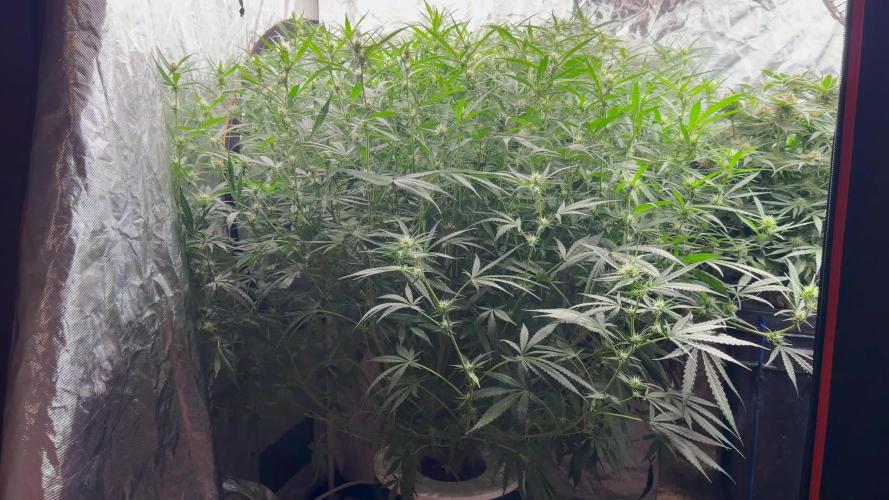
What a great strain...definitely surprised me positively. Thank you Exotic Seeds for the opportunity to work with you trying this awsome plant. It has a steady growth, kinda short and bushy like a lot of plants with strong indica traits Very dense buds, big ones, fat and resinous. With a LOT of productions all-over the plant. So much thricome production it sparkles white. Cutes it yesterday (17/12/2023) altough on my opinion it could have 1 more week. Altough because of the huge problem I had to do it. This grow tent (specially the other plant growing side by side) had a mold issue, bud rot spreading fast. I must have lost about 5 65 grams of wet flower total on the Fat Banana. When I cuted it 🍓 Strawberry Cola weighted 829 grams it has a lot of defoliation done alredy but I'll trim it 100% when dry. This is it, thank you all of you growmies for watching this grow. See u guys on the next one.
Likes
55
Share
What's in the soil? What's not in the soil would be an easier question to answer. 16-18 DLI @ the minute. +++ as she grows. Probably not recommended, but to get to where it needs to be, I need to start now. Vegetative @1400ppm 0.8–1.2 kPa 80–86°F (26.7–30°C) 65–75%, LST Day 10, Fim'd Day 11 CEC (Cation Exchange Capacity): This is a measure of a soil's ability to hold and exchange positively charged nutrients, like calcium, magnesium, and potassium. Soils with high CEC (more clay and organic matter) have more negative charges that attract and hold these essential nutrients, preventing them from leaching away. Biochar is highly efficient at increasing cation exchange capacity (CEC) compared to many other amendments. Biochar's high CEC potential stems from its negatively charged functional groups, and studies show it can increase CEC by over 90%. Amendments like compost also increase CEC but are often more prone to rapid biodegradation, which can make biochar's effect more long-lasting. biochar acts as a long-lasting Cation Exchange Capacity (CEC) enhancer because its porous, carbon-rich structure provides sites for nutrients to bind to, effectively improving nutrient retention in soil without relying on the short-term benefits of fresh organic matter like compost or manure. Biochar's stability means these benefits last much longer than those from traditional organic amendments, making it a sustainable way to improve soil fertility, water retention, and structure over time. Needs to be charged first, similar to Coco, or it will immobilize cations, but at a much higher ratio. a high cation exchange capacity (CEC) results in a high buffer protection, meaning the soil can better resist changes in pH and nutrient availability. This is because a high CEC soil has more negatively charged sites to hold onto essential positively charged nutrients, like calcium and magnesium, and to buffer against acid ions, such as hydrogen. EC (Electrical Conductivity): This measures the amount of soluble salts in the soil. High EC levels indicate a high concentration of dissolved salts and can be a sign of potential salinity issues that can harm plants. The stored cations associated with a medium's cation exchange capacity (CEC) do not directly contribute to a real-time electrical conductivity (EC) reading. A real-time EC measurement reflects only the concentration of free, dissolved salt ions in the water solution within the medium. 98% of a plants nutrients comes directly from the water solution. 2% come directly from soil particles. CEC is a mediums storage capacity for cations. These stored cations do not contribute to a mediums EC directly. Electrical Conductivity (EC) does not measure salt ions adsorbed (stored) onto a Cation Exchange Capacity (CEC) site, as EC measures the conductivity of ions in solution within a soil or water sample, not those held on soil particles. A medium releases stored cations to water by ion exchange, where a new, more desirable ion from the water solution temporarily displaces the stored cation from the medium's surface, a process also seen in plants absorbing nutrients via mass flow. For example, in water softeners, sodium ions are released from resin beads to bond with the medium's surface, displacing calcium and magnesium ions which then enter the water. This same principle applies when plants take up nutrients from the soil solution: the cations are released from the soil particles into the water in response to a concentration equilibrium, and then moved to the root surface via mass flow. An example of ion exchange within the context of Cation Exchange Capacity (CEC) is a soil particle with a negative charge attracting and holding positively charged nutrient ions, like potassium (K+) or calcium (Ca2+), and then exchanging them for other positive ions present in the soil solution. For instance, a negatively charged clay particle in soil can hold a K+ ion and later release it to a plant's roots when a different cation, such as calcium (Ca2+), is abundant and replaces the potassium. This process of holding and swapping positively charged ions is fundamental to soil fertility, as it provides plants with essential nutrients. Negative charges on soil particles: Soil particles, particularly clay and organic matter, have negatively charged surfaces due to their chemical structure. Attraction of cations: These negative charges attract and hold positively charged ions, or cations, such as: Potassium (K+) Calcium (Ca2+) Magnesium (Mg2+) Sodium (Na+) Ammonium (NH4+) Plant roots excrete hydrogen ions (H+) through the action of proton pumps embedded in the root cell membranes, which use ATP (energy) to actively transport H+ ions from inside the root cell into the surrounding soil. This process lowers the pH of the soil, which helps to make certain mineral nutrients, such as iron, more available for uptake by the plant. Mechanism of H+ Excretion Proton Pumps: Root cells contain specialized proteins called proton pumps (H+-ATPases) in their cell membranes. Active Transport: These proton pumps use energy from ATP to actively move H+ ions from the cytoplasm of the root cell into the soil, against their concentration gradient. Role in pH Regulation: This active excretion of H+ is a major way plants regulate their internal cytoplasmic pH. Nutrient Availability: The resulting decrease in soil pH makes certain essential mineral nutrients, like iron, more soluble and available for the root cells to absorb. Ion Exchange: The H+ ions also displace positively charged mineral cations from the soil particles, making them available for uptake. Iron Uptake: In response to iron deficiency stress, plants enhance H+ excretion and reductant release to lower the pH and convert Fe3+ to the more available form Fe2+. The altered pH can influence the activity and composition of beneficial microbes in the soil. The H+ gradient created by the proton pumps can also be used for other vital cell functions, such as ATP synthesis and the transport of other solutes. The hydrogen ions (H+) excreted during photosynthesis come from the splitting of water molecules. This splitting, called photolysis, occurs in Photosystem II to replace the electrons used in the light-dependent reactions. The released hydrogen ions are then pumped into the thylakoid lumen, creating a proton gradient that drives ATP synthesis. Plants release hydrogen ions (H+) from their roots into the soil, a process that occurs in conjunction with nutrient uptake and photosynthesis. These H+ ions compete with mineral cations for the negatively charged sites on soil particles, a phenomenon known as cation exchange. By displacing beneficial mineral cations, the excreted H+ ions make these nutrients available for the plant to absorb, which can also lower the soil pH and indirectly affect its Cation Exchange Capacity (CEC) by altering the pool of exchangeable cations in the soil solution. Plants use proton (H+) exudation, driven by the H+-ATPase enzyme, to release H+ ions into the soil, creating a more acidic rhizosphere, which enhances nutrient availability and influences nutrient cycling processes. This acidification mobilizes insoluble nutrients like iron (Fe) by breaking them down, while also facilitating the activity of beneficial microbes involved in the nutrient cycle. Therefore, H+ exudation is a critical plant strategy for nutrient acquisition and management, allowing plants to improve their access to essential elements from the soil. A lack of water splitting during photosynthesis can affect iron uptake because the resulting energy imbalance disrupts the plant's ability to produce ATP and NADPH, which are crucial for overall photosynthetic energy conversion and can trigger a deficiency in iron homeostasis pathways. While photosynthesis uses hydrogen ions produced from water splitting for the Calvin cycle, not to create a hydrogen gas deficiency, the overall process is sensitive to nutrient availability, and iron is essential for chloroplast function. In photosynthesis, water is split to provide electrons to replace those lost in Photosystem II, which is triggered by light absorption. These electrons then travel along a transport chain to generate ATP (energy currency) and NADPH (reducing power). Carbon Fixation: The generated ATP and NADPH are then used to convert carbon dioxide into carbohydrates in the Calvin cycle. Impaired water splitting (via water in or out) breaks the chain reaction of photosynthesis. This leads to an imbalance in ATP and NADPH levels, which disrupts the Calvin cycle and overall energy production in the plant. Plants require a sufficient supply of essential mineral elements like iron for photosynthesis. Iron is vital for chlorophyll formation and plays a crucial role in electron transport within the chloroplasts. The complex relationship between nutrient status and photosynthesis is evident when iron deficiency can be reverted by depleting other micronutrients like manganese. This highlights how nutrient homeostasis influences photosynthetic function. A lack of adequate energy and reducing power from photosynthesis, which is directly linked to water splitting, can trigger complex adaptive responses in the plant's iron uptake and distribution systems. Plants possess receptors called transceptors that can directly detect specific nutrient concentrations in the soil or within the plant's tissues. These receptors trigger signaling pathways, sometimes involving calcium influx or changes in protein complex activity, that then influence nutrient uptake by the roots. Plants use this information to make long-term adjustments, such as Increasing root biomass to explore more soil for nutrients. Modifying metabolic pathways to make better use of available resources. Adjusting the rate of nutrient transport into the roots. That's why I keep a high EC. Abundance resonates Abundance.
Likes
20
Share
@Bongman
Follow
coming soon... Harvest week..... Cut the girls down week 8 day 5. Did a quick truim and now will hang dry. Will report back on details in a week or so.
Likes
2
Share
@DrBud420
Follow
02.11.'24 After 5 days of drying, this little girl who was a little bigger than a meter gave 950 grams and a little bit of popcorn...this picking was 870 and a little bit of popcorn, and 4-5 weeks ago during a storm, one branch broke, which yielded about 100, but let's say 80 for sure, a total of 950 grams of beautiful, huge, potent buds
Likes
14
Share
@Swiftgrow
Follow
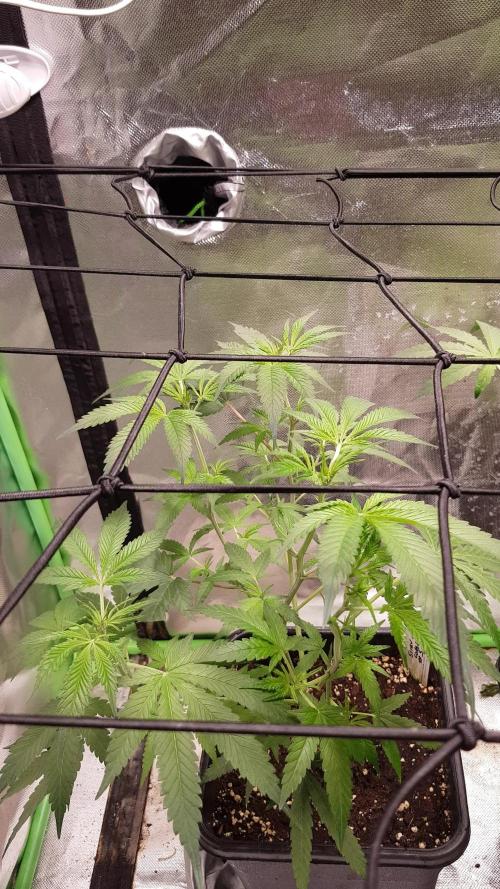
Caught them reaching out to the light, seeing some great growth. Starting to see a few pistols coming up hopefully they will start flowering properly soon
Likes
1
Share
@TTerpz
Follow
Week 1 of flower lights have been switched to a 12/12 schedule Back pot is plastic so she was fed nutrients 8/5 because it takes a little bit longer to dry up
Likes
70
Share
All feeds with nutes use either a whole ratio or combination of "Veg Mix" and "Bloom Mix"concentrates DILUTED in water until a total ppm of add in is reached using a (Total Dissolved Solids)TDS Meter measured in PPM (parts per million). The "Veg Mix" concentrate will eventually be added in smaller ratios and "Bloom Mix" concentrate what will eventually replace the "Veg Mix" concentrate entirely with the ppm and ratios listed when I feed. Veg mix recipe is on week 3. Bloom Mix recipe is on week 5. Day 49 VPD is okay now - temps at 75F RH also now at 65% with ILVent at 50% = VPD of 1.04 - ppfd also same as yesterday mostly 480 to 490 around the ring with 510 and 520 in the center Took ph readings as well - 3 readings 6.43, 6.48, and 6.37 to avg 6.426 Which is good because she's starting to show signs of stress after the topping and defoliation from a couple days ago. The leaves are starting to curl at the tips and the bronze color stripping is happening again - however this time seems to be a slower progression so Im hoping that having the correct ph this time will help while she's re-routing her resources. I 'did notice also that the growth tips seem to be growing at a slower rate than before - I think she's at her limit in colas and the roots are having to find more space to spread, may even be too big for the 5 gallon pot. I have no plans to change her out just yet, but will monitor. Soil is drier today - so I will be watering tomorrow with de-chlorinated water at 6.4ph Day 50 VPD was good at 74/64 with the tent open while I feed that I left it open for a bit and took time in feeding and cleaning - after all that still good at 74F/61%RH/50%ILV ppfd was checked after water and setting back - same as yesterday as most of the newest growth is still coming from the new colas - most seem to be adjusting 1 at a time in each split but both are showing growth now on all cuts. Started feed by making new ph buffer solutions, calibrating/testing both meters. The have about a .15 variance between the two. Checked weight and made 1.5 gallons of feed. started at 228ppm added 450ppm veg and 150ppm bloom for a total of 833ppm feed/epsom salt - splashed h2o2 and ph'd to about 6.4- I fed via watering can and spray and fed the whole amount slowly since I was feeding until bottom drip and she took it all before starting to bottom drip. Afterwords I let her drain (about a quart came out) and checked ppm from runoff at 2500 (telling me she's okay but isnt eating as much as before her topping yet) ph is a mystery - I show 3 readings from top level of 6.62, 6.57, and 6.57 for an avg 6.586 but 2 separate readings from 2 meters (4 readings total) on the bottom runoff showed 5.3 and 5.6 then confirmed later. I expected a variance since the wood ash probably stuck to the top side of the soil - but I didnt expect that much of a difference. I will monitor but honestly dont know what I should do, if anything other than watch. made a video of the fan movements and runoff drip Day 51 What I am calling "stress burn" is progressing as expected. I am monitoring the ph from the top as I did before, but again, not much I can do other than over water, so I'll just watch for now and compare rate of spread until she fixes her resource pathways. It seemed to take about a week to clear up after the ash treatment last time, so I am on day 3 of 7 for now with no treatment. Looking for a spurt of new growth to show and then I'll know she's better. Adjusted the lights to accommodate a week 6 level of 500 to 600 ppfd - that means I can raise the lights to the top of the tent and increase power. So now set at 3 tick up and 37 inches from the soil or 26" from the plant top. Now her ppfd reads about 540 on both of the center colas and 500 to 510 on the surrounding ring. Adjusting lights meant I had to adjust the fans up to medium power and re-directed them to blow at the edges of the pot; made a video. VPD is steady, but still warmer than typical (only by a couple degrees nothing too much) 76F/61%RH/50%ILV for 1.15 kpa on room VPD Day 52 VPD is higher now that I have the lights to the top of my tent and the fans on the lights blowing down at the pot. I moved the IL Vent to the top sucking out with the motor and vent outside the tent now. I also opened two lower air holes with my heater set for fan on the opposite side of the tent than the vent. Currently, I am at a max of 1.2 room VPD and ranging down to 1.0 so I'll take it until it does something else. 74F/65% RH/75%ILV - I will monitor to ensure it's stable. ppfd is same as yesterday as there's little growth still. Spots are still progressing on the oldest leaves at the same rate as before - however the newest leaves are not showing signs yet, so I will continue to monitor. Day 53 ppfd was a little changed today, showing that there's growth coming back now. lowest on outer ring was 500 with most at 520 and 530 highest, center colas were tested at 540 and 560ppfd. VPD was stable as I watched it most of the day since I made changes yesterday. Temps were 74 to 76 and RH was 61% to 68%. ILV was set to 33% with the bottom heater on fan to draw in air. lockout continues on the oldest fan leaves at the last top nodes. New growth is already marked in a couple of spots. I have about 6 gallons of tap water burning off chlorine now and will use about 2 gallons to flush at 8ph. I plan to dunk this weekend with feed so this will allow time to dry out and hopefully reset the ph and lower my ppm readings at the lower part of the pot before then. Day 54 Took Control pics measured VPD and ppfd Lights are at the top of the tent and second tick from highest power level. Lights to soil is 37 inches and lights to plant is 12 inches shorter so 25 inches leaves to light. currently ranging 530 to 550 around the ring and 575/580 ppfd at center (after feed and replaced). Moving the lights (day 51) made the tent hotter so I changed my ILVent to suck out at the top and fresh air in at the bottom - I have been fighting to keep temps under 78 managed to hit 74 to 75 with the heater being set just to fan for the bottom air vents- I did also raise humidity to a setting of 65% a day before moving the lights, so Im hitting 61 to 68% between power cycles on the humidifier. Overall Tent VPD is 1.0 to 1.2 as max. Took controls for feed. Weight 16lbs 11oz. tested and calibrated 2 meters and took 4 ph readings of 6.55, 6.77, 6.53, 6.85 to avg 6.675. from top of soil (last runoff measured 5.6 and 5.3 on two meters) prepared 2 gallons of feed at 500 ppm over tap. (burned chlorine off overnight) starting ppm was 217 - added 75/25 veg/bloom ratio. ph balanced to 7.8 and 7.63 on separate meters (rinsed and retested to be sure got 7.79 and 7.63 again) I used 4 knitting needles in the soil about 3 inches from the plant center. Poured feed water over the needles until it pooled slightly on top of the soil, I then pulled the needle out a little to allow the water to drain into the holes better. I did this in 8 different spots. As soon as she started dripping water from the bottom I poured a little on the leaves and then moved the plant to another drip pan to finish pouring the rest over the top of the soil without dripping any over the sides. Took videos of the drip and waited 10 min before putting her on another clean drip pan and back in the tent. Runoff from second drip pan was measured twice at 5.8ph and 2410 ppm - and first pan 5.85 and 2670ppm (expected higher ppm since I moved perlite on the bottom with the needles) Defoliated the oldest leaves before lights out. Day 55 She mostly looks like she appreciated the clippings and ph balance from yesterday - slower progression of the lockout issue and largest new growth since topping day. So speaking of new growth, I plan to use LST in the next few days to set these colas in what will hopefully be their last bind around the ring. VPD is steady at 75F to 77F and RH is between 63 and 68%. My ILV have been set to 33% and the lower fan blowing rather than heat. top soil ph was measured with 3 readings, on a tested and calibrated meter. 6.47, 6.7, 7.12 to avg 6.763 (kinda wild in those readings so I double checked them all twice and got the same in each hole)
Likes
10
Share
@Eauderay
Follow
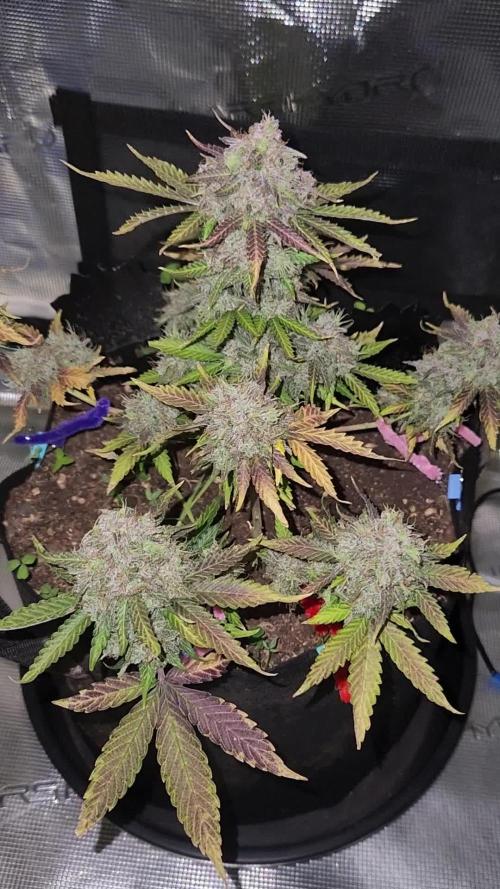
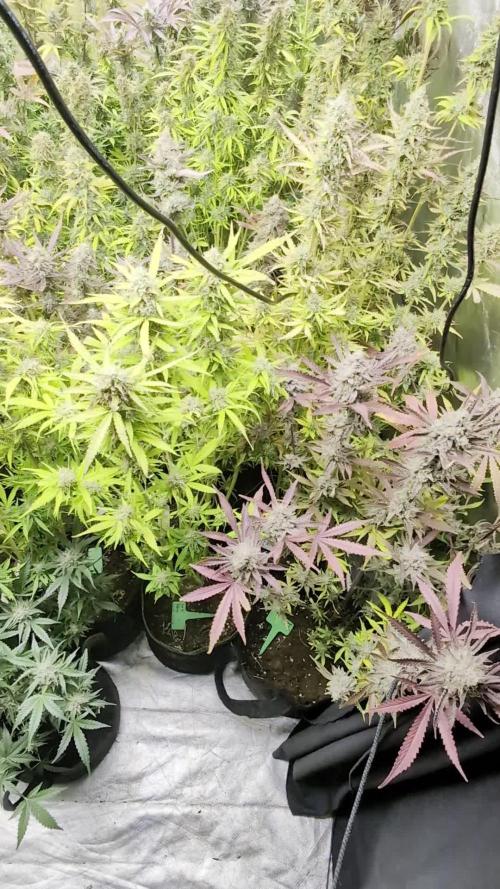
Almost done, leds are really forcing those red colors a lot more than HPS, this strain really look like a mini dragon after feasting and covered with blood splashes, she smells very nice of sweet lemony vanilla skunk. I find this strain very easy to grow and perfect for my environment because buds are small and leaves are few so no bud rot risks, perfect size and bulk for my grow room! Going to be easy to trim, and buds are very compact and a good amount of trichomes covering them. Love cookies!
Likes
10
Share
Week 2 Flower (3/07/22 - 3/13/22)
Likes
18
Share
Привет друзья. Моей растихе сегодня 112 дней 20.10 перевёл свет в режим 12/12 Начал применять LST технику на 19 дне и продалжаю применять её через день, а 18 августа добавил ДЕФОЛИЗАЦИЮ С 20.08 ДЕФОЛИЗАЦИЮ делаю каждые 3,4 дня С 20.08 LST технику делаю каждые 4.6 дней На сегодняшний день влажность 54% 5.09.2023 заметил высокий Ph 7.9 С 48 дня Ph не ниже 5.8 На сегодняшний день Ph 6.0 Начал кормить с 60 дня Canna Terra Vega PPM 870 Всем мира и добра! Не забудь поставить лайк❤️, если понравилась как прошла неделя И читайте наш TELEGRAM: https://t.me/smail_seeds #Smail_Seeds 😀
Likes
2
Share
The girls are smelling really nice…turned out a seed project but I sure would get some fire smoke. I’ve been feeding her 3 gallons of water daily preparing her for some charcoal ash…
Processing
Likes
15
Share
@Smokwiri
Follow
LoL, a little bit of burning on the edges of the leaves, not too much to worry about Progress looks very good Her bud is growing slowly, but dense I made the feeding with just a bit more than 1 L, about 1.25L the molasses is not measured, i just took the back of a spoon and dipped it, and stirred it into the watering. Do keep in mind that i'm only using about 80 watts of light (cob led).
Likes
7
Share
@MistaOC
Follow
Grow Diary – Day 73 (Flowering Day 53) Strain: Sour Frootz by Karma Genetics Plants: 4 clones Training: HST + SCROG Nutrients: Green House Feeding – Bio Grow & Bio Bloom Date: May 24 (Saturday) Status: Entering final ripening – harvest approaching At Flowering Day 53, the Sour Frootz plants are now in the late flowering phase, showing strong signs of maturity. Buds are fully formed, tight, and heavily coated in resin. Trichome development has peaked visually—most heads are now cloudy, with a noticeable rise in amber trichomes, especially on upper colas. The aroma is intense and complex: sweet, citrusy fruit mixed with sour funk and subtle earthy undertones. The terpene expression is at its most volatile, and the flowers are sticky to the touch. Some larger fan leaves are beginning to fade, showing natural senescence—primarily a gentle yellowing, with no signs of stress or deficiency. Nutrient Program: • Still running Bio Bloom, though it can now be tapered or discontinued if you plan a light flush. • Bio Grow is no longer active at this stage (breakdown complete), but residual nutrients are sustaining the plant. Watering is now more moisture-controlled to avoid excess humidity near dense colas, reducing mold risk. Additional Notes: • No pest pressure • Canopy is stable, buds are weighty • Lower humidity maintained (~40–45%) • Good airflow across and under canopy • Natural color fade beginning, especially on fan leave.
Likes
252
Share
Well folks we chopped the Strawberry Gorilla 😁 And the first of the Strawberry Blast 🍓 🍓 🍓 🍓 Shes a killer for sure , incredibly frosty , and sticky , nice nugs for sure my friends , I plan to redo this one again very soon , the smell is sweet and gassy and berry-licious ...... FC4800 from MarsHydro Lights being readjusted and chart updated .........👍I've added a RU45 to the mix 👍 www.marshydro.ca 👉I am using Agrogardens for nutrients for my grows and welcome anyone to give them a try .👈 👉 www.agrogardens.com 👈 Agrogardens Cal MAG Agrogardens Grow A+B Agrogardens Bloom A+B Agrogardens Bud Booster Agrogardens PK13/14 I GOT MULTIPLE DIARIES ON THE GO 😱 please check them out 😎 👉THANKS FOR TAKING THE TIME TO GO OVER MY DIARIES 👈 Would you like to hang with the growdiary community 👉 https://discord.gg/gr4cHGDpdb 👈
Likes
37
Share
@Whitey307
Follow
Hi all just finished another week having trouble with humidity since fan went marshydro said they out of stock but will send me a new one the minute they have it in which is a month haha 😄 all be harvest by then hopefully god help neighbours that's all I can say haha bought a new dehumidifier off amazon a shit cheap one not even making a difference at all haha so today splashed out a 100 euro for one so hopefully that'll do the job. other than all looking good I think. But actually if someone could tell me will I defoliate more leaves she very bush bit I'm afraid of disturbing flower so im leaf tucking but she is very bushy haha. also im looking at other diarys on this and my plants buds not as big or as far along as many im on 9 weeks on the dot at the moment if anyone with more knowledge please let me know. Anyway i lowered light again and up nuts a little bit and on we go one week closer to be stoned hopefully Enjoy all thanks for stopping to have a look and for comments +help. keep growing and blazing.
Likes
25
Share
@Dingle
Follow
The smell is really starting to increase going into week 6 of flower. The buds look like they are in starting to fatten up daily but I have seen a few signs of what looks like could be nutrient burn mainly on the Girl Scout cookies possibly caused by using too much PK 13/14. Some light defoliation again this week along with rotating the pots for better light coverage. Light still set at 90% power. ✌️
Likes
121
Share
💩Holy Crap Growmies We Are Back💩 Code Name FBT2307 Well growmies we are at 56 days in and everything is going much better , she's bounced back pretty good👍 really good actually 👌 👉 Shes getting frosty now , and i hope she fills out 👌if she does gonna have some buds on a stick 💪 Lights being readjusted and chart updated .........👈 Even with early major issues due to the soil/medium she's come a long way 👈 👉I used NutriNPK for nutrients for my grows and welcome anyone to give them a try .👈 👉 www.nutrinpk.com 👈 NutriNPK Cal MAG 14-0-14 NutriNPK Grow 28-14-14 NutriNPK Bloom 8-20-30 NutriNPK Bloom Booster 0-52-34 I GOT MULTIPLE DIARIES ON THE GO 😱 please check them out 😎 👉THANKS FOR TAKING THE TIME TO GO OVER MY DIARIES 👈