




Likes
49
Share


@LockDownGrow
Follow
Ok just finnished a blunt of this a out an hour ago, and I do not smoke blunts lol
But it seems only right too do a real smoked reveiw ,
So the fbt7 has been dry now for about 2 weeks and in a jar and today was the day too take the first bud too try so I rolled a fat one " fat one in photos lol ,
So for me the flavour just isn't there yet and am hoping that will come after a cure ,
So I smoked this all too my self and qiukly ,
Within a few minutes I went white as a ghost as was twitching the the corner hehehe,
This is very strong bud and I would go as far as saying it's probably the strongest bud I've had in years ,
I am what I would describe as a joker smoker , as I turn my bud into oils and do not smoke it ,
But any serious cannabis smoker will absolutely love this strain ,
Well done fast buds and thank you :)

Likes
10
Share


@SnoopyShaggy
Follow
Some leaves are alredy yellowing indicating harvest time is nearing. I also shock stress the plant by reducing nutes to avoid harshness from my smoke. Just banana compost tea+plain water. Since this grow is in a supersoil, dropping the BigBud nute off in last 3 weeks to allow the microbes do its work.
In 2weeks once trichomes are ready, i will chop one of the plant.
Them colors on the strawberry is magical. Cant wait to dry them and cure to see the effects.
Likes
10
Share


@Kusunokii666
Follow
Ho eseguito il topping al 4/5 internodo a seconda dell altezza delle piante per pareggiarle

Processing
Likes
5
Share


@blacknpearl
Follow
nov 8. megacrop 1.06gr/litre ph'ed at 6.00. about 100 ml
nov 10. megacrop 1.06gr/litre ph'ed at 6.00. about 250 ml
nov 10. transplanted to 3 gallon fabric pot
nov 11. realized soil stayed wet for days after very little waterings so increased air flow right next to the plant using a duct.
nov 12. megacrop 0.6gr/litre ph'ed at 6.28. only about 100 ml since soil is still wet

Likes
Comments
Share

@JVKdopegrow
Follow
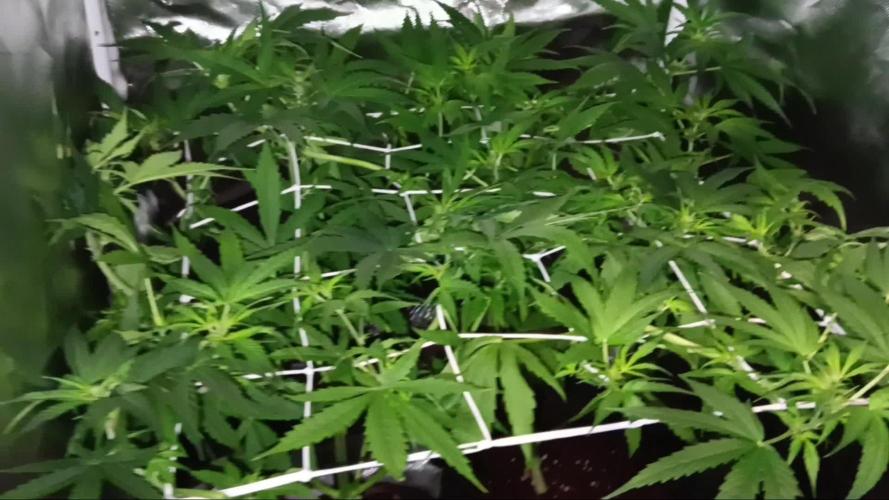
So my first attempt at SCRoG seems to be working. In one short week these two girls went from stretching lanky plants to a well managed grow. Daily leaf tuck and minor adjustments in placement. Bud sites have the first sign of white pistils so they are now in flower.

Likes
4
Share


@BudBrewerz
Follow
This beautiful hazey lady looked ready for the take down, and since I had some time on my hands , thats exactly what I did, she was smelling very nice and rich , Ive got her hanging to dry atm, but im looking very forward of giving her a taste once she's dried and cured. I'll be back for a weigh in once her buds are dried and seperated from the stems etc.




Likes
Comments
Share


@Dankmark420
Follow
Unfortunately I forgot to take pictures from this point on.. I only saved some videos..

Likes
14
Share


@AndrewC
Follow
So this is the Tear Down week. The timing of it makes it so i will need to the harvest flag in a few days when I can weight and test the plants.
I have included the Cleaning, and Cutting and some Root Porn.
I will make the harvest post in about 4-5 days, when I can trim these plants. There is a lot of Plant here. I got way more than I was expecting. I don't have a scale that measure this amount of plant, without taking like 10 measurements and then adding them together. So I will just be posting the dry weight. I will post the wet weight as dry weight * 1.65.
Autopots: Wow, what a great product. I have been blown away by how well and how easy it was to work with them. They really did solve the watering issues. Excellent product. If you are a beginner, start with Autopots.
-= Lessons Learnt =-
- Overdrive the air to your Autopots. In my control plant, I used a small rectangle air stone (instead of a standard air dome). This lead to root rot and some other issues, it also put significantly less air into the water. The root rot, give the material for the Brown Algae to grow. Using a huge Air-disc-Air-Stone would be an excellent combo to mix in with the air dome itself. Something like this: https://www.amazon.ca/Pawfly-Diffuser-Suction-Hydroponics-Aquarium/dp/B01MY3AQ33 at the bottom and the air-dome on top of it, will be what I do with my next experiment.
- Air stone in the reservoir. I had two instances where algae grew into the res. An air stone would have helped. It would have also helped my control plant get less root rot. Given the amount that the air-domes and air sources got engulfed, having the water have more o2 in it would have only been beneficial.
- Don't grow 6 plants in a 4x4. Since my control plant was about 1/8th the size of the others, I think I could have grown 5 in the shape of a 5 (on a 6 sided dice)⚄ This placement would give a much more spaced canopy for airflow and more importantly light. The sides of some of the plants were lighter green and produced larf due to lack of light penetration.
- This tent was on 19-5 schedule. This worked out very well for this strain. After every lights on, they were in the praying position, so this strain was able to recover in that 5hrs off. If I had more seeds, I would run these again, and try 20-4. I think this strain could handle it. All for all, I think I'm going to 19-5 as my default timing. This kept up a solid DLI.
- Staring at .9EC (really .7 EC cause my water here is .2 EC) Then bumping up at .1 a week, until 1.6EC worked out VERY well. I experimented on this crop all the way up to 1.9EC, which burnt the tips of this plant. I think if I did this strain again, I would do 1.6EC until 3-4 weeks left then crank it to 1.9. It did plump them up when I went to 1.9, however it left them looking rough. Bulk was added though.
- Sticking to 6.0PH for all of veg, and 2 weeks into flower worked great. The plant had solid and consistent color and leaf shape . The plant's did get hurt, due to some issues (as noted on the weeks). I switched to 6.5 PH in the last 3-4 weeks and it helped them recover, and plump up noticeably.
-VPD. The #1 thing I focused on was VPD. I keep it .9kpa range, as best as humanly possible. It was honestly, HUGELY noticeable compared to my other grows. I know truly understand the value of properly dialed in VPD. This is the one lesson that will stick with me forever.
- Super-cropping: On the plants I give the chiropractic treatment too, had much thicker stems as much larger channel internally. I did this treatment to 4 of the 6, and the 4 that had it done has larger buds and recovered from defoliation faster.
TLDR; VPD is king. Super-cropping is worth the time. Keeping PH and EC dialed in were all wins. Autopots kick ass.
Likes
11
Share


@Lahuertade_Bototo
Follow
🌱🌱🌱Continuamos este cultivo, con esta hermosa cepa de FastBuds, Girl Scout Cookies Auto, entrando en el periodo de crecimiento mas exuberante vegetativo.🌱🌱🌱
👨🍳👨🌾🏻 Nutrición y Bitácora 👨🌾🏻👨🍳
Día 15 se riega con una solución nutritiva NPK de 1 Litro con Plagron Power Roots (0.3 ml), Plagron Pure Zym (0.5 ml), Plagron Alga Grow (0.7 ml) y Plagron Sugar Royal (0.3).
Día 16, se mantiene saludable creciendo 👨🌾🏻, asimilando de muy buena manera el riego nutritivo del día 15
Día 17, sigue creciendo y creciendo y cada vez mas hermosa esta bella planta 😍
Día 18. Se ajusta el LST para bajar el apical. Se riega con una solución nutritiva NPK de 1 Litro con Plagron Power Roots (0.3 ml), Plagron Pure Zym (0.5 ml), Plagron Alga Grow (0.7 ml) y Plagron Sugar Royal (0.3). También se ve la producción de mas ramas bajas que comienzan a tomar fuerza como posibles colas principales y también se ve la aparición de los primeros pistilos, así que estamos prontos a comenzar la Pre Floración, pero aun le queda un buen tiempo en su etapa vegetativa de máximo crecimiento.
Día 19 sin novedades.
Día 20 se instala la malla para direccionar las ramas. Se realiza defoliación para mejorar la penetracion lumínica y se riega con 1 litro de solución NPK + Trichodermas.
Día 21 la malla mejora el uso del espacio, mejora considerablemente la penetracion lumínica y el crecimiento sigue de manera constante. La planta ya esta pidiendo mas alimentación y riegos, en 24 horas el sustrato se encuentra casi seco. Va de maravilla entrando a la cuarta semana 💪
🚀Equipamiento🚀
Indoor de 60x60x159 cm y una iluminación BlackCob F320, se activa solamente 1 modulo (160w) a 70cm para estimular su crecimiento, pero evitar estrés lumínico (en el día 21 se ajusta la iluminación a 55cm del canopy), se agrega un humidificador HUMIPRO para mantener estable entre 55 y 65 % la Humedad, intractor de 100mm, extractor de 100mm, filtro de carbon, ventilador "oscilofan", ventilador "clip fan", 2 termohigrometros y se agrega el día 20 una malla SCROG de kanovi
Acompáñenme para ver los resultados de este hermoso desafío, un saludo cultivadores 🔥🔥🔥
Likes
12
Share


@SmylinPupil
Follow
Well I’m closing this one out. I had a lot of problems with humidity outside and bud rot, in hindsight i read a few reviews in the last few weeks and purple kush is susceptible to bud rot. I did 2 separate harvest, one on the 9th and one on the 14th. I collected everything I could smoke, there is still buds left on the plants but because of bud rot and immature buds I’m saying fuck it. Sonoma seeds quotes 9-10 weeks flower i harvested at week 8 and week 9. I harvested just shy of a pound total, and just over and oz of “purple” looking weed. Between you guys and i, the purple one was pretty shwaggy as far as bud goes. Would i grow this again outdoors? NOPE. Would i try it indoors? You will have to stay tuned for my next grow. If you plan to grow this strain outdoors do not do it. The fact that it’s pretty much 100%indica it does not like to get wet,🤦♂️🏻 if you are in the desert, indoors or live in Afghanistan (lineage) go for it. The taste is also not quite what I expected, all the reviews say grapes, but i taste a neutral taste. Some of it smells quite good in the jars but as soon as you smell each bud it smells like spicy woody herb with some dank undertone. Trimming it i had some sort of dank spicy smell i just can’t put my fingers on, except it was all over them. The buzz is “ok”but nothing to knock your socks off with. It is a stimulating feeling followed by a calm “not sleepy” feeling. I haven’t grown many outdoor variety’s but I’m sure most of them turn out the same. I’m waiting for my indoor no name to finish and I can start trying to redeem myself with my leftover seeds, and hopefully get the true quality/if there is, with this purple kush strain.
Fall indoor; here i come. Thanks for tagging along.
Cheers.
Update: decided to make bubble hash with it.
Update 2: pressed some hash into some shatter

Likes
15
Share


@PiusWaxis
Follow
Here we are at the end of my plant's wonderful eleventh week of flowering, another week full of exciting developments and new discoveries.
The constant and unstoppable growth of the plant has come to an end, showing a beauty and vitality that are a true spectacle for the eyes. 😎
The abundant layer of resin that has formed is a clear sign of the health and well-being of the plant, once again confirming the benefits of the premium nutrients used throughout the entire growth cycle.
TrollMaster's "TENT-X" environmental control system continues to prove its worth, precisely maintaining optimal temperature and humidity levels to promote vigorous plant growth.
The combination of advanced and precision technologies ensures that plants can thrive in a controlled and conducive environment😎
I am thrilled to share with you the latest video showing the temperature, humidity and VPD trends of this last week of flowering, providing further demonstration of the extraordinary performance of the TrollMaster control system and its synergy with the other elements of the grow room.With each week that passes, the anticipation for the new discoveries and challenges that await us continues to grow.
With the constant support of Plagron nutrients, trust in the TrollMaster control system and the excellence of MEDIC GROW LED lighting, I am sure that I am always ready to face any challenge!
Thank you again for being by my side in this extraordinary adventure, dedicated to exploring the wonders of plant cultivation. Together we continue to look to the future with confidence and enthusiastically anticipate the successes that each new week holds for us. 💪👽🌱✨
REVIEW TENT-X:
I was pleasantly surprised by the effectiveness and functionality of the TROL MASTER!
This device is simply amazing, as it has allowed me to monitor the environments I use it in accurately and efficiently.
One of the most impressive features of this device is its ability to operate LED lights easily and intuitively. Thanks to its user-friendly interface, I could easily customize the lighting of my rooms according to my tastes and different situations. I particularly appreciated the possibility of programming the sunrise/sunset simulation, thus creating a more natural situation.But that's not all: the device goes further and manages to keep me constantly informed about the humidity and temperature of the surrounding environment. This feature has proven to be very useful, especially in times when I am not present.
I was able to set humidity limits, so that the device would immediately alert me if the levels exceeded the desired threshold. This allowed me to intervene promptly and avoid excessive oscillations.
The accuracy of the temperature measurements was another welcome surprise. The device is equipped with a high precision sensor that allows me to constantly monitor the temperature of the rooms. Here too I was able to set temperature limits, allowing me to be notified immediately if they were exceeded.
Overall, I was really satisfied.
The TENT-X exceeded all my expectations. Its ease of use, precision of measurements and possibility of customization make it an indispensable tool for those seeking to monitor and optimize environmental conditions.

Likes
4
Share


@kathlane24
Follow
Freshness in every hit. Citrus terps refresh your mind and body.
Smells hard, hits harder. 26% THC that’ll blow your taste buds off.
The best of both worlds. Perfectly balanced effect, the ideal all-day strain.
Extremely resilient. Top-shelf harvests with minimal maintenance!
Sour citrus terps. Loads of orange terps make for the most delicious hash and extracts.
Likes
13
Share


@Tazard
Follow
She grew very slowly I vegged her for a long time. I finally got her big enough where if she doubled in size I would have a nice plant, well she stretched almost none whatsoever. However, for the small size I was expecting about 56g instead I got 98! What a pleasant surprise to see all the lower buds fully developed and ripe!


Likes
5
Share


@beer420
Follow
Didnt do an update last week because i was on vacation, the plants are doing great tho!!
Lovely colours and great smell. They are extremely sticky :D
Thinking of harvesting next week, toughts?
Thanks for reading and happy growing!
Likes
60
Share


@420DeepGrow
Follow
La semana 1️⃣ a ido bien 👍, destacar que la próxima vez, estresaré lo mínimo posible a las plantas, ya que si quieres una cosecha rápida y saludable lo mejor creo es no estresar a las plantas, nada de low stress ni mierdas, dejarla desarrollar como si estuviera solita.
📅 Día 8: 🔹Pulverizo las hojas con Rootbastic de Atami a 0,15 ml/litro.
📅 Día 9:🔹 Última pulverización con Acti Vera y Alg-A-Mic a 1 ml/litro respectivamente. A partir del día 11 no se le aplicarán más abonos vía foliar para controlar la humedad en el cuarto de cultivo y así evitar que se disparen estos niveles de humedad.
📅 Día 10🔹Última pulverización con Special THC PLUS.
📅 Día 11🔹Riego según la tabla de nutrientes y bajo la dosis de agua ya que me he pasado con el riego. Aplico 350ml e iré subiendo cuando note que no dura 24h mojado.
🔹Cambio los platos de las macetas por una bandeja de 80 x 80para así poder hacer un mejor riego y no molestar a las plantas, ha entrado justa. La pongo sobre una mesa de metal de 60 x 60 cm.
📅 Día 12:🔹 Low Stress
📅 Día 13:🔹Low Stress
📅 Día 14 🔹Riego según la tabla de nutrientes.

Likes
7
Share


@Dunk_Junk
Follow
Flowering stretch stopped by the look so she will get no taller.
Trichomes just showing this week.


Likes
9
Share


@Dutchhobby
Follow
I tried to let her bloom for 2 more weeks..but she had some mold and had to cut some away. Sow shortened bloom by one week. However she is ready do.last so.