


Likes
Comments
Share


Likes
36
Share


@m0use
Follow
The time is finally here to post the harvest. I waited till it was all done and dry before updating the dairy so will add in the dry weights next on the 2nd half of the harvest entry.
Had some ups and downs with this plant. mainly the extreme yellowing that was happening. I should have treated this faster with a flush but was super reluctant and I feel this has suffered in the end. The top best looking buds could have been larger and the lower ones could have been thicker.
There is some smells with this plant but they are not pronounced. Just smells like mild basic weed, this would be one reason not to grow it, however, the crystals on this plant have been the most I've ever grown before. When trimming them every time the scissors snipped or the brush stroked I saw some falling down onto the tray. This plant would be great for making hash. had a good little ball of finger hash at the end of it and will be giving that to my friends to smoke or make a strong edible with.
I don't plan on growing this strain out again, the lack of smells and the fact I'm only trying to grow cbd dominate plants is the main reason. If my friends really like this I have some clones so can always give them some. Speaking of clones they are doing well outside, greened up a lot and showing signs of revegging.
Took some photos of the weed hang drying on day 1 in the tent and a week later to show how much they shrink.
most of the lower growth is quite larfy but will make good edibles or hash, that will be a fun project to do and may include that in my projects diary.
That's about all I can think of if you have any questions just ask.
m0use
Disclaimers:
1. I have divided the total watts of light in half, 300w(150w) for this diary. It will accurately reflect the g/w ratio as the two plants growing in this tent are listed in two separate diaries.
2. I include any shake/trim in my gross totals as I use them to make edibles.
3. I did not follow any proper ways of listing my nutrients. Some are ml/l of total solution watered, others ml/l of total medium and some are just the total amounts I added, not as a ratio.
If you have any questions let me know!
+++++++++++++++++++++++++++++++++++++++++++++++++++++++++++++
Cost + Time Analysis Of Growing Cannabis. m0use’s Breakdown
+++++++++++++++++++++++++++++++++++++++++++++++++++++++++++++
Light Schedule
===
Veg [Dec 18th 2021 - Mar 11th 2022]
18h on 6h off - 6am-12pm
Flower [Mar 12th 2022 - May 10th 2022]
12h on 12h off - 9am-9pm
This is extra tricky this harvest as I went through 2 different hydro rates in three different periods, plus a veg and bloom switch between them.
Mon-Fri are TOU rates, all weekends are off-peak pricing all day.
Off Peak = 7pm-7am + all weekend
Mid peak = 11am-5pm
On peak = 7am-11am + 5pm-7pm
TOU rates:
Dec 18th 2021-Jan 17th 2022
Cost of kwh with on-peak "17.0c", mid-peak "11.3c" and off-peak "8.2c".
Jan 18th 2022 - Feb 7th 2022
Cost of kwh with on-peak "8.2c", mid-peak "8.2c" and off-peak "8.2c".
Feb 8th 2022 - Current
Cost of kwh with on-peak "17.0c", mid-peak "11.3c" and off-peak "8.2c".
—
Dec 18th 2021-Jan 17th 2022
Weekdays “21 days”
6am - 7am -- 1hr @8.2c/kwh off-peak
7am - 11am -- 4hr @17.0c/kwh on-peak
11am - 5pm --6hr @11.3c/kwh mid-peak
5pm - 7pm -- 2hr @17.0c/kwh on-peak
7pm - 12am -- 5hr @8.2c/Kwh off-peak
Weekends “10 days”
6am - 12am – 18hr @8.2c/kwh off-peak
6h @17.0c/kwh
6h @11.3c/kwh
6h @8.2c/kwh + [email protected]/kwh weekdays/weekends
—
Jan 18th 2022 - Feb 7th 2022
Weekdays “15 days”
6am - 7am -- 1hr @8.2c/kwh off-peak
7am - 11am -- 4hr @8.2c/kwh on-peak
11am - 5pm --6hr @8.2c/kwh mid-peak
5pm - 7pm -- 2hr @8.2c/kwh on-peak
7pm - 12am -- 5hr @8.2c/Kwh off-peak
Weekends “6 days”
6am - 12am – 18hr @8.2c/kwh off-peak
18h @8.2c/kwh + [email protected]/kwh weekdays/weekends
—
Feb 8th 2022 - Harvest
Veg
Feb 8th - March 11th 2022
weekdays “24 days”
6am - 7am -- 1hr @8.2c/kwh off-peak
7am - 11am -- 4hr @17.0c/kwh on-peak
11am - 5pm --6hr @11.3c/kwh mid-peak
5pm - 7pm -- 2hr @17.0c/kwh on-peak
7pm - 12am -- 5hr @8.2c/Kwh off-peak
weekends “8 days”
6am - 12am – 18hr @8.2c/kwh off-peak
6h @17.0c/kwh
6h @11.3c/kwh
6h @8.2c/kwh + [email protected]/kwh weekdays/weekends
—
Flower
March 12 - May 10th 2022
weekdays “42 days”
9am - 11am -- 2hr @17.0c/kwh on-peak
11am - 5pm --6hr @11.3c/kwh mid-peak
5pm - 7pm -- 2hr @17.0c/kwh on-peak
7pm - 9am -- 2hr @8.2c/Kwh off-peak
weekends “18 days”
9am - 9pm – 18hr @8.2c/kwh off-peak
4h @17.0c/kwh
6h @811.3c/kwh
2h @8.2c/kwh + [email protected]/kwh weekdays/weekends
—
Total hours in each peak period
126+144+168 = 438h @17.0c/kwh
126+144+252 = 522h @11.3c/kwh
306+378+288+300 = 1,272h @8.2c/kwh
Lights
===
LED’s I use are 48w and 18w, per stick, they are arranged on an array totaling 300w.
6400k 18w*6 = 108w + 3000k 48w*4 = 192 108w+192w=300w | 300w/1000 = 0.3Kw
* note I am using 150w as stated in my disclaimers to account for the missing plant in a separate diary.*
Using the previous c/kwh numbers above I can find out the total cost of the lamps in the 3 peak periods. I converted the cents into dollar amounts beforehand to avoid dividing by 100. 8.2c/h = 0.082$/h
438h * 0.17c/kwh = $74.46kw * 0.15kw = $11.17 on peak
522h * 0.113c/kwh = $58.99kw *0.15kw = $8.85 mid peak
1,272h * 0.082c/kwh = $104.30kw *0.15kw = $15.65 off peak
The "h" hours and "kw" kilowatts cancel out and we are left with a value of $ dollars per peak period, add all the peak periods up and you get your total cost of running the lights in dollars.
$11.17 + $8.85 + $15.65 = $35.67 for the grow light only.
My light grew for 20 weeks and 4 days, or 144 days. almost 21 weeks total.
$35.67 / 144d = 0.2477$/d average of about 25c a day in electricity
337.2kw for the entire grow.
Using the regular calculation of grams harvested divided by watts used is not accurate to me, it does not account for all the time the lamps are on, the length of grow to the over all cost. The calculation that makes sense to me is this, harvested dry weight of usable cannabis buds/trim/keif/whatever in grams divided by total kw used. Could also combine it with grams per total single use costs “anything you used only for this grow and wont reuse in the next, or fractions of multi use items like fertilizers if they ½ full” and see how much you’re investing per gram.
"kw" ÷ "g" = kw/g
"$" ÷ "g" = $/g
I have harvested 5.34oz or 151.6g on 337.2kw.
337.2kw ÷151.6g = 2.22 kw/g of usable cannabis. This is not an ideal ratio for me and looks like a lot of energy waste happened from the extended veg period.
$35.67 ÷ 151.6g = 0.24c/g
It cost 24c/g when comparing total electricity cost to gross yield, almost identical to the comparison of total electrical cost to the number of days in the grow 25c/day.
Neat!
legend,
kwh = kilowatt per hour
kw = kilowatt
w = watt
h = hour
c = cents
$ = dollars
d = day
LED= Light Emitting Diode


Likes
8
Share


@Oldwied
Follow
Day 23
The third week of flowering is complete. Most of the height growth is finished. Time for a radical defoliation.
The girls look great.
Unfortunately, Kush has formed hermaphrodites on the flowers in the shade. I hope that I have removed them all.
The lamp will be raised to 100% output in two stages.

Likes
5
Share

@xTaps
Follow
23.08
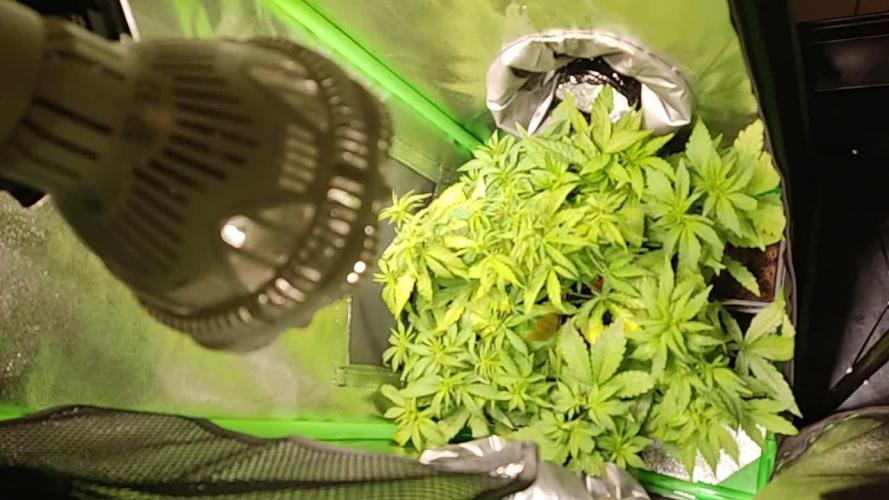
The Drainmaster moved into the tent to control the drain.
Defoliated and lollipopped them.


Likes
88
Share


@ILoVeThiSpLaNt
Follow
Giorno 42. Peccato per una watermelon zkittlez che non sta bene. Lavo terreno e ricomincio da metà dose levando le foglie malate

Likes
17
Share


@420DeepGrow
Follow
📆 Semana 5:
La Blue Zushi está entrando en su mejor momento. Los cogollos empiezan a formar unas colas gordas y compactas, y el aroma ya se vuelve más complejo: mezcla de frutas dulces y un punto funky muy interesante.
Los Adlite de Mars Hydro están sacándole todo el potencial, con una luz muy homogénea que hace que incluso las puntas más alejadas estén produciendo resina. Se nota cómo mejora la estructura y la densidad de las flores bajo estos paneles, ¡una pasada!
La nutrición sigue de la mano de XpertNutrients, y el resultado salta a la vista: hojas bien verdes, tallos fuertes y sin signos de bloqueo o deficiencias. La planta se mantiene sana y empuja con fuerza hacia el final.
Ahora toca seguir mimándola para que termine de explotar en las próximas semanas.


Likes
9
Share
@Trinidad
Follow
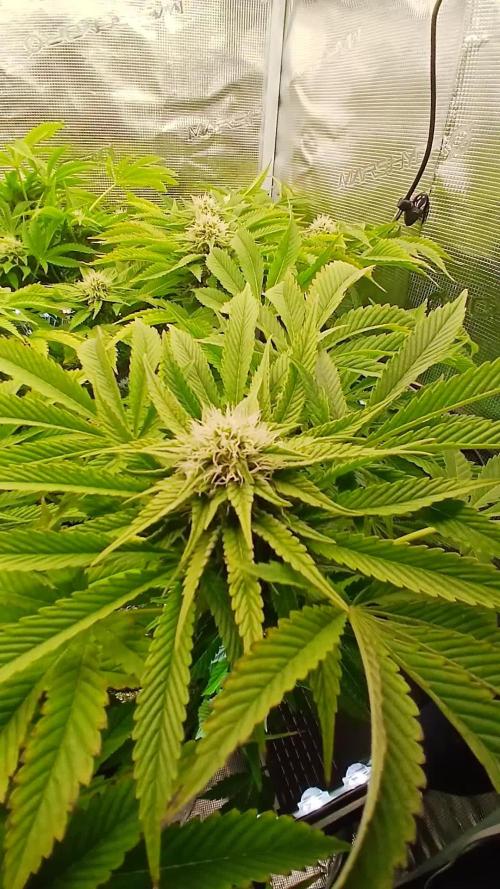
Gorilla Runtz. Seedsman.
Day 80,
Day 32 since 12/12
I added in AC infinity supplemental lights to the under canopy for experimental purposes. I use these for my seedlings however, I decided to use them to see if I notice any difference. I used them on my 1st indoor run (Wurlz F1) and thought they made little difference but I'm thinking just to give it all I got on this lady. I am also using marshydro IR and UV supplement lights. We will see if all these give me a bountiful harvest with the most frosty and dense buds I have ever grown.
Fresh reservoir change out today. She drank all 16 liters I added in 7 days ago. I will be adding another 16liters.
The mushrooms at the end of the video is Copelandia Hawaiian, which is said to be 5 times more potent than regular magic mushrooms. Big up to Zamnesia.
Day 82
I have tidied things up a bit in grow tent. I have decided to leave tent open beacuse the temperatures was getting up to 30°C when closed. It's now 26°C. I have also raised lights a bit. Started timelaspe today. One picture every hour.

Likes
4
Share


@Ledros
Follow
Day 36 (2020-06-14): Changed out the reservoir today with fresh 5.6 PH. I am trying adding in an ice pack each day to keep res temps closer to 68F. I think this should help the algae growth I am still fighting.
Day 37 (2020-06-15): Stretching in full effect. Topped off the reservoir with another gallon since so much was consumed overnight. PH at 5.65
Day 38 (2020-06-16): Officially off the Blumats. They have really turned out to be more trouble than its worth in my opinion. I've spent just as much time fiddling with them (probably a lot more!) and the reservoir as I would have just hand watering. Maybe better for larger grows. Hand watering out the rest of the current reservoir. Did some accidental major defoliation. Kind of a "whoops" moment, just wasn't paying attention to how much I was pulling off! The G14 really needed it bad though. Due to its mutant nature it seems much more leafy as there a lot of "two headed" growth patterns with double the veg as compared to normal.
Day 39 (2020-06-17): Things are looking OK after the Blumat switch and mass defoliation.
Day 40 (2020-06-18): Watered today, 5.8 PH, 50% Pre-Flower Megacrop around 1/2 gallon each plant, but about 25% of that was runoff.
Day 41 (2020-06-19): Watered, around 1/4 gallon each @ 5.75 PH. Did some LST to even things out. G14 canopy is a bit taller than the CBD but not sure what I can do about it at this point. Out of room in the tent to widen things out much more! I might slide a brick under the CBD to raise it to keep even lighting.
Day 42 (2020-06-20): Watered again, 5.8 PH. I raised the CBD Crack so the canopy is even with the G14.

Likes
Comments
Share


Processing
Likes
5
Share


@Highdro
Follow
I started getting new growth from the tops of my colas. I thought this might of been down to raising the light up 10cm but it might of been down to high light intensity so I also moved one abit further away from the other to try and help.
The pictures in the dark and videos was around 4minutes before the lights came on as all my photos are over exposed.
Next to this plant I have an experiment with pink kush and zombie kush using the light given of from this grow.


Likes
210
Share


@Rock_n_Roll_Randy
Follow
I'm really looking forward to these seeds and strains from NUKA SEEDS. I've heard and seen amazing things from them.
CHECK EM OUT:
https://nukaseeds.com
Likes
8
Share


@eldruida_lamota
Follow
Bueno familia ya finalizamos con el proyecto de las Blue Spider, son una cepa bestial, me sorprendieron para bien
La verdad que el secado muy bien 7 días en Malla y a los botes, 50% humedad y 23 grados es la temperatura ambiental que han tenido en el secado.
En resumen la cepa es muy fácil de cultivar,
Por lo demás de miedo os la recomiendo.
Gracias a Agrobeta y Mars hydro , sin ellos este proyecto no sería igual 🙏.
Agrobeta:
https://www.agrobeta.com/agrobetatiendaonline/36-abonos-canamo
Mars hydro:
Code discount: EL420
https://www.mars-hydro.com/
Buenos humos 💨


Likes
Comments
Share


@TheBulldozerSicily
Follow
Iniziamo un altro ciclo, la bella stagione è alle porte, anche quest'anno iniziamo indoor in idroponica e preparo 2 in vaso da passare in outdoor
Likes
31
Share


@Reaper
Follow
picture: start of week 8, preflowers show up
video: end of week 8, flowers start to bloom

Likes
Comments
Share


@Rizzokicksbuds123
Follow
New home bigger pots finish of this training and flip them