


Likes
Comments
Share


@mikheil007
Follow
Harvested Girl Scout cookies auto from Fast Buds! Very satisfied with result: 200gr. dry buds!. Thank You Fast Buds for consistently such a strong genetics!



Likes
48
Share


@MG2009
Follow
Just water and tea from now on as needed I hope you can see tghe frost!😎,
I will be taken better photos in natural light when José, and Maria ( tropical storm's clear out of east coast next week,outside cleaning mould from plants😢


Likes
47
Share


@Ultraviolet
Follow
The cannabis strain Grape Guava can be a purple strain, depending on its specific phenotype and genetic makeup. While not all phenotypes of Grape Guava are purple, some variations, such as the Zatix Grape Guava, are noted for their striking purple appearance due to the genetic expression of anthocyanin pigments.
https://www.youtube.com/watch?v=cKdVmdoKJ5k
In a garden of green, Grape Guava gleams,
With its fruity aroma, enchanting dreams.
Clusters of grapes, guava's sweetness ignite,
A strain so divine, in purple and white.
Euphoria whispers, a lush fruity haze,
Grape Guava's embrace, a tranquil daze.
Off and away.@1400ppm. The increased CO2 allows plants to thrive at higher temperatures, which in turn necessitates higher humidity to maintain the ideal VPD for healthy growth and transpiration. 80F -5F = 75F LST with 70% RH = 0.72 kPa. Higher temperatures and humidity promote rapid growth, nutrient uptake, and photosynthesis while maintaining a lower stress level. Temperature influences the rate of enzymatic reactions involved in aerobic respiration. Enzymes, such as those involved in glycolysis, the Krebs cycle, and the electron transport chain, work most efficiently at an optimal temperature range. In low temperatures, enzymatic activity will slow down, thus reducing the rate of aerobic respiration. In high temperatures, enzymes can become denatured, thus impairing their function and stopping the process of aerobic respiration. Glucose is the primary fuel for aerobic respiration. The rate of aerobic respiration increases with the availability of glucose, as it is the starting point for glycolysis. If glucose levels are low, cells may rely on alternative energy sources such as fatty acids or amino acids , but these processes may yield less ATP or be less efficient. To determine this effect, carbon dioxide volume was measured (as carbon dioxide is an output of aerobic respiration)
18/6 with the 6 being IR. The near infrared (IR-a) borders around 700nm up to 1400nm @ photon par flux density of 1.8 instead of darkness, keeping temps overnight a neat 77F-80F.
Think of my tent as a lung. What goes in must come out. When the rate of air going out exceeds the amount of air coming in, it creates a negative pressure. Tent concaves (bends in). If set up correctly, your RH will begin to drop slowly to the desired level you set, and the extraction turns off when it reaches desired% RH. The plant, as it performs cellular respiration, will always be releasing more water into the air, so the RH% of the tent overnight will always increase, so long as oxidative phosphorylation is occurring. As soon as the RH% creeps back up to 55%, the extraction turns back on, over and over. This creates a strong pressure differential which will work wonders on your grow. Replicating high and low-pressure fronts in nature. Critical for oxygen diffusion at the critical time of peak cellular respiratory function..
Moisture will not transfer from a saturated atmosphere to another if that air is already at or above its saturation point, meaning the air can't hold any more water vapor. Once I understood that water is produced as a by product during cellular respiration, specifically at the very end of the electron transport chain (ETC) where electrons are finally transferred to molecular oxygen, the higher the RH of the air, the more resistance there is for more moisture to be added to that environment, and effects the ease with which it does so. But none of that water comes from the pot; it's pulled from the air. If you run high daytime RH, your medium/pot is 100% reliant on transpirational root pull to move water. ZERO evaporation happens across the atmosphere if the tent air has high RH%, the medium cannot release its water through evaporation. Once a canopy develops, light no longer slowly wicks and evaporates from the topsoil. The Soil-Plant-Atmosphere Continuum (SPAC) describes the continuous pathway and process of water movement, driven by a gradient in water potential, from the soil, through the plant's roots, stem, and leaves, and finally evaporating into the atmosphere through transpiration. There is evaporation, there is transpiration, and then there is evapotranspiration; Evapotranspiration (ET) is the combined total of two processes: evaporation (water lost directly from soil and surface water into the atmosphere) and transpiration (water released from plants to the atmosphere through their leaves). Evapotranspiration represents the total amount of water that moves from the medium into the air. There is no such thing as a medium with too much water, only a medium that retains too much for too long.
The water must always flow efficiently from one atmosphere(Medium) to another(Air) in a timely manner. Moisture is a critical factor for bacterial growth and decay. Dictating how long it's allowed to sit in any one location for any given period is a key preferred control. To ensure a net reduction in a bacterial population, the rate of removal (ET) must exceed the rate of bacterial growth (decay rate), which is often modeled as a growth rate for the specific bacterium under the given conditions. By optimizing daytime VPD, we also optimize conditions for bacterial growth to explode exponentially above 77°F.. If water is allowed to sit in a medium without an escape within a timeframe, nothing good will happen. IF High RH is maintained overnight as well as during the day, placing 100% of water movement at the behest of daytime transpiration, roots can only pull where they can reach, and if soil is compressed above a certain point, moisture will become trapped in a medium with no way of moving day or night. This will begin the countdown for decay to take hold. When water stagnates in a medium, it loses oxygen, creating anaerobic conditions that foster the growth of harmful microorganisms like bacteria and fungi, which can produce toxins and disease vectors.
Thigmomorphogenesis, the process by which plants respond to mechanical stimuli like touch by altering their growth and development, results in significant morphological changes to improve survival against mechanical perturbations. This complex response involves sensing touch and initiating physiological and genetic responses, leading to changes in form and structure over days or weeks. The process is triggered by physical forces such as wind, rain, or touch. Plants adapt to these stimuli by changing their shape and structure, which may include slower growth, thickened stems, or altered leaf development. Plants possess sophisticated mechanisms to detect even subtle mechanical stimuli and initiate responses. A variety of molecules, including calcium ions, jasmonates, ethylene, and nitric oxide, are involved in signaling these mechanical inputs. Touch can induce the expression of genes that encode proteins for calcium sensing, cell wall modification, and defense mechanisms. A plant exposed to constant wind may become shorter and sturdier. A plant that is touched frequently might grow more slowly to conserve energy and develop thicker cell walls. These changes increase a plant's resilience and ability to survive in harsh environments.
Let's get Thiggy with it.
Likes
25
Share


@Mrs_Larimar
Follow
Sunday
Another week starts. The trichomes are still clear and they will get nutes today. Watering is not needed because we had rein the last 2 days. They are smelling strong and they are sticky.
Monday and Tuesday
only water. its very hot the plants are every day dry
Wednesday
I started to flush them. they get 10 liters of pure water(Rainwater). this i will do every second day
Thursday
Very hot Day34 degree.. they got nothing
Friday
Flushing in the vening , another hot day is over
Saturday
The last days are breaking for Stress KIller. Today i stripped her. picking away nearly all bigger leaves

Likes
9
Share


@HUMO_Cultiva
Follow
We start week 3 of bloom!! Goofiez 2 amor compound genetics it’s the champions!!


Likes
8
Share


@emeraldlabs
Follow
Not too much to report on this week besides beginning LST. I did a few pistils appearing, may be in pre-flower, but not positive as it’s my first auto. Will progress as normal.
Video/photos taken 21 days after breaking soil.

Processing
Likes
3
Share


Likes
8
Share


@ElchichodelaGrasa
Follow
En esta última han pegado un estirón de miedo y ya con la malla puesta a para el día 30 de vida

Likes
17
Share


@Salgeezi
Follow
Slowly going into flower. I mean real slow lol. It's showed some pistills about a week ago and still you really have to look for them a week later. My veg lights are 5700k and are on 24/7. Guna let them stretch a bit more and flip to my flower light's 3500k and change time to 20/4 sometime this week

Likes
9
Share


@SlickCityOrganics
Follow
I wished that I could've done things a little different but the end result was fiiire! Taste like Peaches when you give it a nice 4 week cure. Wish that I could've yielded more. But experience will overcome all my flaws. But it will only get better.


Likes
15
Share


@Viccrazyweed
Follow
Its been an amazing week, now i can understand why Carl Linneus was amazed about this miracle of blooming 🌸
Flowers are starting to grow everywhere, smell isn’t a big deal yet but my girls are just super beautiful 🤩
Colouring is homogeneous ☘️, only a single-couple of leaves showing a bit of nutrient deficiency/excess
Critical is becoming literally twice the size of the cookies growing laterally but cookie’s branches are fatter, stronger and harder 💪🏼
Its been a long way but im proud of myself, very pleasant experience, its my first indoor grow and its almost scary how much i have learned ✍️🏼
LST shows an amazing structure and definitely not training your plant its the biggest mistake you can make 🏋️♂️
Unintentionally i applied a light cropping and the branches made the bulbs expected, don’t really know if it will show any gains
Likes
63
Share


@Wyregrasser
Follow
START WEEEK Day 98 4/24/22
+With the exception of the cranky girl, the room is exploding with incredible sights and smells.
+Lowered ppm just a bit to 800. I guess? that I will decrease to nothing and get prepared for harvest
+Kolas are exploding with neon carrot pistols. Very Beautiful
+Smell is average, and increasing
+light is 12" away from tallest kola and up to 24 for the very shortest. I have 4" of lift left. Should I raise?
+It's summer in the South. Temp and Humidity vary greatly, daily. Days in 80's Nights upper 60's. Humidity anywhere from 58% to
+Each plant has developed at it's on rate so this week I will continue selective defoliation.
+Almost forgot. I am going to try some Epsom salt in an attempt to get the cranky girl to feel a little better.
THINKING OUT LOUD
?Cranky girl has been weird from day one. Maybe genetics might be me. I was rough on the girls to start with. She however, was always super green, slow to grow, squatty, huge fan leaves and now (according to growmies) now possibly has a magnesium deficiency. I am critical of myself but I am actually starting to lean toward genetics. Just a note. This was the only plant that I did 0 training to. Just defoliation (light). Nice that I had 3 others to give me backup.
?Need to take a look at some trimming tools on Amazon. Bare Essentials (right :))
THANKS TO EVERYONE WHO HELPED WITH MY MOST RECENT GROW QUESTION. AS ALWAYS ANY QUESTIONS, COMMENTS, SUGGESTIONS, GOOD OR BAD ARE ALWAYS WELCOME😁
SO... GOING TO TRY 4 DIFFERENT STRAINS ON THIS NEXT RUN. BLACKBERRY MOONROCKS, BLUE COOKIES, BANANNA SHERBERT AND A RE-RUN OF A PLATINUM OG. MIGHT ALSO DO IN SOIL. WHO KNOWS? I will be germinating in just a couple of days.

Likes
26
Share


@GrowGuy97
Follow
Day 35, start of week 2 in flower, everything is going great so far✌️🏼🌱
Day 37 - All the ladies are looking great✌️🏼🌱
Day 38 - ladies got watered today, looking good & starting to put off a nice smell😍
Day 40 - Still have a lot of yellowing leaves towards the bottom of almost all the plants can’t figure out exactly what’s wrong😅😅

Likes
74
Share


@KrautFabrik
Follow
Day 60: flush 💦
Pictures are taken on day 62📸
--------------------------------------------
I found again some bud rot 😑 cutted the hole bud 😑 (last pictures)
Happy growing 🍧🌱
Likes
12
Share

@Brujha77
Follow
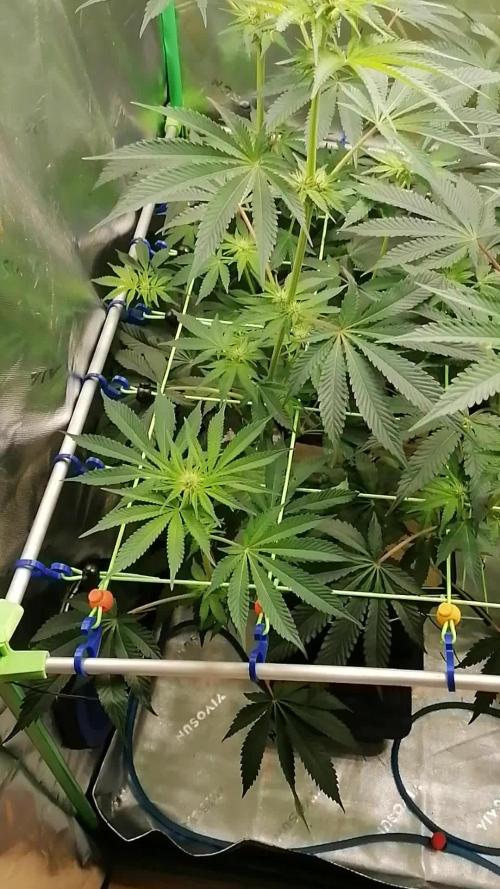
Start Woche 4 Blüte
Heute bekamen alle 3 wieder 20ml Green Bull. Ansonsten gibt's grad nix zu tun.
Alle 3 entwickeln sich richtig schön. Grade #3 währ von Wuchs her n Keeper..


Likes
92
Share


@DogDoctorOfficial
Follow
Week 9 - First Week of Flowering 🌸
The dark period has ended, and these ladies came back into the light fully energized and ready for action! It’s just the first week of flower, and they’re all praying, stretching, and absolutely thriving—filling up every inch of the tent. This grow space is officially packed from wall to wall, with each plant competing for its share of light and showing off some of the biggest, healthiest leaves I’ve seen yet! 🌱
A few strategic plucks here and there have kept airflow smooth and light penetration balanced. Those big leaves? They’re a sign of happy, healthy growth. Large leaves help the plant capture maximum light energy, essential during this stage, especially as they start focusing on developing those flowers. When plants grow huge, vibrant leaves like these, it means they’re well-nourished and content in their environment—a true testament to the well-balanced conditions we’ve got going in the tent!
Flowering Parameters 🌡️
Room Environment:
• Temperature: 26.7°C
• Humidity: 63.3%
• CO2: 960 ppm
• VPD: 1.29 kPa (prime zone for flowering health!)
Lighting:
• Light Intensity: 835 PPFD (ideal for boosting flower growth)
• Solution: pH 5.96, TDS 460 ppm, temp 21.1°C
• Medium: Moisture: 100%, TDS: 520 ppm, Temp: 21.6°C
Carbon Filter Installation & Smell Management 🌬️🌱
With the transition to flower, the scent profile is already starting to kick in—crazy for the first week, right? 🌸 To keep everything fresh and under wraps, I’ve set up a carbon filter system. Here’s how it’s working: I’ve connected the filter to my Aerofan, which pulls air directly from the tent. This air is cleaned by the filter and released into the main room, where it then passes through another filter before exiting my space. This dual-filter setup means no scent escapes into the wild, keeping things stealthy and the grow room a peaceful, scent-contained environment. Perfect for anyone concerned about keeping their home free from that telltale aroma! 🕶️🌬️
Enhanced Lighting with Emerson Effect 🌞
This week, I’ve introduced an extra 15 minutes of red light at the beginning and end of each light cycle. Why? Well, this red boost taps into the Emerson effect, enhancing photosynthesis efficiency, especially during the flowering stage. By stimulating a little extra wake-up and wind-down light, we’re mimicking the natural sunrise and sunset experience for these plants, which can help reduce flowering time. Not only does it encourage smoother transitions into day and night, but in theory, it’ll help these ladies finish a bit faster, while giving them a little nudge to build more substantial, quality flowers. 🌇
Nutrient Adjustments 🌱
Now that we’re in flower, I’ve swapped out the Start Booster for P-Boost and TopBooster to specifically support flowering needs. Here’s why:
• P-Boost brings in additional phosphorus, vital for energy transfer and cell division as the plant channels more resources into budding sites.
• TopBooster supports the flowering phase by improving flower quality and density, helping to build those big, aromatic buds we’re after.
These changes bring the nutrient mix in line with what’s most beneficial at this stage. All this precise dialing in is easy to manage thanks to the TrolMaster system. From pH to nutrient scheduling, the TrolMaster ecosystem and ThinkGrow LEDs have been the ultimate teammates in this grow journey, giving me real-time data, fine control, and peace of mind. 💯
(Not introducing UV light just yet, but stay tuned as that’s coming soon for an added boost!)
Looking Forward 🌟
Next week, we’ll be upping the reds, giving us an even greater chance of activating those flowering signals for a smoother, faster transition through the cycle. I’ll keep tweaking and fine-tuning every parameter to make sure these ladies get exactly what they need to thrive.
Big thanks to the TrolMaster system for keeping everything in balance and optimized, along with the supportive Grow Fam following this journey! Your enthusiasm, advice, and support are a huge part of this grow’s success. Keep following for more updates, and stay tuned for what’s next! 🌿✨
P.S. Deep Dive: TrolMaster’s MBS-S8 CO₂ Sensor & Smoke Detector 🚨
The MBS-S8 CO₂ Sensor from TrolMaster is a powerhouse for growers, especially when it comes to optimizing plant growth and efficiency in a controlled environment. This sensor continuously monitors CO₂ levels and integrates directly with the TrolMaster ecosystem, giving you real-time data on CO₂ concentration. Ideal levels of CO₂ can significantly boost growth and yield during certain stages, so understanding and managing CO₂ is key. With the MBS-S8, I can control CO₂ levels precisely, keeping them within the optimal range for photosynthesis. This sensor is a game-changer because it adjusts CO₂ delivery automatically, giving plants exactly what they need without any extra monitoring from me.
Meanwhile, TrolMaster’s Smoke Detector is an essential safety device, especially in spaces with electrical equipment, lights, and heat-generating components. This detector can be set up to alert me instantly via the TrolMaster app if any smoke is detected, allowing me to respond immediately to any potential issues. Fires and smoke are rare in controlled grow setups but having this safety measure provides peace of mind and lets me focus on the plants without constant worry. It’s an incredible tool for any grower prioritizing safety and proactive monitoring.
Discount Codes so you can save big on your next check out 💚💚💚
Kannabia - DOGDOCTOR 30% off
SeedsmanSeeds - DOGDOCTOR 10% off
CannaKan- DOGDOCTOR 15% off
terpyz.eu - DOCTOR 15% off
The Neutralizer - PORKIT5-DOG 15% off
As always thank you all for stopping by, for the love and for it all , this journey of mine wold just not be the same without you guys, the love and support is very much appreciated and i fell honored and so joyful with you all in my life 🙏
With true love comes happiness 💚🙏 Always believe in your self and always do things expecting nothing and with an open heart , be a giver and the universe will give back to you in ways you could not even imagine so 💚
Friendly reminder all you see here is pure research and for educational purposes only
Growers Love to you all 💚💚💚


Processing
Likes
27
Share


@Stigghiola
Follow
Questa settimana sta andando bene i fiori stanno diventando più grandi, sono tutti pieni di resina ma sono comunque ancora piccolini, speriamo che ingrossino ancora 🤞🏻
Aggiornamento 17 Novembre:
Oggi ho aggiunto una nuova luce di supporto appositamente per illuminare i fiori che sono più indietro rispetto agli altri. La lascerò accesa h24 per vedere se può cambiare qualcosa, nel frattempo alcuni fiori sembra che stiano iniziando ad ingrossare e ad unirsi.