The Grow Awards 2026 🏆
Likes
Comments
Share
Likes
3
Share
@cost420
Follow
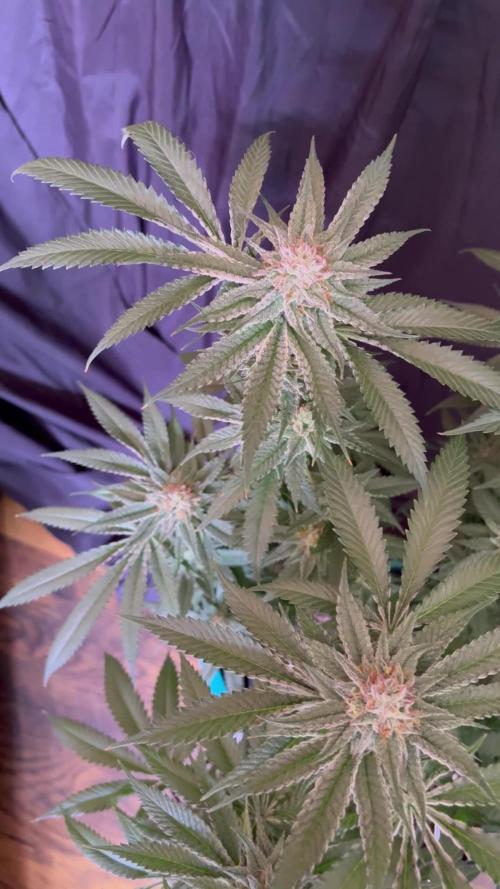
Week 16: Purple on the buds and underneath the leaves, with a smell of gelato X milky cookies.
Likes
4
Share
@twenty20mendocino A-Team R&D Update ~ Let’s Go day 24 of flower 🌸 an we are looking amazing! Ladies are starting to stack an oh my we getting a lot of frost going on! starting to get some gassy stanky notes of em too😍 ! We are only into week 4 ladies an gents we still got a few weeks to go of stacking! Keep your eyes peeled for next week’s update yall , peace love a positive to all y’all , an have an amazing productive day ! Cheers an blaze on !!
Likes
6
Share
The plant is still going strong, but I noticed that the colors have faded a bit. Not necessarily a bad thing, though—I realized the temperature difference between day and night was a bit too extreme, which probably caused unnecessary stress. It did look absolutely stunning with those colorful leaves, but stability is more important now.🌱 Other than that, everything is going great! The buds are getting thicker, stinkier, and completely covered in frost.😍 The dominant smell is still pink pepper, which is really interesting. Sometimes I get a hint of something sweet, but I’m not sure yet if it will develop more over time.💚
Likes
16
Share
@Mrg7667
Follow
Another eventful week! Transplanted into 5 gallong pots. Its interesting to see that there hasnt been much vertical growth but allot of branchung out compared to how it was with the other lights
Likes
7
Share
She looks so gorgeous, almost all of these turned purple Nugs looking beautiful Super scared of Budrot, will spray her few days with baking soda-milk-water mix. This will be the last week of feeding her , checked her on the magnifier she is milky like 90% Thinking to defoliate her to prevent, for more air circulation Start adding overdrive this week
Likes
9
Share
@MacBrGrow
Follow
this week I did the top pruning to increase the production of the lower shoots to serve as clones when they are put to flower
Likes
26
Share
Big week! I got my new EarthBoxes and a bunch of goodies. I picked up the Probiotic Farmer's Alliance kit from BuildASoil, so I also got some EM-1, Kashi Blend, dolomite lime and Malibu compost. Alongside that I picked up Colorado Worm Compost (vermicompost), Gnarley Barley (malted barley, corn and hemp) and Craft Blend (aprox 3-5-2 organic mix). Unfortunately there was a bag of soil missing, so I ended up using my own mix though I am somewhat scared of it being too clay-heavy for the SIP. I inoculated with EM-1 and began fermenting a batch of activated EM-1 to make the bottle last longer. It looks about a week from LST, after that I hope to set up a two-tier SCROG setup and begin growing the bushes. I will begin spraying AEM-1/EM-FPE/EM-5 alternatively once a week for IPM, I will try to avoid using neem this round (unless I find this approach lacking). I also brewed a batch of EM-FPE with aloe that smells incredible, I can't wait to give it a go.
Likes
Comments
Share
Likes
37
Share
@Roberts
Follow
Mandarin XL autoflower is finally starting to shoot pistils. She is overdue on a solution change. Everything is going good and I will get to a change this weekend. Nothing else to report at the moment. Thank you Gen1:11, Medic Grow, and Ganja Farmer. 🤜🏻🤛🏻🌱🌱🌱 Thank you grow diaries community for the 👇likes👇, follows, comments, and subscriptions on my YouTube channel👇. ❄️🌱🍻 Happy Growing 🌱🌱🌱 https://youtube.com/channel/UCAhN7yRzWLpcaRHhMIQ7X4g
Processing
Likes
3
Share
@Reaper
Follow
the buds are very small, i had the same problem on the motherplant that i grew in hydro, its just a very bad phenotype, i had 2 of these in the package of 10 seeds, 8/10 was very good plants with very big yields of 125 grams/plant wich took very less space in the growroom. i yielded 170grams of this pheno in the rdwc system but the plant was very big ( took almost the whole tent in) so i reccomend not groIng this in hydro, it also finishes faster in soil with autumn colors at the end. i have a feeling the buds will get more weight in the coming week this is also only a 104watt LED.
Likes
56
Share
Blackcherry punch has come down and been trimmed. Will post harvest soon when completely dried. Jack Herer has come down. In the process of trimming her. Everyone else is flushing. The real work has begun......
Likes
52
Share
Once again she passes my expectations, late to the show with trichome production. I'm surprised there is purple on the bud, maybe Purpinator does work. I thought I could see hints under the grow lights and thought my eyes were deceiving me, I was just being hopeful. But nah 2 of the 3(under the UV) have developed a beautiful tone of purple. I was never going to bother with a deep freeze but maybe the whole bud will change given conditions, that would be something, fingers crossed. 🤔 was a little skeptical that reducing temps humidity would change density, but it does, buds are solid something I've not been able to achieve before. Rule of thumb is never to surpass 60% RH in the flowering phase and try to progressively reduce it down to 40% in the last 2–3 weeks before harvest. The plant will react as it seeks to protect its flowers, responding by producing denser buds and a higher concentration of resin. Cannabis plants are sensitive to sudden temperature changes, especially in the flowering stage. Extreme heat or cold can impact bud density and overall yields. In nature as a defense mechanism from cold, the plant sensing sudden dips in temperature will attempt to remove the pockets of air within the bud, it achieves this by compacting itself in doing so to better protect itself from cold snaps which are normally indicators in nature that worse weather is on the way. Terpene levels are the highest just before the sun comes out. Ideally, you want as many terpenes present in your plants as possible when you harvest. Cannabis plants soak up the sun during the day and produce resin and other goodies at night. The plant is at its emptiest from "harvest undesirables" so to speak right before the lights on. Boiling cannabis roots during harvesting slows down the drying process. When you boil cannabis roots, it shocks the plant, closing the stomata on the leaves. This prevents massive moisture loss through the leaves, leaving only the floral clusters actively losing moisture at a reduced pace. I've always run a strict 60/60 and it took almost twice as long to dry to a snap than previous grows where I didn't boil for what it's worth. Chlorophyll is good for the plant but not for you. When you harvest the buds, even after you flush them, if you flush them, they’re still filled with chlorophyll. Freshly cut buds are greener than dried buds because they still contain loads of chlorophyll. However, when rushed through the drying process, the buds dry but retain some chlorophyll, and when you smoke it, you will taste it. Chlorophyll-filled buds are smokable, but they aren’t clean. Slow drying gives the buds enough time and favorable conditions to lose the chlorophyll and sugars, giving you a smoother smoke. How the plant disposes of the chlorophyll and sugars by a process of chemically breaking them down and attaching the decomposed matter once small enough to water molecules which then evaporate back into the ether. Time must be given to the process to break down the chlorophyll and sugars. Think of it like optimizing the environment for decay. All the nutrients it could ever need are in abundance, it eats nutrients based on its demand for growth, which is dictated primarily by available light. Plant growth and geographic distribution (where the plant can grow) are greatly affected by the environment. If any environmental factor is less than ideal, it limits a plant's growth and/or distribution. For example, only plants adapted to limited amounts of water can live in deserts. Either directly or indirectly, most plant problems are caused by environmental stress. In some cases, poor environmental conditions (e.g., too little water) damage a plant directly. In other cases, environmental stress weakens a plant and makes it more susceptible to disease or insect attack. Environmental factors that affect plant growth include light, temperature, water, humidity, and nutrition. It's important to understand how these factors affect plant growth and development. With a basic understanding of these factors, you may be able to manipulate plants to meet your needs, whether for increased leaf, flower, or fruit production. By recognizing the roles of these factors, you'll also be better able to diagnose plant problems caused by environmental stress. Water and humidity *Most growing plants contain about 90 percent water. Water plays many roles in plants. It is:* A primary component in photosynthesis and respiration Responsible for turgor pressure in cells (Like the air in an inflated balloon, water is responsible for the fullness and firmness of plant tissue. Turgor is needed to maintain cell shape and ensure cell growth.) A solvent for minerals and carbohydrates moving through the plant Responsible for cooling leaves as it evaporates from leaf tissue during transpiration A regulator of stomatal opening and closing, thus controlling transpiration and, to some degree, photosynthesis The source of pressure to move roots through the soil The medium in which most biochemical reactions take place Relative humidity is the ratio of water vapor in the air to the amount of water the air could hold at the current temperature and pressure. Warm air can hold more water vapor than cold air. Relative humidity (RH) is expressed by the following equation: RH = water in air ÷ water air could hold (at constant temperature and pressure) The relative humidity is given as a percent. For example, if a pound of air at 75°F could hold 4 grams of water vapor, and there are only 3 grams of water in the air, then the relative humidity (RH) is: 3 ÷ 4 = 0.75 = 75% Water vapor moves from an area of high relative humidity to one of low relative humidity. The greater the difference in humidity, the faster water moves. This factor is important because the rate of water movement directly affects a plant's transpiration rate. The relative humidity in the air spaces between leaf cells approaches 100 percent. When a stoma opens, water vapor inside the leaf rushes out into the surrounding air (Figure 2), and a bubble of high humidity forms around the stoma. By saturating this small area of air, the bubble reduces the difference in relative humidity between the air spaces within the leaf and the air adjacent to the leaf. As a result, transpiration slows down. If the wind blows the humidity bubble away, however, transpiration increases. Thus, transpiration usually is at its peak on hot, dry, windy days. On the other hand, transpiration generally is quite slow when temperatures are cool, humidity is high, and there is no wind. Hot, dry conditions generally occur during the summer, which partially explains why plants wilt quickly in the summer. If a constant supply of water is not available to be absorbed by the roots and moved to the leaves, turgor pressure is lost and leaves go limp. Plant Nutrition Plant nutrition often is confused with fertilization. Plant nutrition refers to a plant's need for and use of basic chemical elements. Fertilization is the term used when these materials are added to the environment around a plant. A lot must happen before a chemical element in a fertilizer can be used by a plant. Plants need 17 elements for normal growth. Three of them--carbon, hydrogen, and oxygen--are found in air and water. The rest are found in the soil. Six soil elements are called macronutrients because they are used in relatively large amounts by plants. They are nitrogen, potassium, magnesium, calcium, phosphorus, and sulfur. Eight other soil elements are used in much smaller amounts and are called micronutrients or trace elements. They are iron, zinc, molybdenum, manganese, boron, copper, cobalt, and chlorine. They make up less than 1% of total but are none the less vital. Most of the nutrients a plant needs are dissolved in water and then absorbed by its roots. In fact, 98 percent are absorbed from the soil-water solution, and only about 2 percent are actually extracted from soil particles. Fertilizers Fertilizers are materials containing plant nutrients that are added to the environment around a plant. Generally, they are added to the water or soil, but some can be sprayed on leaves. This method is called foliar fertilization. It should be done carefully with a dilute solution because a high fertilizer concentration can injure leaf cells. The nutrient, however, does need to pass through the thin layer of wax (cutin) on the leaf surface. It is to be noted applying a immobile nutrient via foliar application it will remain immobile within the leaf it was absorbed through. Fertilizers are not plant food! Plants produce their own food from water, carbon dioxide, and solar energy through photosynthesis. This food (sugars and carbohydrates) is combined with plant nutrients to produce proteins, enzymes, vitamins, and other elements essential to growth. Nutrient absorption Anything that reduces or stops sugar production in leaves can lower nutrient absorption. Thus, if a plant is under stress because of low light or extreme temperatures, nutrient deficiency may develop. A plant's developmental stage or rate of growth also may affect the amount of nutrients absorbed. Many plants have a rest (dormant) period during part of the year. During this time, few nutrients are absorbed. Plants also may absorb different nutrients as flower buds begin to develop than they do during periods of rapid vegetative growth. 432 Hz is said to be mathematically consistent with the patterns of the universe. Studies reveal that 432 Hz tuning vibrates with the universe’s golden mean PHI and unifies the properties of light, time, space, matter, gravity and magnetism with biology, the DNA code and consciousness. When our atoms and DNA start to resonate in harmony with the spiraling pattern of nature, our sense of connection to nature is said to be magnified. Another interesting factor to consider is that the A=432 Hz tuning correlates with the color spectrum while the A=440 Hz is off. Audiophiles have also stated that A = 432 Hz music seems to be non-local and can fill an entire room, whereas A=440 Hz can be perceived as directional or linear in sound propagation. Once you adopt the idea that sound (or vibration in general) can have an equalizing and harmonizing effect (as well as a disturbing effect), the science of harmony can be applied to bring greater harmony into ones life or a tune to specific energies. There is a form of absolute and of relative harmony. Absolute harmony can for example be determined by the tuning of an instrument. The ancients tuned their instruments at an A of 432 Hz instead of 440 Hz - and for a good reason. There are plenty of music examples on the internet that you can listen to in order to establish the difference for yourself. Attuning the instrument to 432 Hz results in a more relaxing sound, while 440 Hz slightly tenses up to body. This is because 440 Hz is out of tune with both macro and micro cosmos. On the contrary, 432 Hz is in tune. To give an example of how this is manifested micro cosmically: our breath (0,3 Hz) and our pulse (1,2 Hz) relate to the frequency of the lower octave of an A of 432 Hz (108 Hz) as 1:360 and 1:90. It is interesting to note that 432 Hz was the standard pitch of many old instruments, and that it was only recently (19th and 20th century) the standard pitch was increased. This was done in order to be able to play for bigger audiences. Bigger audiences (more bodies) absorb more of the lower frequencies, so the higher pitch was more likely to “cut through”. One of the oldest instruments of the world is the bell ensemble of Yi Zeng (dated 423 BC), tuned to a standard F4 of 345 Hz which gives an A= 432 Hz. The frequency of 345 Hz is that of the platonic year! Similarly many old organs are tuned in an A=432 as well; for example: St. Peter’s Capella Gregoriana, St. Peter’s Capella Giulia, S. Maria Maggiore in Rome. Maria Renold’s book “Intervals Scales Tones and the Concert Pitch C=128 Hz” claims conclusive evidence that 440 Hz and raising concert pitch above scientific “C” Prime=128 Hz (Concert A=432 Hz) disassociates the connection of consciousness to the body and creates anti-social conditions in humanity. The difference between concert pitch A=440 Hz and Concert A=432 Hz is only 8 cycles per second, but it is a perceptible difference of awareness in the human consciousness experience of the dream we share called existence.
Likes
26
Share
1️⃣02.10.23- День 94 от семечки и 34 день 12/12. Проведено мероприятие по разведению веток lst для проникновение света и лучшей циркуляции воздуха . В планах убирать по несколько листов за сеанс . В остальном растение счастливо , хоть она и не высокая) 2️⃣05.10.23- Проведена масштабная дефолиации около 30% листвы . Дабы избежать плесени и дать огромному количеству соцветий свет .
Likes
36
Share
@m0use
Follow
The time is finally here to post the harvest. I waited till it was all done and dry before updating the dairy so will add in the dry weights next on the 2nd half of the harvest entry. Had some ups and downs with this plant. mainly the extreme yellowing that was happening. I should have treated this faster with a flush but was super reluctant and I feel this has suffered in the end. The top best looking buds could have been larger and the lower ones could have been thicker. There is some smells with this plant but they are not pronounced. Just smells like mild basic weed, this would be one reason not to grow it, however, the crystals on this plant have been the most I've ever grown before. When trimming them every time the scissors snipped or the brush stroked I saw some falling down onto the tray. This plant would be great for making hash. had a good little ball of finger hash at the end of it and will be giving that to my friends to smoke or make a strong edible with. I don't plan on growing this strain out again, the lack of smells and the fact I'm only trying to grow cbd dominate plants is the main reason. If my friends really like this I have some clones so can always give them some. Speaking of clones they are doing well outside, greened up a lot and showing signs of revegging. Took some photos of the weed hang drying on day 1 in the tent and a week later to show how much they shrink. most of the lower growth is quite larfy but will make good edibles or hash, that will be a fun project to do and may include that in my projects diary. That's about all I can think of if you have any questions just ask. m0use Disclaimers: 1. I have divided the total watts of light in half, 300w(150w) for this diary. It will accurately reflect the g/w ratio as the two plants growing in this tent are listed in two separate diaries. 2. I include any shake/trim in my gross totals as I use them to make edibles. 3. I did not follow any proper ways of listing my nutrients. Some are ml/l of total solution watered, others ml/l of total medium and some are just the total amounts I added, not as a ratio. If you have any questions let me know! +++++++++++++++++++++++++++++++++++++++++++++++++++++++++++++ Cost + Time Analysis Of Growing Cannabis. m0use’s Breakdown +++++++++++++++++++++++++++++++++++++++++++++++++++++++++++++ Light Schedule === Veg [Dec 18th 2021 - Mar 11th 2022] 18h on 6h off - 6am-12pm Flower [Mar 12th 2022 - May 10th 2022] 12h on 12h off - 9am-9pm This is extra tricky this harvest as I went through 2 different hydro rates in three different periods, plus a veg and bloom switch between them. Mon-Fri are TOU rates, all weekends are off-peak pricing all day. Off Peak = 7pm-7am + all weekend Mid peak = 11am-5pm On peak = 7am-11am + 5pm-7pm TOU rates: Dec 18th 2021-Jan 17th 2022 Cost of kwh with on-peak "17.0c", mid-peak "11.3c" and off-peak "8.2c". Jan 18th 2022 - Feb 7th 2022 Cost of kwh with on-peak "8.2c", mid-peak "8.2c" and off-peak "8.2c". Feb 8th 2022 - Current Cost of kwh with on-peak "17.0c", mid-peak "11.3c" and off-peak "8.2c". — Dec 18th 2021-Jan 17th 2022 Weekdays “21 days” 6am - 7am -- 1hr @8.2c/kwh off-peak 7am - 11am -- 4hr @17.0c/kwh on-peak 11am - 5pm --6hr @11.3c/kwh mid-peak 5pm - 7pm -- 2hr @17.0c/kwh on-peak 7pm - 12am -- 5hr @8.2c/Kwh off-peak Weekends “10 days” 6am - 12am – 18hr @8.2c/kwh off-peak 6h @17.0c/kwh 6h @11.3c/kwh 6h @8.2c/kwh + [email protected]/kwh weekdays/weekends — Jan 18th 2022 - Feb 7th 2022 Weekdays “15 days” 6am - 7am -- 1hr @8.2c/kwh off-peak 7am - 11am -- 4hr @8.2c/kwh on-peak 11am - 5pm --6hr @8.2c/kwh mid-peak 5pm - 7pm -- 2hr @8.2c/kwh on-peak 7pm - 12am -- 5hr @8.2c/Kwh off-peak Weekends “6 days” 6am - 12am – 18hr @8.2c/kwh off-peak 18h @8.2c/kwh + [email protected]/kwh weekdays/weekends — Feb 8th 2022 - Harvest Veg Feb 8th - March 11th 2022 weekdays “24 days” 6am - 7am -- 1hr @8.2c/kwh off-peak 7am - 11am -- 4hr @17.0c/kwh on-peak 11am - 5pm --6hr @11.3c/kwh mid-peak 5pm - 7pm -- 2hr @17.0c/kwh on-peak 7pm - 12am -- 5hr @8.2c/Kwh off-peak weekends “8 days” 6am - 12am – 18hr @8.2c/kwh off-peak 6h @17.0c/kwh 6h @11.3c/kwh 6h @8.2c/kwh + [email protected]/kwh weekdays/weekends — Flower March 12 - May 10th 2022 weekdays “42 days” 9am - 11am -- 2hr @17.0c/kwh on-peak 11am - 5pm --6hr @11.3c/kwh mid-peak 5pm - 7pm -- 2hr @17.0c/kwh on-peak 7pm - 9am -- 2hr @8.2c/Kwh off-peak weekends “18 days” 9am - 9pm – 18hr @8.2c/kwh off-peak 4h @17.0c/kwh 6h @811.3c/kwh 2h @8.2c/kwh + [email protected]/kwh weekdays/weekends — Total hours in each peak period 126+144+168 = 438h @17.0c/kwh 126+144+252 = 522h @11.3c/kwh 306+378+288+300 = 1,272h @8.2c/kwh Lights === LED’s I use are 48w and 18w, per stick, they are arranged on an array totaling 300w. 6400k 18w*6 = 108w + 3000k 48w*4 = 192 108w+192w=300w | 300w/1000 = 0.3Kw * note I am using 150w as stated in my disclaimers to account for the missing plant in a separate diary.* Using the previous c/kwh numbers above I can find out the total cost of the lamps in the 3 peak periods. I converted the cents into dollar amounts beforehand to avoid dividing by 100. 8.2c/h = 0.082$/h 438h * 0.17c/kwh = $74.46kw * 0.15kw = $11.17 on peak 522h * 0.113c/kwh = $58.99kw *0.15kw = $8.85 mid peak 1,272h * 0.082c/kwh = $104.30kw *0.15kw = $15.65 off peak The "h" hours and "kw" kilowatts cancel out and we are left with a value of $ dollars per peak period, add all the peak periods up and you get your total cost of running the lights in dollars. $11.17 + $8.85 + $15.65 = $35.67 for the grow light only. My light grew for 20 weeks and 4 days, or 144 days. almost 21 weeks total. $35.67 / 144d = 0.2477$/d average of about 25c a day in electricity 337.2kw for the entire grow. Using the regular calculation of grams harvested divided by watts used is not accurate to me, it does not account for all the time the lamps are on, the length of grow to the over all cost. The calculation that makes sense to me is this, harvested dry weight of usable cannabis buds/trim/keif/whatever in grams divided by total kw used. Could also combine it with grams per total single use costs “anything you used only for this grow and wont reuse in the next, or fractions of multi use items like fertilizers if they ½ full” and see how much you’re investing per gram. "kw" ÷ "g" = kw/g "$" ÷ "g" = $/g I have harvested 5.34oz or 151.6g on 337.2kw. 337.2kw ÷151.6g = 2.22 kw/g of usable cannabis. This is not an ideal ratio for me and looks like a lot of energy waste happened from the extended veg period. $35.67 ÷ 151.6g = 0.24c/g It cost 24c/g when comparing total electricity cost to gross yield, almost identical to the comparison of total electrical cost to the number of days in the grow 25c/day. Neat! legend, kwh = kilowatt per hour kw = kilowatt w = watt h = hour c = cents $ = dollars d = day LED= Light Emitting Diode
Likes
9
Share
@Chucky324
Follow
Hello. This is the end of week 9 and the beginning of week 10 of veg. Got them outside and repotted. They look much happier... Look at the last pictures to see they have grown a few inches in a few days. I put a heat sink in this year. 8 - 5 gallon containers were put under the table and are supposed to trap the heat and release it slowly. You can see the white containers behind the plants under the middle of the table. I'll take them out when it gets warmer at night. The soil is 5 gallons of SunShine Mix #4 ( 70% Moss) and 5 gallons of compost from my household composter. I mixed them together. I surrounded the root ball with the SunShine Mix neutral ph soil, so the root ball doesn't get burnt by the hot soil. The roots will grow into the mixed soil when they are ready. Lots of light in there with the new window film I've installed. Plants have a tangy smell to them. OK. Be Great. Chuck.
Likes
8
Share
@Str907
Follow
Right do to unfscean circomstances I had to put them in a cold garage in a green house with lights left them for two weeks and just didn't have time to care for them so this is what they looked like and I only had 3 ladies left dates of photos range in-between 2nd of November to 10th November