


Likes
Comments
Share


@eldruida_lamota
Follow
Vamos familia que ya actualizamos la cosecha de estas Frosted Guava de Zamnesia.
Vaya flores que se han marcado repletas de tricomas, parecen escarcha y las flores se marcan aromas muy tropicales, la verdad que únicos.
Es una variedad bastante fácil de cultivar pero al tener un periodo de floración algo más largo, hay que estar pendiente de alimentarlas bien, gracias Agrobeta en mi sala es posible.
Temperaturas máximas en 24 y mínimas en 20 y una humedad estable en torno al 36%.
Las mantuve 10 semanas pero facilmente si se quedan 11 tampoco estaría mal, yo las vi bien maduras y ya tenía tricomas ambar así que les di matarile.
Os comento que tengo un descuento y para que compréis en la web de Zamnesia de un 20%, el código es ZAMMIGD2023
The discount 20% and the code is ZAMMIGD2023
https://www.zamnesia.com/
Agrobeta:
https://www.agrobeta.com/agrobetatiendaonline/36-abonos-canamo
Mars hydro:
Code discount: EL420
https://www.mars-hydro.com/
Espero que disfruteis este diario, buenos humos 💨💨💨

Likes
11
Share


@GorillaZativus
Follow
7 días .
Ph: 5,9-6,0
Ec: 02 - max 0,6
1 semana y ya completamos el pan de raíz.
Desde el día 3 riego foliar , knactive , mycochum + orca .

Likes
12
Share


@FrecheOma60
Follow
Die meisten sehen relativ gesund aus, außer der große hintere. Dieser ist so extrem gestretscht, dass ich die lampe nun nicht mehr weiter weghängen kann. Ich habe die Stränge hinten noch mehr runter gebunden. Da die Pflanze etwas verkümmertes Budwachstum zeigt. Ausserdem bis jetzt die einzige Pflanze mit lila Stamm, vermutlich wegen Lichtintensität. Die restlichen entwickeln sich dann doch recht gut.

Likes
26
Share


@DrRobeRt
Follow
Another great week, They are both enjoying the new nute schedule. Keeping the light 18" from the canopy is proving tricky as they grow. Its approx 16" and Im gonna try to tame the crazy branch at the back of Nancy. But im feeling good about them so far.Im wondering how long the flower will take ;-)


Likes
22
Share


@Slobasian
Follow
Love every plant each one is growing differently stacking different even the visual difference of one strain growin two different ways combined smells of diesel, pez candy and lemons


Likes
13
Share


@Krautbauern
Follow
Gorilla Punch will be harvested today, the ZTRAWBERRIEZ also will be harvested in a few days. It seems that the ZKITTELZ needs one day more.

Likes
14
Share


@Naujas
Follow
79 days!!!!! and the harvest is already harvested :) The whole growth until week 6 went very well, then the girl got a little worse, (I think it's my mistake, which I described in previous weeks), but besides all that she managed to ripen perfectly, matured stiff flowers, full of shiny sticky trichomes with a very, very sweet aroma ;) 210 gr of wet buds, I also collected a lot of sugar leaves from which I will make bubble hash :) I can't wait to taste it :) this is my first trip with Sweetseeds Looking at the flowers I understand that I will definitely repeat it :) I will leave more feedback after the smoke review:) good luck to everyone.

Likes
70
Share


@Insaniac_0
Follow
All feeds with nutes use either a whole ratio or combination of "Veg Mix" and "Bloom Mix"concentrates DILUTED in water until a total ppm of add in is reached using a (Total Dissolved Solids)TDS Meter measured in PPM (parts per million). The "Veg Mix" concentrate will eventually be added in smaller ratios and "Bloom Mix" concentrate what will eventually replace the "Veg Mix" concentrate entirely with the ppm and ratios listed when I feed. Veg mix recipe is on week 3. Bloom Mix recipe is on week 5.
Day 70/0
Flipped to 12/12 - increased ppfd by 100 and worked to stabilize temps/humidity with new gear. I used 15 minutes of IR light before main lights and then 30 minutes of UV light at mid day and will still use 15 minutes of IR light after main light are out. I plan to increase the time of UV lights to a max of 2.5 hours per day mid day but for now Im easing her into the treatments.
Watered with 1.12 gallons of 6.3ph de-chlorinated tap water, used 50ppm of veg mix and 50ppm of bloom mix in the water. VPD is mostly steady 74F/65%RH/33%ILV
Day 71/1
tested and calibrated my meter, tested the top soil 1 day after feed for ph - tested 4 times for an avg of 6.48
Trimmed brown leaves and did some HST/LST training/binding. Took control pics for UV treatments of 15 minutes per day. Will monitor and increase weekly it she holds up okay. Still doin 15 minutes of IR light before and after lights on/off.
PPFD after training was 630 at highest and 540 lowest. VPD was 74F/60%RH/33%ILV
Day 72/2
Just a watch today, VPD was 75F/60%RH/setting 4/10 of ILV (about 33% like the last tent)
PPFD ranged from 530 to 650. I only used 5 minutes of UV light today as she has a tinge of browning on the tips of a few leaves. Im not cutting it out completely because I still plan to use upto 2.5 hrs by end of flower, so she needs to adjust. Im also still using 15 minutes of IR before and after main light schedule.
Her stretch seems to be picking up, from 16 inches 2 days ago to 18 today.
Day 73/3
VPD same as yesterday 75F/60%RH/40%ILV
PPFD hit 670 at highest and 550 at lowest. Stayed with 5 minutes of UV light and monitored burnt tips from previous days... no spread, so I may add 5 more minutes tomorrow and monitor. 15 minutes of IR before/after main light schedule.
Growth continues, another inch in stretch to 19 inches. I turned her slightly because there are still two runted colas that I rather provide more light to. It's been 3 days since last feed and I think with as much growth as she's putting on, I should feed again tomorrow. Im still introducing nutes in lower portions but will add 300ppm and feed about 2 gallons at a 25/75 ratio of veg:bloom mix to see if I can get some run off to measure conditions.
Day 74/4
Watered with 2 gallons of 6.4 ph de-chlorinated tap water. I added 300ppm total of 25% Veg/75% Bloom. Starting ppm was 296; ending was 595 and I added a pinch of epsom salt. Poured over the whole base until I got runoff - Since I was so close to the whole 2 gallons, I used it all. I only used the feed water over the roots today as I want her to get the nutes from the soil since the transfer into new soil was so recent.
So far VPD is 75F/60%RH/40%ILV. No issues with controls.
PPFD was upto 700 at center so I raised the lights to almost 42" from soil - Since the plant is almost 20" that's 22" leaves to light. New PPFD now ranges at 480 to 650 on 70% power.
I increased UV time to 10minutes today and took control pics for light burn. I am still using 15 IR before and after main lights.
Took some black back picks since I think she's looking good now.
Day 75/5
Started the day with evaluation of ph and control pics. Comparisons show no further spread of lock out issues from earlier or light burn of a more recent change. Upto 20 inches before HST/LST today.
Meter was tested/calibrated and soil ph was tested 4 times for avg of 6.34 (yesterday's runoff was about 6.35 too) Soil temp is about 66F. Also tested CO2 and got 1050. Room VPD was 74F/60%RH/30%ILV
I spread the leaves further apart because I noticed there were two colas not getting as much light and somewhat crowded by the colas near by. So I positioned the larger part of the tomato ring around the limbs extending here out to 32x32 and the used HST/LST to break and bend the center colas inward clockwise (I think I went a bit too hard on one as the others already show a bounce back and now one is still limp-ish (will monitor obviously) But with that the height is now 18" so 32x32x18 - but here's the kicker, I only have a 24x48 tent, so there's a few colas touching the walls and doorway now, so I may have to reconsider the larger ring.
New position, new PPFD right?, not exactly, for some reason these settings still gave me range of 480 to 650 as I had yesterday with just a few more of the outer colas have 480 than yesterday. However, there's more light getting lower levels now and I only had to cut 1 leaf. Which is good because I did 15 minutes of UV today with the regular 15 minutes of IR before and after main lights.
Day 76/6
VPD is a lil wonky now as humidity is starting to go up in the tent - so I plan to put in the dehumidifier this weekend and just leaving the humidifier off today and tomorrow. Heat seems to also be ticking up - so I reduced the temp on the heater and will monitor. Temps about 75 to 76 - humidity at about 62% as high as 65 though and Im trying to be at or under 60 this week. Increased ILV to 40%
I repositioned the fans to hang on the lights while blowing down onto the plant. I tried to make every leaf dance a little.
LST seemed to hold up okay - had to reposition a few branches and thinking I may have to build a larger box this weekend since the colas are now pressing the door and back wall.
PPFD is between 470 and 700. I used 15 minutes of UV mid day with 15 minutes (30 total) IR before and after main light timers.

Likes
7
Share


@Adkguerrilla44
Follow
Oh man I messed up by not cutting candy kush #3 before the rain last week and lost a little less than half to botrytis 😓😓😞 but can only be mad at myself for not chopping her down sooner and I will still end up with a few ozs from CKE #3. Candy kush #2 just exploded with trichomes and orange pistils over the last 8 days so I'm very glad I left #1 & #2 out,going to chop #2 today or maybe tomorrow if it stays warm and sunny!!! Candy kush #1 is the biggest of the 3(makes sense since I put her in a full 15 gallon grow bag). When I chopped #3 last week cke #1 was no where near done but now almost all her pistils have turned brown and she has milky trichomes all over!! Im the most excited for CKE #2 ,she smells like the old school west coast og kush with a hint of chem to her it's amazing!! Candy kush #1 got more of the sweet special traits in the nose smells very sweet and earthy but im sure both will be amazing smoke no doubt in my mind!! ✌️ ☮️
Likes
5
Share


@whenindoubtsmokeitout
Follow
found a small bud rot site, we had to remove the whole cluster around, and sanitise with alcohol.


Processing
Likes
8
Share


@saintetiennegrows
Follow
I think Zkittlez Auto has two weeks left, including this one. She definitely looks like the ten week pheno and I think she’ll bulk nicely in these last weeks. I loved growing this auto and am so impressed I was able to get these results considering I’m not an auto grower. I’ve already begun flushing and I think she’ll be a nice smooth smoke when she’s done. I’m amazed at how resinous she is. Looking forward to harvesting and then exploring more auto strains.
Likes
Comments
Share

@smoking_hills9
Follow
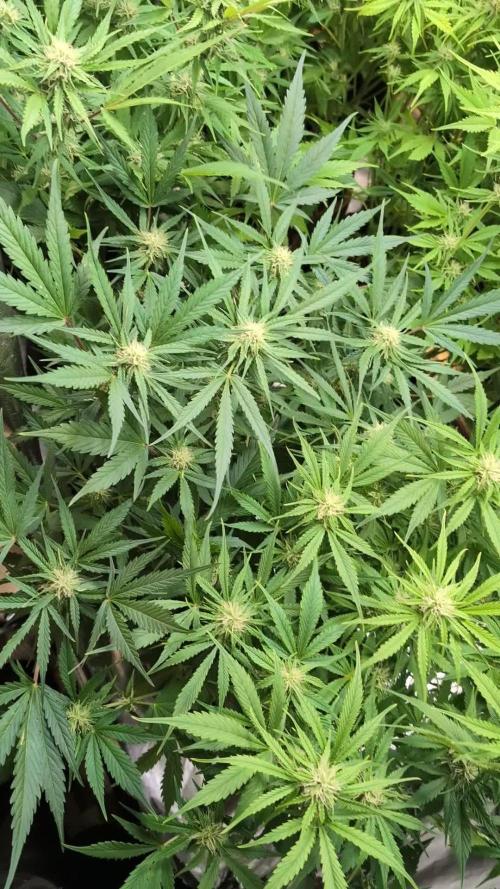
Very happy I went Original Sensible Seeds beens this grow. 🤩 All 3 autos from some special american line, and o boy , they don't disappoint.🔥 Bangers genetics 👏🏻 all trees are huge with 100s of well structured and close to each other bud sites. All very frosty for this stage already. The smell is quite stable on most , sweet creem and lemon pine. I like it a lot 💚

Likes
21
Share


@420DeepGrow
Follow
Este sueño es posible gracias a Royal Queen Seeds, Marshydro, XpertNutrients y Trolmaster, sin ellos esto no se podria cumplir .
💐🍁 Dynamite Diesel:
Royal Queen Seeds se ha asociado con Tyson 2.0 para ofrecer la genética desarrollada por este campeón en forma de semillas.
La Dynamite Diesel recibe su nombre en honor al apodo de Mike Tyson al inicio de su carrera, Kid Dynamite. Es un cruce entre dos variedades míticas, la Sour Diesel y la Skywalker OG, que son conocidas por sus intensos sabores y sus efectos estimulantes,tiene un 22% de THC, lo que la sitúa en la categoría de peso crucero.
En interior, esta variedad crece a alturas de 100-150cm y produce hasta 550g/m² tras una fase de floración de unas 9 semanas. Al aire libre, puede alcanzar hasta 2m de altura y produce una cosecha máxima de 675g por planta.
🚀 Consigue aqui tus semillas:
https://www.royalqueenseeds.es/rqs-semillas-cannabis-tyson/664-dynamite-diesel.html
💡TS-3000 + TS-1000: se usaran dos de las lámparas de la serie TS de Marshydro, para cubrir todas las necesidades de las plantas durante el ciclo de cultivo, uso las dos lámparas en floracion para llegar a toda la carpa de 1.50 x 1.50 x 1.80.
https://marshydro.eu/products/mars-hydro-ts-3000-led-grow-light/
🏠 : Marshydro 1.50 x 1.50 x 1.80, carpa 100% estanca con ventanas laterales para llegar a todos los lugares durante el grow
https://marshydro.eu/products/diy-150x150x200cm-grow-tent-kit
🌬️💨 Marshydro 6inch + filtro carbon para evitar olores indeseables.
https://marshydro.eu/products/ifresh-smart-6inch-filter-kits/
💻 Trolmaster Tent-X TCS-1 como controlador de luz, optimiza tu cultivo con la última tecnología del mercado, desde donde puedes controlar todos los parametros.
https://www.trolmaster.com/Products/Details/TCS-1
🍣🍦🌴 Xpert Nutrients es una empresa especializada en la producción y comercialización de fertilizantes líquidos y tierras, que garantizan excelentes cosechas y un crecimiento activo para sus plantas durante todas las fases de cultivo.
Consigue aqui tus Nutrientes:
https://xpertnutrients.com/es/shop/
📆 Semana 4:
Aparecieron un monton de erizos esta semana, el temporal ha hecho algo de mella en la carpa al bajar las temperaturas aunque todo sigue correcto.
Continuamos con las dosis de nutrientes recomendadas por el fabricante, esta tomando un tono precioso
Likes
Comments
Share


@Elguacho420
Follow
Buenas a tod@s... Bueno otra semanita más para las niñas... Las frosty tooth... De momento va todo bien, eh tenido un "problemita" con la lámpara pero ya está solucionado, de momento todo en orden, las eh pasado a la maceta de 7 lt para q ya estén ahí, un buen sustrato y un poquitito de nutrientes para las raíces... A esta altura no podemos hacer mas q darles cariño y dedicación... De momento esto, luego más y mejor, a seguir trabajando duro... 💪🏻💪🏻 Buenos humos para tod@s... 😎⚕️💪🏻💪🏻
🇦🇷🤝🏻🇪🇦
Processing
Likes
2
Share

@eldruida_lamota
Follow
Que pasa familia, ya estamos entrando en la recta final de estas misty gorillas auto. Son plantas pequeñas con flores compactas, tengo mucha curiosidad por ver cómo están y como pegan.
Ph regulado en 6,2 temperstura aumentó a 27 grados y la humedad la tenemos por debajo de 40%.
Queda limpiar raices y poco más , buenos humos fumetillas.


Likes
11
Share


@tangie
Follow
Chopped her two days into week 14.
What else. Buds. There are a lot of them. And they are quite large. And they look like they will require little effort to trim.
What more can I wish for? I am a very happy man.
Upd 1: Trimming is SO SIMPLE! Not much sticking out to begin with, because of the amazing bud structure and me plucking most bud node fans. Solid nugs which are not bothered by anything, so pulling smaller sub-bud fans is very simple too, while the buds are what I would call moist. I'll call this Moist Trim 😄
✂️✂️✂️ Went for the best trimming tools available on the market (well at least my research concluded so) and LOVING every minute of trimming with the B-500SRF. Why would I or anyone else use something less suitable or less comfortable for such a delicate and long job is beyond me, except if you cannot afford one right now, in which case I wish you to experience it one day.
Fiskars are also very good in therms of the blades, coating and cutting ability and precision, but the spring is just too stiff, like way, way to stiff for something that is to be used for hours on end. One might argue that such spring force helps overcome resin buildup, but please just rinse your instrument regularly in an appropriate solvent (ethy, iso, whatever — consider you instrument materials as well) and wipe it after. Why would you let significant amounts of resin to accumulate on such a gentle and precise tool? Kinda defeats the purpose?

Likes
20
Share


@RunWithIt
Follow
I mean, overall this was an extremely painless grow. The test of whether we should or shouldn't top autos is still TBD imo. Our topped candidate produced denser, frostier buds, but weighed slightly less, at 14 grams of bud total. And our lst plant produced 18 grams of bud, not as frosty, and almost as dense as our topped girl. I'll be topping autoflowers from here on out only under the circumstance I have 4+ to grow at the same time. Seems like it could be used to speed up the autoflower grow cycle if done properly, like with right. Since I'm doing a perpetual cycle, it's still a viable option for me in the long run. A few tips I have for anyone growing this strain in organics:
Start feeding bloom nutes a little bit prior to flower transition - this makes the transition more seemless. From weeks 1-3 flower, I slowly dropped the grow dosage until I cut off grow nutes week 3 flower.
Starting the flush around week 6 flower seemed to really bring out this plant's potential. But I think you could get away with starting the flush around week 5. I hope this helps anyone trying this strain out. It's a good one, I hope to see more journals of it, eventually.
Cheers everyone! Time for me to take a well-deserved puff. :) ☁️ 🌼
Processing
Likes
16
Share


@Andres
Follow
I have problems with her. I think it's because of the local water. the earth is not fertilized with any product. only earthworm humis.
