


Likes
Comments
Share


@Mzsnoop2001
Follow
Está en si es la semana 11 pero colgué una semana en publicar.
Ya coseche a principio de semana la whithe widow y dejé los bajos para principio de esta semana que entra y cosecharla junto a blue moby que está hermosa, moby Dick empezó a remontar vuelo y avanzo muy bien y está formando lindas flores gordas



Likes
36
Share


@ReeLeaf
Follow
Things are going ok with this plant for now. Droops a bit now and then, but it's alright I figure. Depends heavily on how much water it has left.


Likes
15
Share


@Bread_n_Buds
Follow
Our Wurlz F1 hybrids are very, very beautiful, they were as fast as light, in fact it's an understatement to say as fast as light, here we are well below the average in terms of times and above the average in terms of quality, does that seem like little to you? Do some calculations...
In 12 months you could do 6 cycles, unlike normal autoflowering plants which take 3 months on average, i.e. 4 cycles per year, knowing how to do 12 divided by 2 and 12 divided by three, right? Here it is... and it's not the only quality of these plants: maintained stability and hermaphroditism will now be a distant memory.
Our Wurlz are colourful, full of resin and are about two weeks away from being two months old. Have you ever seen autoflowering plants so advanced at 1 and a half months or so after birth?
Beautiful, beautiful, beautiful, big congratulations to Zammi.
https://www.zamnesia.io/it/10669-zamnesia-seeds-wurlz-f1-automatic.html
Video Reel Coming soon on Sunday
Food by Plagron https://plagron.com/en
Light www.viparspectra.com/
Tent & Air www.secretjardin.com
Music of the week www.radionula.com
+++ 432 hz frequencies to keep in line my Girls to Gaia.
Site Description
ZAMNESIA SEEDS - WURLZ F1 HYBRID AUTOMATIC: EFFECTS TO LEAVE YOUR HEAD IN A WHIRL!
As the end product of combining Runtz with Watermelon Candy, Wurlz F1 hybrid Automatic showcases a reliable, uniform, and, above all, easy growing experience. The resulting buds offer mind-blowing flavors and soothing effects, making Wurlz F1 Automatic more than worthy of being on your radar.
GROWING WURLZ F1 HYBRID AUTOMATIC
As an autoflowering strain, it takes just 9–10 weeks for Wurlz F1 Automatic to move from germination to harvest. Fortunately, there's very little required other than a bit of maintenance along the way. This is partly due to the F1 genetics that make this strain robust and uniform, resulting in plants that reach a similar height and provide a similar (large) yield. Moreover, Wurlz F1 Automatic is highly resistant to disease, pests, and other ailments.
Reaching heights of about 65–80cm, Wurlz F1 Automatic is not an overbearing plant and can fit into smaller spaces with zero fuss. Once ready to yield, growers have the potential to see a return in the region of 450–500g/m² indoors and 50–150g/plant outdoors.
AROMAS, FLAVORS, AND EFFECTS OF WURLZ F1 HYBRID AUTOMATIC
After Wurlz F1 Hybrid Automatic wows you with its easygoing growing experience, the best is yet to come: the smoke test. Teeming with terpenes, this cultivar offers a fruity and candy-like flavor tinged with just a little bit of pine for good measure. In terms of effects, Wurlz F1 Automatic is bolstered by 24% THC and a finely tuned array of cannabinoids, making for a soothing, physically relaxing, and, in larger amounts, couch-locking high. So settle in with some of your favorite friends, snacks, and movies; this is relaxation at its finest.
www.zamnesia.io


Likes
7
Share


@Cultivatorcarlos
Follow
still growing fast as fuck. i was falling more and more in love with her as time passed. she was showing signs of hunger so i gave her, her first feed of veg nutes on december 5th 2021. I mixed 1/2 tsp to each gallon. I used a bucket with 3 gallons of dechlorinated tap water.
Decmber 8th: same amount of veg to gallons of water with the same 1/2 tsp. phd to 6.4.
December 10th gave her a feed honestly dont know how much. id say about 10-20 cups worth of dechlorinated tap water with 1/2 tsp of veg nutes to 3 gallons.
Likes
114
Share


@RockoCalenberg
Follow
Letzte Tage vor der Ernte
Auch hier in den letzten Tagen kaum noch Entwicklung.
Die Pflanze stand optisch fertig,
hat aber nicht mehr wirklich weitergereift.
Foxtailing lief weiter auf bereits entwickelten Buds,
ohne dass sich die Reife sichtbar nach vorne bewegt hat.
Der Chop erfolgte ebenfalls aus praktischen Gründen,
da ein weiteres Warten keinen klaren Mehrwert gezeigt hätte.
👉 Optisch fertig, aber ohne echten Abschluss.
Kurzfazit:
👉 Unruhiger Finish-Verlauf ohne klaren Reifepunkt.
Grow on 🌱
Last Days Before Harvest
Again, very little development in the final days.
The plant looked finished,
but did not continue ripening in a meaningful way.
Foxtailing continued on developed buds,
without real progress in maturity.
Chopped as well for practical reasons,
since waiting longer showed no clear benefit.
👉 Looks done, but never fully completed.
Quick summary:
👉 Unstable finish without a clearly defined ripening point.
Grow on 🌱
Likes
22
Share


@ButterfliesLittleFarm
Follow
Hello Diary.
We have reached the end of the journey.🙌 Fat Banana exceeded my expectations in every way. Smell, taste, yield. In the end I got a little less than 70g of dried flowers which is above average for my farm. 💪
Here's how it all went since the last call.
28/11/2020 - Day 65.
Harvest. I checked with a microscope and most of the trichomes are milky and about 5% have turned brown. Everything is ready. After the last photo shoot, I cut the plant at the very bottom of the stalk.
Before that, I prepared a handmade cardboard box in which I would put the branches to dry for a minimum of 10 days.
After hanging the branches in the box, I put the box back in the grow box, between Haze Berry who had further extended their stay at the Farm.
Temp / Humidity on the farm - 24.5 degrees and 38% humidity.
10/12/2020 - Day 77.
After 12 days of drying, I took the dry branches out of the box and pruned the rest of the dry leaves. I put the dried flowers in jars, put in moisture fighters for better moisture regulation and for better curing.
Temp / Humidity on the farm - 25.5 degrees and 39% humidity.
20/12/2020 - Day 87.
Tasting. Great smoke, fruity tropical flavor.
A brief overview of the whole story.
Fat Banana Auto (Royal Queen Sees) - 18/09/2020 - Sprouted - 28/11/2020 - Harvest - Total 72 days.
Three weeks of vegetation and six weeks of flowering.
I did a small defoliation twice.
A total of 68 g of yield.
The best strain so far on my Farm.
Finally, I would like to thank James from the Royal Queen Seeds, for his support, seeds and nutrients. And I would like to thank all of you who support me and give advice with the help of which I also grow along with my plants. Many thanks to everyone and see you soon with the new diaries.🙌

Processing
Likes
8
Share


Likes
8
Share

@Oldwied
Follow
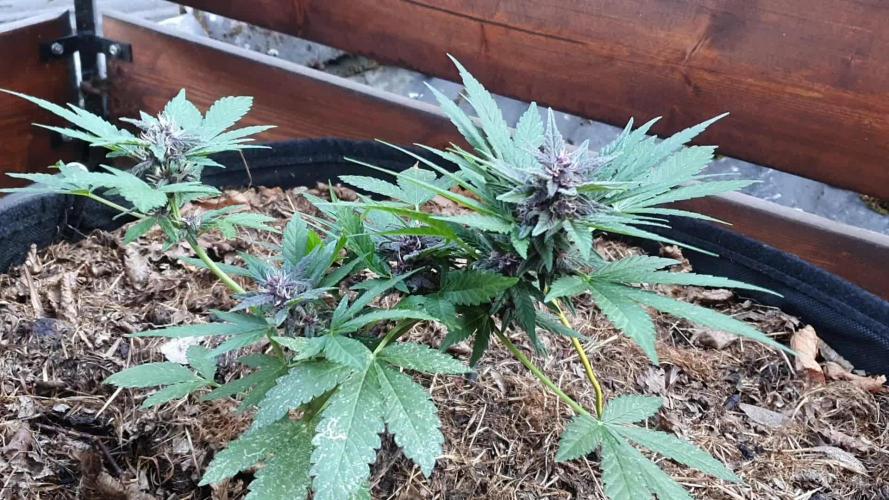
Unfortunately I had to take the photos a little earlier this week as I'm traveling. I think the biggest stretch is finished. In the meantime, the little one exudes a pleasant fruity smell.
Day 56
Photoshooting
Defoliation
Likes
7
Share


@LegalGrowMyOwn
Follow
After 12 weeks of flowering and an incredible fragrance, I cut off the larger top blooms. The smaller ones that were covered will be given another 1-2 weeks to ripen.
Incredibly beautiful colors, pink-purple-green colored flowers
The larger fan leaves were quickly cut off. The scissors were covered in purple resin.
The wet flowers were carefully sorted into the drying net.
Now they can
be dried in the dark at 19°C and a humidity of 50-55%
Likes
10
Share

@Bncgrower
Follow
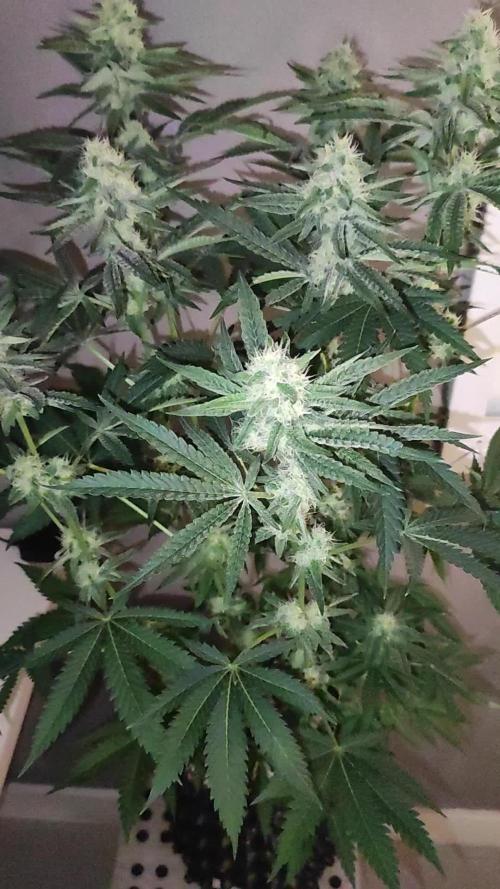
Another week successfully completed... All the plants are developing very well, the flowers are plumping up nicely, and all the plants smell great... Everything is as expected, and now we're closer to the end than before... Happy growing to all! 🌱🌿💪


Likes
19
Share


@green_impression
Follow
We begin the third week of flowering with a look at those many growing buds all over the canopy of these FastBuds photo fems. The plants themselves exploded in size to the sides and top of the tent, filling it completely!
Likes
245
Share


@Roberts
Follow
Thc bomb is coming towards the end soon. Trichromes are starting to turn, but still early. The bud is still putting on weight so likely will feed this week and reassess thru the week. Experiencing a few minor sign from giving a low dose of nitrogen. That is ok the plant has a lot of stored energy. Plus it is close to done. If anyone is interested in purchasing a SF-1000 please follow the link below
US:https://amzn.to/396hXXb
CA:https://amzn.to/3ol4oK4
DE:https://amzn.to/3q15SJT
UK:https://amzn.to/2L7NVKN
AU:https://amzn.to/3pZD6ZQ
FR:https://amzn.to/2Xkomsi
IT:https://amzn.to/3nk7A7h
ES:https://amzn.to/2XhtGwB
Thank you again bomb seeds🌱🔥💣💥
Thank you grow diaries community for the likes, follows, comments, and a big thanks to my YouTube subscribers. Happy growing everyone, and be safe out there 🌱🌱🌱

Likes
12
Share


@Naturalist
Follow
Increased feeding to 3ml FP on day 35 & light to 40% (abound 18-20000 lux) today on day 36, greening up nicely.


Likes
13
Share


@YOUNGSTERBR
Follow
Estava sem celular, perdi várias mídias da semana passada e dessa semana

Likes
53
Share


@DogDoctorOfficial
Follow
Hey there, fellow plant enthusiasts! It’s time for another exciting update on our magnificent P.C.R.s as they journey through their second week of flowering. Buckle up, because things are getting wild in the grow room!
Our P.C.R.s are on a growth spurt like no other! They're reaching for the stars and filling up the entire room with their lush foliage and budding flowers. It's like a jungle in here, and I’m loving every minute of it! The energy in the room is electric, and you can practically feel the excitement buzzing in the air.
With all this growth, our grow room is bursting at the seams! These plants are not messing around—they’re taking up every inch of space and demanding attention. It's like they're saying, "Look at us, we're the stars of the show!" And let me tell you, they're stealing the spotlight with their beauty and vigor.
As we approach day 21, the anticipation for defoliation is real. But our P.C.R.s have other plans—they're playing hard to get! Despite their reluctance, I’m keeping a close eye on them and patiently waiting for the perfect moment to give them a little trim. After all, a little pruning goes a long way in ensuring optimal light penetration and airflow, leading to healthier and happier plants.
Defoliation is like a mini makeover for our plants—it removes excess foliage, allowing more light to reach the lower buds and promoting better airflow throughout the canopy. This not only improves bud development but also reduces the risk of mold and pests. It's like giving our P.C.R.s a spa day—they come out looking refreshed and rejuvenated!
Week 2 of flowering has been nothing short of exhilarating! Our P.C.R.s are growing like champs, filling the room with their vibrant energy and undeniable charm. While we wait for the perfect defoliation moment, we'll continue to shower them with love and attention, nurturing them every step of the way.
Shout Outs
A big shout out to @aptusholland for their incredible products that keep our plants thriving. And to the amazing community at Grow Diaries and all our followers, your support and enthusiasm fuel our passion for growing. Let's keep the green revolution going strong!
Until next time, happy growing, and may your gardens be abundant and bountiful!
Genetics - P.C.R. @Art_Genetix_Team https://artgenetix.world/
Nutricion @aptusholland https://aptus-holland.com/
LED Power @Lumatek and @viparspectra
As always thank you all for stopping by , for the love and for it all, i fell blessed to have you all with me for one more love journey Thank you Thank you Thank you , you guys are great and have been amazing , thank you for everything !
#aptus #aptusplanttech #aptusgang #aptusfamily #aptustrueplantscience #inbalancewithnature #trueplantscience #dogdoctorofficial #growerslove
With true love comes happiness , Always believe in your self and always do things expecting nothing and with an open heart , be a giver and the universe will give back to you in ways you could not even imagine so !
Growers love to you all

Likes
5
Share


@RnDgrows
Follow
A great week with the buds really swelling in size and the smell getting more potent!
Gave it a last bit of molasses and continued with the flush.
Trichomes are milky with a few clear still.
Super excited to harvest soon!!!