@TechDCo
Follow
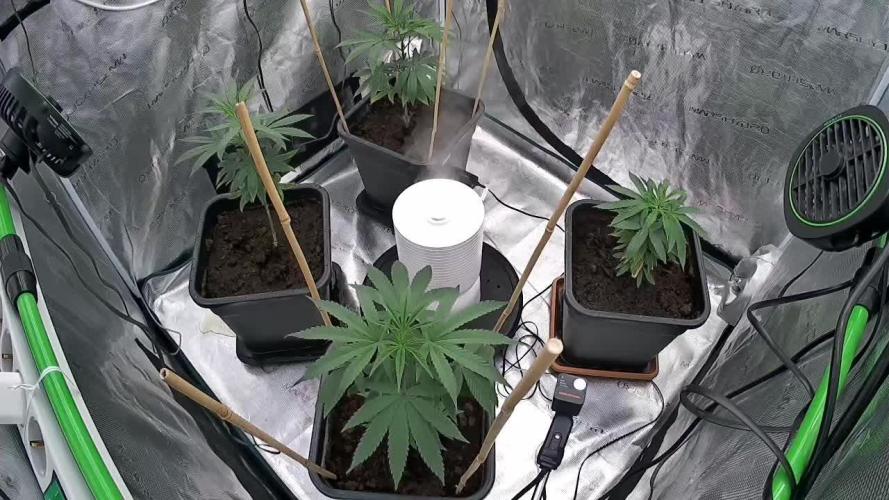
In the seventh week, I am preparing a detailed essay to explain my training method. I plan to increase the nutrient solution dosage to 35ml, including Warmcasts, seaweed, and a flower mix I concocted. Additionally, I will introduce 100% Gaba powder at half a teaspoon, mixed with water, to be administered at nighttime for the next two weeks. This natural chemical compound can help the plant relax and alleviate stress as it transitions into the pre-flowering stage and starts producing flowers. On the 11th of January, I completed the last defoliation procedure before the plant enters the pre-flowering stage in three days. I observed that the DLI (Daily Light Integral) reading is a bit high, and the light is positioned at the top. Therefore, I aim to adjust the light to achieve an ideal DLI range between 20-30. There is currently no CO2 supplementation in place. On the 12th of January, I eagerly await the pre-flowering stage and anticipate its onset in a few more days. It's time to initiate a 3-day mid-drying period.
A notable event on the 12th of January was the arrival and easy installation of the Spectrum King Sk600. The brightness of this new light is noticeably superior compared to the Budmasters. On the 13th of January, the plants experienced the first half-day under the SK600, and everything appears to be in good condition. Furthermore, I decided to move one of the vegetative plants, "Mango Skunk," into the flower tent on the same day. Additionally, there was a rearrangement of the lights in the flower tent, with the Spectrum King SK600 and Cropmaster Pro 1000 DIY being utilized. The readings for both lights were documented as follows: DLI - 197 u/mols, PPFD (Photosynthetic Photon Flux Density) - 3000 and up at 23 inches from the canopy, PPFD 2942 at 24 inches from the canopy.
I also applied blood fish and bone on topsoil and worked it in, using 2 cups of the mixture on the 14th of January. It was a relatively quiet day, and to lighten the growing mood, I took a quick video and uploaded some pictures of my dog Martina, showcasing her journey from a puppy. The bottom node leaves are significantly large, leading me to anticipate massive buds in the future. Late-night observations revealed that Pablo, a plant in the tent, may not have fully stretched to fill the available space, suggesting that it could be male. On the other hand, the forgotten haze cakes strain occupies a substantial portion of the tent, showcasing positive training outcomes.
On January 15, 2024, I removed the twist ties from the cola stalks to allow for better airflow and to support the unrestricted growth of the plants.
The following day, I took some photos to document the progress of the plants. It's always fascinating to visually track their development over time.
Also on January 16, a plant named "Freaky Pablo" displayed unusual characteristics, signaling that it might be a male plant. To prevent any potential pollination issues, I decided to remove "Freaky Pablo" from the grow space.
On the same day, I observed the presence of pre-flowers, indicating the beginning of the flowering stage. This marks an exciting phase in the growing process as the plants transition to a crucial stage of their life cycle.
During this time, I made some adjustments to the positioning of the "Mango Skunk" plant, initially moving it up to the top bed and then deciding to move it back to the bottom.
On January 18, I noted that the lights were turned on, marking the start of the flowering phase. This is a significant milestone in the plant's development as it shifts its focus from vegetative growth to flower production.
Additionally, I relocated a plant named "Spicy Temp" to the flower tent. This move ensures that all plants in the flowering stage are in the optimal environment for the next phase of their growth.
Overall, it appears that the grow operation is progressing well, and I am looking forward to witnessing how the plants continue to develop.
And finally, here's a joke for you: What did one plant say to the other? "Hey bud, how's it growing?"
I am not, because i am dead!


@Rangaku
Follow
Fat basted is vegging nicely, started tying her down and spreading her out some more after transplanting again into a 27 L pot where she will stay , same same next week . Maybe 1 or two more weeks of veg


@JamMAKEcan
Follow
7wk into flowering..i should have de-foliate way more than i did.. Cola's should be fatter.. Think I'm off on something🤔🤔not sure where.. Great genetics . good soil..great nutrients.. GREAT LIGHT .maybe it was temperature or as simple as SIZE OF CONTAINER...any advice would be appreciated..OH MAYBE A MORE POWERFULL LIGHT??


@TrippyFreeman
Follow
First time trying dwc these spider farmer kits seemed to be a good buy with everything I needed to get started


@DillyGenetics
Follow
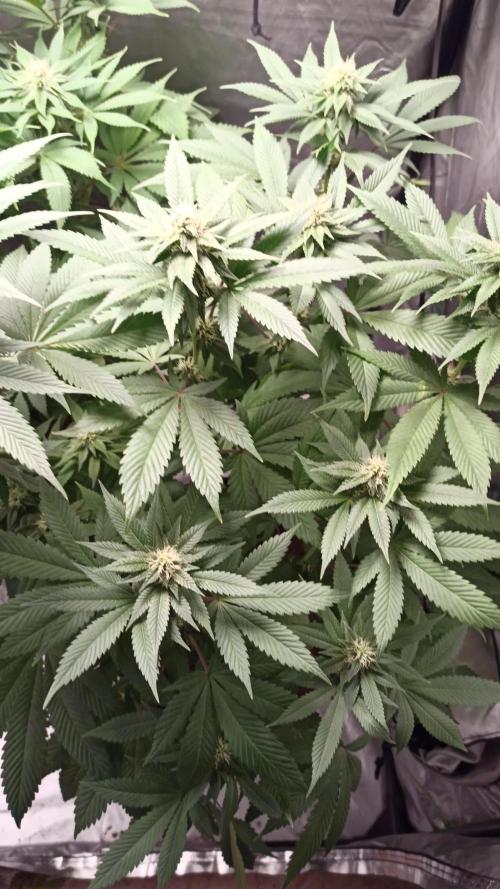
Broke couple buds sights off that amber was 20% during microscope Trichomes observation temps is high tonight 75% Fahrenheit lights off , ideal I like it around 68 light off 70-75 light on
18-6 light schedule pro mix hp with auto flower concrete with clay pebbles for roots to breathe and thrive thought out cycle with air flow in the medium .added silica to rebuild cell walls after taking couple cuts


@Michijardinero
Follow
Muy buenas familia aqui estamos una semana más con mis niñas más gorditas 😁😁😁en este último riego sólo le he puesto atazyme le medi el pH y la EC todo está en su punto en el próximo riego le pondré de todo ahora ya tengo trabajando al 100% el foco en ventilador lo subí al 2 la temperatura ahora que el foco está el 100% ha subido a 25.5 26 grados lo tengo a 30 más o menos de las puntas ya saben familia si ven algún fallo algo en lo que pueda mejorar para que salgan al 100 los escucho un abrazo muy fuerte nos vemos en 7 días paz


@artems
Follow
Thats a new experience for me. To grow and share the result. Im really like it. It's helpful, inspiring and have a great community! Thank for support, keep in touch for new grows!


@BrediGreeny
Follow
So my new Mars Hydro FC-E1500 is here. Swaped the very old MarsHydro LED in the middle. Gave them a little bit more CalMag and for the 1st Wedding Cake Bio Grow. Very minimal trimming. I noticed that the leafs from the 2nd Wedding Cake are glossy like. I think it could be too much nitrogen. Stoped giving her Bio Grow 1 week ago.
Thanks for all the answers, i will flush both the weddingcakes out and see how they react. Also measuring the run off EC and PH and also soil PH.
1/10/25
I like this community already 😁 you guys gave me such good answers to my grow question. So I measured soil PH roughly between 7 and 7,5 so alkaline. Not good. I flushed with Phed water 5,3 and measured PH of runoff at 6,6 and ppm at 1480 . Repeated, measured runoff PH 6,3 ; ppm 1210. Repeat, but with PHed 5,0 water, runoff PH 5,9 ppm 1010. Stoped. 1st WddngCake took 3 flushes with total of 30 l of water.
2nd Wddncake got a flush with 25 l of water at the end runoff PH aprox 5,9 ppm 990 . Gave them both Nematodes because i saw a reduction in fungus gnats that is good. Almost none flying around. Fingers crossed. 😊
1/11/25
Aprox. 24h from "The Big Flush" 😁 and they seem to be happier. Temp in tent 23 C and RH 44% - 48% . Also added a few photos of them after the flush.
1/12/25
Aprox. 48h after flush. They are doing very good. 1st WddngCake shows off more of her colors with splashes on the calyxes and sugar leafs. 2nd WddngCake stands tall and bulks the buds up. I also noticed that Pheno 1 WddnCake has a fruitty creamy like sweat smell and the 2nd Pheno ,the tall girl, reminds me of a tropical IPA, fruity , fresh and pungent like cousin hops. Also the end of this week, today, looking forward at the week ahead. In the tent 22 C at the moment with 50% RH because i let the mars hydro ventilators off for the day. they are back on now.
shorts_status_processing


@XxBILLZAxX
Follow
Increased their food by a tad. Looked perfectly health raised to about 1900ppm.
Again spider mites at it crawling up every leaf and creating a colony. I thought it was over until I sat there nearly every night finding the f*****s and rubbing the leaves with the spray.
Defoliation was needed ASAP due to them stretching nicely. Started slowly from the bottom up. (repeated this process every 3-5 days.)


@Ninjabuds
Follow
My Skunk Apple Run plant is still a bit young, but I can see those buds starting to form. It's a bit of a slow starter, with buds popping up all over the place instead of a nice even line. We'll see if adjusting the light cycle or its food might help it along. I'll keep you posted on any changes.
The past few weeks have been so beautiful, watching the plants grow and change. It's amazing how something so small and fragile can turn into something so strong and vibrant. Now that they're getting ready to bloom, it feels a little bittersweet. I'm so excited to see the finished product, but I'll definitely miss having them around while they're growing.


@Northern_Ent
Follow
June 8: planted out first one. Other two are in a single peat pot as I messed up during planting. Oh well.
Using peat pots as intermediate containers because it is too cold here to start seeds outdoors in final containers.
Solo cups last year didn’t work well cuz I left them in the cups too long. Hence my later start using peat pots this year.


@SamDo
Follow
Hello... fin de semaine 13, floraison 7.
Le moment de la récolte est imminent pour la critical+2.0, je pense que d’ici 2 ou 3 jours ce sera bon... Et pour la gorilla Cbd, peu être une petite semaine de plus. Je surveille de près les trichromes.
Juste avant la récolte, je vais laisser 24/48h les plantes dans le noir.
Le flushing est fait aussi, j’ai commencé déjà la semaine dernière, et aussi hier. J’ai rincer la terre des pots de 10L avec environ 30L d’eau au pH 6.2~. J’ai effectué cette opération 2 fois.
Voilà pour cette presque dernière semaine... 😉
Happy grow...😎


@gse314
Follow
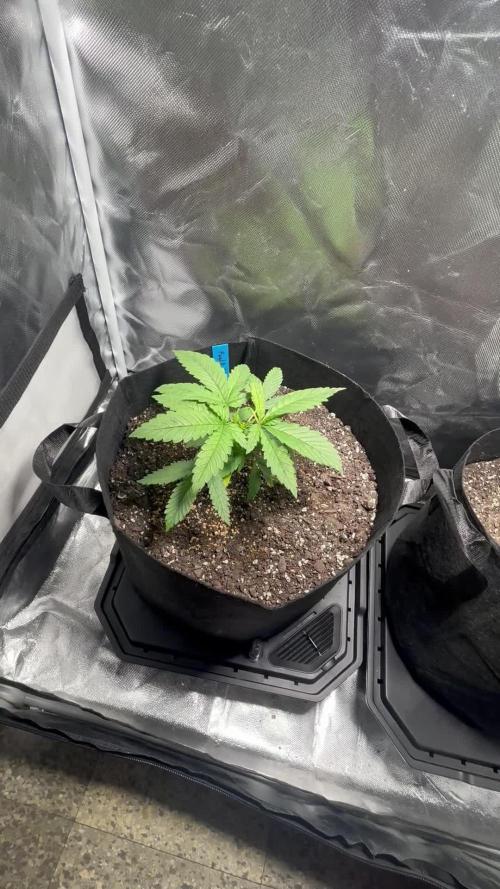
Did my 1st topping of 3 kicking off 5 week of veg the seedsman Fuel D. OG is growing bigger so far


@DogDoctorOfficial
Follow
🚂 8×8 Adventure – Week 12
🌿 Cash Express – Pheno B
🚨 When Trouble Knocks: Bud Rot, Staying Calm & Learning From It
Hello everyone, and welcome back to another chapter of the 8×8 Adventure! 🌱💚
And this week...
Well...
Trouble ate the house.
😂🚨
But before anyone starts panicking...
NO.
That's not how we're going to handle this.
Because in a room with this many different cultivars and phenotypes, sometimes something happens.
And this time...
Cash Express Pheno B gave us a little lesson.
We found bud rot.
😬🌸
Am I happy about it?
Absolutely not.
Did I panic?
Absolutely not.
And that's Rule Number One.
────────────────────────
🚨 Rule Number One: Don't Panic
When you discover something like bud rot in a flowering room, the first reaction can very easily be:
"Oh shit."
😂
And yes...
that's a completely understandable reaction.
But panic doesn't help.
You need to stop.
Look carefully.
Confirm what you're actually seeing.
And then act.
That's exactly what happened here.
This was not immediately obvious from the outside.
It was hiding.
The flower looked perfectly capable of blending into the rest of the plant.
But after looking...
and looking...
and looking again...
something didn't feel right.
And eventually, experience kicked in.
Maybe it's because I've seen enough plants by now.
Maybe my eye has become trained.
Maybe I'm simply getting better at noticing the little things.
Whatever it was...
I noticed it.
And once I knew something was wrong?
There was no hesitation.
────────────────────────
✂️ Rule Number Two: Get It Out
The affected cola was removed.
Straight away.
I didn't stand there wondering what might happen.
I didn't leave it for another day.
I didn't say:
"Let's see what it looks like tomorrow."
Nope.
Out it came.
🚨✂️🌸
The goal at that moment was simple:
Remove the affected material and prevent the problem from becoming a bigger problem.
And once it was removed, I opened it up.
That's when the real lesson began.
Because from the outside...
it wasn't nearly as obvious as it became once the flower was opened.
And that's exactly why I wanted to document this.
Not because bud rot is fun.
It isn't.
But because if we're going to document the 8×8 Adventure honestly, we have to document the bad moments too.
Not just the beautiful frost.
Not just the giant flowers.
Not just the perfect photographs.
Sometimes...
we show the ugly stuff.
Because that's where people can learn.
────────────────────────
🔍 What Is Bud Rot?
Bud rot is commonly associated with the fungal pathogen Botrytis cinerea.
It can develop in dense flowering structures, particularly when moisture becomes trapped inside areas where airflow and drying are limited.
And here's the important part:
You don't necessarily need to look at your room and think:
"Wow, it's extremely humid."
for this to happen.
A room can have relatively controlled environmental conditions while a dense flower creates its own little microclimate.
Inside a thick flower...
things can be very different from what your room sensor is telling you.
That's why the plant itself still needs to be inspected.
The room sensor tells you about the room.
The flower tells you about the flower.
And sometimes...
those are two very different stories.
────────────────────────
🌸 What Did I See?
This is where I really want to use the photographs from this week.
Because the first thing you might notice from the outside isn't necessarily some huge obvious patch of mould.
Sometimes the warning signs can be subtle.
In this case, there were brownish/discoloured areas that didn't look quite right.
The flower wasn't simply progressing uniformly.
There was something different happening within the structure.
And that is one of the things I want everyone following this diary to take away:
LOOK.
Actually look at your flowers.
Don't just look at the whole plant from three metres away.
Don't just look at the beautiful tops.
Don't just look at the trichomes.
Get your eyes into the structure.
Look between flowers.
Look at areas that are unusually discoloured.
Look for tissue that doesn't seem to fit with the normal progression of the plant.
Look for anything that makes you think:
"That's not how the rest of this flower looks."
That little thought can be important.
────────────────────────
👀 The Outside Doesn't Always Tell The Whole Story
This was probably the most interesting part for me.
From the outside, this problem was surprisingly well disguised.
The flower still looked like a flower.
It still had its normal structure.
It still had all the visual complexity that makes these plants so beautiful.
But something was happening inside.
Once I opened it...
the story became much clearer.
And that's why I decided to photograph it.
I want people to see both sides.
What you might notice with the naked eye...
and what you can discover when you investigate further.
Because bud rot doesn't always arrive with a giant flashing sign saying:
"HELLO, I'M MOULD."
😂
Sometimes it whispers.
And that's why observation matters.
────────────────────────
🔬 Let's Go Deeper
Once the affected cola was opened, the difference became much easier to understand.
Healthy flower tissue has a certain consistency and appearance.
Rotten tissue doesn't.
You may see brown or greyish areas, damaged-looking plant material, unusual discoloration, tissue that appears to be breaking down, or fungal growth associated with the damaged area.
And sometimes you'll see something that simply doesn't look like healthy flower anymore.
That's the important part.
You don't need to become a laboratory scientist.
You need to learn what YOUR healthy plants normally look like.
Because once you know normal...
abnormal becomes much easier to spot.
That's something experience teaches you.
You look at hundreds of flowers.
You photograph them.
You handle them.
You inspect them.
And eventually your brain starts saying:
"Wait..."
That's what happened here.
────────────────────────
❌ What Bud Rot Is NOT
This is also extremely important.
Not every brown pistil is bud rot.
Not every colour change is mould.
Not every damaged leaf means there's an infection.
Not every flower that looks different is automatically rotten.
Flowers naturally change as they mature.
Pistils change colour.
Leaves age.
Plant tissue can become damaged.
Flowers can become darker.
Some cultivars naturally develop unusual colours and structures.
And photographs can make perfectly normal things look much more dramatic than they really are.
So...
don't panic at the first brown hair you see.
😂
Look at the whole structure.
Compare it with the rest of the flower.
Look for tissue damage.
Look for unusual discoloration.
Look for signs that don't fit the normal maturation pattern.
And if you're genuinely unsure?
Investigate carefully rather than immediately assuming the worst.
────────────────────────
🚨 But When You KNOW It's Rot...
That's when we stop debating.
Once I was confident that this was a genuine problem...
out it came.
✂️🌸
No emotional attachment.
No:
"But it's such a beautiful cola."
No:
"Maybe she'll recover."
Nope.
She's gone.
Because once a flower is affected, keeping it attached simply because we don't want to lose it isn't a sensible trade.
One damaged cola is frustrating.
A larger problem spreading through the room is much worse.
So the decision was easy.
Remove.
Remove carefully.
Remove immediately.
And then inspect what was around it.
────────────────────────
After Removal — Don't Forget The Basics
Once the affected material is removed, cleanliness matters.
Tools should be cleaned appropriately.
Hands should be clean.
The removed material shouldn't be left sitting around in the grow space.
And the affected material?
That's waste.
Not medicine.
Not something to save.
Not something to experiment with.
If plant material is visibly affected by mould or rot, it isn't something I would consider suitable for consumption.
That's an important line.
We can be relaxed about a lot of things in this hobby.
Mould isn't one of them.
🚫🌸
────────────────────────
🌬️ How Can Bud Rot Happen In A "Good" Room?
This is where things get particularly interesting for the 8×8 Adventure.
Because this room is not some uncontrolled jungle.
We're monitoring temperature.
We're monitoring humidity.
We're managing airflow.
We're managing lighting.
We're watching the plants.
And we're still pushing the environment toward strong flowering conditions.
But the room environment is not the same thing as the microenvironment inside a giant flower.
A dense flower can contain tiny spaces where air movement is lower.
Moisture can linger.
Plant material can be packed tightly together.
And the interior can behave differently from the surrounding room.
That's why even growers who monitor their environment carefully can still encounter bud rot.
It doesn't automatically mean:
"Everything was done wrong."
Sometimes biology simply finds an opportunity.
And this is exactly why inspection remains important.
────────────────────────
🌡️ The Current Room
The room this week is sitting around:
🌡️ Day temperature: ~27°C
🌙 Night temperature: ~25°C
💧 Relative humidity: ~60%
⚗️ pH: ~6.04
⚡ EC: ~2.05 mS/cm
🌡️ Solution temperature: ~25.2°C
🌱 Substrate temperature: ~26°C
🌬️ CO₂: ~693 ppm
💡 Light schedule: 12/12
💦 Irrigation: ~1.4 L/plant/24h
🌱 Pot size: 15 L
We're also continuing with the upgraded Future of Grow lighting setup.
Two additional Black Series 600W fixtures are now part of the experiment, currently being controlled at approximately 59% power from the plug.
The upper canopy is around the ~1,500 PPFD range.
And this is important:
I'm not saying these numbers "caused" the problem.
I'm saying that even in a carefully managed room, problems can still happen.
That's the reality of growing living organisms.
────────────────────────
💨 VPD, Humidity & Reality
This is another area where I think it's important not to oversimplify things.
We can talk about VPD.
We can talk about relative humidity.
We can talk about temperature.
We can monitor everything.
And we absolutely should.
But no environmental number guarantees that a dense flower will never develop a problem.
The inside of the flower can have a different microclimate.
That's why I don't believe in saying:
"My humidity is X, therefore bud rot is impossible."
Nothing is impossible.
Especially when you're growing dense flowers.
The bigger and tighter the flower structure becomes, the more important physical inspection becomes.
And that's a lesson I'm happy to repeat.
────────────────────────
👁️ Prevention Starts With Observation
For me, one of the biggest prevention tools is simply knowing your plants.
Look at them regularly.
Learn what healthy flowers look like.
Learn how your particular genetics develop.
Know what normal pistil colour changes look like.
Know what normal late-flowering leaf changes look like.
And then pay attention when something doesn't match.
Because prevention isn't only about numbers on a controller.
It's also about your eyes.
Your nose.
Your experience.
Your photographs.
Your memory.
And your willingness to investigate.
The more familiar you become with your plants, the easier it becomes to notice when something doesn't belong.
────────────────────────
🌬️ Airflow Still Matters
Dense flowers benefit from good airflow around the plant and through the room.
Not because airflow magically makes plants immune to fungal problems...
but because stagnant, damp microclimates are exactly the sort of conditions we don't want around dense flowers.
So we keep paying attention to airflow.
We keep the room moving.
We avoid unnecessarily wet conditions around the flowers.
We monitor environmental changes.
And we inspect.
That's the combination.
Not one magic trick.
Not one number.
Not one piece of equipment.
A whole system.
────────────────────────
🧠 Don't Turn One Problem Into Ten Problems
This is another important lesson.
When something goes wrong, don't suddenly change everything.
One cola has a problem?
Don't immediately decide the entire room is failing.
Don't panic and start changing five environmental variables at once.
Don't start throwing random solutions at the plants.
Stop.
Identify the problem.
Remove the affected material.
Inspect the surrounding area.
Clean up properly.
Then continue monitoring.
That's what I did here.
One problem.
One response.
And then back to watching the room.
Because the other eleven girls don't suddenly become guilty just because one flower had a problem.
😂
────────────────────────
🌿 And What About Cash Express Pheno B?
Well...
this is where we have to give this girl a little respect.
Because despite this little incident...
she is still beautiful.
She's still developing.
She's still flowering.
She's still doing what Cash Express Pheno B has been doing throughout this entire journey.
Growing tall.
Building flowers.
Occupying her space.
Doing things her own way.
And yes...
she gave me one little headache.
😂🚨
But one affected cola doesn't erase everything else this plant has done.
This is still a beautiful phenotype.
And now she's also taught us something.
That's part of the adventure.
────────────────────────
🌸 One Cola Doesn't Define The Plant
I think this is important to say.
When you see photographs of the affected flower, it can be easy to let that become the entire story.
But it isn't.
The 8×8 Adventure isn't about pretending everything is perfect.
It's about documenting reality.
And reality contains both:
😍 Beautiful flowers
and
😬 Problems.
That's growing.
Sometimes you get incredible frost.
Sometimes you get a plant that surprises you.
Sometimes you get a beautiful phenotype.
And sometimes...
bud rot decides to pay you a visit.
You deal with it.
You learn from it.
And you keep going.
────────────────────────
📸 Why I Took These Photos
I deliberately photographed this because I think it's valuable education.
Not to scare anyone.
Not to create drama.
And certainly not to say:
"Look how bad things can get!"
No.
Quite the opposite.
I want someone looking at this diary six months from now to see these photographs and think:
"Okay... THAT is the kind of thing I should be looking for."
That's useful.
The beautiful photographs are inspiring.
But the ugly photographs can be educational.
And sometimes...
the ugly ones are the ones people remember.
────────────────────────
🔬 The 8×8 Adventure Isn't A Perfect-Grow Competition
This is not a showroom.
It's a living room full of living plants.
Twelve individual phenotypes.
Different genetics.
Different flower structures.
Different densities.
Different responses.
And sometimes...
different problems.
That's why I'm not embarrassed to show this.
If anything, I think it's important.
Because if we only show perfect plants, people can get the impression that experienced growers never have problems.
That's simply not reality.
Experienced growers have problems too.
The difference is often how quickly they recognize them...
and how calmly they respond.
────────────────────────
🚨 What To Do If You Find It
My approach here was simple:
1️⃣ Stay calm.
2️⃣ Confirm that what you're seeing is actually abnormal.
3️⃣ Inspect the flower carefully.
4️⃣ Remove the affected material promptly.
5️⃣ Keep affected material out of the grow space.
6️⃣ Clean the tools and anything that contacted the affected material.
7️⃣ Inspect nearby flowers and dense areas carefully.
8️⃣ Continue monitoring the room and the plants closely.
9️⃣ Don't panic and start changing everything at once.
🔟 Keep documenting.
That's what this diary is for.
We're learning as we go.
────────────────────────
💚 The Rest Of The Room Keeps Moving
And this is the important part.
The rest of the 8×8 is still doing what the 8×8 does.
Growing.
Flowering.
Developing.
Different girls are moving at different speeds.
Some are faster.
Some are slower.
Some are compact.
Some are huge.
And now we've had our reminder that even a beautiful flowering room can throw you a curveball.
That's okay.
We deal with it.
And we continue.
Because the adventure doesn't stop because one cola decided to misbehave.
😂🚂🌿
────────────────────────
💡 The Photons Keep Coming
The Future of Grow Black Series lighting continues providing the artificial sun for this room.
We're still working with the additional two 600W fixtures.
We're still controlling their output rather than simply running everything flat out.
We're still watching how the different plants respond.
And we're still using Lumiflora to add another layer of light deeper into the canopy.
Nothing about one affected cola changes the larger experiment.
If anything...
it gives us another variable to observe.
That's what real grows are.
Not controlled laboratory experiments where nothing unexpected ever happens.
Real plants.
Real rooms.
Real environmental changes.
Real genetics.
Real problems.
Real learning.
────────────────────────
🌸 And Yes... We're Still Going To Make Her Shine
Absolutely.
Because this girl deserves it.
Even with the little bit of trouble she gave us.
😂💚
Cash Express Pheno B is still beautiful.
She's still tall.
She's still developing.
She's still building flowers.
She's still showing us her own expression.
And now she's also given us an opportunity to talk about something that every flowering grower should understand:
Sometimes things go wrong.
The important part is what you do next.
So I'm not going to hide the ugly side.
I'm going to put it right here beside the beautiful side.
This is the plant.
This is the journey.
This is growing.
────────────────────────
🔮 Looking Ahead
From here...
we continue.
We'll keep watching Cash Express Pheno B closely.
We'll keep inspecting the flowers.
We'll keep monitoring the environment.
We'll keep paying attention to the dense areas.
We'll keep providing stable conditions.
And we'll see where the rest of her flowers take us.
The affected cola is gone.
The lesson remains.
And the plant?
She's still here.
Still growing.
Still flowering.
Still beautiful.
So let's see what she does next.
────────────────────────
❤️ Final Thoughts – A Lesson Hidden Inside The Flower
This week wasn't the update I expected to write.
😂
But honestly?
I'm glad I can write it.
Because this is the part of growing that doesn't always make it into the pretty photographs.
Bud rot can happen.
Even in a room where you're monitoring your environment.
Even when the plants look beautiful.
Even when you're doing everything you can to keep the room stable.
Dense flowers can create their own little microclimates.
And sometimes...
fungal problems find an opportunity.
The important thing is not to panic.
That's Rule Number One.
Rule Number Two?
Get it out.
✂️🚨
That's what we did.
I noticed something that didn't look right.
I investigated.
I found the problem.
I removed the affected cola.
I opened it.
I photographed it.
And now we're using that experience to help educate everyone following along.
What does it look like?
What should you pay attention to?
What is normal?
What isn't?
And what should you do when you find it?
That's the value of documenting the entire journey.
Not just the wins.
Not just the frost.
Not just the beautiful macro shots.
Everything.
And Cash Express Pheno B?
She's still shining.
One bad cola doesn't define a beautiful plant.
It simply gives us one more lesson from her story.
🚂🌸💚
So...
no panic.
No drama.
No hiding.
Just learn.
Observe.
Act when necessary.
And keep going.
That's growing.
And that's the 8×8 Adventure.
────────────────────────
🙏 Thank You
A huge thank you to Zamnesia for giving us these genetics and allowing us to follow these individual phenotypes throughout this entire adventure.
Thank you to Plagron for supporting the room with the nutrition we're using throughout flowering.
A massive thank you to Future of Grow for providing the Black Series lighting and especially the two additional 600W fixtures we're now testing in the 8×8 Adventure.
Thank you to Lumiflora for helping us bring additional light deeper into the canopy.
Thank you to TrolMaster for helping us monitor and manage the environment behind the scenes.
And thank you to everyone following this crazy experiment here on GrowDiaries.
This week, you're getting something a little different.
Not just beautiful flowers.
Not just frost.
Not just another perfect macro photograph.
You're getting a lesson.
You're getting the reality of growing.
Because sometimes...
Trouble eats the house.
😂🚨
But we don't burn the house down.
We stay calm.
We find the problem.
We deal with it.
We learn.
And we keep growing.
Cash Express Pheno B is still here.
She's still beautiful.
She's still developing.
And she's still writing her story.
One cola gave us a headache.
The rest of the plant?
Still shining.
🚂🌸💚
And if there is one thing I hope people take from this week's report:
Don't be afraid of problems.
Respect them.
Learn to recognize them.
Act quickly when you need to.
And never let one problem convince you that the whole grow is lost.
Growing is not about never having problems.
It's about learning how to deal with them.
And this week...
Cash Express Pheno B taught us exactly that.
Until next week...
Keep your eyes open.
Keep your plants close.
Keep learning.
And let's keep this beautiful girl shining.
Growers Love & Happy Growing! 🌱💚🚂
shorts_status_processing


@GrowGuy97
Follow
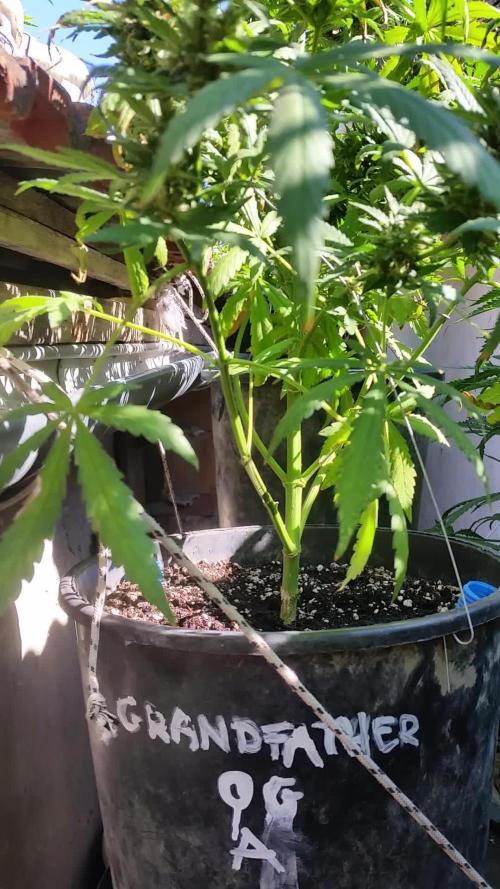
Flower day 31 - Having a little trouble with the temperature getting higher than I would like because my dehumidifier puts off some heat while it’s running so it’s been a constant struggle to keep the environment in this tent stable! Definitely will not have so many plants next run lol, but all in all the ladies are growing great & I can’t wait to see how they turn out! Thanks for following friends & happy growing!✌️🏼🌱
Flower day 33 - Fed half the plants today with PH at 6.4 to try and keep the humidity down some I’ll water the other half tomorrow!



@Argos
Follow
Szépen dagadnak a rügyei, a hőstresszt picit jobban bírja mint a Moonshine Cookies autoflower. A rügyek szerkezete is picit szellősebb, de nem zavaróan. A Weedseedsexpress útmutatása szerint 10 - 11 hét a virágzási ideje. A cukorleveleken viszont már lassan borostyánszínűek a trichomái.


@KellosaurusGrows
Follow
Well everything went smoothly this week still feeding same schedule I have notice the leaves are fading a good amount but it’s pretty late flower so nothing to worry about, I did check trichomes at day 70 and they seem to be about half cloudy half clear, no Amber in sight yet but hopefully next week they start ambering up I’m thinking maybe 85 days or longer for this one


@TgOgFaRms
Follow
🌿🌸 Week 4 Flowering Update! 🌸🌿
We have officially entered week 4 of the flowering phase, a crucial period where things can get a little nerve-wracking. However, I'm happy to share that everything is looking great so far! 🎉
First off, let me express my relief that I haven't encountered any hermaphroditism issues like some unfortunate growers have experienced. I've been extra vigilant in checking my plants for any signs of bananas or seeds, and thankfully, all is going smoothly on that front. Fingers crossed, and let's hope it stays that way. 🤞
Now, let's talk about the progress of these beauties. The plants are thriving, exhibiting vigorous growth and magnificent stretching. 🌱✨
Maintaining the well-being of my plants remains my top priority. They're displaying a healthy thirst, as each plant continues to drink around 2 liters of water every two days. I've been closely monitoring the pH level of the nutrient solution, which has been steady at 6.11. This ensures optimal nutrient uptake and keeps the plants in their prime condition. Moreover, the TDS range is consistently between 1050 and 1150, providing them with the ideal nutrient balance. ⚖️💧
Speaking of the plants, I must mention how amazing they smell! The aroma is becoming more intense with each passing day. Today, I conducted a smell test for the OG and Oreo strains. The OG emitted a super strong smell of OG/Skywalker, while the Oreo strain has a unique and captivating scent that is difficult to describe but absolutely amazing. I can't wait to smoke that one! Tomorrow, I'll do a smell test for the Queen strain as well. 🌿👃🔥
As we progress through this crucial stage, I'll continue to provide the best care possible to ensure a successful harvest. Today (Day 22) marks the last day of foliar feeding with Bud Factor X, an essential step to maximize THC development and quality. This phase demands attention to detail and careful observation. 👀🌿💦
That wraps up this week's update, fellow growers! Keep your fingers crossed for a smooth journey ahead, and may your own gardens thrive. 🤞🌿🌸
Happy growing, lads! 🌱💚