


Likes
Comments
Share


@603grower
Follow
Great grow excellent quality. Probably gonna end up keeping #2 since she was an absolute best but won’t know until she’s cured

Likes
4
Share


@SamDo
Follow
Vegetative Week 3
This third week of vegetative growth was expected to be a turning point, but it turned out to be another difficult one.
The plant did gain a bit of height, roughly a couple of centimeters, which shows that growth hasn’t completely stalled.
However, foliage development remains poor, and overall vigor is clearly lacking.
The plant is growing, but it doesn’t look healthy or strong.
No additional watering was done this week, as the medium did not justify it.
Humidity management appears to be a key issue.
Under the dome, humidity was still around 95%, which is excessive.
The dome has now been fully opened to allow better gas exchange.
Removing the small support revealed another concern:
the stem lacks strength, as the plant fell over once unsupported.
This points to weak structural development and possibly limited transpiration and nutrient uptake.
Condensation droplets were observed on the leaves, confirming that the plant is likely oversaturated with moisture.
Excess humidity may be preventing proper respiration, which could explain the lack of nutrient absorption and overall stagnation.
At this stage, no drastic action is taken.
The focus is on observation, environmental adjustments, and understanding the root cause of the stress.
This plant should normally be much larger by week three, so close monitoring will continue into next week.
See you next week!

Likes
14
Share


@OutForReal
Follow
Song of the week : Jingle bells 🌲
14.12
Boom bang 🔥 ! I think I've found my outdoor 12/12 Autoflowering phenotype , with this height , that shape in a 7tL pot , the flowering under 18/6 , and the vigour : she have all that I was searching for.
Now I have to wait and see for the flowering and yield to really know if I've found my winner
I also hope that the sex reversion will be effective soon but to stop doubting I prefer to spray it again with sts
Now concerning her health and feeding : she has been feed with 1 tea spoon of Mr.B's Green trees Bloom because it's time to push some more pistils but on the other hand the lower leaves are starting to yellowing a bit so suspect her to be or a huge eater or that the pot is so small that she need to be feed at each watering. Whatever it could be she will 're rice s little amount of beg nuts this week then I'll get back to the regular feeding ✌️🏼🦎
-------
15.12 - I have made 2 videos today. One to show you how it rain in my country and the second to show you the wind during the rain. A regular rain not the hard one
Likes
26
Share


@DreamIT
Follow
-Sponsored by:
🏡GANJA FARMER SEEDS🏡-💡VIPARSPECTRA💡-💐GREEN BUZZ LIQUIDS💐-🛠️WEDRYER🛠️
8/7 After several days of Growdiaries making it difficult for me to write and respond to comments, I found that I can still update the journals. I apologize to everyone for the non-replies but I have replaced the main email and the email to confirm the account never arrives, and Growdiaries' customer service seems to be non-existent.
10/7 everything is going well, nothing special to add🤘🦄
12/7 all right, we are two weeks before the cut, yeah
__________________________________________
Personal advertising (contains affiliate links)
__________________________________________
🦄 Huge collection of exquisite genetics since 2009! Anonymous shipping!
✅https: //bit.ly/Ganjafarmer
__________________________________________
Did you know that Green Buzz Liquids fertilizers are 100% vegan? A complete line of products ready to give the best to each of your plants! Visit the site and see my journals to see how they work 🦄
🤯 And with the code "dreami t" you will immediately receive a 15% discount on your purchases
✅https: //bit.ly/GreenBuzzLiquidsPro
__________________________________________
👀 Are you looking for a good lamp to start with? 👀
🌞Viparspectra has something more than the others, take a look at their site.
⏩ Use "GDVIP" for an extra discount or "DREAMIT3" for an extra 5 %% discount
👀 Search for it on Amazon
✅Amazon USA: https://amzn.to/30xSTVq
✅Amazon Canada: https://amzn.to/38udUVe
✅Viparspectra UE: bit.ly/ViparspectraUE
✅Viparspectra USA: bit.ly/ViparspectraUS
______________________________________________
🌈 Tired of blowing on your weed hoping it dries quickly? Check out the Wedryer website! You will find a well-made accessory that will help your weed dry in just 8-10 days without the annoying risk of finding mold or other annoyances! (no affiliate links)
✅https: //bit.ly/Wedryer_
______________________________________________
📷🥇Follow the best photos on Instagram 🥇📷
https://www.instagram.com/dreamit420/
Backup
https://www.instagram.com/dreamit4200/
🔻🔻Leave a comment with your opinion if you pass by here🔻🔻
🤟🦄💚 Thank you and good growth 💚🦄🤟

Likes
Comments
Share

@Piratebay
Follow
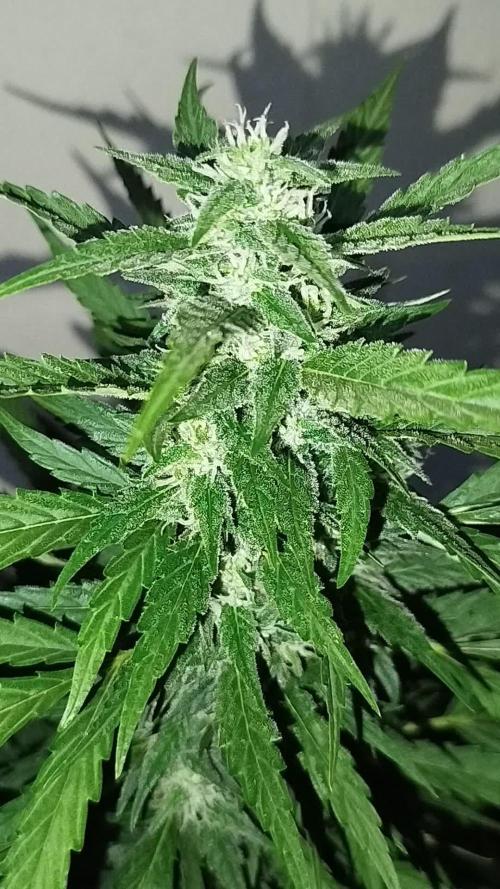
mix de esquejes de papaya zoap en experimento de suelo vivo en el exterior.
A priori con la maceta se ven la diferencia en resina mucho más cargada un aroma más pronunciado comparando de una maceta de 25litros a un suelo vivo de 200litros de turba en arriate conectado directamente a la tierra del suelo vivo.
Dspues de esta prueba en calidad.
Las observaremos en interior bajo los leds y una buena cama de living soil.
Super satisfecho por lo que veo de esta genética. 🍋?📂

Likes
20
Share


@gr3g4l
Follow
Esta semana empezó relativamente bién por lo que hace el tiempo y terminó con lluvias.
con 30 dias creo que se empezó a ver a observar algún pistilo por ahí por lo que ya comencé a regar con bloom
Os recuerdo que el agua de osmosis me sale a 0,08 Ec y 8 de ph , añadí un poco de cal-mag hasta 0,4 Ec, y con bloom hasta el 1,4 Ec . Para bajar PH ácido cítrico hasta dejarlo por debajo de 7ph. 6,5 áprox.


Likes
2
Share


@ChitownCannaChica
Follow
She’s in the ugly stage right now. Getting frosty— lots of bud sites.
No feeding yet!!! Just did a topping of living soil— Sohum. So I should t have to feed this lady for a few weeks. ✌️💚🌿💨
Likes
18
Share


@DevilDice
Follow
Final Week
Freunde es ist so weit.
Viel gibt es nicht zu berichten nur etwas zum Prozess.
Anfang der Woche wurde gehörig geflushed. Im Anschluss gab es noch ein paar Tage Licht und wenig klares Wasser.
3 Tage vor der Ernte war komplette Dunkelheit angesagt Damit sie schön Terpene schießt. Kleiner Spoiler, heute ist Erntetag 😊
Wahrscheinlich hätte sie noch länger gekonnt ich wollte aber keine zu große schimmel Gefahr eingehen.
Und selbst beim Entfernen der großen Blätter harzte sie als ob es keinen Morgen gibt 😂
Das Werk ist vollbracht! Nun hängt sie da und wir schauen mal wie viel nach dem snap und anschließendem trim übrig bleibt.
Das nächste Mal berichte ich nach dem Trim und Wiegen! Einen Rauch Bericht reiche ich nach. Ich bin jetzt schon gespannt 🤩
Einen schönen Sonntag liebe Community.



Likes
11
Share

@Bncgrower
Follow
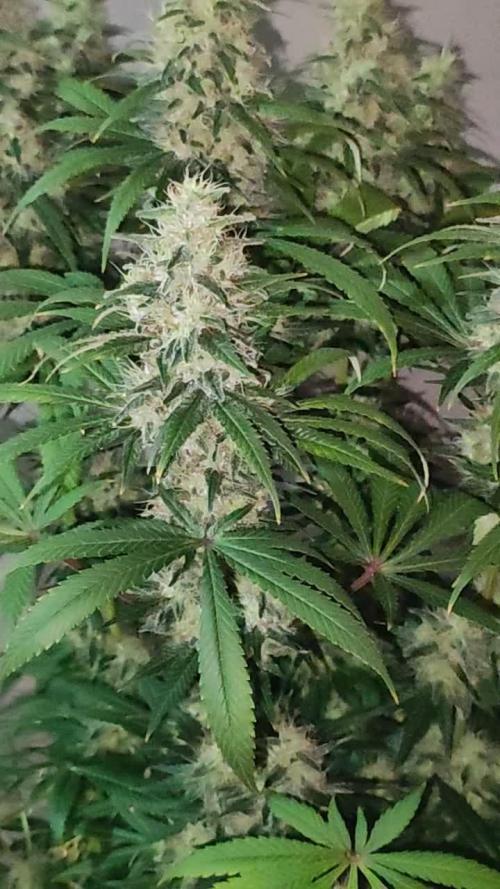
We've reached the end of the penultimate week. This girl's buds are also very dense, resinous, and fragrant. Based on the trichome analysis, she's at a great point. 😎
In the 15 days before harvest, I start watering only with RO water and a pH of 6.2. At the beginning of the last week, and about 3 days before harvest, I'll flush with RO + Cleanse 10mL.

Processing
Likes
5
Share


@GoodBudz
Follow
This week you could see the bud sites starting to really show :)
Did some heavy defoliation but again you can't tell by the pictures
Pheno #1 and #2 were growing so tall and were stretching every day it was hard to get the lights any higher. Soon they won't be able to go any higher.
Feeding schedule stayed constant for most of the grow. See previous weeks
Likes
4
Share


@SlickCityOrganics
Follow
Done some light defoliation. To get more light to bottom leaves. Looking good so far.
Likes
17
Share


@halexxo
Follow
Empiezan a oler bastante bien. El primer riego de esta semana fue de 1200ml.
Les he conectado un extractor con salida a la calle porque empezaba a oler toda mi casa.
Último riego de la semana 1500ml
Likes
21
Share


@GrowBro503
Follow
About 100 tops! Plant is as wide as it is tall. Going to cut clones before I put her into flower. This strain requires very, very little water. It responds to over watering more than any plant I've ever grown.
Processing
Likes
15
Share


@AK1210
Follow
New flowering continues to develop on this lady, she seems to be swelling up day by day.
Yellowing of the fan leaves has started which usually means it's time to flush, I need to check the trichomes to see how amber they appear before I do just in case the flavour or yield could be effected.
Likes
Comments
Share


@GothBotanical
Follow
Both outdoor autos settled firmly into early-to-mid flower this week. Nice Cream Auto showed steady bud development with tightly stacking colas and strong lateral structure, holding a healthy green canopy and giving off the first creamy berry aroma. Tiger #2 Auto remained more compact but equally vigorous, pushing dense flower sites and releasing a sweet grape-diesel scent. Trichomes began appearing on sugar leaves across both plants, mostly clear but multiplying daily. The 5-gallon Nice Cream retained moisture longer while Tiger #2 dried faster under afternoon heat, prompting slight watering adjustments. By the end of the week, both plants were thriving under the warm SoCal sun, entering the stacking phase that will define mid-flower in Week 9.


Likes
21
Share


@NSCanna
Follow
Compost tea turned out well and if your curious about the microscopy, check the comments on my GMP grow. No signs of senescence yet so no feed needed, they are in a second run of the same soil so there should be plenty in there from before.
Not very resinous or smelly, with weird wide stumpy buds. Definitely my least fav pheno of any plant I've grown so far, but it's the end product we're after so she may yet surprise.

Likes
26
Share


@BlackDragon22
Follow
Eccoci qui per questa settimana, tutto procede bene nonostante gli insetti si nutrono delle mie foglie loro stanno benissimo. cavallette, formiche, mosche bianche... Li ho visti tutti 🤣
Ormai sono rimaste in 3= 2 gorilla skittles e 1 gorilla punch!
Le restanti 3 le ho pulite e messe a seccare dopo 5 giorni di flush, visibili nel raccolto che pubblicherò a breve!
Il loro profumo pervade l'aria è la loro colla è davvero luminosa ed appiccicosa, mi scende la saliva dalla bocca 👹🤣
Likes
13
Share


@TiRobotProds
Follow
Arrosage avec engrais début semaine, j'ai mis une bonne dose de CalMag pour atténuer le manque.
